Sustainability Leaders Milan • December 3Roundtables, AI workshops and networking.Discover the event →

Solutions

Resources

Solutions

Resources

ESG Certifications, Ratings & Assessment

ESG Certifications, Ratings & Assessment

ISO certifications: what they are, why they matter and the main standards

ISO certifications: what they are, why they matter and the main standards

Updated September 2026

Headshot Alessandro Nora
Alessandro Nora
Illustration of ISO certification covering quality, environment, energy, safety, emissions and information security.
Infographic on ISO certifications: standards, independent certification body, ISO certificate and business value.

What are ISO certifications and what are they used for?

The International Organization for Standardization, ISO, develops international standards for products, services, processes and management systems.

For companies, some of the best-known standards define organizational requirements covering areas such as production quality, environmental impacts, occupational health and safety or energy performance.

According to the International Organization for Standardization, certification is the provision by an independent body of written assurance that a product, service or system meets specified requirements.

Being ISO certified therefore means that an independent certification body has assessed whether the company's system meets the requirements of the relevant standard.

ISO does not certify companies or issue ISO certificates itself. Certification is carried out by an external ISO certification organization, more commonly referred to as a certification body, which conducts the initial audit and subsequent surveillance activities to assess whether conformity is maintained over time.

For a company, the value of certification largely depends on its ability to translate the standard into an operating system that reflects its actual processes. Procedures need to be applicable, responsibilities clearly assigned and activities supported by documents, records and other evidence.

An ISO certification can serve several business purposes.

It may be requested by customers or companies further along the supply chain, included among the qualification requirements for tenders and procurement processes, or used to strengthen internal management.

In other cases, companies adopt ISO standards to make existing processes easier to control. A common framework allows criteria, responsibilities and verification methods to be applied consistently across plants, departments or legal entities within the same group.

The practical value therefore depends both on the ISO standard selected and on how effectively its management system is integrated into day-to-day operations.

What are the main ISO certifications?

There is no single ISO certification that applies to every organization. Different standards address different areas, and the relevant certification depends on the company's operations, risks and customer or supply chain requirements.

When looking at the main types of ISO certifications, or an ISO certifications list for businesses, several standards are particularly common across quality, environmental management, occupational safety and energy. Other standards, such as ISO 14064-1, follow a different model and can be subject to independent verification rather than management system certification.

Infographic on the main ISO certifications: ISO 9001, 14001, 45001, 50001, 14064 and ISO/IEC 27001.

ISO 9001: quality management

ISO 9001:2026 defines the requirements for a quality management system.

The standard helps companies structure the processes that affect the quality of their products and services, from supplier management to performance monitoring and the management of nonconformities.

A central element is the organization's ability to monitor processes against defined criteria and take action when results differ from expectations.

ISO 14001: environmental management

ISO 14001:2026 defines the requirements for an environmental management system and is one of the most widely used environmental ISO certifications.

The 2026 edition updates the previous version of the standard while maintaining its role as the main certifiable reference within the ISO 14000 family. Companies already certified or preparing for certification therefore need to consider the changes introduced by ISO 14001:2026.

The standard requires organizations to identify the environmental aspects associated with their activities, determine which are significant and establish how they will be managed.

Energy consumption, raw materials, emissions, discharges, waste and other operational impacts may all fall within the environmental management system.

ISO 14001 enables companies to address these areas through a structured process of planning, operational control, performance evaluation and improvement.

A related framework is EMAS, the European Union's voluntary Eco-Management and Audit Scheme. Although EMAS is an EU scheme, it can be relevant to international companies with European operations. EMAS incorporates the environmental management system requirements of ISO 14001 while adding further requirements, including a validated environmental statement. The European Commission's EMAS framework provides the official reference for the scheme.

ISO 45001: occupational health and safety

ISO 45001 specifies requirements for an occupational health and safety management system.

The system requires companies to identify hazards and risks, establish controls, manage incidents and nonconformities, and monitor whether the measures adopted remain effective.

For organizations operating across several plants or complex operational environments, the standard can also provide a common structure for applying consistent health and safety processes across different locations.

ISO 50001: energy management

ISO 50001 focuses on energy management and energy performance.

It requires companies to analyze energy use, identify significant energy uses and establish indicators for measuring performance.

This gives organizations a structured basis for connecting energy-efficiency initiatives with measurable data and monitoring results over time.

When several sites, plants or teams are involved, an energy management software can centralize consumption data, performance indicators and improvement initiatives within the same workflow.

ISO 14064: greenhouse gas quantification and verification

The ISO 14064 family addresses the quantification, reporting, validation and verification of greenhouse gas emissions and removals.

At organizational level, ISO 14064-1:2018 establishes principles and requirements for defining inventory boundaries, identifying emission sources, calculating emissions and documenting the methodologies and data used.

Unlike management system standards such as ISO 9001 or ISO 14001, ISO 14064-1 is primarily used as a reference for preparing organizational GHG inventories, which can then be independently verified.

It is particularly relevant for companies developing structured greenhouse gas accounting processes or preparing their inventories for external verification.

Building a reliable corporate inventory requires organizations to identify and classify their sources correctly, including Scope 1, Scope 2 and Scope 3 emissions, collect activity data and document calculation methods.

The relationship between ISO standards and corporate GHG accounting is also evolving. The convergence process between ISO 14064 and the GHG Protocol is intended to improve alignment between two of the main references used globally for greenhouse gas accounting.

For companies handling data across several legal entities, facilities or emission categories, carbon footprint software can support data collection, calculations and the traceability of the information used in the inventory.

ISO/IEC 27001: information security

ISO/IEC 27001 specifies the requirements for an information security management system.

It requires organizations to assess risks related to corporate information and define appropriate controls for protecting it.

The certification is particularly relevant to companies that manage data, digital infrastructure or information that is critical to customers, partners or business operations.

Management system standards can be implemented separately or integrated within the same management structure. A manufacturing company, for example, may manage quality, environmental performance, occupational safety and energy at the same time while avoiding unnecessary duplication across internal audits, document management and corrective actions.

How to get ISO certified

The process of obtaining an ISO certification starts with selecting the relevant standard and assessing the company's current processes against its requirements.

Companies asking how to get ISO certified commonly begin with a gap analysis to identify which processes already meet the requirements and where improvements are needed.

Infographic on how to obtain and maintain ISO certification, from gap analysis to periodic surveillance audits.

This assessment helps determine the work required and prevents the creation of procedures that are disconnected from actual business operations.

The next stage involves building or adapting the management system.

Depending on the standard, the organization may need to establish or revise processes, responsibilities, control criteria, performance indicators and record-keeping methods.

Documentation supports the system but must reflect what the organization actually does. During an audit, the certification body may assess both documented procedures and evidence that these procedures are being applied in practice.

Some companies use ISO certification consulting services during this stage, particularly when developing a management system for the first time, coordinating several sites or integrating multiple standards. A consultant may support implementation and preparation, but the consultant is separate from the independent certification body carrying out the certification audit.

An internal audit is also normally conducted before certification. Its purpose is to identify nonconformities and weaknesses before the external assessment takes place.

The organization must also perform the management activities required by the relevant standard to periodically evaluate whether its system remains effective, including management review where applicable.

The ISO certification body then performs the external assessment.

When selecting an ISO certification organization or comparing certification bodies, companies can consider sector expertise, geographical coverage, relevant accreditation and the scope of certification required. ISO recommends checking whether the certification body is accredited by an appropriate accreditation body, as accreditation provides independent confirmation of competence. Companies operating internationally can verify this through their national accreditation body or international accreditation databases referenced by ISO's guidance on choosing a certification body.

The initial certification process is generally divided into stages. The certification body first reviews the structure and documentation of the management system and subsequently assesses whether the processes implemented in practice conform to the applicable requirements.

If nonconformities are identified, the organization must address them through appropriate corrective actions.

Issuance of the ISO certification certificate, generally called an ISO certificate, completes the initial certification phase, but the management system remains subject to periodic assessment. Procedures, controls and records therefore need to remain current after certification has been achieved.

How much does ISO certification cost and how long does it take?

The cost of ISO certification can vary significantly between organizations.

Company size is one factor because it affects the number of processes, employees and sites that need to be assessed. Operational complexity and the selected standard also influence audit duration and therefore certification costs.

Another important variable is the organization's starting level of readiness.

A company with established procedures, clearly assigned responsibilities and documented controls may require relatively limited preparation. An organization building its management system from the beginning will usually need a more extensive implementation phase.

Total costs can therefore include initial assessment, external consulting where used, management system implementation, training, certification audits and subsequent surveillance audits.

The timeline varies for the same reasons.

An organization with relatively simple and well-documented processes may complete the preparation more quickly, while companies with multiple sites, complex operations or several departments involved may require a longer implementation period.

Certification also requires continued assessment after the initial certificate is issued. Management system certification normally operates within a certification cycle that includes periodic surveillance audits and subsequent recertification, according to the applicable scheme and certification body's procedures.

Estimating the project therefore starts with understanding the gap between current operations and the requirements of the selected ISO standard, rather than applying a fixed timeline or cost to every company.

How to manage multiple ISO certifications

Complexity increases when an organization has to maintain several ISO certifications at the same time.

ISO 9001, ISO 14001, ISO 45001 and ISO 50001, for example, may involve different departments while sharing a significant part of their management processes.

Document control is one of the areas where this overlap becomes particularly visible.

Procedures, records, assessments, responsibilities and corrective actions need to remain current and accessible during audits. Managing each standard through separate repositories increases the risk of duplicated information and inconsistent document versions.

The same applies to deadlines.

Internal audits, surveillance activities, equipment checks, document reviews and corrective actions create a continuous flow of work that needs to be assigned, tracked and completed.

An integrated management system allows companies to use a common structure for shared elements while keeping standard-specific requirements separate where necessary.

Technology can support this approach by centralizing requirements, documents, responsibilities and evidence within one environment.

Metrikflow, for example, enables organizations to coordinate several standards through the same ISO certification software, including ISO 14001, ISO 45001, ISO 9001, ISO 14064 and ISO 50001.

Companies can connect requirements with operational activities, assign responsibilities, retain supporting evidence and monitor the status of required actions.

Certification, or independent verification in the case of standards such as ISO 14064-1, remains the responsibility of qualified external bodies. Software supports the day-to-day management of the system, where consistent information and traceable activities are essential for reaching audits and verification engagements with documentation and data under control.

ISO certifications are widely used by companies to demonstrate that specific processes are managed according to internationally recognized requirements.

Quality, environmental management, occupational health and safety, energy, information security and greenhouse gas emissions are some of the areas covered by ISO standards. For a company, adopting one of these standards means structuring procedures, responsibilities, controls and evidence around defined and verifiable requirements.

An ISO certification is issued following an assessment conducted by an independent body. It is therefore important to distinguish between an ISO standard, which defines the requirements to be met, and certification, which provides independent assurance that the company's management system conforms to those requirements.

The outcome of this process is an ISO certification certificate, more commonly referred to as an ISO certificate, issued by a competent certification body after assessing the organization against the selected standard and the defined certification scope.

A company holding a valid certificate for a specific management system can therefore describe that system as ISO certified, within the scope covered by the certification.

This distinction also matters when comparing ISO standards with other corporate sustainability tools. ESG certifications, ratings and ISO standards, for example, can serve different purposes and should not be treated as interchangeable.

Understanding their role helps companies identify which ISO certifications are relevant to their operations and what is required to obtain and maintain them over time.
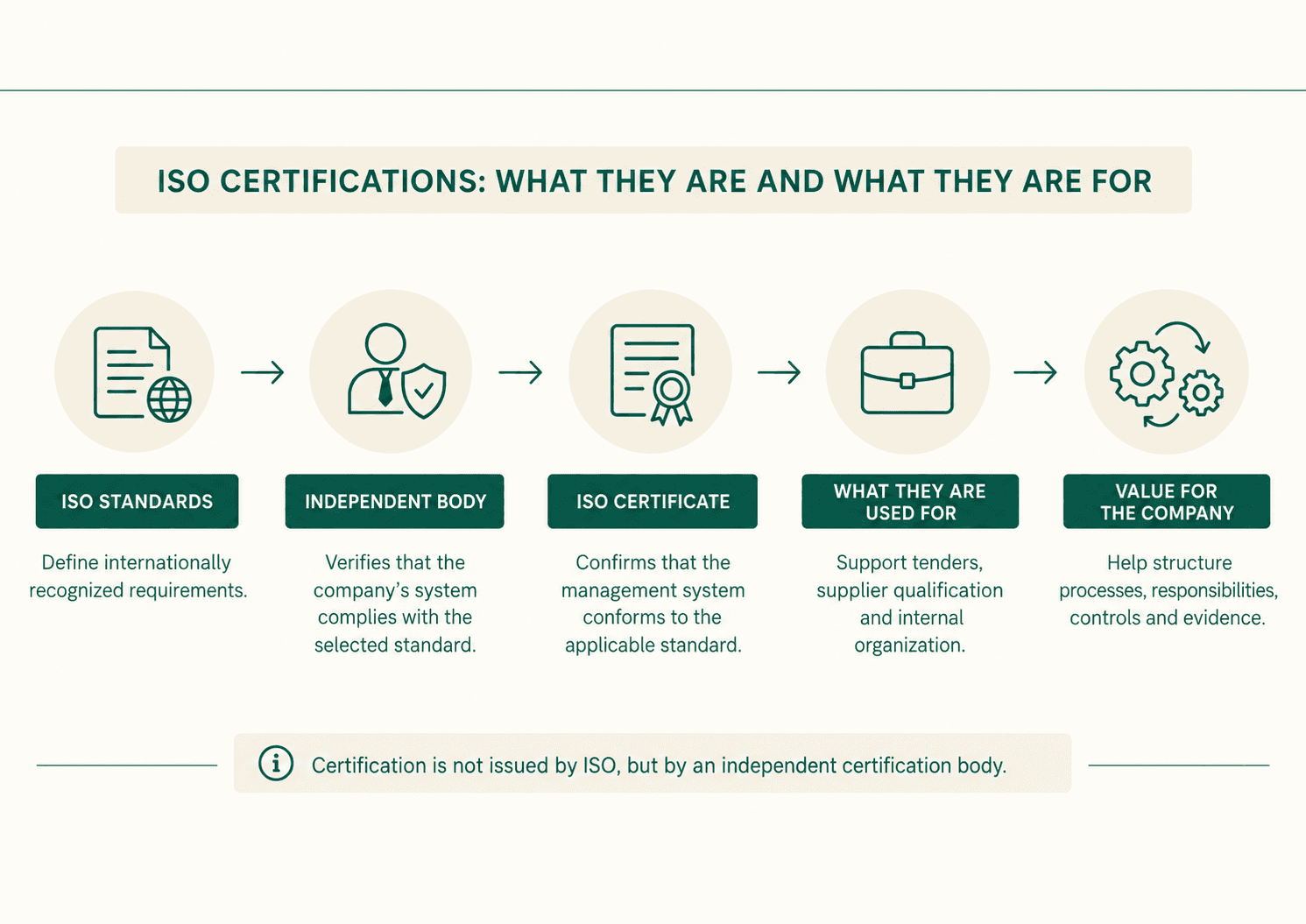
Infographic on ISO certifications: standards, independent certification body, ISO certificate and business value.

What are ISO certifications and what are they used for?

The International Organization for Standardization, ISO, develops international standards for products, services, processes and management systems.

For companies, some of the best-known standards define organizational requirements covering areas such as production quality, environmental impacts, occupational health and safety or energy performance.

According to the International Organization for Standardization, certification is the provision by an independent body of written assurance that a product, service or system meets specified requirements.

Being ISO certified therefore means that an independent certification body has assessed whether the company's system meets the requirements of the relevant standard.

ISO does not certify companies or issue ISO certificates itself. Certification is carried out by an external ISO certification organization, more commonly referred to as a certification body, which conducts the initial audit and subsequent surveillance activities to assess whether conformity is maintained over time.

For a company, the value of certification largely depends on its ability to translate the standard into an operating system that reflects its actual processes. Procedures need to be applicable, responsibilities clearly assigned and activities supported by documents, records and other evidence.

An ISO certification can serve several business purposes.

It may be requested by customers or companies further along the supply chain, included among the qualification requirements for tenders and procurement processes, or used to strengthen internal management.

In other cases, companies adopt ISO standards to make existing processes easier to control. A common framework allows criteria, responsibilities and verification methods to be applied consistently across plants, departments or legal entities within the same group.

The practical value therefore depends both on the ISO standard selected and on how effectively its management system is integrated into day-to-day operations.

What are the main ISO certifications?

There is no single ISO certification that applies to every organization. Different standards address different areas, and the relevant certification depends on the company's operations, risks and customer or supply chain requirements.

When looking at the main types of ISO certifications, or an ISO certifications list for businesses, several standards are particularly common across quality, environmental management, occupational safety and energy. Other standards, such as ISO 14064-1, follow a different model and can be subject to independent verification rather than management system certification.
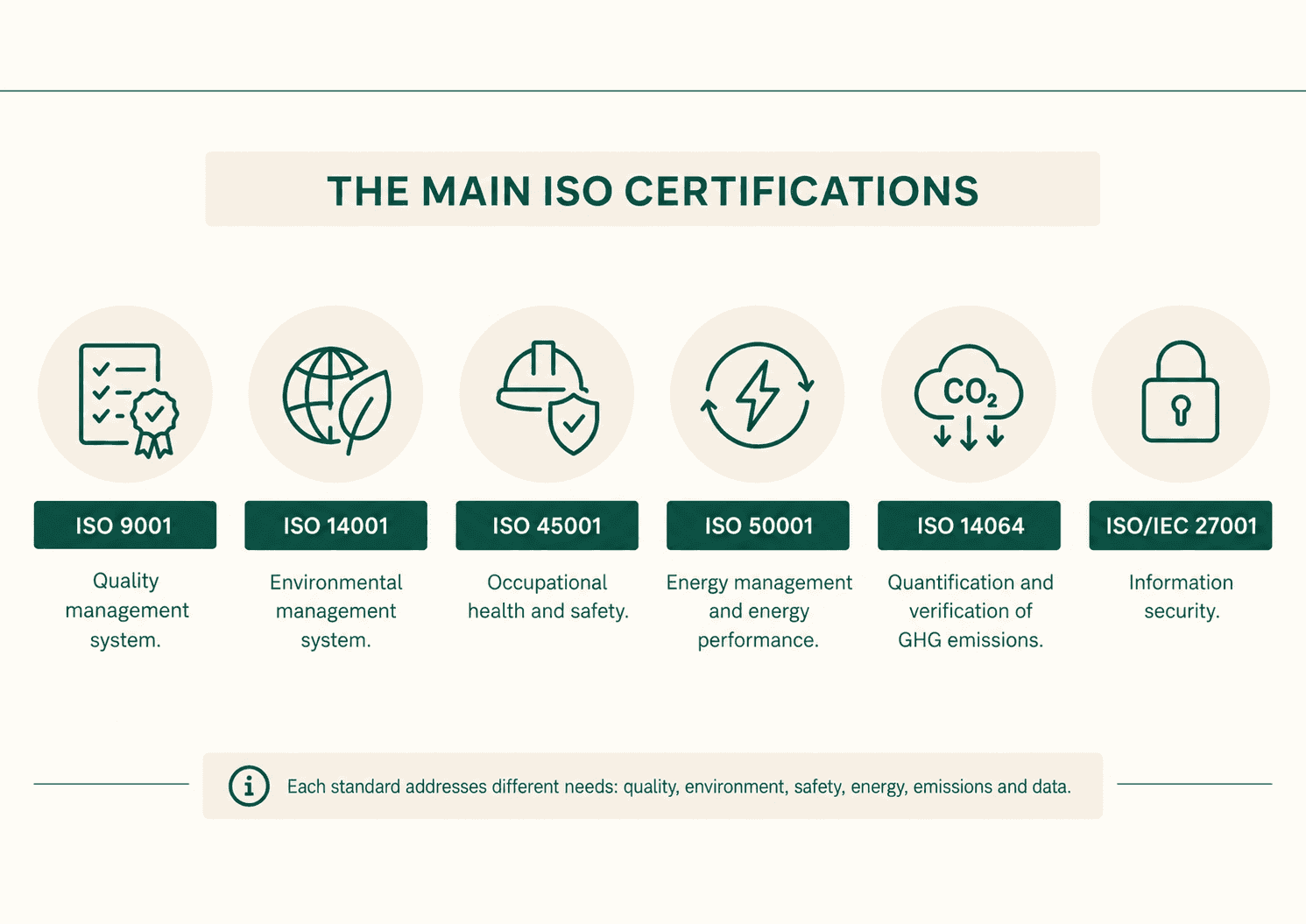
Infographic on the main ISO certifications: ISO 9001, 14001, 45001, 50001, 14064 and ISO/IEC 27001.

ISO 9001: quality management

ISO 9001:2026 defines the requirements for a quality management system.

The standard helps companies structure the processes that affect the quality of their products and services, from supplier management to performance monitoring and the management of nonconformities.

A central element is the organization's ability to monitor processes against defined criteria and take action when results differ from expectations.

ISO 14001: environmental management

ISO 14001:2026 defines the requirements for an environmental management system and is one of the most widely used environmental ISO certifications.

The 2026 edition updates the previous version of the standard while maintaining its role as the main certifiable reference within the ISO 14000 family. Companies already certified or preparing for certification therefore need to consider the changes introduced by ISO 14001:2026.

The standard requires organizations to identify the environmental aspects associated with their activities, determine which are significant and establish how they will be managed.

Energy consumption, raw materials, emissions, discharges, waste and other operational impacts may all fall within the environmental management system.

ISO 14001 enables companies to address these areas through a structured process of planning, operational control, performance evaluation and improvement.

A related framework is EMAS, the European Union's voluntary Eco-Management and Audit Scheme. Although EMAS is an EU scheme, it can be relevant to international companies with European operations. EMAS incorporates the environmental management system requirements of ISO 14001 while adding further requirements, including a validated environmental statement. The European Commission's EMAS framework provides the official reference for the scheme.

ISO 45001: occupational health and safety

ISO 45001 specifies requirements for an occupational health and safety management system.

The system requires companies to identify hazards and risks, establish controls, manage incidents and nonconformities, and monitor whether the measures adopted remain effective.

For organizations operating across several plants or complex operational environments, the standard can also provide a common structure for applying consistent health and safety processes across different locations.

ISO 50001: energy management

ISO 50001 focuses on energy management and energy performance.

It requires companies to analyze energy use, identify significant energy uses and establish indicators for measuring performance.

This gives organizations a structured basis for connecting energy-efficiency initiatives with measurable data and monitoring results over time.

When several sites, plants or teams are involved, an energy management software can centralize consumption data, performance indicators and improvement initiatives within the same workflow.

ISO 14064: greenhouse gas quantification and verification

The ISO 14064 family addresses the quantification, reporting, validation and verification of greenhouse gas emissions and removals.

At organizational level, ISO 14064-1:2018 establishes principles and requirements for defining inventory boundaries, identifying emission sources, calculating emissions and documenting the methodologies and data used.

Unlike management system standards such as ISO 9001 or ISO 14001, ISO 14064-1 is primarily used as a reference for preparing organizational GHG inventories, which can then be independently verified.

It is particularly relevant for companies developing structured greenhouse gas accounting processes or preparing their inventories for external verification.

Building a reliable corporate inventory requires organizations to identify and classify their sources correctly, including Scope 1, Scope 2 and Scope 3 emissions, collect activity data and document calculation methods.

The relationship between ISO standards and corporate GHG accounting is also evolving. The convergence process between ISO 14064 and the GHG Protocol is intended to improve alignment between two of the main references used globally for greenhouse gas accounting.

For companies handling data across several legal entities, facilities or emission categories, carbon footprint software can support data collection, calculations and the traceability of the information used in the inventory.

ISO/IEC 27001: information security

ISO/IEC 27001 specifies the requirements for an information security management system.

It requires organizations to assess risks related to corporate information and define appropriate controls for protecting it.

The certification is particularly relevant to companies that manage data, digital infrastructure or information that is critical to customers, partners or business operations.

Management system standards can be implemented separately or integrated within the same management structure. A manufacturing company, for example, may manage quality, environmental performance, occupational safety and energy at the same time while avoiding unnecessary duplication across internal audits, document management and corrective actions.

How to get ISO certified

The process of obtaining an ISO certification starts with selecting the relevant standard and assessing the company's current processes against its requirements.

Companies asking how to get ISO certified commonly begin with a gap analysis to identify which processes already meet the requirements and where improvements are needed.
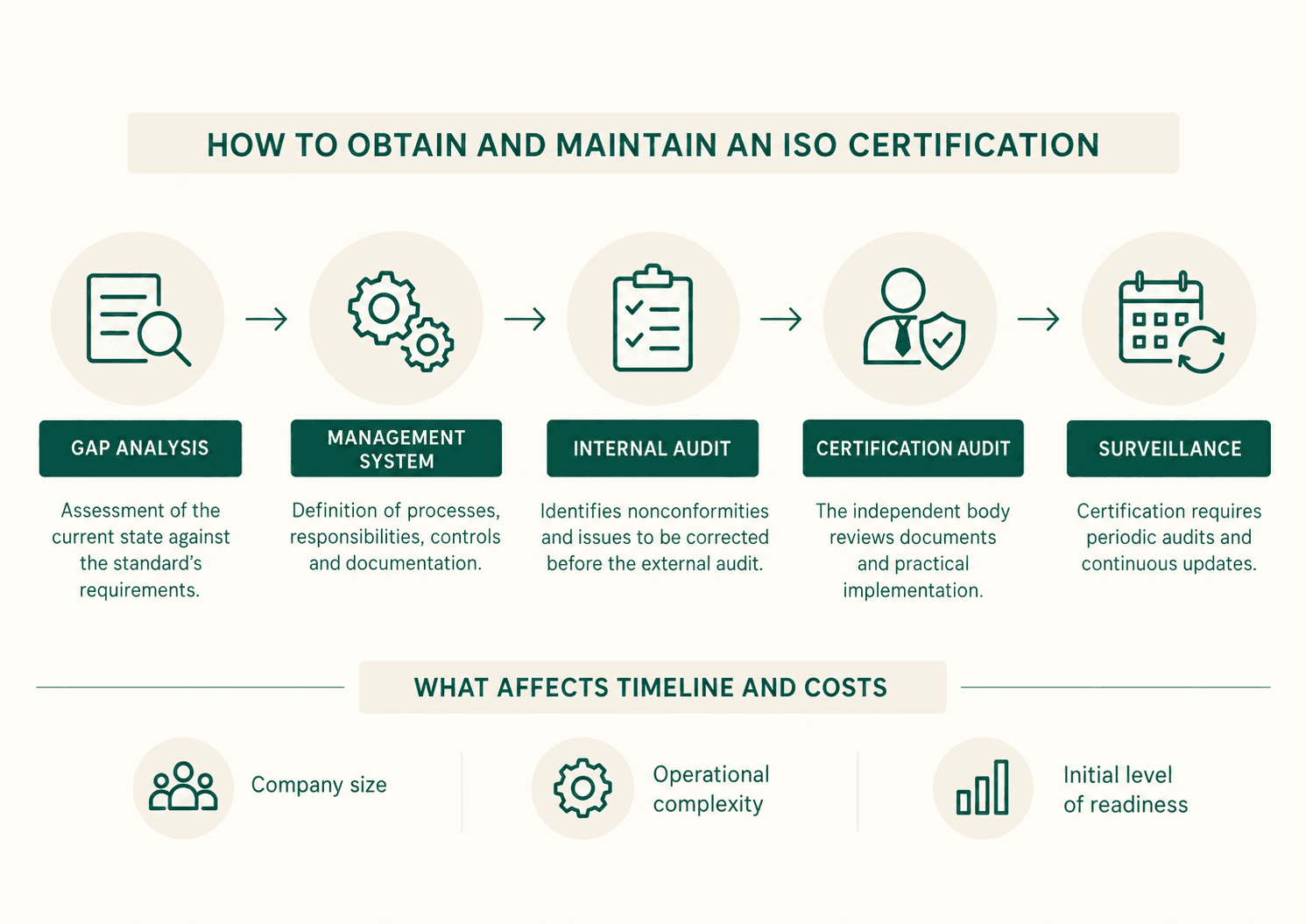
Infographic on how to obtain and maintain ISO certification, from gap analysis to periodic surveillance audits.

This assessment helps determine the work required and prevents the creation of procedures that are disconnected from actual business operations.

The next stage involves building or adapting the management system.

Depending on the standard, the organization may need to establish or revise processes, responsibilities, control criteria, performance indicators and record-keeping methods.

Documentation supports the system but must reflect what the organization actually does. During an audit, the certification body may assess both documented procedures and evidence that these procedures are being applied in practice.

Some companies use ISO certification consulting services during this stage, particularly when developing a management system for the first time, coordinating several sites or integrating multiple standards. A consultant may support implementation and preparation, but the consultant is separate from the independent certification body carrying out the certification audit.

An internal audit is also normally conducted before certification. Its purpose is to identify nonconformities and weaknesses before the external assessment takes place.

The organization must also perform the management activities required by the relevant standard to periodically evaluate whether its system remains effective, including management review where applicable.

The ISO certification body then performs the external assessment.

When selecting an ISO certification organization or comparing certification bodies, companies can consider sector expertise, geographical coverage, relevant accreditation and the scope of certification required. ISO recommends checking whether the certification body is accredited by an appropriate accreditation body, as accreditation provides independent confirmation of competence. Companies operating internationally can verify this through their national accreditation body or international accreditation databases referenced by ISO's guidance on choosing a certification body.

The initial certification process is generally divided into stages. The certification body first reviews the structure and documentation of the management system and subsequently assesses whether the processes implemented in practice conform to the applicable requirements.

If nonconformities are identified, the organization must address them through appropriate corrective actions.

Issuance of the ISO certification certificate, generally called an ISO certificate, completes the initial certification phase, but the management system remains subject to periodic assessment. Procedures, controls and records therefore need to remain current after certification has been achieved.

How much does ISO certification cost and how long does it take?

The cost of ISO certification can vary significantly between organizations.

Company size is one factor because it affects the number of processes, employees and sites that need to be assessed. Operational complexity and the selected standard also influence audit duration and therefore certification costs.

Another important variable is the organization's starting level of readiness.

A company with established procedures, clearly assigned responsibilities and documented controls may require relatively limited preparation. An organization building its management system from the beginning will usually need a more extensive implementation phase.

Total costs can therefore include initial assessment, external consulting where used, management system implementation, training, certification audits and subsequent surveillance audits.

The timeline varies for the same reasons.

An organization with relatively simple and well-documented processes may complete the preparation more quickly, while companies with multiple sites, complex operations or several departments involved may require a longer implementation period.

Certification also requires continued assessment after the initial certificate is issued. Management system certification normally operates within a certification cycle that includes periodic surveillance audits and subsequent recertification, according to the applicable scheme and certification body's procedures.

Estimating the project therefore starts with understanding the gap between current operations and the requirements of the selected ISO standard, rather than applying a fixed timeline or cost to every company.

How to manage multiple ISO certifications

Complexity increases when an organization has to maintain several ISO certifications at the same time.

ISO 9001, ISO 14001, ISO 45001 and ISO 50001, for example, may involve different departments while sharing a significant part of their management processes.

Document control is one of the areas where this overlap becomes particularly visible.

Procedures, records, assessments, responsibilities and corrective actions need to remain current and accessible during audits. Managing each standard through separate repositories increases the risk of duplicated information and inconsistent document versions.

The same applies to deadlines.

Internal audits, surveillance activities, equipment checks, document reviews and corrective actions create a continuous flow of work that needs to be assigned, tracked and completed.

An integrated management system allows companies to use a common structure for shared elements while keeping standard-specific requirements separate where necessary.

Technology can support this approach by centralizing requirements, documents, responsibilities and evidence within one environment.

Metrikflow, for example, enables organizations to coordinate several standards through the same ISO certification software, including ISO 14001, ISO 45001, ISO 9001, ISO 14064 and ISO 50001.

Companies can connect requirements with operational activities, assign responsibilities, retain supporting evidence and monitor the status of required actions.

Certification, or independent verification in the case of standards such as ISO 14064-1, remains the responsibility of qualified external bodies. Software supports the day-to-day management of the system, where consistent information and traceable activities are essential for reaching audits and verification engagements with documentation and data under control.

CONTRIBUTOR

Headshot Alessandro Nora

Alessandro Nora

CEO & Co-founder

Alessandro's goal is to make a real impact on sustainability. After founding a sustainable fashion marketplace, he decided to focus on ESG digitalisation with the aim of making sustainability more concrete, measurable and accessible for companies. A careful and methodical founder, with experience in Genoa, Berlin and Lisbon, Alessandro combines international vision and operational rigour in the development of digital solutions that simplify ESG regulations and compliance, supporting companies in adapting to ESG regulations, certifications and ratings through structured and audit-ready tools. Topics covered: CSRD, CSDDD, EUDR, CBAM ESG ratings, ESG certifications, Ecovadis, sustainability governance, regulatory compliance.

No headings found on page

Stay up to date with Metrikflow Insights!

We deliver expert insights, product updates, industry trends, and actionable strategies straight to your inbox. Stay ahead in ESG, GHG, and LCA — one edition at a time.

By submitting this form, you consent to receive the requested resource. For more information on how we process and protect your data, view our Privacy Policy.

The go-to software solution for
Sustainability Managers.

The go-to software solution for Sustainability Managers.

Customer-Oriented

Data Accurate

Built on Smart Tech

Contact us

Our team is here to help. Feel free to ask us anything.

By submitting this form you consent to our Privacy Policy.

ESG radar: The Metrikflow Newsletter

Everything you need to know about sustainability,
all-in-one email. Weekly insights. Zero spam.

By submitting this form, you consent to receive the requested resource. For more information on how we process and protect your data, view our Privacy Policy.

Ask AI for a summary of Metrikflow

chatgptclaudeperplexity

Contact Us

The only platform you ever need to manage ESG and Compliance.

Data Security

Measurable Impact

AI + ESG Experts

Measurable Impact

AI + ESG Experts

Data Security

Contact us

Our team is here to help. Feel free to ask us anything.

By submitting this form you consent to our Privacy Policy.

ESG radar: The Metrikflow Newsletter

Everything you need to know about sustainability,
all-in-one email. Weekly insights. Zero spam.

By submitting this form, you consent to receive the requested resource. For more information on how we process and protect your data, view our Privacy Policy.

Ask AI for a summary of Metrikflow

chatgptclaudeperplexity