ESG Certifications, Ratings & Assessment

ESG Certifications, Ratings & Assessment

ESG certifications: what they are, which ones to choose, and why they matter for companies

ESG certifications: what they are, which ones to choose, and why they matter for companies

A practical guide to choosing ESG certifications for companies.

Headshot Alessandro Nora
Alessandro Nora
Metrikflow-style illustration about ESG certifications, with icons for verification, environment, emissions, product data, business documentation, and compliance.

What are ESG certifications?

ESG certifications are tools that allow a company to demonstrate, through verifiable criteria, how it manages environmental, social, and governance aspects. They can cover the entire organization, a production site, a process, a product, a building, or a specific performance area, such as greenhouse gas emissions, environmental management, energy efficiency, health and safety, governance, or supply chain responsibility.

For companies, the value of an ESG certification depends mainly on how usable it is in business processes. A useful certification should respond to concrete needs: supplier qualification, public tenders, group audits, customer questionnaires, banking requests, ESG ratings, sustainability reporting, or access to regulated markets. Before starting a certification process, companies should clarify which business objective the certification needs to support and which stakeholders must recognize its value.

The topic has become more relevant because companies are expected to document ESG information with greater precision. The EU Directive 2024/825 strengthens the focus on generic environmental claims, sustainability labels, and unsupported communication. In this scenario, a recognized certification can reduce the risk of weak claims and improve the quality of available evidence.
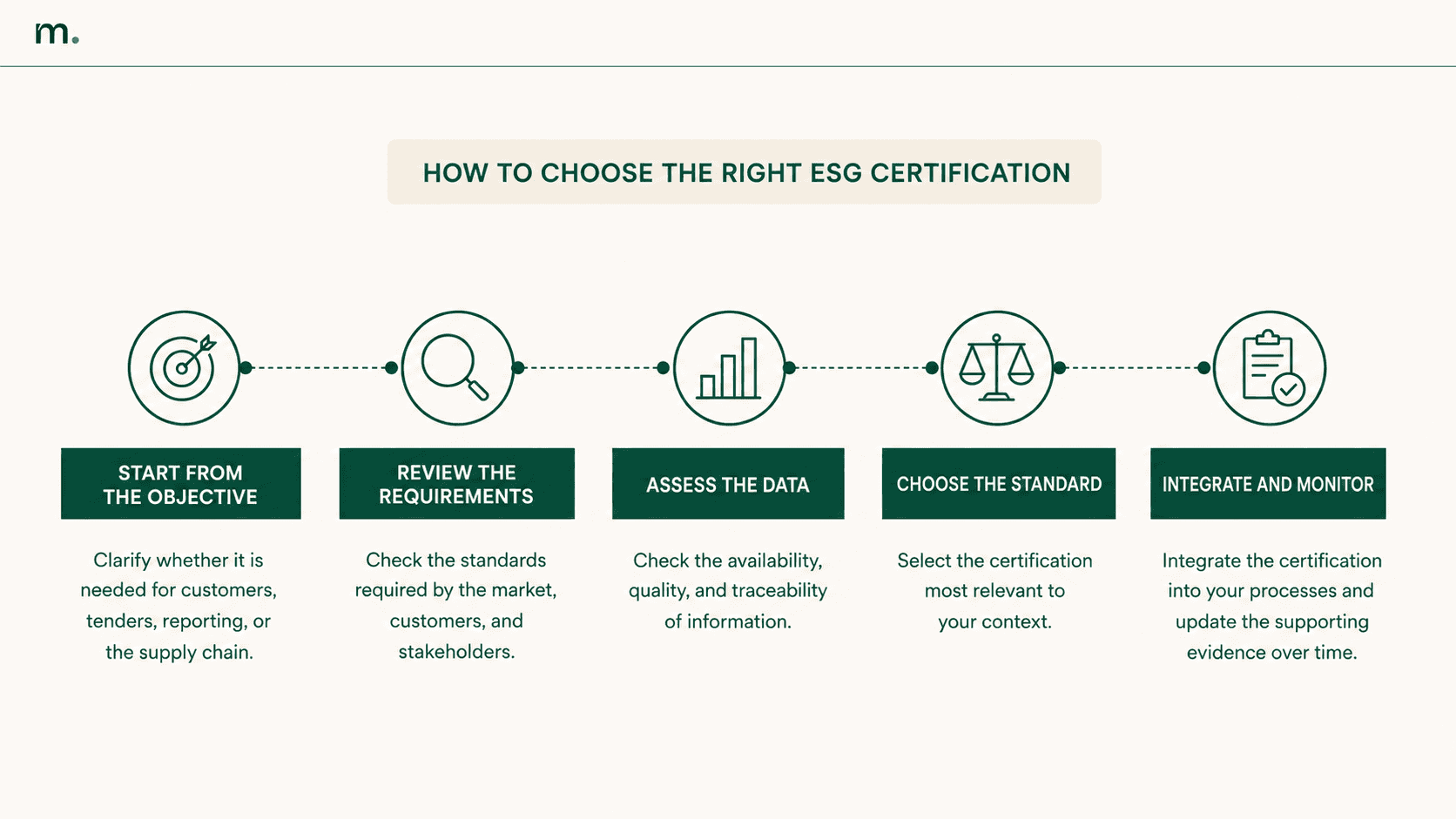
Infographic showing the process for choosing the right ESG certification: define the objective, analyze requirements, assess data, choose the standard, and monitor over time.

The main types of ESG certifications for companies

ESG certifications do not all have the same purpose. Some verify the company’s management system, others measure an environmental impact, while others focus on a product, a building, or an overall assessment of corporate ESG performance. To choose the most suitable one, a company must first understand which evidence it needs to produce: process control, supplier qualification, support for environmental claims, tender participation, responses to corporate customers, or stronger reporting.
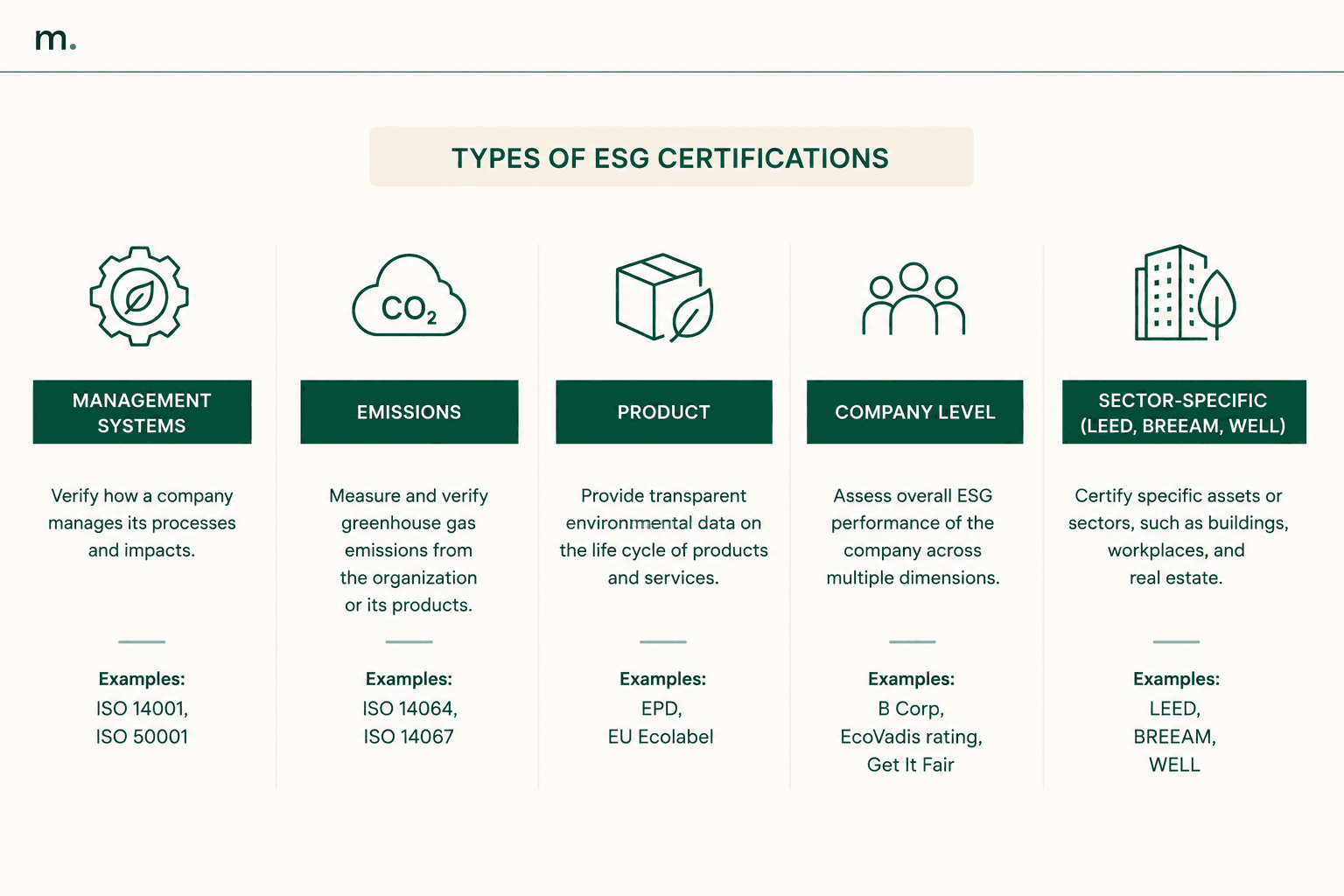
Infographic showing the types of ESG certifications: management systems, emissions, product, company-level certifications, and sector-specific certifications.

Management system certifications: ISO 14001 and ISO 50001

Management system certifications assess how the company manages processes, responsibilities, controls, and improvement targets. They do not focus on a single product, but on the organization or on specific operational sites. They are particularly useful for industrial companies, logistics providers, utilities, multi-site organizations, and suppliers that need to demonstrate structured management of environmental or energy impacts.

ISO 14001 is one of the most widely recognized environmental certifications internationally. It certifies that the company has implemented an environmental management system, with procedures to identify relevant environmental aspects, monitor performance, manage regulatory compliance, and define improvement objectives. For a customer or auditor, this certification shows that the company manages environmental topics through a formalized process, with documented responsibilities and controls.

ISO 50001 follows a similar logic, but focuses on energy management. It is relevant for energy-intensive companies, production plants, data centers, large-scale retail, and organizations with significant energy consumption. Its operational value lies in connecting measurement, efficiency, and cost reduction, making energy performance an indicator managed on an ongoing basis.

Climate certifications and carbon footprint: ISO 14064 and ISO 14067

A second group concerns the measurement and verification of greenhouse gas emissions. In this case, the focus is the quality of climate data: reporting boundaries, emission factors, sources used, calculation methodology, and traceability of information.

ISO 14064 is used to quantify and report GHG emissions at organizational level. It is useful for companies that need to respond to requests on Scope 1, Scope 2, and Scope 3 emissions, prepare decarbonization plans, support climate targets, or provide verifiable data to customers, investors, and parent companies. To understand emissions classification, the topic of Scope 1, 2 and 3 remains central.

To optimize data collection in line with the relevant ISO standard, especially for medium and large companies with multiple production sites, it can be very useful to rely on carbon footprint software that has already supported other companies through the verification process.

ISO 14067, instead, concerns the product carbon footprint. It is suitable when a company needs to measure the emissions associated with the life cycle of a product or service, from raw materials to production, distribution, use, and end of life, according to the defined scope. This type of certification is particularly useful in manufacturing and B2B sectors, where customers and supply chains require specific environmental data to compare materials, components, or suppliers.

Here too, to reduce costs, increase scalability and efficiency, and improve data quality, companies can rely on LCA software able to support the relevant ISO standard and/or EPD requirements.

Product environmental certifications and declarations: EPD and EU Ecolabel

Product certifications are used to communicate environmental information related to a specific good or service. They are relevant when the market requires comparable, verifiable data connected to product characteristics, especially in sectors such as construction, furniture, packaging, fashion, chemicals, electronics, food, and industrial materials.

An EPD, or Environmental Product Declaration, is a product environmental declaration based on an LCA analysis. It does not automatically certify that a product has the best performance on the market, but it makes its environmental impacts transparent according to defined methodological rules. For this reason, it is widely used in B2B, industrial supply chains, and sectors where comparable environmental data is required. To build a solid EPD, the starting point is often a well-structured life cycle assessment, as explained in the guide on what LCA is.

The EU Ecolabel has a different function. It is a European environmental label awarded to products and services that meet specific criteria for reduced environmental impact throughout the life cycle. It is more oriented toward market recognition and can be useful for companies selling products also intended for end consumers, public administrations, or channels where an environmental label has immediate commercial value.

ESG certifications and corporate assessment schemes: B Corp, Get It Fair, and EcoVadis

Some tools have a broader scope and assess the company across environmental, social, and governance dimensions. This group includes certifications, ratings, and assessment schemes often requested by customers, investors, partners, or international groups.

B Corp is a certification that assesses the company’s overall impact on governance, workers, community, environment, and customers. It is suitable for companies that want to make a business model based on social and environmental responsibility verifiable, especially when these elements are part of the company’s positioning.

Get It Fair is an ESG assessment scheme focused on risk management and due diligence. It can be relevant for companies operating in sectors exposed to supply chain requirements, tenders, construction, or supplier qualification processes. In this case, the value does not lie only in external recognition, but in the ability to structure a process for analyzing and improving ESG risks.

EcoVadis, instead, is an ESG rating and not a certification in the strict sense. It assesses company practices across environment, labor and human rights, ethics, and sustainable procurement, producing a score often used in international supply chains. For many companies, improving the EcoVadis score means strengthening documentation, policies, KPIs, and operational evidence requested by customers.

Certifications for buildings and real estate assets: LEED, BREEAM, and WELL

Another category concerns buildings, real estate assets, and corporate spaces. These certifications are relevant for developers, real estate funds, facility management companies, corporate offices, retail, hospitality, and organizations that want to measure or enhance the environmental and functional quality of their buildings.

LEED and BREEAM assess building sustainability by considering aspects such as energy, water, materials, indoor environmental quality, site management, and life cycle impacts. They are often used to increase asset value, reduce operating costs, access green capital, or respond to ESG criteria in real estate.

WELL has a more direct focus on the well-being of people occupying the spaces. It assesses elements such as air quality, lighting, comfort, health, and indoor environmental characteristics. For companies with offices, operational sites, or spaces open to the public, it can become a useful tool to connect sustainability, productivity, and workplace management.

ESG certification and ESG rating: what is the difference?

In corporate language, “ESG certification” and “ESG rating” are often used as if they meant the same thing, but they refer to different tools. A certification attests compliance with a standard, scheme, or set of requirements verified by a third party. An ESG rating, instead, assesses a company’s performance or risk profile according to a methodology defined by a platform or provider.

The difference is operational. A certification such as ISO 14001 shows that the company has implemented a structured environmental management system. An ESG rating provides a score, often used by customers, investors, or parent companies to compare companies and suppliers. In some cases, the rating is more relevant for access to a supply chain; in others, the certification is required as formal evidence in a tender or audit.

To explore this distinction further, it may be useful to read Metrikflow’s guide on ESG ratings and the article dedicated to EcoVadis, which explains why EcoVadis is an ESG rating and not a certification in the strict sense.
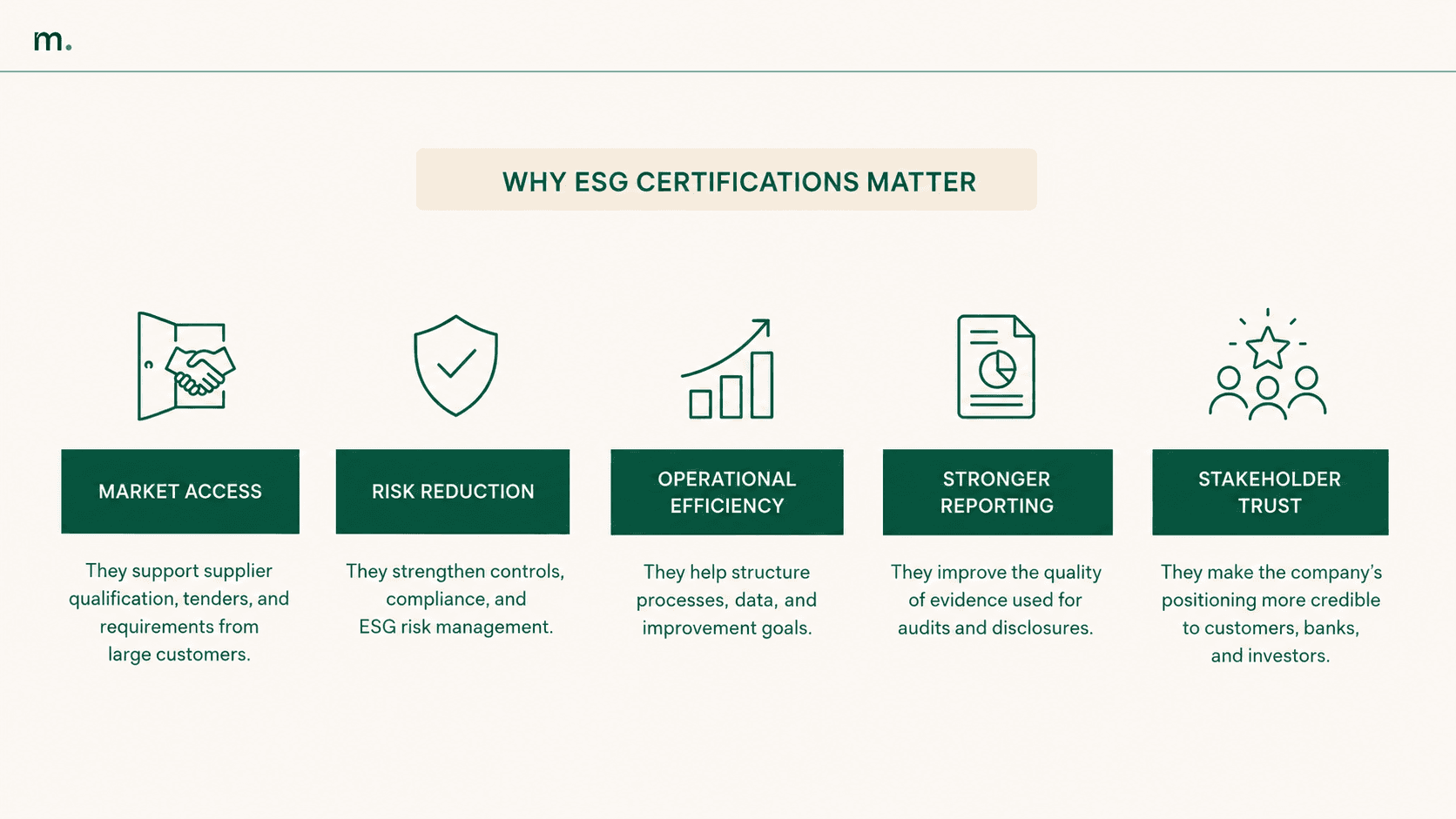
Infographic showing the business benefits of ESG certifications: market access, risk reduction, operational efficiency, stronger reporting, and stakeholder trust.

Are ESG certifications mandatory?

In general, ESG certification is not mandatory for all companies. However, it becomes necessary or highly convenient when requested by a customer, tender, specification, international supply chain, or supplier qualification system. In some sectors, the distinction between legal obligation and commercial obligation is narrow: the company may not be required by law to obtain certification, but without it, it risks losing commercial opportunities, additional scores, or access to specific markets.

Some environmental certifications are used as evidence for public procurement criteria, others support tender participation, and others help respond to requests from customers subject to CSRD or reporting obligations across the value chain. For this reason, the right question is not only whether certification is formally mandatory, but how much weight it carries in commercial, financial, and qualification processes.

Why ESG certifications matter in the supply chain

ESG pressure on companies often moves through the supply chain. Companies subject to reporting, ratings, or due diligence obligations must collect data from suppliers, assess environmental and social risks, verify Scope 3 emissions, and document the criteria used to select partners and materials. As a result, even unlisted companies or SMEs can receive very specific ESG requests from their customers.

A certification can reduce the verification workload because it provides standardized evidence. A supplier with ISO 14001, verified GHG data, product EPDs, or an updated ESG rating makes customer assessment easier. This does not remove the need for accurate data, but it improves documentation quality and reduces the risk of incomplete responses.

To structure these processes at scale, a supplier ESG assessment platform allows companies to collect information, evidence, and indicators in a more organized way than isolated files and questionnaires. This is particularly useful when the company needs to compare different suppliers, monitor periodic updates, and maintain a history of responses received.

ESG certifications and sustainability reporting

ESG certifications can support sustainability reporting, but they do not replace it. A sustainability report requires a broader view of impacts, risks, opportunities, policies, targets, and results. Certifications provide useful evidence on specific areas, such as environmental management, emissions, products, energy, supply chain, or governance, but they must be integrated into a coherent reporting system.

This connection is particularly important for companies preparing for CSRD, ESRS, or information requests from customers subject to reporting obligations. An ISO certification or verified environmental declaration can strengthen the quality of information, but data collection processes, internal controls, defined responsibilities, and updated indicators are also required.

Sustainability reporting software helps connect certifications, KPIs, documentation, and approval workflows into a single audit-ready process. The operational advantage lies in avoiding duplication: the same data can feed reporting, audits, customer questionnaires, and internal monitoring, while maintaining consistency across different requests.

ESG certifications and communication: beware of greenwashing

Certifications help make ESG communication more robust, but only if they are presented precisely. Saying that a company is “ESG certified” without explaining which certification it holds, what scope it covers, who issued it, and which requirements it verifies can create ambiguity. A product environmental certification is not equivalent to certification of the entire company; an ISO management system certification does not automatically prove that a product has the lowest impact on the market; an ESG rating does not certify every environmental claim used in commercial communication.

For companies, this means that certifications and ratings should always be communicated by specifying scope, standard, year of validity, and verifier. The topic is also connected to the Anti-Greenwashing Directive, which makes it increasingly important to build environmental messages based on data, evidence, and verifiable documents.

How to choose the right ESG certification

The choice should start from the most relevant requests for the company. Which customers ask for ESG data? Which tenders require environmental evidence? What information do banks, investors, or parent companies need? Which impacts are most relevant for the sector? Which data is already available, and which data requires a structured collection process?

A manufacturing company with strong exposure to industrial customers may prioritize ISO 14001, carbon footprint, EPDs, and Scope 3 data. A company selling products in the European market may consider EU Ecolabel or product environmental declarations. A supplier operating in global value chains may focus on ESG ratings, sustainability questionnaires, and evidence traceability. A company subject to reporting requirements should instead connect certifications, KPIs, and reporting in a single system, supported by ESG software able to reduce fragmentation, errors, and duplication.

The strongest criterion is consistency between certification, business objective, and available data. Starting a certification process without a reliable data foundation can generate costs, delays, and outputs that are difficult to maintain. A well-built ESG roadmap allows the company to move by priority: first the most relevant data, then the most useful standards, and finally integration with reporting, supply chain, and communication.

The role of software in managing ESG certifications

Many certifications require recurring data, documentary evidence, internal responsibilities, and periodic updates. Managing these elements through separate files makes it difficult to maintain consistency across audits, reporting, customer questionnaires, and external communication. The risk is not only operational: misaligned data can produce inconsistent responses between certification, sustainability reporting, ESG ratings, and supply chain requests.

ESG software allows companies to centralize environmental, social, and governance data, connect evidence to KPIs, assign responsibilities, monitor progress, and prepare verifiable outputs.

Conclusion

ESG certifications are useful when they help the company demonstrate, in a verifiable way, what it manages, measures, and improves. They do not all have the same value for every sector, and they do not all respond to the same needs. The choice depends on market requirements, customers, indirect obligations, regulatory exposure, data maturity, and business objectives.

To build an effective path, companies should start from the most relevant requirements, verify which data is needed, choose the standards most recognized by stakeholders, and integrate certifications, ratings, and reporting into a single process. In this way, ESG certification becomes an operational tool: it reduces documentation risk, improves information quality, and strengthens the company’s position with customers, investors, suppliers, and auditors.

Whitepaper

A Conversation between EFRAG and Industry

Dolor netus eget suspendisse pellentesque. Diam elit lobortis elementum mi sed turpis quisque feugiat leo. Ipsum purus faucibus sed potenti phasellus duis vestibulum risus sagittis. Sit viverra convallis ultrices netus pulvinar.

Download Now

What are ESG certifications?

ESG certifications are tools that allow a company to demonstrate, through verifiable criteria, how it manages environmental, social, and governance aspects. They can cover the entire organization, a production site, a process, a product, a building, or a specific performance area, such as greenhouse gas emissions, environmental management, energy efficiency, health and safety, governance, or supply chain responsibility.

For companies, the value of an ESG certification depends mainly on how usable it is in business processes. A useful certification should respond to concrete needs: supplier qualification, public tenders, group audits, customer questionnaires, banking requests, ESG ratings, sustainability reporting, or access to regulated markets. Before starting a certification process, companies should clarify which business objective the certification needs to support and which stakeholders must recognize its value.

The topic has become more relevant because companies are expected to document ESG information with greater precision. The EU Directive 2024/825 strengthens the focus on generic environmental claims, sustainability labels, and unsupported communication. In this scenario, a recognized certification can reduce the risk of weak claims and improve the quality of available evidence.

Infographic showing the process for choosing the right ESG certification: define the objective, analyze requirements, assess data, choose the standard, and monitor over time.

The main types of ESG certifications for companies

ESG certifications do not all have the same purpose. Some verify the company’s management system, others measure an environmental impact, while others focus on a product, a building, or an overall assessment of corporate ESG performance. To choose the most suitable one, a company must first understand which evidence it needs to produce: process control, supplier qualification, support for environmental claims, tender participation, responses to corporate customers, or stronger reporting.

Infographic showing the types of ESG certifications: management systems, emissions, product, company-level certifications, and sector-specific certifications.

Management system certifications: ISO 14001 and ISO 50001

Management system certifications assess how the company manages processes, responsibilities, controls, and improvement targets. They do not focus on a single product, but on the organization or on specific operational sites. They are particularly useful for industrial companies, logistics providers, utilities, multi-site organizations, and suppliers that need to demonstrate structured management of environmental or energy impacts.

ISO 14001 is one of the most widely recognized environmental certifications internationally. It certifies that the company has implemented an environmental management system, with procedures to identify relevant environmental aspects, monitor performance, manage regulatory compliance, and define improvement objectives. For a customer or auditor, this certification shows that the company manages environmental topics through a formalized process, with documented responsibilities and controls.

ISO 50001 follows a similar logic, but focuses on energy management. It is relevant for energy-intensive companies, production plants, data centers, large-scale retail, and organizations with significant energy consumption. Its operational value lies in connecting measurement, efficiency, and cost reduction, making energy performance an indicator managed on an ongoing basis.

Climate certifications and carbon footprint: ISO 14064 and ISO 14067

A second group concerns the measurement and verification of greenhouse gas emissions. In this case, the focus is the quality of climate data: reporting boundaries, emission factors, sources used, calculation methodology, and traceability of information.

ISO 14064 is used to quantify and report GHG emissions at organizational level. It is useful for companies that need to respond to requests on Scope 1, Scope 2, and Scope 3 emissions, prepare decarbonization plans, support climate targets, or provide verifiable data to customers, investors, and parent companies. To understand emissions classification, the topic of Scope 1, 2 and 3 remains central.

To optimize data collection in line with the relevant ISO standard, especially for medium and large companies with multiple production sites, it can be very useful to rely on carbon footprint software that has already supported other companies through the verification process.

ISO 14067, instead, concerns the product carbon footprint. It is suitable when a company needs to measure the emissions associated with the life cycle of a product or service, from raw materials to production, distribution, use, and end of life, according to the defined scope. This type of certification is particularly useful in manufacturing and B2B sectors, where customers and supply chains require specific environmental data to compare materials, components, or suppliers.

Here too, to reduce costs, increase scalability and efficiency, and improve data quality, companies can rely on LCA software able to support the relevant ISO standard and/or EPD requirements.

Product environmental certifications and declarations: EPD and EU Ecolabel

Product certifications are used to communicate environmental information related to a specific good or service. They are relevant when the market requires comparable, verifiable data connected to product characteristics, especially in sectors such as construction, furniture, packaging, fashion, chemicals, electronics, food, and industrial materials.

An EPD, or Environmental Product Declaration, is a product environmental declaration based on an LCA analysis. It does not automatically certify that a product has the best performance on the market, but it makes its environmental impacts transparent according to defined methodological rules. For this reason, it is widely used in B2B, industrial supply chains, and sectors where comparable environmental data is required. To build a solid EPD, the starting point is often a well-structured life cycle assessment, as explained in the guide on what LCA is.

The EU Ecolabel has a different function. It is a European environmental label awarded to products and services that meet specific criteria for reduced environmental impact throughout the life cycle. It is more oriented toward market recognition and can be useful for companies selling products also intended for end consumers, public administrations, or channels where an environmental label has immediate commercial value.

ESG certifications and corporate assessment schemes: B Corp, Get It Fair, and EcoVadis

Some tools have a broader scope and assess the company across environmental, social, and governance dimensions. This group includes certifications, ratings, and assessment schemes often requested by customers, investors, partners, or international groups.

B Corp is a certification that assesses the company’s overall impact on governance, workers, community, environment, and customers. It is suitable for companies that want to make a business model based on social and environmental responsibility verifiable, especially when these elements are part of the company’s positioning.

Get It Fair is an ESG assessment scheme focused on risk management and due diligence. It can be relevant for companies operating in sectors exposed to supply chain requirements, tenders, construction, or supplier qualification processes. In this case, the value does not lie only in external recognition, but in the ability to structure a process for analyzing and improving ESG risks.

EcoVadis, instead, is an ESG rating and not a certification in the strict sense. It assesses company practices across environment, labor and human rights, ethics, and sustainable procurement, producing a score often used in international supply chains. For many companies, improving the EcoVadis score means strengthening documentation, policies, KPIs, and operational evidence requested by customers.

Certifications for buildings and real estate assets: LEED, BREEAM, and WELL

Another category concerns buildings, real estate assets, and corporate spaces. These certifications are relevant for developers, real estate funds, facility management companies, corporate offices, retail, hospitality, and organizations that want to measure or enhance the environmental and functional quality of their buildings.

LEED and BREEAM assess building sustainability by considering aspects such as energy, water, materials, indoor environmental quality, site management, and life cycle impacts. They are often used to increase asset value, reduce operating costs, access green capital, or respond to ESG criteria in real estate.

WELL has a more direct focus on the well-being of people occupying the spaces. It assesses elements such as air quality, lighting, comfort, health, and indoor environmental characteristics. For companies with offices, operational sites, or spaces open to the public, it can become a useful tool to connect sustainability, productivity, and workplace management.

ESG certification and ESG rating: what is the difference?

In corporate language, “ESG certification” and “ESG rating” are often used as if they meant the same thing, but they refer to different tools. A certification attests compliance with a standard, scheme, or set of requirements verified by a third party. An ESG rating, instead, assesses a company’s performance or risk profile according to a methodology defined by a platform or provider.

The difference is operational. A certification such as ISO 14001 shows that the company has implemented a structured environmental management system. An ESG rating provides a score, often used by customers, investors, or parent companies to compare companies and suppliers. In some cases, the rating is more relevant for access to a supply chain; in others, the certification is required as formal evidence in a tender or audit.

To explore this distinction further, it may be useful to read Metrikflow’s guide on ESG ratings and the article dedicated to EcoVadis, which explains why EcoVadis is an ESG rating and not a certification in the strict sense.

Infographic showing the business benefits of ESG certifications: market access, risk reduction, operational efficiency, stronger reporting, and stakeholder trust.

Are ESG certifications mandatory?

In general, ESG certification is not mandatory for all companies. However, it becomes necessary or highly convenient when requested by a customer, tender, specification, international supply chain, or supplier qualification system. In some sectors, the distinction between legal obligation and commercial obligation is narrow: the company may not be required by law to obtain certification, but without it, it risks losing commercial opportunities, additional scores, or access to specific markets.

Some environmental certifications are used as evidence for public procurement criteria, others support tender participation, and others help respond to requests from customers subject to CSRD or reporting obligations across the value chain. For this reason, the right question is not only whether certification is formally mandatory, but how much weight it carries in commercial, financial, and qualification processes.

Why ESG certifications matter in the supply chain

ESG pressure on companies often moves through the supply chain. Companies subject to reporting, ratings, or due diligence obligations must collect data from suppliers, assess environmental and social risks, verify Scope 3 emissions, and document the criteria used to select partners and materials. As a result, even unlisted companies or SMEs can receive very specific ESG requests from their customers.

A certification can reduce the verification workload because it provides standardized evidence. A supplier with ISO 14001, verified GHG data, product EPDs, or an updated ESG rating makes customer assessment easier. This does not remove the need for accurate data, but it improves documentation quality and reduces the risk of incomplete responses.

To structure these processes at scale, a supplier ESG assessment platform allows companies to collect information, evidence, and indicators in a more organized way than isolated files and questionnaires. This is particularly useful when the company needs to compare different suppliers, monitor periodic updates, and maintain a history of responses received.

ESG certifications and sustainability reporting

ESG certifications can support sustainability reporting, but they do not replace it. A sustainability report requires a broader view of impacts, risks, opportunities, policies, targets, and results. Certifications provide useful evidence on specific areas, such as environmental management, emissions, products, energy, supply chain, or governance, but they must be integrated into a coherent reporting system.

This connection is particularly important for companies preparing for CSRD, ESRS, or information requests from customers subject to reporting obligations. An ISO certification or verified environmental declaration can strengthen the quality of information, but data collection processes, internal controls, defined responsibilities, and updated indicators are also required.

Sustainability reporting software helps connect certifications, KPIs, documentation, and approval workflows into a single audit-ready process. The operational advantage lies in avoiding duplication: the same data can feed reporting, audits, customer questionnaires, and internal monitoring, while maintaining consistency across different requests.

ESG certifications and communication: beware of greenwashing

Certifications help make ESG communication more robust, but only if they are presented precisely. Saying that a company is “ESG certified” without explaining which certification it holds, what scope it covers, who issued it, and which requirements it verifies can create ambiguity. A product environmental certification is not equivalent to certification of the entire company; an ISO management system certification does not automatically prove that a product has the lowest impact on the market; an ESG rating does not certify every environmental claim used in commercial communication.

For companies, this means that certifications and ratings should always be communicated by specifying scope, standard, year of validity, and verifier. The topic is also connected to the Anti-Greenwashing Directive, which makes it increasingly important to build environmental messages based on data, evidence, and verifiable documents.

How to choose the right ESG certification

The choice should start from the most relevant requests for the company. Which customers ask for ESG data? Which tenders require environmental evidence? What information do banks, investors, or parent companies need? Which impacts are most relevant for the sector? Which data is already available, and which data requires a structured collection process?

A manufacturing company with strong exposure to industrial customers may prioritize ISO 14001, carbon footprint, EPDs, and Scope 3 data. A company selling products in the European market may consider EU Ecolabel or product environmental declarations. A supplier operating in global value chains may focus on ESG ratings, sustainability questionnaires, and evidence traceability. A company subject to reporting requirements should instead connect certifications, KPIs, and reporting in a single system, supported by ESG software able to reduce fragmentation, errors, and duplication.

The strongest criterion is consistency between certification, business objective, and available data. Starting a certification process without a reliable data foundation can generate costs, delays, and outputs that are difficult to maintain. A well-built ESG roadmap allows the company to move by priority: first the most relevant data, then the most useful standards, and finally integration with reporting, supply chain, and communication.

The role of software in managing ESG certifications

Many certifications require recurring data, documentary evidence, internal responsibilities, and periodic updates. Managing these elements through separate files makes it difficult to maintain consistency across audits, reporting, customer questionnaires, and external communication. The risk is not only operational: misaligned data can produce inconsistent responses between certification, sustainability reporting, ESG ratings, and supply chain requests.

ESG software allows companies to centralize environmental, social, and governance data, connect evidence to KPIs, assign responsibilities, monitor progress, and prepare verifiable outputs.

Conclusion

ESG certifications are useful when they help the company demonstrate, in a verifiable way, what it manages, measures, and improves. They do not all have the same value for every sector, and they do not all respond to the same needs. The choice depends on market requirements, customers, indirect obligations, regulatory exposure, data maturity, and business objectives.

To build an effective path, companies should start from the most relevant requirements, verify which data is needed, choose the standards most recognized by stakeholders, and integrate certifications, ratings, and reporting into a single process. In this way, ESG certification becomes an operational tool: it reduces documentation risk, improves information quality, and strengthens the company’s position with customers, investors, suppliers, and auditors.

CONTRIBUTOR

Headshot Alessandro Nora

Alessandro Nora

CEO & Co-founder

Alessandro's goal is to make a real impact on sustainability. After founding a sustainable fashion marketplace, he decided to focus on ESG digitalisation with the aim of making sustainability more concrete, measurable and accessible for companies. A careful and methodical founder, with experience in Genoa, Berlin and Lisbon, Alessandro combines international vision and operational rigour in the development of digital solutions that simplify ESG regulations and compliance, supporting companies in adapting to ESG regulations, certifications and ratings through structured and audit-ready tools. Topics covered: CSRD, CSDDD, EUDR, CBAM ESG ratings, ESG certifications, Ecovadis, sustainability governance, regulatory compliance.

No headings found on page

Stay up to date with Metrikflow Insights!

We deliver expert insights, product updates, industry trends, and actionable strategies straight to your inbox. Stay ahead in ESG, GHG, and LCA — one edition at a time.

By submitting this form, you consent to receive the requested resource. For more information on how we process and protect your data, view our Privacy Policy.

The go-to software solution for Sustainability Managers.

Customer-Oriented

Data Accurate

Built on Smart Tech

ESG radar: The Metrikflow Newsletter

Everything you need to know about sustainability,
all-in-one email. Weekly insights. Zero spam.

By submitting this form, you consent to receive the requested resource. For more information on how we process and protect your data, view our Privacy Policy.

ESG radar: The Metrikflow Newsletter

Everything you need to know about sustainability, all-in-one email. Weekly insights. Zero spam.

By submitting this form, you consent to receive the requested resource. For more information on how we process and protect your data, view our Privacy Policy.

The go-to software solution for Sustainability Managers.

Customer-Oriented

Data Accurate

Built on Smart Tech

The go-to software solution for Sustainability Managers.

Customer-Oriented

Data Accurate

Built on Smart Tech

ESG radar: The Metrikflow Newsletter

Everything you need to know about sustainability,
all-in-one email. Weekly insights. Zero spam.

By submitting this form, you consent to receive the requested resource. For more information on how we process and protect your data, view our Privacy Policy.