


ISO and GHG Protocol are working toward a single global standard for corporate greenhouse gas accounting. The process began with the partnership announced by ISO in September 2025 and reached a more concrete stage on July 29, 2026, when GHG Protocol confirmed that their respective corporate standards would be consolidated into a single harmonized reference.
For companies that already calculate their corporate carbon footprint, apply the GHG Protocol, or build their GHG inventory according to ISO 14064-1, the development directly affects how these standards may evolve in the coming years. This is particularly relevant where a business carbon footprint must be calculated consistently across several entities, facilities, or markets and form part of the company's broader corporate footprint measurement processes.
The new standard is not yet in force, and many technical details still need to be defined. However, companies can already assess the direction of the work, understand the current differences between the two frameworks, and identify which elements of their data and processes should be strengthened ahead of future convergence.
ISO and GHG protocol moving toward one standard: what is happening
ISO and the Greenhouse Gas Protocol announced a partnership in September 2025 aimed at harmonizing their standards for greenhouse gas measurement and reporting. The agreement covers the ISO 1406X family of standards and the GHG Protocol portfolio, including the Corporate Standard, Scope 2 Guidance, and Scope 3 Standard. The two organizations are also working toward a common reference for calculating product carbon footprints.
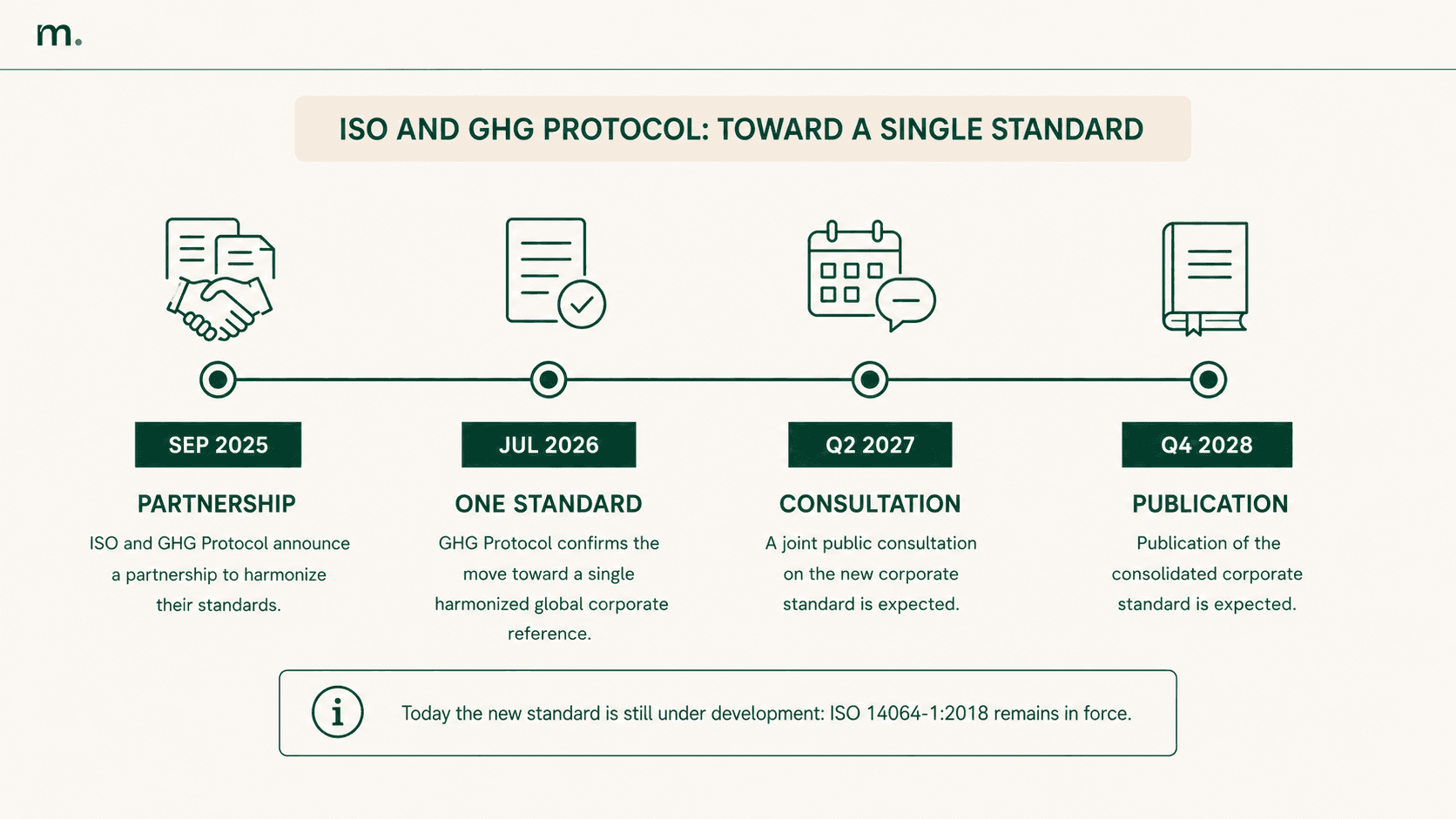
On July 29, 2026, GHG Protocol provided further detail on the direction of the project: the organizations' corporate standards will be consolidated into a single harmonized global standard for corporate carbon accounting. According to the update published by GHG Protocol, the process is expected to include a joint public consultation in the second quarter of 2027 and publication of the consolidated corporate standard in the fourth quarter of 2028.
The objective is to establish a common reference for organizations that may currently use standards developed separately, with differences in structure, terminology, and approaches to verification.
Why ISO and GHG protocol are converging
ISO 14064 and GHG Protocol share several principles, but they were developed through different processes. As a result, companies may need to reconcile criteria, categories, and reporting approaches when the same GHG inventory has to support different internal, regulatory, customer, or market requirements.
The partnership is intended to reduce this fragmentation. ISO identifies greater consistency and comparability of emissions data, together with a reduction in the burden associated with applying different standards, among the objectives of the project.
For companies, the expected outcome is a more consistent methodological framework. More closely aligned definitions, accounting boundaries, and reporting criteria could make it easier to use the same GHG data for multiple purposes without subsequently reconciling different methodologies.
This would also improve consistency across GHG accounting processes, particularly where companies manage emissions data across multiple legal entities, facilities, business units, or countries.
ISO 14064 and GHG Protocol: What They Are and How They Differ Today
Understanding the impact of convergence requires distinguishing between the two references as they operate today.
What is the GHG protocol?
The Greenhouse Gas Protocol is one of the main international references for greenhouse gas accounting and reporting. Its Corporate Standard provides a framework for building a corporate GHG inventory and establishes the classification of emissions into Scope 1, Scope 2, and Scope 3, supported by additional standards and guidance.
The GHG Protocol therefore provides a widely adopted methodology for setting inventory boundaries, classifying emission sources, and reporting results. The GHG Protocol Corporate Standard is designed to support the preparation of a verifiable inventory, although it does not itself establish a standard for how the verification process must be performed.
What is ISO 14064-1?
ISO 14064-1:2018 specifies principles and requirements for the quantification and reporting of greenhouse gas emissions and removals at the organizational level. It covers the design, development, management, reporting, and verification-related requirements of a GHG inventory.
The 2018 edition remains in force, while a new edition is under development.
ISO 14064-1 is also independent of any specific GHG programme. Organizations can therefore use it as a methodological reference for corporate carbon footprint calculation and apply additional requirements where necessary to meet regulatory, programme-specific, customer, or disclosure requirements.
It is also useful to distinguish ISO 14064-1 from the concept commonly described as “ISO 14064 certification.” The standard applies to the organization's GHG inventory; that inventory can then be independently verified against the applicable requirements of the ISO 14064 family.
ISO 14064-1 vs GHG protocol: key differences
The two frameworks share several core principles and can be used in a complementary way, but their structures are not identical.
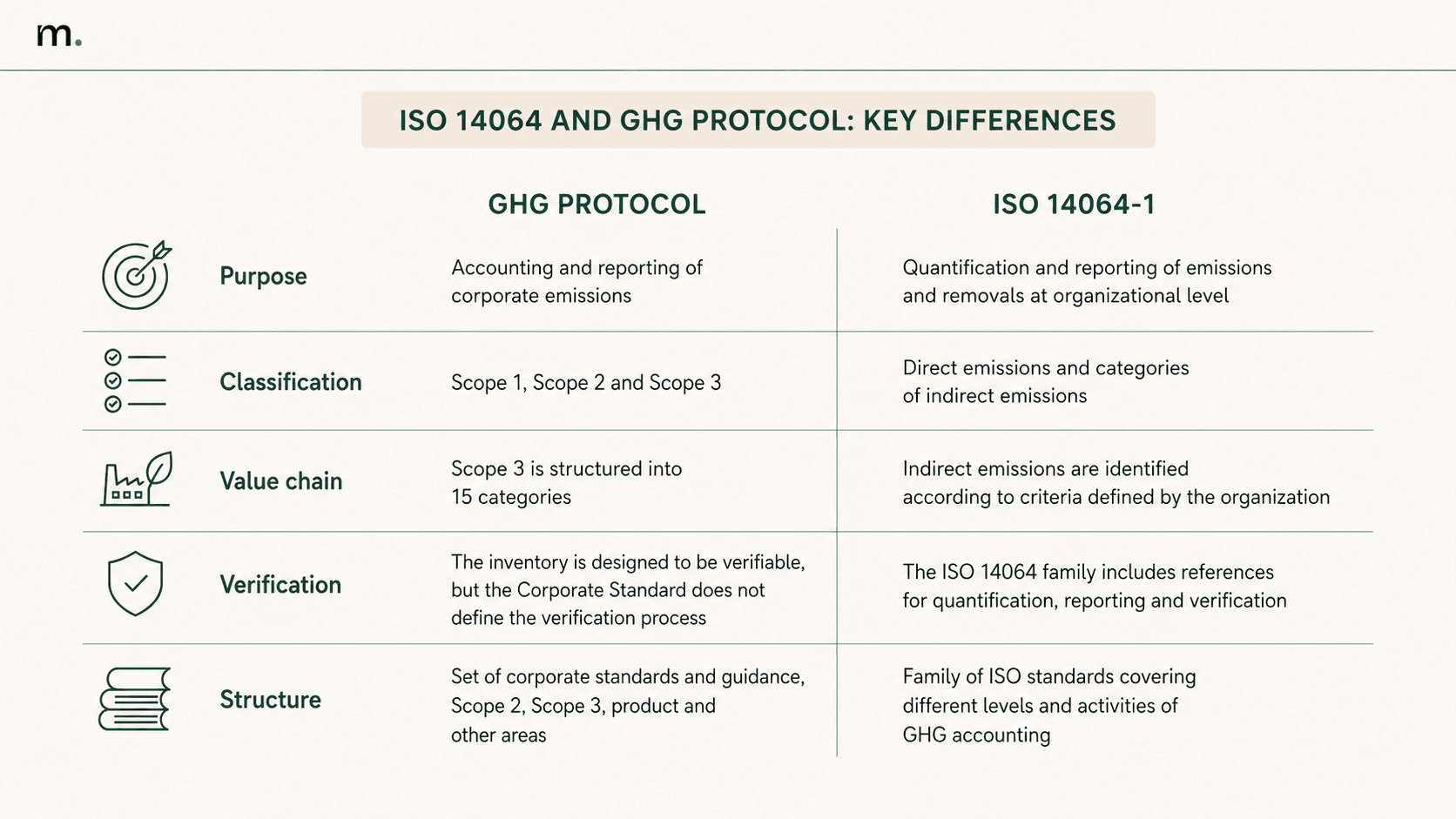
These differences matter when a company needs one inventory to support corporate reporting, customer requests, external verification, or other disclosure requirements. The convergence process is intended to reduce these areas of misalignment while building on the methodological work already developed by both systems.
What the new unified standard could change for emissions accounting
A final version of the new corporate standard is not yet available. It is therefore too early to determine which individual technical requirements will change or exactly how the current differences between ISO 14064-1 and GHG Protocol will be resolved.
The announced direction is nevertheless clear: the two organizations intend to develop one harmonized corporate reference rather than maintaining separate parallel approaches. The project will bring together the revision work already underway within GHG Protocol and the development work relating to the ISO 14064 family.
A common reference for the GHG inventory
One of the main expected effects concerns the GHG inventory itself: the system through which a company identifies emission sources, collects activity data, applies emission factors, and consolidates its results.
A common reference could reduce the need to interpret requirements from two separate standards. This is particularly relevant for corporate groups with multiple sites or subsidiaries, companies receiving emissions-data requests throughout their supply chains, and organizations using the same emissions data for several reporting or disclosure purposes.
For companies trying to estimate a carbon footprint accurately, the first methodological challenge is defining what must be included in the inventory. Teams need to figure out carbon footprint boundaries, determine which data sources are reliable enough for calculation, and document any estimates or assumptions used where primary data is unavailable.
The quality of the inventory will still depend on the quality of the underlying data. A harmonized methodology does not solve problems such as missing data, excessive reliance on estimates, outdated emission factors, or inconsistent application of organizational boundaries.
For this reason, companies should treat methodological convergence and data management as two related but distinct issues. A common standard can provide greater consistency in how emissions are accounted for, while reliable results still require structured data collection, documented calculation rules, and clear ownership of the information used.
Scope 1, Scope 2, and Scope 3: what companies should monitor
The Scope 1, 2, and 3 classification is one of the most widely recognized elements of the GHG Protocol. These areas are already subject to revision work. GHG Protocol is updating its Corporate Standard, while technical development continues alongside the harmonization process with ISO.
Companies should therefore monitor how the future standard addresses organizational boundaries, indirect emissions, calculation criteria, emission factors, and documentation of methodologies. These elements directly affect whether results can be compared consistently across reporting periods, subsidiaries, facilities, and organizations.
Traceability also has a direct operational impact. Knowing where a data point came from, which emission factor was applied, which reporting period it refers to, and which assumptions were used enables companies to update their inventories when methodologies or requirements change without rebuilding the entire calculation process.
This becomes particularly important for Scope 3, where data often originates outside the organization and where assumptions, proxies, supplier-specific information, and secondary databases may coexist within the same inventory.
What companies should do now
The convergence between ISO and GHG Protocol does not currently require companies to stop calculating emissions or rebuild existing inventories. ISO 14064-1:2018 remains in force, while the harmonized standard is still under development.
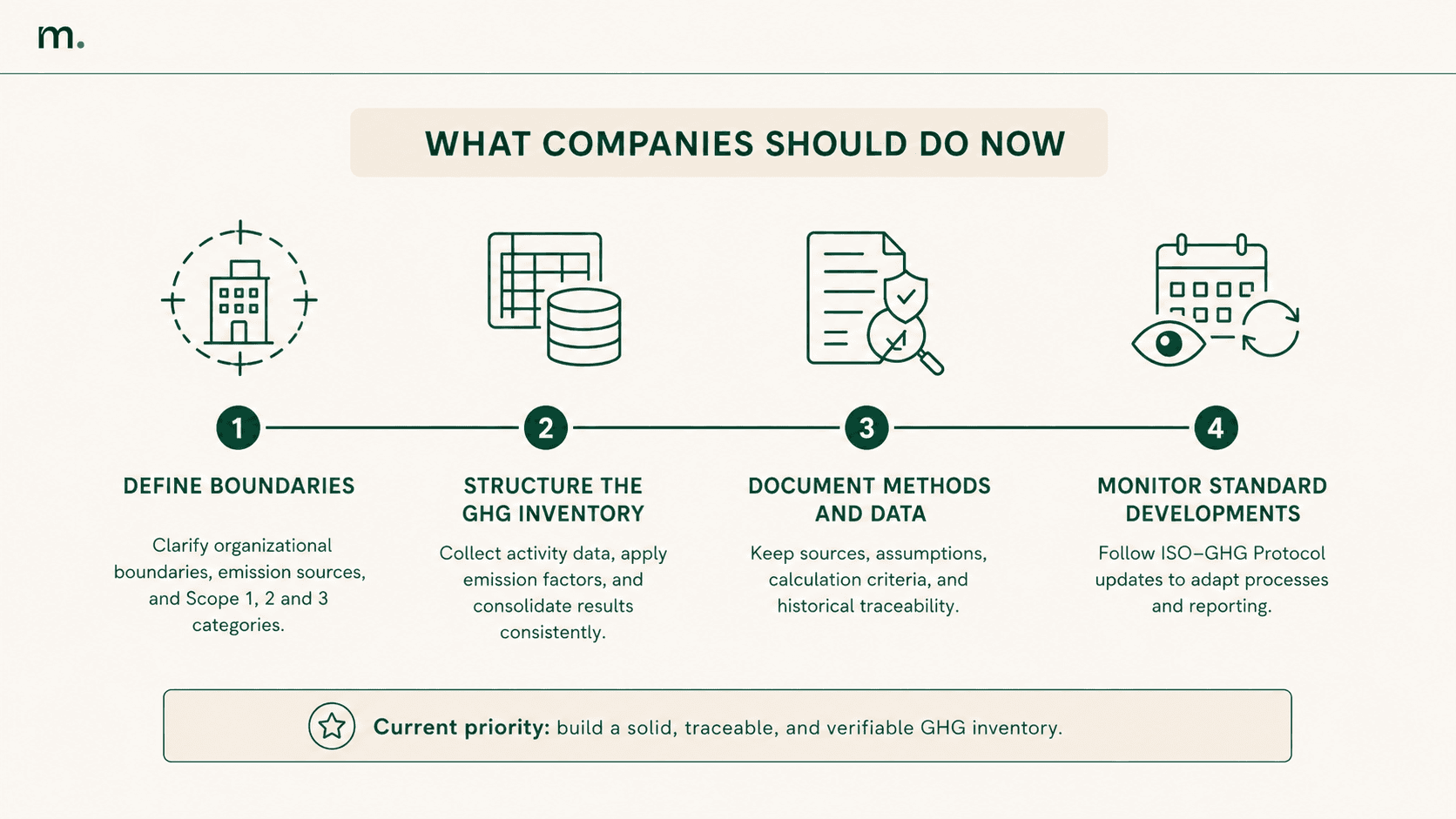
For companies already measuring their emissions, the priority remains to build and maintain a methodologically sound GHG inventory. This means defining organizational boundaries clearly, classifying emission sources correctly, documenting the criteria applied to Scope 1, Scope 2, and Scope 3, and retaining the sources of activity data and emission factors.
A well-structured inventory also makes future revisions easier to manage. If a requirement changes, the company should be able to identify which data and calculations are affected, update the methodology, and assess the impact on historical results. An inventory based on disconnected files, manual steps, and poorly documented criteria makes this process more resource-intensive and increases the risk of inconsistencies between reporting periods.
Companies beginning their carbon accounting or GHG accounting process today therefore have no reason to wait for publication of the new standard. An initial carbon footprint calculator can be useful for preliminary estimates, but companies that need repeatable, auditable results usually require a more structured carbon footprinting tool and a documented calculation methodology.
The most useful preparation is to make GHG data structured, traceable, and verifiable: assign clear internal responsibilities, retain evidence supporting calculations, apply methodologies consistently over time, and ensure that emission factors and calculation criteria can be updated without losing the historical audit trail.
The same structure makes it easier to identify measures to reduce carbon footprint over time and quantify whether those measures are actually affecting Scope 1, Scope 2, or Scope 3 results. Reduction plans can then be evaluated against a consistent emissions baseline rather than against calculations that change methodology from one reporting period to the next.
For companies managing large volumes of data across multiple subsidiaries, facilities, and Scope 3 categories, carbon footprint software can support this process by centralizing data collection, calculations, emission factors, and inventory documentation. The ability to adapt to the future standard will depend primarily on the quality, structure, and traceability of the data used in the calculations.
The ISO–GHG Protocol process should therefore be monitored as the technical work progresses. For businesses, the most practical approach today is to continue measuring emissions against recognized standards and maintain an inventory that is sufficiently documented and structured to evolve as those standards change.
CONTRIBUTOR

Alessandro Nora
CEO & Co-founder
Alessandro's goal is to make a real impact on sustainability. After founding a sustainable fashion marketplace, he decided to focus on ESG digitalisation with the aim of making sustainability more concrete, measurable and accessible for companies. A careful and methodical founder, with experience in Genoa, Berlin and Lisbon, Alessandro combines international vision and operational rigour in the development of digital solutions that simplify ESG regulations and compliance, supporting companies in adapting to ESG regulations, certifications and ratings through structured and audit-ready tools. Topics covered: CSRD, CSDDD, EUDR, CBAM ESG ratings, ESG certifications, Ecovadis, sustainability governance, regulatory compliance.
Stay up to date with Metrikflow Insights!
We deliver expert insights, product updates, industry trends, and actionable strategies straight to your inbox. Stay ahead in ESG, GHG, and LCA — one edition at a time.
By submitting this form, you consent to receive the requested resource. For more information on how we process and protect your data, view our Privacy Policy.


