ESG Regulations & Compliance

ESG Regulations & Compliance

ISO 14001:2026: what changes with the new update

ISO 14001:2026: what changes with the new update

Updated July 2026

Headshot Alessandro Nora
Alessandro Nora
Illustration of ISO 14001:2026 showing an environmental management checklist connected to climate risks, supply chain, compliance, business operations and performance monitoring.

What ISO 14001 is and how it supports companies

ISO 14001 defines the requirements for establishing, implementing and improving an environmental management system, commonly referred to as an EMS.

The standard provides companies with a structured method for identifying the environmental impacts of their activities, managing applicable compliance obligations, addressing risks and monitoring performance over time.

ISO 14001 is part of the ISO 14000 family of standards. Terms such as “ISO 14000 environmental certification” are sometimes used generically, but ISO 14001 is the certifiable standard for environmental management systems.

It can be adopted by companies of any size and in any industry. For a manufacturing company, the system may cover energy consumption, emissions, wastewater, waste, raw material use and emergency management. For a service company, it may address buildings, business travel, procurement, suppliers and resource consumption.

Implementing the standard and obtaining certification are two separate steps. A company can use ISO 14001 as an internal reference without requesting certification. ISO 14001 certification, on the other hand, is issued by an independent certification body after verifying that the system complies with the requirements and is effectively implemented. Certification is voluntary and is not issued directly by ISO.

As with other ESG and environmental certifications, its value for the company depends on how effectively requirements, controls and responsibilities are integrated into business processes.

A well-structured environmental management system can help reduce waste, consumption and inefficiencies, improve control over regulatory obligations and make the evidence required during audits easier to manage.

Certification may also be required to participate in tenders, enter specific supply chains or meet the environmental criteria set by customers and contracting organisations.

These are some of the main benefits of ISO 14001 environmental certification, but the outcome depends on the company’s ability to turn its objectives into verifiable activities.

For example, stating that energy consumption should be reduced has limited value unless the company defines a baseline, a deadline, a responsible person and a measurement method.

The same applies to consumption, energy performance and other environmental indicators. Energy management software can help centralise data, monitor consumption trends and verify progress against defined targets.

ISO 14001 provides continuity to this process and gives management usable information to assess whether the actions taken are delivering the expected results.

Why ISO 14001:2026 was published

ISO 14001:2015 had already introduced key elements such as context analysis, the assessment of risks and opportunities, the life cycle perspective and the integration of environmental management into business processes.

Over the past ten years, however, the conditions in which companies operate have changed. Climate events, resource scarcity, biodiversity loss, supply disruptions and new regulatory obligations now affect business continuity, costs and production capacity.
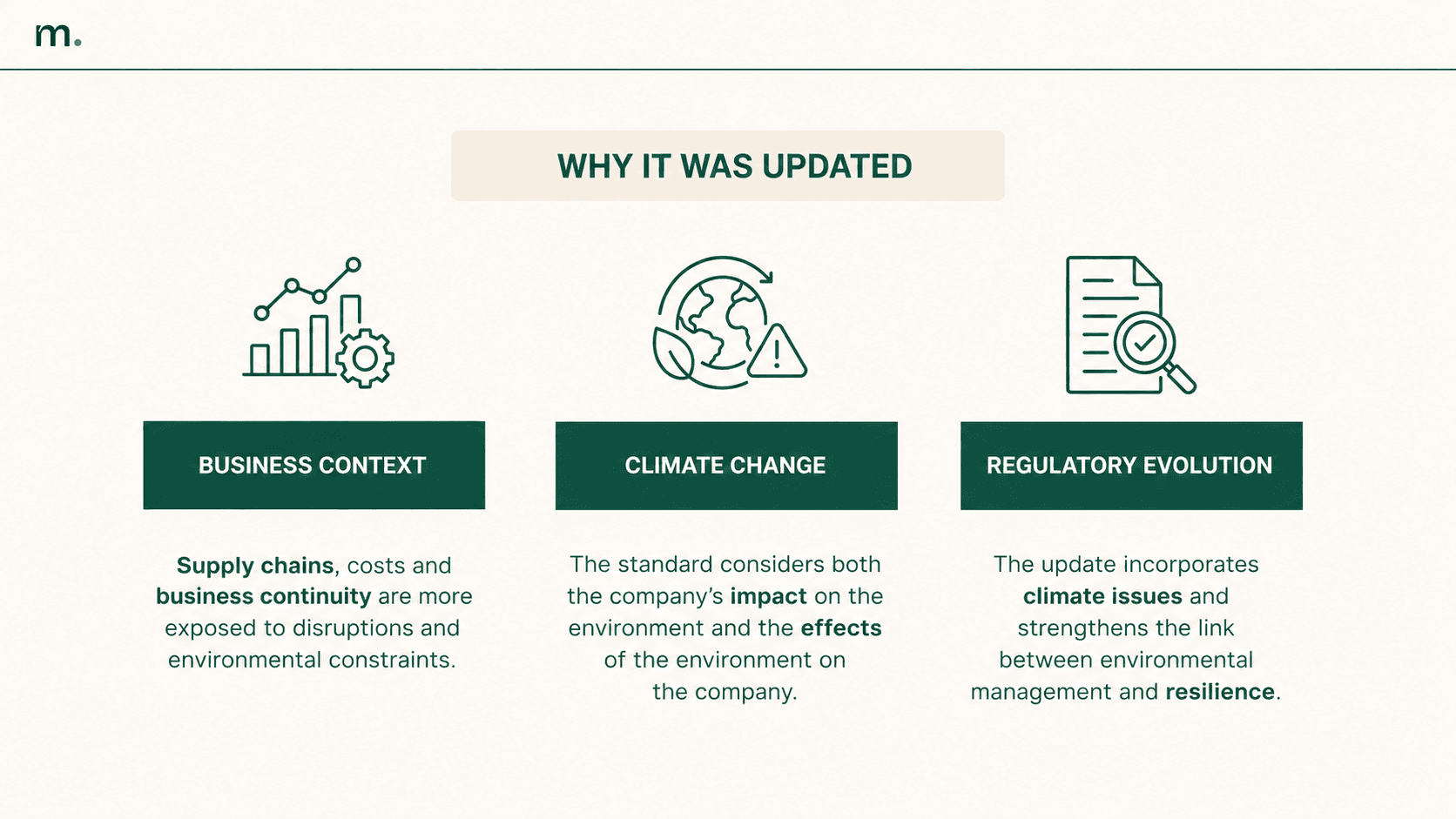
Why ISO 14001:2026 was updated: business context, climate change and regulatory evolution.

ISO links the new edition to the need for a clearer system that is better aligned with issues such as climate change, biodiversity and resource efficiency. An official ISO guide to the standard also provides an overview of its purpose and business applications.

The 2026 edition updates the standard to reflect current conditions and sets clearer expectations for organisations. The revision strengthens the relationship between planned activities, business decisions and achieved performance.

For many companies, climate risk is already an economic factor that needs to be managed. A flood can stop operations at a production site, a landslide can disrupt a logistics route and a prolonged drought can reduce the availability or increase the price of certain raw materials.

These effects may occur directly on company assets or further along the supply chain. A company can be exposed even when its own facilities remain undamaged, for example when a strategic supplier is unable to produce or a transport route becomes temporarily unavailable.

Italian legislation also reflects this development. The 2024 Budget Law introduced an obligation for companies registered in the Italian Business Register to insure certain assets against damage caused by earthquakes, floods, landslides, inundations and overflows. The implementation rules were defined by Interministerial Decree No. 18 of 30 January 2025 and by subsequent updates published by the Italian Ministry of Enterprises and Made in Italy.

This insurance requirement is separate from ISO 14001, but it shows how exposure to natural hazards has become part of ordinary business management. Insuring an asset transfers part of the financial risk, but it does not replace vulnerability analysis, prevention or business continuity planning.

The amendment published in February 2024 had already required organisations to determine whether climate change was a relevant issue for their management system. ISO 14001:2026 incorporates this requirement into the main text of the standard.

The assessment must consider two directions: the company’s impact on the environment and the effect of environmental conditions on the company.

A business may generate emissions, consume resources or produce waste. At the same time, it may depend on vulnerable infrastructure, suppliers located in exposed areas or resources whose availability could become less stable.

The standard does not require every organisation to implement the same environmental projects. It requires a documented assessment of the relevant factors and their potential effect on business processes.

The company must therefore be able to explain which environmental conditions were considered, which risks arise from them and how they are translated into controls, responsibilities and measurable objectives.

What changes in ISO 14001:2026

One of the main changes concerns the analysis of the organisation’s context. The standard refers more clearly to environmental conditions such as climate change, biodiversity, ecosystem health, resource availability and pollution.

These factors must be considered when they are relevant to the organisation’s activities, impacts or ability to achieve the objectives of its environmental management system.

For a company, the analysis may include dependence on raw materials exposed to water scarcity, the vulnerability of facilities and warehouses to weather events, future energy availability or changes in environmental requirements imposed by customers.
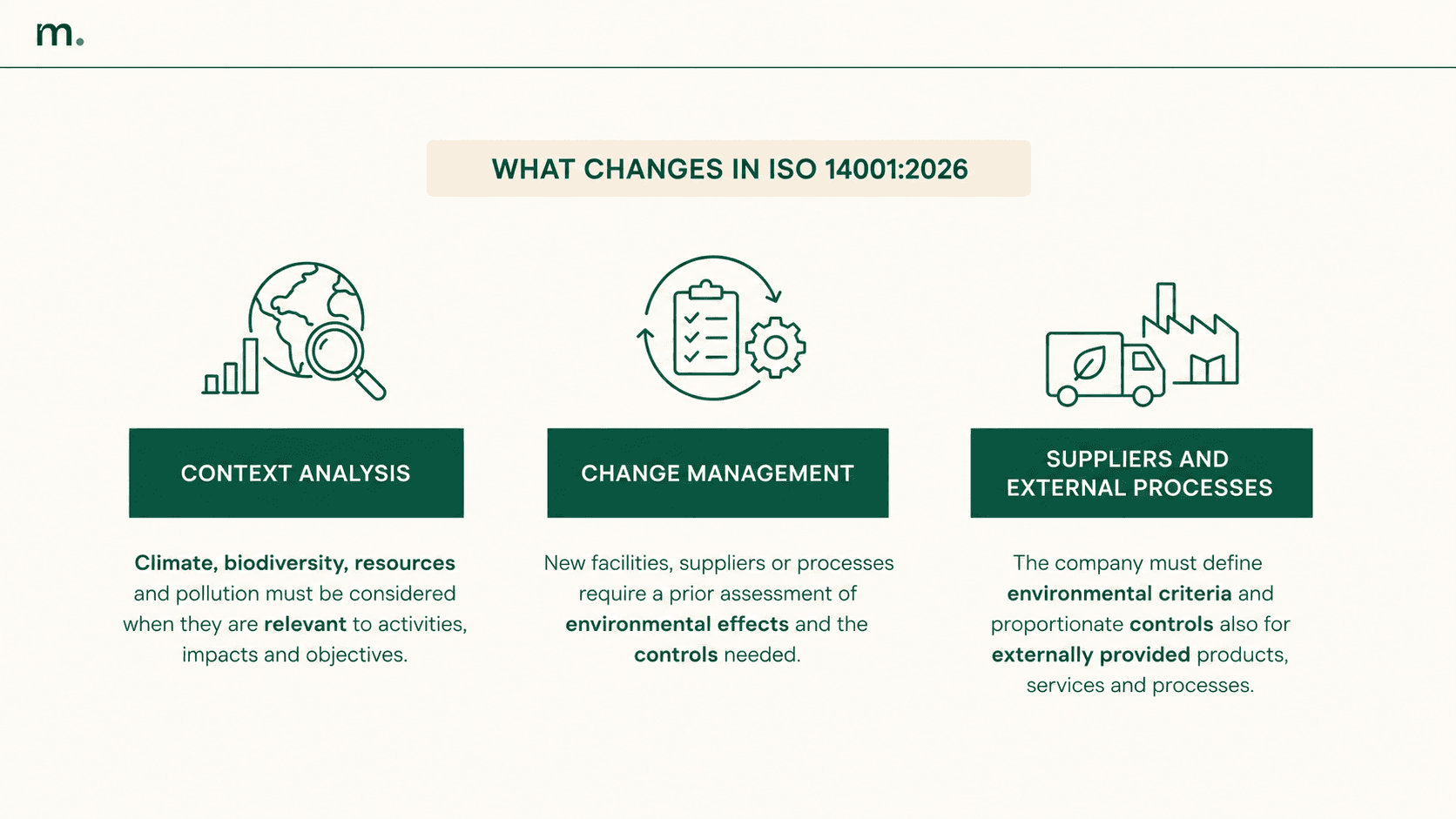
Main changes in ISO 14001:2026: context analysis, change management and control of external suppliers and processes.

The context analysis must lead to operational decisions, rather than producing a generic assessment disconnected from business processes.

A practical example emerged during Metrikflow’s webinar on the new ISO 14001:2026. An extreme event can interrupt production, damage a site or make a raw material unavailable.

The same risk can arise along the supply chain when a supplier is unable to produce or goods cannot be transported. The assessment should therefore include relevant operational dependencies, even when they are outside the direct boundaries of the company’s facilities.

The full ISO 14001:2026 webinar recording is available here.

ISO 14001:2026 also strengthens the role of top management. Environmental objectives must be consistent with the company’s priorities and supported by adequate resources, clearly assigned responsibilities and scheduled review points.

Management must be able to evaluate the performance of the system using reliable information, including environmental indicators, nonconformities, audit results and the progress of corrective actions.

Another change concerns the management of risks and opportunities. The new Clause 6.1.4 creates a clearer connection between environmental aspects, compliance obligations, issues identified through the context analysis and planned actions.

The assessment should make it possible to define priorities, responsibilities, timelines and verification criteria. A risk register that is not connected to action plans or performance indicators would provide limited operational value.

Clause 6.3 also introduces a more explicit approach to change management. Production expansions, equipment replacements, acquisitions, new suppliers, changes in raw materials or outsourced activities can alter the organisation’s environmental impacts.

Before implementing a significant change, the company will need to assess its effects, update the necessary controls and determine whether new expertise, permits or monitoring procedures are required.

The organisation’s responsibility is also described more clearly in relation to externally provided processes, products and services. This wider scope may require companies to review the environmental criteria used to select and monitor suppliers.

For some businesses, this will involve updating technical specifications, questionnaires, contractual conditions and the information requested across the supply chain. Supplier assessment software can support evidence collection, questionnaire distribution and the monitoring of risks associated with external partners.

The level of control should be proportionate to the environmental relevance of the outsourced process and to the company’s ability to influence it.

The revision also addresses internal audits and management reviews. Audit programmes must be documented and linked to clear objectives. Management reviews should provide a concrete basis for approving changes, investments and corrective actions.

The life cycle perspective remains a central element. Companies are not required to conduct a complete LCA for every product, but they must assess the relevant environmental impacts associated with the stages they can control or influence: sourcing, design, production, transport, use and end of life.

To understand the difference between a life cycle perspective and a complete study, companies can consult the guide explaining what Life Cycle Assessment is and why it matters. When impacts need to be quantified at product level, LCA software can be used to organise data, system boundaries, inventories and scenarios.

Overall, ISO 14001:2026 requires stronger traceability between analysis, decisions, actions and results. Procedures and records remain important, but they must demonstrate how the system contributes to the effective management of environmental performance.

How to obtain ISO 14001 certification and prepare for the transition

Companies certified under ISO 14001:2015 have three years to complete the transition. The transition period ends on 30 April 2029, after which certificates issued under the 2015 edition will no longer be valid.

From 30 October 2027, certification bodies will no longer be able to issue new ISO 14001:2015 certificates. The deadlines are described in the Accredia circular on the transition to ISO 14001:2026.

As explained during the Metrikflow webinar, the transition audit may be carried out during a surveillance audit, as part of the recertification process or through a separate audit. The most appropriate option will depend on the company’s certification cycle and the schedule agreed with its certification body.

The first operational step is an assessment of the gaps between the current system and the requirements of the new edition.

This analysis should involve the environmental management system owner and the functions responsible for relevant processes, including production, procurement, maintenance, quality, logistics and senior management.
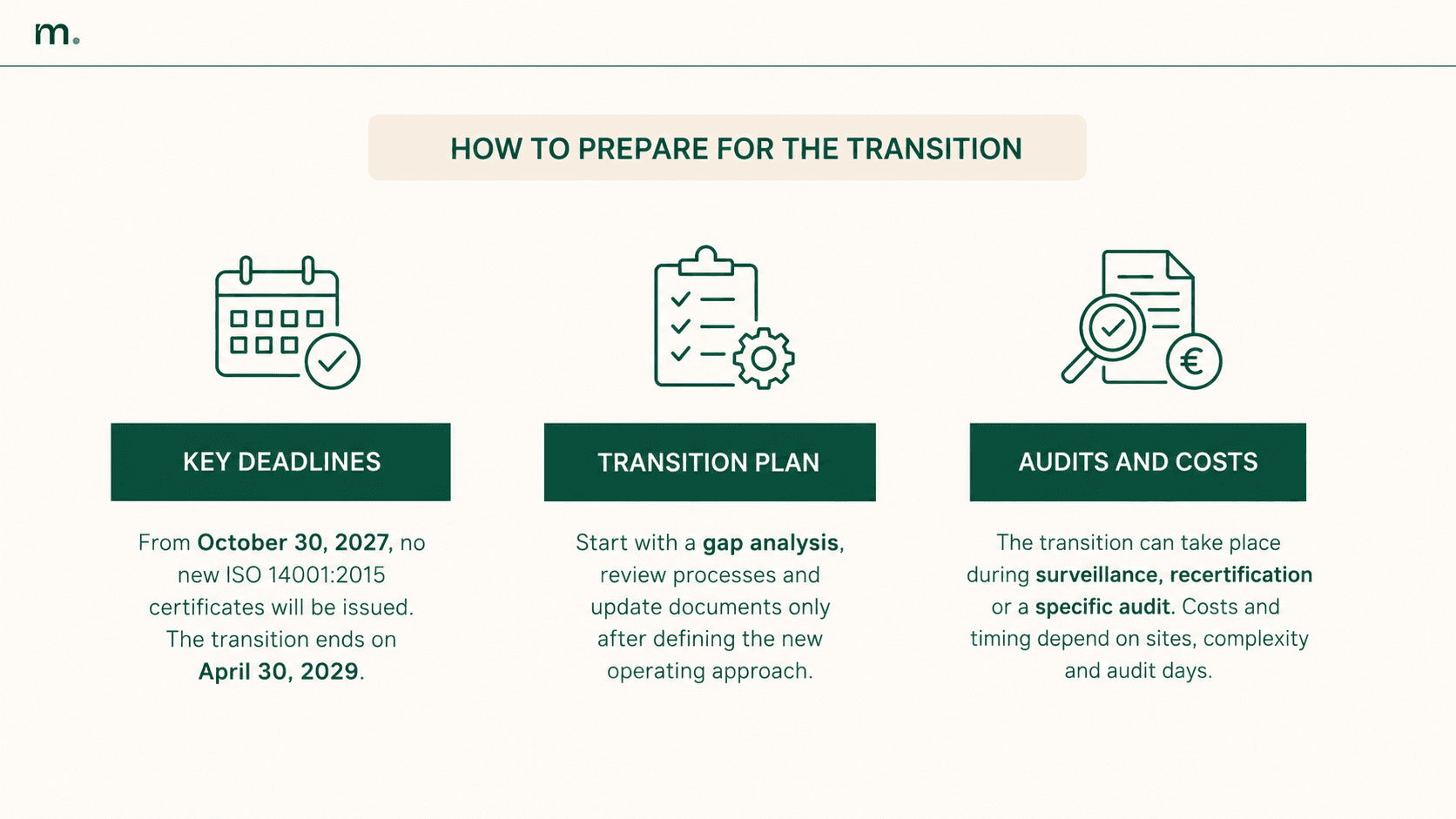
How to prepare for the ISO 14001:2026 transition: deadlines, transition plan, audits and costs.

The assessment should clarify which parts of the system are already aligned and which require changes. Areas to review include the context analysis, change management, management involvement, supplier controls, the audit programme, environmental objectives and the way supporting evidence is stored.

The results can then be used to prepare a transition plan with assigned activities, responsibilities, deadlines and priorities.

Document updates should follow the review of business processes. Revising procedures and templates before deciding how the new requirements will be applied can result in documentation that is formally correct but difficult to use in practice.

Another operational recommendation emerged from the discussion with the webinar experts: companies should avoid concentrating the transition activities in the final months of the available period.

A finding identified during an audit requires time to be analysed, corrected and verified. As the 30 April 2029 deadline approaches, auditor availability may also become more limited.

Scheduling the transition within the ordinary surveillance or recertification cycle allows companies to distribute activities and costs more effectively and reduces the likelihood of requiring an additional audit.

The cost of ISO 14001 certification or of updating an existing certification is not fixed. It depends on the number of sites, the industry, the complexity of the activities, the number of employees, the maturity of the system and the number of audit days required.

For companies that are already certified, costs may include purchasing the new standard, training the people involved, obtaining external advisory support, conducting the gap assessment, revising processes and documentation, performing an additional internal audit and completing the transition audit.

Further investments may be needed to correct operational gaps identified during the review. Replacing equipment, introducing new monitoring systems or modifying a production process has a different financial impact from updating a procedure.

To estimate the budget accurately, companies should distinguish between the costs required to achieve compliance and the investments they decide to make to improve environmental performance.

Companies seeking ISO 14001 certification for the first time will need to define the scope of the system, identify applicable aspects and obligations, establish controls and objectives, train employees and conduct internal audits and a management review before the certification audit.

ISO 14001 can also be integrated with other management systems. Common combinations include ISO 14001 and ISO 9001, covering environmental and quality management, and ISO 14001 and ISO 45001, where occupational health and safety are also managed through an integrated system.

Integration makes it possible to share processes such as context analysis, document control, audits, corrective actions and management reviews, reducing duplication across the different systems.

How to manage ISO 14001 with software

The transition to ISO 14001:2026 increases the amount of information that needs to be connected and kept up to date.

Context analyses, environmental aspects, obligations, risks, objectives, actions, indicators and audit results should not be managed as separate and disconnected documents.

ISO certification software can make these relationships visible and reduce reliance on files distributed across different teams, individuals and locations.

A risk identified during the context analysis can be linked to the affected process, a responsible person, an action plan and a performance indicator. During an audit, this makes it easier to reconstruct which decision was made, which data supported it and what results were achieved.

Centralisation also supports the management of deadlines and evidence. Permits, controls, records, meeting minutes, audits, nonconformities and corrective actions can be stored with traceable versions, owners and dates.

Management can access more reliable information for periodic reviews, while operational teams can monitor the progress of activities and intervene before a deadline is missed.

A modular ESG software platform also makes it possible to connect the environmental management system with other activities, including energy management, emissions calculations, supply chain assessments, reporting and life cycle analysis.

With Metrikflow, companies can manage the ISO 14001 certification process through traceable activities, centralised document collection and collaboration between internal teams, consultants and auditors.

The platform makes it possible to monitor the progress of each activity, maintain a history of changes and prepare the evidence required during audits.

To manage the transition to ISO 14001:2026 effectively, the first priority is to understand which changes have a real impact on the company’s existing system. An accurate initial assessment allows the organisation to define timelines, resources and costs based on its actual needs, without adding unnecessary complexity to the environmental management system.

On 15 April 2026, ISO 14001:2026 was published as the fourth edition of the international standard for environmental management systems. The new version replaces ISO 14001:2015 and incorporates the climate change amendment introduced in 2024. Further details are available on the official ISO page dedicated to the new edition.

For companies that are already certified, the update does not require rebuilding the environmental management system from scratch. They will, however, need to verify that their processes, responsibilities, assessment criteria and control mechanisms are aligned with the revised requirements.

The revision clarifies areas that could be interpreted differently under the previous edition and strengthens the connection between environmental risks, operational decisions and measurable performance.

Companies will need to demonstrate more precisely how environmental factors are considered in day-to-day management, investment decisions, supplier selection and change planning.

What ISO 14001 is and how it supports companies

ISO 14001 defines the requirements for establishing, implementing and improving an environmental management system, commonly referred to as an EMS.

The standard provides companies with a structured method for identifying the environmental impacts of their activities, managing applicable compliance obligations, addressing risks and monitoring performance over time.

ISO 14001 is part of the ISO 14000 family of standards. Terms such as “ISO 14000 environmental certification” are sometimes used generically, but ISO 14001 is the certifiable standard for environmental management systems.

It can be adopted by companies of any size and in any industry. For a manufacturing company, the system may cover energy consumption, emissions, wastewater, waste, raw material use and emergency management. For a service company, it may address buildings, business travel, procurement, suppliers and resource consumption.

Implementing the standard and obtaining certification are two separate steps. A company can use ISO 14001 as an internal reference without requesting certification. ISO 14001 certification, on the other hand, is issued by an independent certification body after verifying that the system complies with the requirements and is effectively implemented. Certification is voluntary and is not issued directly by ISO.

As with other ESG and environmental certifications, its value for the company depends on how effectively requirements, controls and responsibilities are integrated into business processes.

A well-structured environmental management system can help reduce waste, consumption and inefficiencies, improve control over regulatory obligations and make the evidence required during audits easier to manage.

Certification may also be required to participate in tenders, enter specific supply chains or meet the environmental criteria set by customers and contracting organisations.

These are some of the main benefits of ISO 14001 environmental certification, but the outcome depends on the company’s ability to turn its objectives into verifiable activities.

For example, stating that energy consumption should be reduced has limited value unless the company defines a baseline, a deadline, a responsible person and a measurement method.

The same applies to consumption, energy performance and other environmental indicators. Energy management software can help centralise data, monitor consumption trends and verify progress against defined targets.

ISO 14001 provides continuity to this process and gives management usable information to assess whether the actions taken are delivering the expected results.

Why ISO 14001:2026 was published

ISO 14001:2015 had already introduced key elements such as context analysis, the assessment of risks and opportunities, the life cycle perspective and the integration of environmental management into business processes.

Over the past ten years, however, the conditions in which companies operate have changed. Climate events, resource scarcity, biodiversity loss, supply disruptions and new regulatory obligations now affect business continuity, costs and production capacity.

Why ISO 14001:2026 was updated: business context, climate change and regulatory evolution.

ISO links the new edition to the need for a clearer system that is better aligned with issues such as climate change, biodiversity and resource efficiency. An official ISO guide to the standard also provides an overview of its purpose and business applications.

The 2026 edition updates the standard to reflect current conditions and sets clearer expectations for organisations. The revision strengthens the relationship between planned activities, business decisions and achieved performance.

For many companies, climate risk is already an economic factor that needs to be managed. A flood can stop operations at a production site, a landslide can disrupt a logistics route and a prolonged drought can reduce the availability or increase the price of certain raw materials.

These effects may occur directly on company assets or further along the supply chain. A company can be exposed even when its own facilities remain undamaged, for example when a strategic supplier is unable to produce or a transport route becomes temporarily unavailable.

Italian legislation also reflects this development. The 2024 Budget Law introduced an obligation for companies registered in the Italian Business Register to insure certain assets against damage caused by earthquakes, floods, landslides, inundations and overflows. The implementation rules were defined by Interministerial Decree No. 18 of 30 January 2025 and by subsequent updates published by the Italian Ministry of Enterprises and Made in Italy.

This insurance requirement is separate from ISO 14001, but it shows how exposure to natural hazards has become part of ordinary business management. Insuring an asset transfers part of the financial risk, but it does not replace vulnerability analysis, prevention or business continuity planning.

The amendment published in February 2024 had already required organisations to determine whether climate change was a relevant issue for their management system. ISO 14001:2026 incorporates this requirement into the main text of the standard.

The assessment must consider two directions: the company’s impact on the environment and the effect of environmental conditions on the company.

A business may generate emissions, consume resources or produce waste. At the same time, it may depend on vulnerable infrastructure, suppliers located in exposed areas or resources whose availability could become less stable.

The standard does not require every organisation to implement the same environmental projects. It requires a documented assessment of the relevant factors and their potential effect on business processes.

The company must therefore be able to explain which environmental conditions were considered, which risks arise from them and how they are translated into controls, responsibilities and measurable objectives.

What changes in ISO 14001:2026

One of the main changes concerns the analysis of the organisation’s context. The standard refers more clearly to environmental conditions such as climate change, biodiversity, ecosystem health, resource availability and pollution.

These factors must be considered when they are relevant to the organisation’s activities, impacts or ability to achieve the objectives of its environmental management system.

For a company, the analysis may include dependence on raw materials exposed to water scarcity, the vulnerability of facilities and warehouses to weather events, future energy availability or changes in environmental requirements imposed by customers.

Main changes in ISO 14001:2026: context analysis, change management and control of external suppliers and processes.

The context analysis must lead to operational decisions, rather than producing a generic assessment disconnected from business processes.

A practical example emerged during Metrikflow’s webinar on the new ISO 14001:2026. An extreme event can interrupt production, damage a site or make a raw material unavailable.

The same risk can arise along the supply chain when a supplier is unable to produce or goods cannot be transported. The assessment should therefore include relevant operational dependencies, even when they are outside the direct boundaries of the company’s facilities.

The full ISO 14001:2026 webinar recording is available here.

ISO 14001:2026 also strengthens the role of top management. Environmental objectives must be consistent with the company’s priorities and supported by adequate resources, clearly assigned responsibilities and scheduled review points.

Management must be able to evaluate the performance of the system using reliable information, including environmental indicators, nonconformities, audit results and the progress of corrective actions.

Another change concerns the management of risks and opportunities. The new Clause 6.1.4 creates a clearer connection between environmental aspects, compliance obligations, issues identified through the context analysis and planned actions.

The assessment should make it possible to define priorities, responsibilities, timelines and verification criteria. A risk register that is not connected to action plans or performance indicators would provide limited operational value.

Clause 6.3 also introduces a more explicit approach to change management. Production expansions, equipment replacements, acquisitions, new suppliers, changes in raw materials or outsourced activities can alter the organisation’s environmental impacts.

Before implementing a significant change, the company will need to assess its effects, update the necessary controls and determine whether new expertise, permits or monitoring procedures are required.

The organisation’s responsibility is also described more clearly in relation to externally provided processes, products and services. This wider scope may require companies to review the environmental criteria used to select and monitor suppliers.

For some businesses, this will involve updating technical specifications, questionnaires, contractual conditions and the information requested across the supply chain. Supplier assessment software can support evidence collection, questionnaire distribution and the monitoring of risks associated with external partners.

The level of control should be proportionate to the environmental relevance of the outsourced process and to the company’s ability to influence it.

The revision also addresses internal audits and management reviews. Audit programmes must be documented and linked to clear objectives. Management reviews should provide a concrete basis for approving changes, investments and corrective actions.

The life cycle perspective remains a central element. Companies are not required to conduct a complete LCA for every product, but they must assess the relevant environmental impacts associated with the stages they can control or influence: sourcing, design, production, transport, use and end of life.

To understand the difference between a life cycle perspective and a complete study, companies can consult the guide explaining what Life Cycle Assessment is and why it matters. When impacts need to be quantified at product level, LCA software can be used to organise data, system boundaries, inventories and scenarios.

Overall, ISO 14001:2026 requires stronger traceability between analysis, decisions, actions and results. Procedures and records remain important, but they must demonstrate how the system contributes to the effective management of environmental performance.

How to obtain ISO 14001 certification and prepare for the transition

Companies certified under ISO 14001:2015 have three years to complete the transition. The transition period ends on 30 April 2029, after which certificates issued under the 2015 edition will no longer be valid.

From 30 October 2027, certification bodies will no longer be able to issue new ISO 14001:2015 certificates. The deadlines are described in the Accredia circular on the transition to ISO 14001:2026.

As explained during the Metrikflow webinar, the transition audit may be carried out during a surveillance audit, as part of the recertification process or through a separate audit. The most appropriate option will depend on the company’s certification cycle and the schedule agreed with its certification body.

The first operational step is an assessment of the gaps between the current system and the requirements of the new edition.

This analysis should involve the environmental management system owner and the functions responsible for relevant processes, including production, procurement, maintenance, quality, logistics and senior management.

How to prepare for the ISO 14001:2026 transition: deadlines, transition plan, audits and costs.

The assessment should clarify which parts of the system are already aligned and which require changes. Areas to review include the context analysis, change management, management involvement, supplier controls, the audit programme, environmental objectives and the way supporting evidence is stored.

The results can then be used to prepare a transition plan with assigned activities, responsibilities, deadlines and priorities.

Document updates should follow the review of business processes. Revising procedures and templates before deciding how the new requirements will be applied can result in documentation that is formally correct but difficult to use in practice.

Another operational recommendation emerged from the discussion with the webinar experts: companies should avoid concentrating the transition activities in the final months of the available period.

A finding identified during an audit requires time to be analysed, corrected and verified. As the 30 April 2029 deadline approaches, auditor availability may also become more limited.

Scheduling the transition within the ordinary surveillance or recertification cycle allows companies to distribute activities and costs more effectively and reduces the likelihood of requiring an additional audit.

The cost of ISO 14001 certification or of updating an existing certification is not fixed. It depends on the number of sites, the industry, the complexity of the activities, the number of employees, the maturity of the system and the number of audit days required.

For companies that are already certified, costs may include purchasing the new standard, training the people involved, obtaining external advisory support, conducting the gap assessment, revising processes and documentation, performing an additional internal audit and completing the transition audit.

Further investments may be needed to correct operational gaps identified during the review. Replacing equipment, introducing new monitoring systems or modifying a production process has a different financial impact from updating a procedure.

To estimate the budget accurately, companies should distinguish between the costs required to achieve compliance and the investments they decide to make to improve environmental performance.

Companies seeking ISO 14001 certification for the first time will need to define the scope of the system, identify applicable aspects and obligations, establish controls and objectives, train employees and conduct internal audits and a management review before the certification audit.

ISO 14001 can also be integrated with other management systems. Common combinations include ISO 14001 and ISO 9001, covering environmental and quality management, and ISO 14001 and ISO 45001, where occupational health and safety are also managed through an integrated system.

Integration makes it possible to share processes such as context analysis, document control, audits, corrective actions and management reviews, reducing duplication across the different systems.

How to manage ISO 14001 with software

The transition to ISO 14001:2026 increases the amount of information that needs to be connected and kept up to date.

Context analyses, environmental aspects, obligations, risks, objectives, actions, indicators and audit results should not be managed as separate and disconnected documents.

ISO certification software can make these relationships visible and reduce reliance on files distributed across different teams, individuals and locations.

A risk identified during the context analysis can be linked to the affected process, a responsible person, an action plan and a performance indicator. During an audit, this makes it easier to reconstruct which decision was made, which data supported it and what results were achieved.

Centralisation also supports the management of deadlines and evidence. Permits, controls, records, meeting minutes, audits, nonconformities and corrective actions can be stored with traceable versions, owners and dates.

Management can access more reliable information for periodic reviews, while operational teams can monitor the progress of activities and intervene before a deadline is missed.

A modular ESG software platform also makes it possible to connect the environmental management system with other activities, including energy management, emissions calculations, supply chain assessments, reporting and life cycle analysis.

With Metrikflow, companies can manage the ISO 14001 certification process through traceable activities, centralised document collection and collaboration between internal teams, consultants and auditors.

The platform makes it possible to monitor the progress of each activity, maintain a history of changes and prepare the evidence required during audits.

To manage the transition to ISO 14001:2026 effectively, the first priority is to understand which changes have a real impact on the company’s existing system. An accurate initial assessment allows the organisation to define timelines, resources and costs based on its actual needs, without adding unnecessary complexity to the environmental management system.

CONTRIBUTOR

Headshot Alessandro Nora

Alessandro Nora

CEO & Co-founder

Alessandro's goal is to make a real impact on sustainability. After founding a sustainable fashion marketplace, he decided to focus on ESG digitalisation with the aim of making sustainability more concrete, measurable and accessible for companies. A careful and methodical founder, with experience in Genoa, Berlin and Lisbon, Alessandro combines international vision and operational rigour in the development of digital solutions that simplify ESG regulations and compliance, supporting companies in adapting to ESG regulations, certifications and ratings through structured and audit-ready tools. Topics covered: CSRD, CSDDD, EUDR, CBAM ESG ratings, ESG certifications, Ecovadis, sustainability governance, regulatory compliance.

No headings found on page

Stay up to date with Metrikflow Insights!

We deliver expert insights, product updates, industry trends, and actionable strategies straight to your inbox. Stay ahead in ESG, GHG, and LCA — one edition at a time.

By submitting this form, you consent to receive the requested resource. For more information on how we process and protect your data, view our Privacy Policy.

The go-to software solution for
Sustainability Managers.

Customer-Oriented

Data Accurate

Built on Smart Tech

ESG radar: The Metrikflow Newsletter

Everything you need to know about sustainability,
all-in-one email. Weekly insights. Zero spam.

By submitting this form, you consent to receive the requested resource. For more information on how we process and protect your data, view our Privacy Policy.

Ask AI for a summary of Metrikflow

chatgptclaudeperplexity

Contact Us

The only platform you ever need to manage ESG and Compliance.

Data Security

Measurable Impact

AI + ESG Experts

Measurable Impact

AI + ESG Experts

Data Security

ESG radar: The Metrikflow Newsletter

Everything you need to know about sustainability,
all-in-one email. Weekly insights. Zero spam.

By submitting this form, you consent to receive the requested resource. For more information on how we process and protect your data, view our Privacy Policy.

Ask AI for a summary of Metrikflow

chatgptclaudeperplexity