
Decarbonization, Carbon Footprint & LCA

Decarbonization, Carbon Footprint & LCA

Product Carbon Footprint: what it is, how to calculate it and why it matters for companies

Product Carbon Footprint: what it is, how to calculate it and why it matters for companies

Measuring product emissions with verifiable data

Luis Antazema Headshot
Luis Antazema
Conceptual image of a sustainable product with life cycle icons for production, logistics, use and recycling.

Product Carbon Footprint, or PCF, measures the greenhouse gas emissions generated by a product throughout its life cycle. The result is expressed in CO2 equivalent and quantifies the climate impact associated with raw materials, manufacturing processes, energy consumption, logistics, product use and end-of-life treatment.

For companies, PCF connects the environmental impact of products to technical and operational data. It shows which components, suppliers or process stages contribute most to emissions, making the result useful for decisions on product design, procurement, production efficiency, packaging, supply chain management and technical documentation requested by customers or partners.

Infographic explaining what Product Carbon Footprint is, what it measures and why it is useful for assessing product emissions across the life cycle.

Product Carbon Footprint should be distinguished from corporate carbon footprint. A corporate carbon footprint measures the overall emissions of an organization, including Scope 1, Scope 2 and Scope 3 emissions according to the GHG Protocol. PCF narrows the analysis to a specific product. While corporate carbon footprint provides a company-level view, Product Carbon Footprint helps assess where and how to intervene on a product line, a single SKU or a family of products.

Product Carbon Footprint and LCA: why the life cycle matters

Product Carbon Footprint is based on the logic of LCA, or Life Cycle Assessment. Life Cycle Assessment evaluates the environmental impacts of a product across the stages of its life cycle; PCF focuses specifically on the climate impact category, meaning GHG emissions expressed in CO2 equivalent.

This approach prevents partial assessments. A product may have an efficient manufacturing phase but rely on emission-intensive raw materials. Another product may generate limited emissions within the plant but have a relevant impact during transportation, use or end-of-life. Looking at the full product life cycle makes it possible to identify emission hotspots and focus improvement actions on the stages that carry the greatest weight.

The study boundary is one of the first methodological decisions. A Product Carbon Footprint can stop at the point where the product leaves the factory, following a cradle-to-gate approach, or include distribution, use and end-of-life, following a cradle-to-grave approach. This choice must be clearly stated, because it affects the result and determines whether the data can be used for comparisons, customer requests, technical documentation or processes such as EPDs and environmental product declarations.

How to calculate a Product Carbon Footprint

The carbon footprint calculation starts with the definition of the functional unit, meaning the reference used to measure emissions. This can be one item, one kilogram of product, one square meter, one package or a specific function delivered by the product. The functional unit affects how the result is interpreted and whether products, materials or alternative scenarios can be compared.
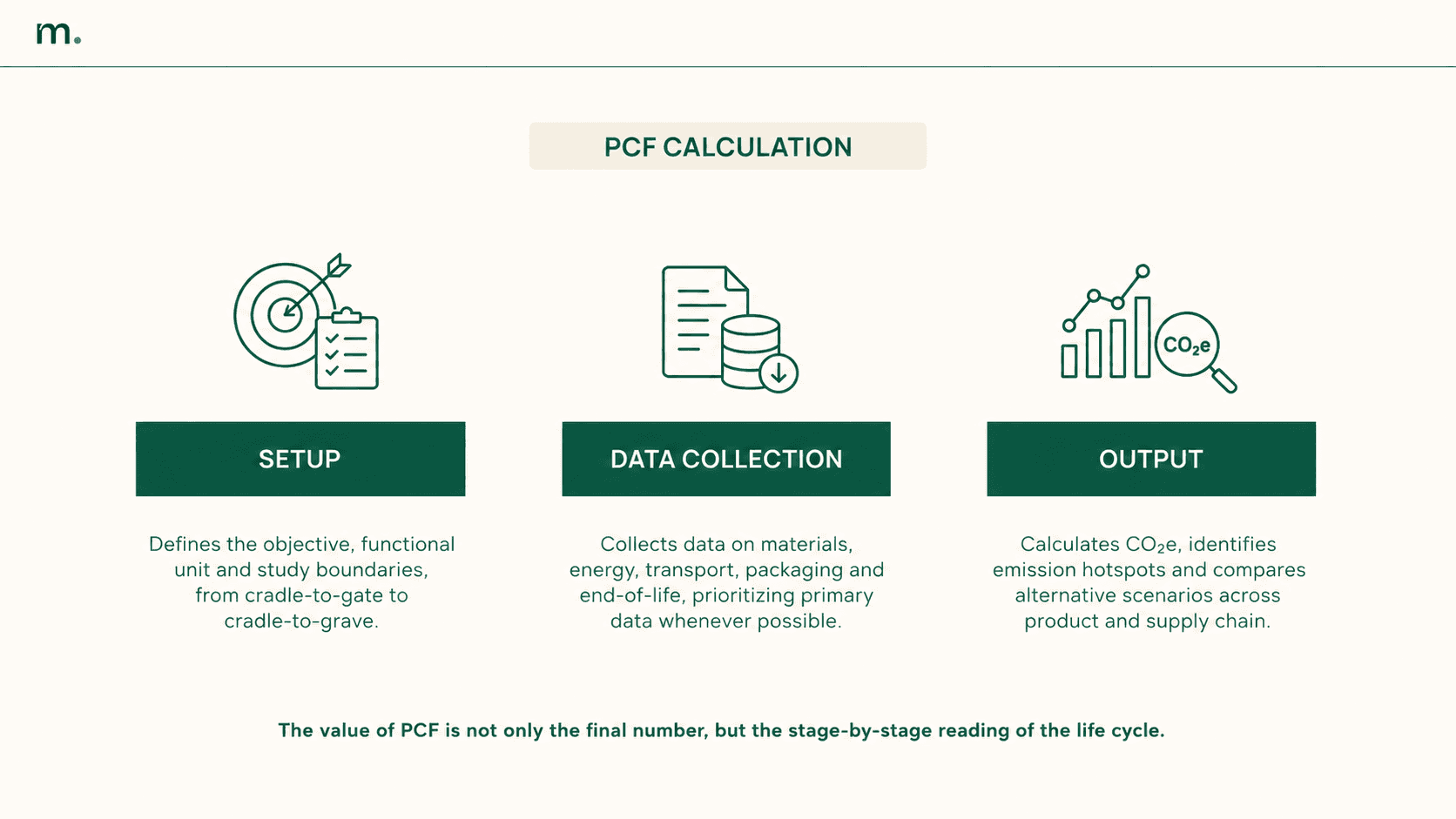
Infographic on Product Carbon Footprint calculation, showing setup, data collection and output phases to identify emission hotspots and reduction scenarios.

Once the objective, functional unit and study boundaries have been defined, the necessary data can be collected. The information usually includes material quantities, energy consumption, manufacturing processes, yields, waste, packaging, transport distances, transport modes and end-of-life scenarios. Primary data should be used whenever possible, especially for internal processes and the most relevant life cycle stages. When direct data is not available, recognized emission factors and databases can be used, provided that sources, assumptions and model limitations are documented.

The final PCF result should not be treated as a standalone number. Its real value comes from the breakdown by life cycle stage. If most emissions come from raw materials, the available levers may involve suppliers, technical specifications, recycled content or alternative materials. If the main hotspot is production, the work may focus on energy efficiency, electricity mix, waste reduction or process optimization. If the largest impact appears in the use phase, product design and operational performance become the key areas for improvement.

This makes corporate emission reduction more measurable. Each intervention can be compared against a baseline and translated into scenarios: how much the PCF changes if a supplier is replaced, a raw material is substituted, packaging is reduced or a transport mode is changed. In this way, Product Carbon Footprint becomes a tool for evaluating industrial decisions, rather than a reporting output alone.

ISO 14067, GHG Protocol and EPD: references for a robust PCF

ISO 14067 is the reference standard for quantifying and communicating the carbon footprint of products. It defines requirements and guidelines for building a consistent, transparent and verifiable study, in continuity with the ISO standards dedicated to LCA. For companies, this matters because it makes the data stronger in audits, customer requests, external verification and technical documentation.

Alongside ISO 14067, the GHG Protocol Product Standard provides a methodological reference for accounting and reporting emissions across the product life cycle. For companies already working on corporate carbon footprint, Scope 1, 2 and 3, Scope 3 emissions, sustainability reporting or decarbonization plans, consistent criteria reduce the risk of creating disconnected data sets.

Product Carbon Footprint can also provide a technical basis for more structured processes, such as LCA certification, EPD certification and Environmental Product Declarations. The International EPD System defines EPDs as standardized, verified documents that communicate environmental information about products and services from a life cycle perspective. In these cases, data quality becomes critical: boundaries, functional unit, sources, emission factors and assumptions must be clear and traceable. A weak PCF can generate figures that are difficult to defend; a well-documented PCF can support technical communication, supplier qualification and market requests.

Why PCF is useful for product, procurement and supply chain teams

Product Carbon Footprint becomes useful when it enters decision-making processes. For product teams, it helps evaluate the emission impact of materials, components, packaging, durability and use-phase performance. For procurement, it supports supplier assessment and comparison between alternatives with the same technical requirements. For operations and logistics, it measures the contribution of plants, energy consumption, transport and waste.
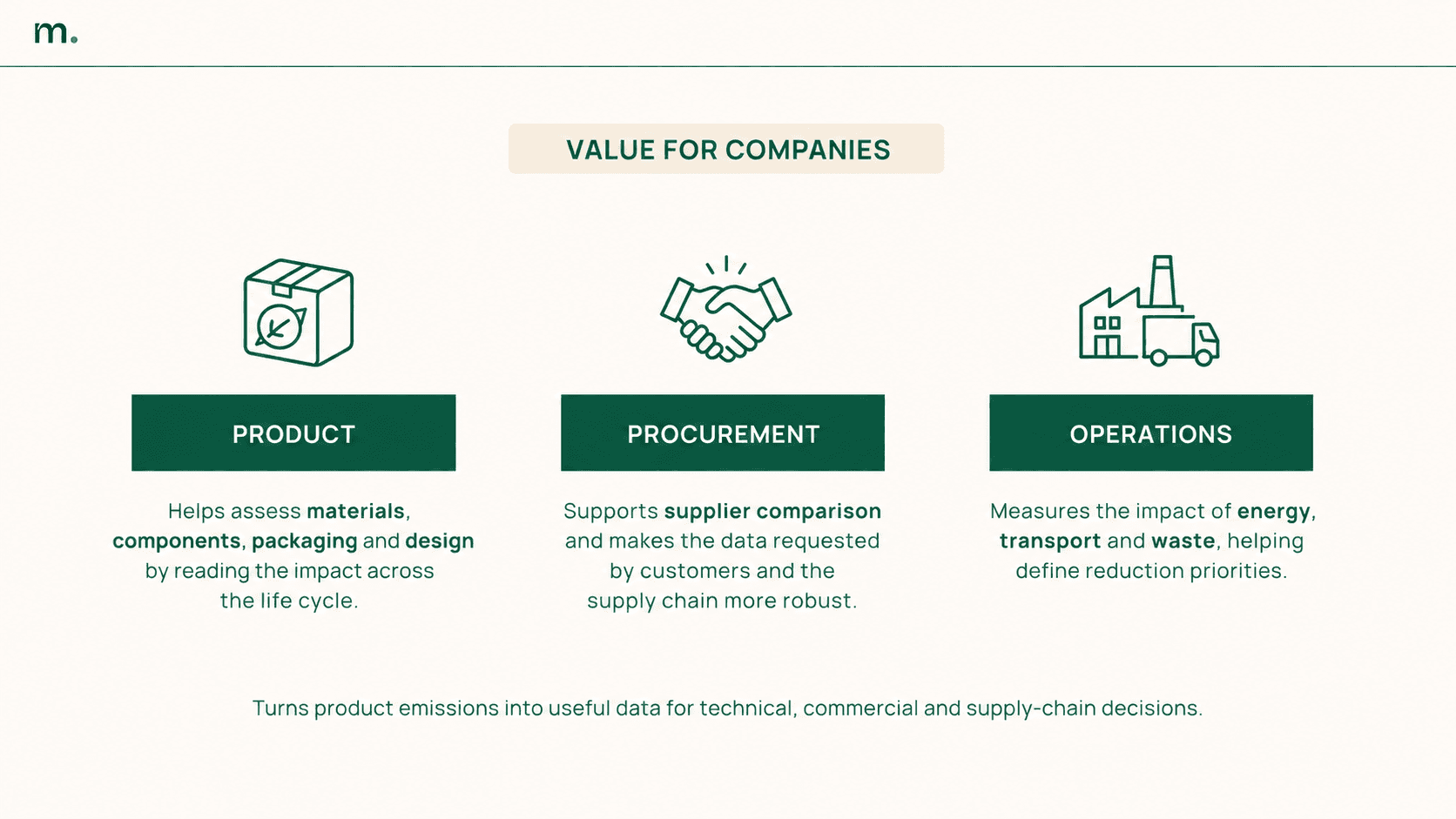
Infographic showing the value of Product Carbon Footprint for companies, product teams, procurement and operations, with a focus on materials, suppliers, energy, transport and waste.

This level of granularity is particularly relevant in B2B supply chains. Industrial customers, large groups and structured buyers increasingly request precise product-level emissions data, including to feed their own Scope 3 calculations. A verifiable PCF allows companies to respond more consistently to ESG questionnaires, supply chain requests, tenders, audits and qualification processes.

PCF can also support commercial positioning, but the data must be handled carefully. Environmental claims, product comparisons and reduction statements should be based on consistent boundaries, verifiable data and documented assumptions. The risk is broader than communication: weak information can create issues during qualification, document review or discussions with enterprise customers. For this reason, PCF should also be considered alongside the rules on the Anti-Greenwashing Directive, especially when product data is used in external communication.

Carbon footprint software and long-term data management

A single PCF study can be managed with manual models, but complexity increases quickly when products, plants, suppliers, versions and updates grow. Every change to a bill of materials, emission factor, supplier or production process can affect the result. Without a controlled data structure, it becomes difficult to understand which version of the calculation is valid and which assumptions were used.

A carbon footprint software or LCA software helps centralize data, emission factors, responsibilities, controls and versions. This makes the process more scalable and reduces duplication, manual errors and loss of traceability. The value increases when Product Carbon Footprint needs to connect with other ESG processes: sustainability reporting, CSRD, ESRS, decarbonization plans, audits, supplier assessment and customer requests.

Technology does not replace methodology, but it helps make PCF updateable and comparable over time. For companies aiming to integrate sustainability into product and supply chain decisions, the central requirement is to build a stable process: consistent data, clear responsibilities, documented criteria and results that can be used across business functions.

Product Carbon Footprint enables companies to measure product emissions through an approach grounded in LCA, ISO 14067 and GHG Protocol. Its value depends on the ability to connect the final CO2 equivalent result to operational decisions on materials, suppliers, production, logistics, design and technical communication.

When built with clear boundaries, reliable data and adequate tools, PCF becomes a practical metric for identifying emission hotspots, supporting customers and audits, preparing environmental documentation and setting reduction actions based on measurable evidence.

Whitepaper

A Conversation between EFRAG and Industry

Dolor netus eget suspendisse pellentesque. Diam elit lobortis elementum mi sed turpis quisque feugiat leo. Ipsum purus faucibus sed potenti phasellus duis vestibulum risus sagittis. Sit viverra convallis ultrices netus pulvinar.

Download Now

Product Carbon Footprint, or PCF, measures the greenhouse gas emissions generated by a product throughout its life cycle. The result is expressed in CO2 equivalent and quantifies the climate impact associated with raw materials, manufacturing processes, energy consumption, logistics, product use and end-of-life treatment.

For companies, PCF connects the environmental impact of products to technical and operational data. It shows which components, suppliers or process stages contribute most to emissions, making the result useful for decisions on product design, procurement, production efficiency, packaging, supply chain management and technical documentation requested by customers or partners.

Infographic explaining what Product Carbon Footprint is, what it measures and why it is useful for assessing product emissions across the life cycle.

Product Carbon Footprint should be distinguished from corporate carbon footprint. A corporate carbon footprint measures the overall emissions of an organization, including Scope 1, Scope 2 and Scope 3 emissions according to the GHG Protocol. PCF narrows the analysis to a specific product. While corporate carbon footprint provides a company-level view, Product Carbon Footprint helps assess where and how to intervene on a product line, a single SKU or a family of products.

Product Carbon Footprint and LCA: why the life cycle matters

Product Carbon Footprint is based on the logic of LCA, or Life Cycle Assessment. Life Cycle Assessment evaluates the environmental impacts of a product across the stages of its life cycle; PCF focuses specifically on the climate impact category, meaning GHG emissions expressed in CO2 equivalent.

This approach prevents partial assessments. A product may have an efficient manufacturing phase but rely on emission-intensive raw materials. Another product may generate limited emissions within the plant but have a relevant impact during transportation, use or end-of-life. Looking at the full product life cycle makes it possible to identify emission hotspots and focus improvement actions on the stages that carry the greatest weight.

The study boundary is one of the first methodological decisions. A Product Carbon Footprint can stop at the point where the product leaves the factory, following a cradle-to-gate approach, or include distribution, use and end-of-life, following a cradle-to-grave approach. This choice must be clearly stated, because it affects the result and determines whether the data can be used for comparisons, customer requests, technical documentation or processes such as EPDs and environmental product declarations.

How to calculate a Product Carbon Footprint

The carbon footprint calculation starts with the definition of the functional unit, meaning the reference used to measure emissions. This can be one item, one kilogram of product, one square meter, one package or a specific function delivered by the product. The functional unit affects how the result is interpreted and whether products, materials or alternative scenarios can be compared.

Infographic on Product Carbon Footprint calculation, showing setup, data collection and output phases to identify emission hotspots and reduction scenarios.

Once the objective, functional unit and study boundaries have been defined, the necessary data can be collected. The information usually includes material quantities, energy consumption, manufacturing processes, yields, waste, packaging, transport distances, transport modes and end-of-life scenarios. Primary data should be used whenever possible, especially for internal processes and the most relevant life cycle stages. When direct data is not available, recognized emission factors and databases can be used, provided that sources, assumptions and model limitations are documented.

The final PCF result should not be treated as a standalone number. Its real value comes from the breakdown by life cycle stage. If most emissions come from raw materials, the available levers may involve suppliers, technical specifications, recycled content or alternative materials. If the main hotspot is production, the work may focus on energy efficiency, electricity mix, waste reduction or process optimization. If the largest impact appears in the use phase, product design and operational performance become the key areas for improvement.

This makes corporate emission reduction more measurable. Each intervention can be compared against a baseline and translated into scenarios: how much the PCF changes if a supplier is replaced, a raw material is substituted, packaging is reduced or a transport mode is changed. In this way, Product Carbon Footprint becomes a tool for evaluating industrial decisions, rather than a reporting output alone.

ISO 14067, GHG Protocol and EPD: references for a robust PCF

ISO 14067 is the reference standard for quantifying and communicating the carbon footprint of products. It defines requirements and guidelines for building a consistent, transparent and verifiable study, in continuity with the ISO standards dedicated to LCA. For companies, this matters because it makes the data stronger in audits, customer requests, external verification and technical documentation.

Alongside ISO 14067, the GHG Protocol Product Standard provides a methodological reference for accounting and reporting emissions across the product life cycle. For companies already working on corporate carbon footprint, Scope 1, 2 and 3, Scope 3 emissions, sustainability reporting or decarbonization plans, consistent criteria reduce the risk of creating disconnected data sets.

Product Carbon Footprint can also provide a technical basis for more structured processes, such as LCA certification, EPD certification and Environmental Product Declarations. The International EPD System defines EPDs as standardized, verified documents that communicate environmental information about products and services from a life cycle perspective. In these cases, data quality becomes critical: boundaries, functional unit, sources, emission factors and assumptions must be clear and traceable. A weak PCF can generate figures that are difficult to defend; a well-documented PCF can support technical communication, supplier qualification and market requests.

Why PCF is useful for product, procurement and supply chain teams

Product Carbon Footprint becomes useful when it enters decision-making processes. For product teams, it helps evaluate the emission impact of materials, components, packaging, durability and use-phase performance. For procurement, it supports supplier assessment and comparison between alternatives with the same technical requirements. For operations and logistics, it measures the contribution of plants, energy consumption, transport and waste.

Infographic showing the value of Product Carbon Footprint for companies, product teams, procurement and operations, with a focus on materials, suppliers, energy, transport and waste.

This level of granularity is particularly relevant in B2B supply chains. Industrial customers, large groups and structured buyers increasingly request precise product-level emissions data, including to feed their own Scope 3 calculations. A verifiable PCF allows companies to respond more consistently to ESG questionnaires, supply chain requests, tenders, audits and qualification processes.

PCF can also support commercial positioning, but the data must be handled carefully. Environmental claims, product comparisons and reduction statements should be based on consistent boundaries, verifiable data and documented assumptions. The risk is broader than communication: weak information can create issues during qualification, document review or discussions with enterprise customers. For this reason, PCF should also be considered alongside the rules on the Anti-Greenwashing Directive, especially when product data is used in external communication.

Carbon footprint software and long-term data management

A single PCF study can be managed with manual models, but complexity increases quickly when products, plants, suppliers, versions and updates grow. Every change to a bill of materials, emission factor, supplier or production process can affect the result. Without a controlled data structure, it becomes difficult to understand which version of the calculation is valid and which assumptions were used.

A carbon footprint software or LCA software helps centralize data, emission factors, responsibilities, controls and versions. This makes the process more scalable and reduces duplication, manual errors and loss of traceability. The value increases when Product Carbon Footprint needs to connect with other ESG processes: sustainability reporting, CSRD, ESRS, decarbonization plans, audits, supplier assessment and customer requests.

Technology does not replace methodology, but it helps make PCF updateable and comparable over time. For companies aiming to integrate sustainability into product and supply chain decisions, the central requirement is to build a stable process: consistent data, clear responsibilities, documented criteria and results that can be used across business functions.

Product Carbon Footprint enables companies to measure product emissions through an approach grounded in LCA, ISO 14067 and GHG Protocol. Its value depends on the ability to connect the final CO2 equivalent result to operational decisions on materials, suppliers, production, logistics, design and technical communication.

When built with clear boundaries, reliable data and adequate tools, PCF becomes a practical metric for identifying emission hotspots, supporting customers and audits, preparing environmental documentation and setting reduction actions based on measurable evidence.

CONTRIBUTOR

Luis Antazema Headshot

Luis Antazema

Sustainability Analyst

Formed as a Chemical Engineer and with a focus on the energy sector, Luis applies a rigorous technical and analytical approach to decarbonisation and emissions measurement. Born in Bolivia and professionally developed across the United States and Europe, he contributes to the design and implementation of Carbon Footprint and Life Cycle Assessment (LCA) methodologies, helping organisations accurately quantify emissions while identifying opportunities to optimise processes, improve resource efficiency, and reduce operational costs. Luis approaches sustainability not only as a compliance exercise, but as a driver of measurable business value—linking environmental performance with economic returns, risk reduction, and long-term competitiveness.He works to make sustainability practical, data-driven, and financially meaningful for organisations and their stakeholders. Topics covered: Decarbonisation, Corporate Carbon Footprint, Life Cycle Assessment (LCA), Scope 1–2–3 accounting, GHG Protocol, Product Carbon Footprint (PCF).

No headings found on page

Stay up to date with Metrikflow Insights!

We deliver expert insights, product updates, industry trends, and actionable strategies straight to your inbox. Stay ahead in ESG, GHG, and LCA — one edition at a time.

By submitting this form, you consent to receive the requested resource. For more information on how we process and protect your data, view our Privacy Policy.

The go-to software solution for Sustainability Managers.

Customer-Oriented

Data Accurate

Built on Smart Tech

ESG radar: The Metrikflow Newsletter

Everything you need to know about sustainability,
all-in-one email. Weekly insights. Zero spam.

By submitting this form, you consent to receive the requested resource. For more information on how we process and protect your data, view our Privacy Policy.

ESG radar: The Metrikflow Newsletter

Everything you need to know about sustainability, all-in-one email. Weekly insights. Zero spam.

By submitting this form, you consent to receive the requested resource. For more information on how we process and protect your data, view our Privacy Policy.

The go-to software solution for Sustainability Managers.

Customer-Oriented

Data Accurate

Built on Smart Tech

The go-to software solution for Sustainability Managers.

Customer-Oriented

Data Accurate

Built on Smart Tech

ESG radar: The Metrikflow Newsletter

Everything you need to know about sustainability,
all-in-one email. Weekly insights. Zero spam.

By submitting this form, you consent to receive the requested resource. For more information on how we process and protect your data, view our Privacy Policy.