
Certificaciones, Calificaciones y Evaluación ESG

Certificaciones, Calificaciones y Evaluación ESG

ESG Ratings: what they are, how they work, and why they matter even for private companies

ESG Ratings: what they are, how they work, and why they matter even for private companies

How ESG ratings work, how ESG scores are calculated, how companies can improve

Retrato de Alessandro Nora
Alessandro Nora
Business professional selecting a five-star rating on a virtual review interface, representing ESG ratings, sustainability assessment, customer evaluation, and corporate performance measurement

What are ESG ratings

ESG ratings are assessments that measure a company’s performance against environmental, social, and governance criteria. Their goal is to turn complex information into an ESG score or synthetic judgement that can be used to compare companies, assess risks, and support investment, credit, or procurement decisions.

The “E” dimension covers environmental topics such as emissions, energy, resource use, waste management, and climate strategy. The “S” dimension evaluates social topics such as working conditions, health and safety, human rights, diversity, and relationships with stakeholders and communities. The “G” dimension focuses on governance, ethics, internal controls, board structure, and risk management.

An ESG rating is therefore not simply a reputational judgement. It is an assessment that aims to summarize how exposed a company is to ESG risks and how prepared it is to manage them.

This is an important point: an ESG rating does not only measure how “sustainable” a company is in general terms, but also how ESG factors may affect its resilience, competitiveness, and reliability.

What is an ESG rating used for

An ESG rating helps make a company’s sustainability position easier to interpret. Instead of reviewing dozens of separate documents, policies, and KPIs, external stakeholders can use an ESG score as a synthetic indicator of the company’s maturity level.

For investors and financial institutions, ESG ratings can become a risk assessment tool. A company with weak ESG data, poor governance structures, or limited environmental transparency may be perceived as more exposed to regulatory, reputational, or operational risks.

For clients and large companies, ESG ratings can be used in supplier selection and evaluation processes. In many value chains, offering a competitive price is no longer enough: companies are increasingly expected to demonstrate reliability from an environmental and social perspective as well.

For the company being assessed, an ESG rating can have very practical value. It can help identify data gaps, weaker areas, and processes that need to be strengthened to improve its position with the market, banks, and business partners.

Who issues ESG ratings

ESG ratings can be issued by different types of organizations. There are large international ESG rating providers, such as MSCI, Sustainalytics, or S&P Global, which are mainly used in the financial sector and for listed companies.

There are also widely used platforms focused on environmental disclosure or supply chain assessment. CDP, for example, is one of the best-known references for environmental and climate disclosure. It collects data on topics such as climate, water, and forests, and assigns scores that help stakeholders and investors assess an organization’s level of environmental transparency and management.

EcoVadis is instead one of the most widely used platforms for sustainability assessments across supply chains. It is often used by large companies to evaluate suppliers and partners on environmental, social, ethical, and sustainable procurement topics.

In both cases, it is important to speak of ratings, scores, or assessments — not ESG certifications in the strict sense. CDP publishes scores and an A List, while EcoVadis defines its system as a sustainability rating and awards medals and badges based on eligibility criteria and relative positioning.

Alongside these providers, ESG assessment models developed by banks, large clients, marketplaces, procurement teams, or sector-specific platforms are also becoming more common. In these cases, we can speak more broadly of alternative ESG ratings or internal ESG evaluation models, built to address specific needs.

This means there is no single ESG rating that applies universally to every company. A business may receive different assessments depending on the provider, the methodology used, its industry, and the information available.

This is where one of the main challenges arises: the same ESG data point may be interpreted differently by different actors. For this reason, rather than simply “chasing the score,” companies should focus on building a solid, traceable, and consistent ESG data foundation.

How an ESG rating works

An ESG rating works through the collection, analysis, and weighting of company data across the three ESG dimensions.

Typically, the process begins by identifying the information that is most relevant for the company and its sector. An industrial company, for example, will usually be assessed more closely on emissions, energy consumption, workplace safety, and supply chain management. A service-based company may instead be evaluated more deeply on governance, workforce management, privacy, or reputational risk.

Once the data is collected, the provider assigns scores to different areas. These scores are then combined according to a specific methodology, which can vary significantly from one organization to another.

Some ESG ratings are more focused on financial risk: they assess how ESG factors may affect company value. Others are more focused on operational sustainability: they evaluate business practices, policies, and generated impacts.

For this reason, reading an ESG rating without understanding its methodology can be misleading. Two companies with the same score may have very different ESG profiles, and two providers may assign different ratings to the same organization.

How an ESG rating is calculated

There is no single universal formula for calculating an ESG rating. Each agency or platform uses its own methodology, but the process is usually based on three elements: data, indicators, and weightings.

Data may come from public sources, questionnaires, sustainability reports, corporate documents, external databases, audits, or information provided directly by the company. Indicators turn this data into comparable metrics, while weightings define the relative importance of each topic.

In practice, an ESG rating may consider variables such as:

  • greenhouse gas emissions and energy consumption

  • climate policies and reduction targets

  • health, safety, and working conditions

  • diversity and inclusion

  • supply chain management

  • governance quality

  • transparency, auditability, and data continuity

The key point is that having a lot of information is not enough. What matters is having reliable, up-to-date, and consistent data over time.

A company may claim to have ESG policies, but if it does not have measurable KPIs, documentary evidence, and monitoring processes, its rating may still be weak. This is one of the most common mistakes: confusing ESG communication with ESG management.
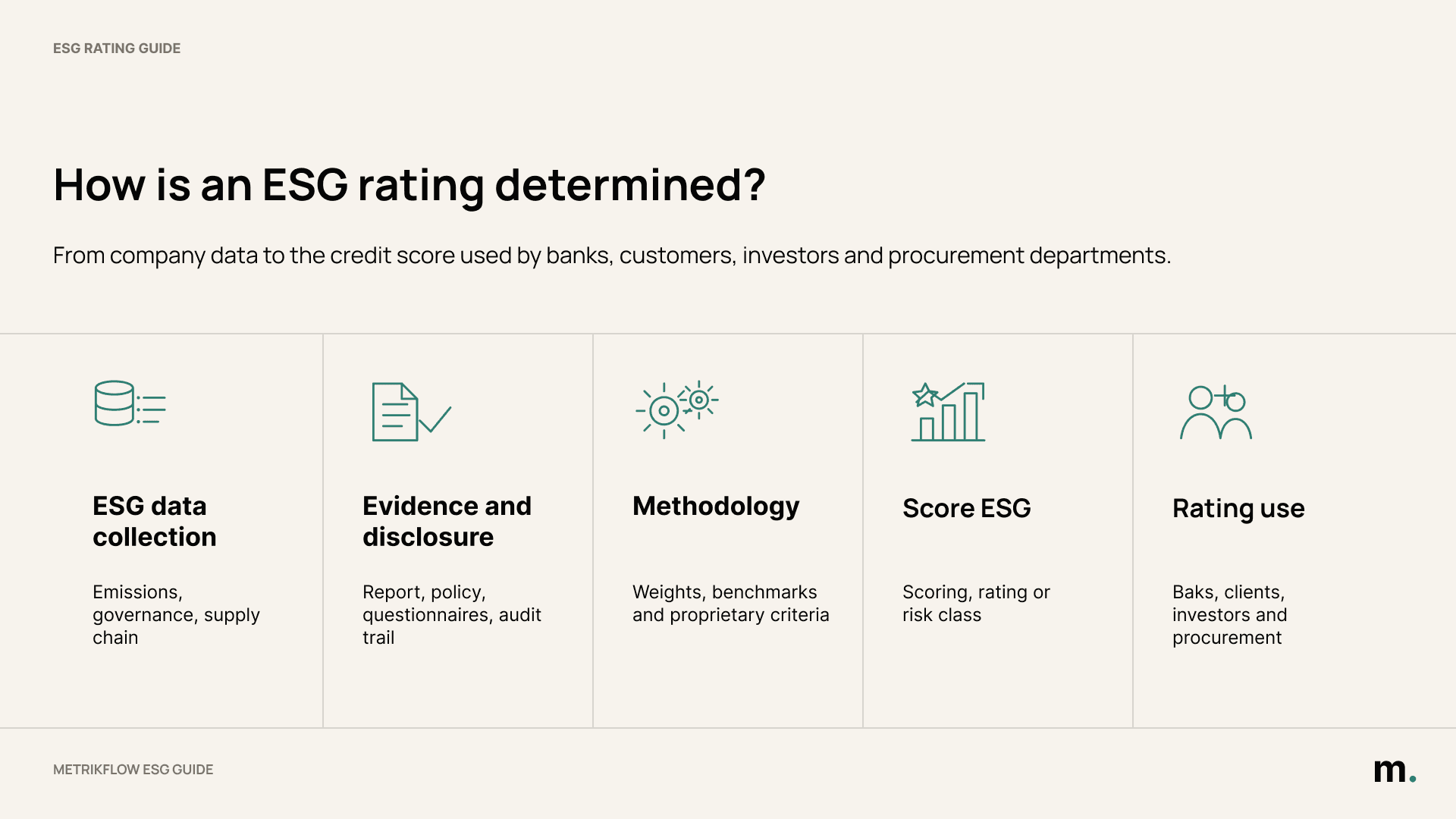
How is an ESG rating determined?

What really influences an ESG score

An ESG score depends on a combination of actual performance, data quality, and the company’s ability to prove what it claims.

Companies with stronger ratings are not necessarily those that communicate the most, but those that are able to turn sustainability into measurable processes. This means having clear responsibilities, continuously collected data, monitored KPIs, and verifiable documentation.

Another important factor is materiality. Not all ESG topics carry the same weight for every company. For an industrial manufacturer, emissions and energy may be highly material. In these cases, a structured measurement of the carbon footprint, Scope 1, 2, and 3 emissions, or Scope 3 emissions can significantly improve the quality of the available information. For a digital company, cybersecurity, governance, data protection, or human capital may be more relevant.

Benchmarking also plays a major role. An ESG rating does not assess a company in isolation; it often compares it against peers and sector benchmarks. This means that improving the score requires not only internal progress, but also a clear understanding of how the company is positioned relative to the market.

How to improve an ESG rating

Improving an ESG rating does not simply mean filling out a questionnaire more effectively. It means building a more mature ESG management system.

The first step is centralizing data. Many companies already have useful information, but it is spread across finance, HR, operations, procurement, and sustainability teams. Without a shared system, this data remains fragmented and difficult to use.

The second step is defining clear KPIs. An ESG rating improves when a company can demonstrate measurable progress: reduced emissions, improved safety performance, supplier monitoring, updated policies, and formalized targets. From an environmental perspective, this may also include a decarbonization pathway, supply chain data collection, or more specific analyses such as LCA for products.

A third element is traceability. Every ESG data point should be connected to a source, an owner, and a process. This is especially important when the rating is based on documentary evidence or when the company must respond to requests from clients, banks, or investors.

Finally, improving an ESG rating requires continuity. Collecting data once a year is not enough: companies need a recurring process, integrated into business management. Only then does ESG assessment stop being a one-off exercise and become a real improvement tool.

ESG rating, sustainability report, and ESG certifications: what is the difference

ESG ratings, sustainability reports, and ESG certifications are often confused, but they serve different purposes. Understanding the difference matters because a company can use all three tools, but they are not equivalent.

An ESG rating is a synthetic evaluation. It represents a company’s ESG profile through a score, rating, risk class, or performance level. It is therefore an internal or external assessment tool, useful for comparing companies, supporting investment decisions, evaluating suppliers, or analyzing risk. Platforms such as CDP or EcoVadis follow this logic: they collect data, apply a methodology, and return a score or assessment.

A sustainability report, on the other hand, is a reporting document. It describes the company’s ESG performance, collected data, objectives, actions, and results in a structured way. It can be prepared according to standards such as GRI, VSME, or ESRS, and often represents one of the information sources used to feed an ESG assessment. In other words, a sustainability report explains the company’s journey and data; an ESG rating summarizes an assessment of that data.

ESG certifications are different again. A certification confirms compliance with a specific standard through a defined verification process, usually carried out by an accredited third-party body. There is no single universal ESG certification covering all environmental, social, and governance aspects. Instead, there are specific certifications covering individual areas, such as environmental management systems, carbon footprint, quality, safety, gender equality, or product sustainability.

It is therefore important to clarify that CDP and EcoVadis are not ESG certifications, but assessment systems. CDP assigns scores linked to disclosure and management of environmental topics such as climate, water, and forests. EcoVadis assigns a scorecard and may award medals such as Bronze, Silver, Gold, and Platinum. These medals do not certify compliance with a universal standard: they represent recognition based on the EcoVadis methodology and on the company’s position relative to other assessed organizations.

The practical difference is this: the sustainability report explains, certification verifies a specific aspect, and the rating summarizes an overall assessment. A company may have a strong sustainability report but a weak ESG rating if its data is not comparable, if documentary evidence is missing, or if material topics are not properly addressed. Similarly, an environmental certification can strengthen the credibility of specific information, but it does not automatically guarantee a high ESG rating.
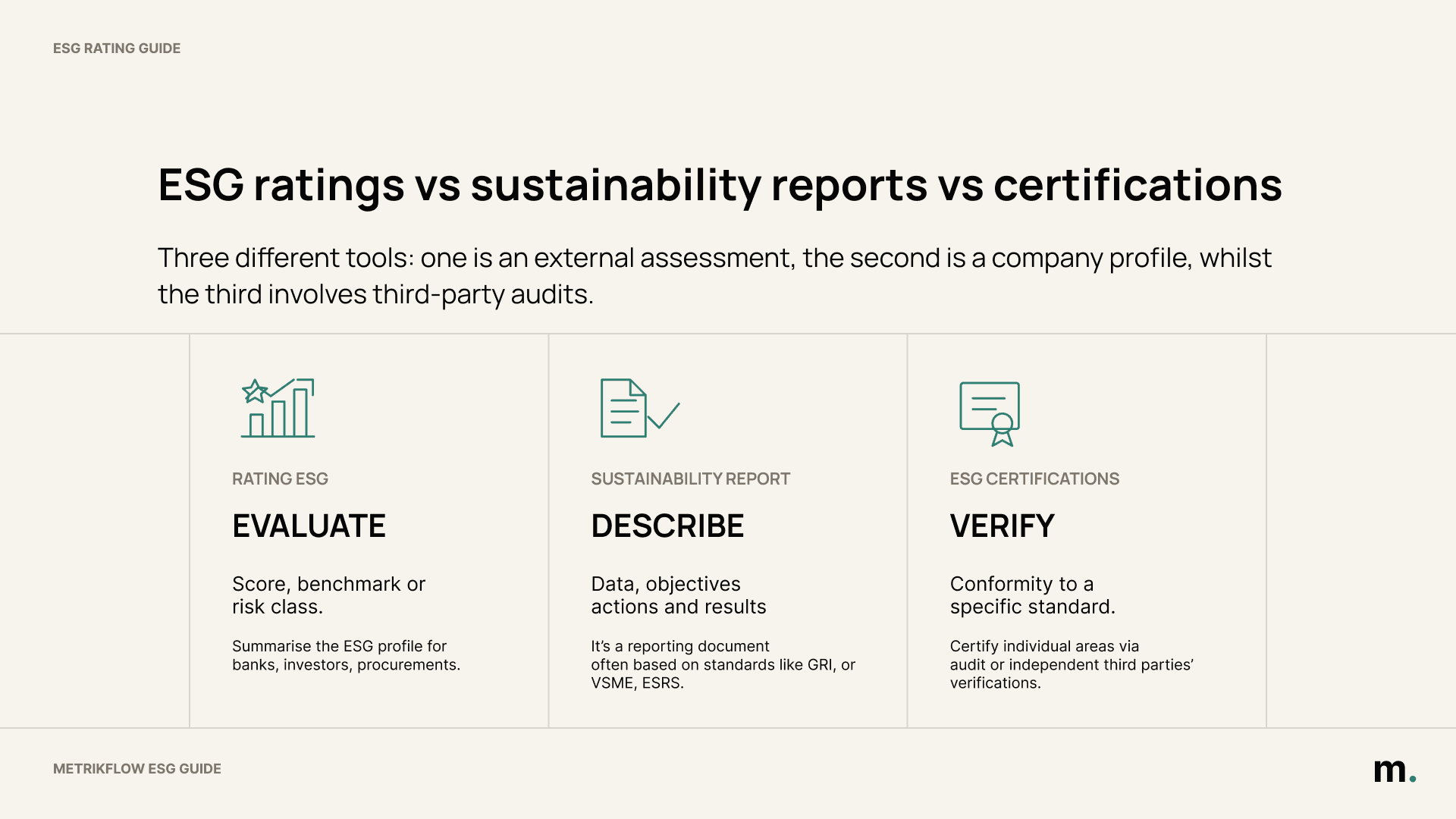
ESG ratings vs sustainability reports vs certifications

Why ESG ratings matter even if your company is not listed

One of the most common misconceptions is that ESG ratings only matter for listed companies. In reality, more and more private companies are being assessed indirectly through banks, clients, business partners, or procurement platforms.

This happens because large companies and financial institutions need to better understand the risks embedded in their value chains. As a result, they request increasingly structured ESG data from suppliers.

For an SME, this can translate into questionnaires, document requests, internal scores, or sustainability assessments. Even when the term “ESG rating” is not used formally, the principle is the same: the company is evaluated based on the quality of its ESG data and processes.

In addition, regulations and frameworks such as the CSRD, the Omnibus Package, and mechanisms such as CBAM are making the ability to collect, organize, and demonstrate reliable ESG data increasingly central across the value chain.

For this reason, building a strong ESG data foundation is not only useful for obtaining a better score, but also for remaining competitive in business relationships.

ESG software: simplifying data, ratings, and ESG assessment

The main challenge in managing an ESG rating is not only understanding which data is required, but collecting it consistently, updating it over time, and making it usable for different stakeholders.

ESG software turns this process from a manual and fragmented activity into a structured system. By centralizing data, defining KPIs, and keeping track of sources, a company can respond more easily to questionnaires, rating requests, sustainability reports, and assessments from clients or banks.

In this context, Metrikflow helps companies organize ESG data, monitor performance, and prepare consistent and verifiable information for different stakeholders. The result is more efficient ESG management: less reactive, more structured, and more useful for supporting business decisions, ratings, and reporting.

Conclusion

ESG ratings are no longer a tool reserved for listed multinationals. More and more companies are being assessed based on the quality of their ESG data, often before they have even started a formal reporting journey.

Understanding how ESG ratings work, who issues them, and which factors influence the score is therefore essential to prepare for market expectations.

The point is not to chase a number, but to build a credible ESG system: solid data, clear processes, measurable KPIs, and verifiable information.

This is where a stronger ESG rating begins. And, more importantly, where sustainability management becomes truly useful for the business.

Libro blanco

Una conversación entre EFRAG y la industria

El dolor netus eget suspendisse pellentesque. Diam elit lobortis elementum mi sed turpis quisque feugiat leo. Ipsum purus faucibus sed potenti phasellus duis vestibulum risus sagittis. Sit viverra convallis ultrices netus pulvinar.

Descargar ahora

What are ESG ratings

ESG ratings are assessments that measure a company’s performance against environmental, social, and governance criteria. Their goal is to turn complex information into an ESG score or synthetic judgement that can be used to compare companies, assess risks, and support investment, credit, or procurement decisions.

The “E” dimension covers environmental topics such as emissions, energy, resource use, waste management, and climate strategy. The “S” dimension evaluates social topics such as working conditions, health and safety, human rights, diversity, and relationships with stakeholders and communities. The “G” dimension focuses on governance, ethics, internal controls, board structure, and risk management.

An ESG rating is therefore not simply a reputational judgement. It is an assessment that aims to summarize how exposed a company is to ESG risks and how prepared it is to manage them.

This is an important point: an ESG rating does not only measure how “sustainable” a company is in general terms, but also how ESG factors may affect its resilience, competitiveness, and reliability.

What is an ESG rating used for

An ESG rating helps make a company’s sustainability position easier to interpret. Instead of reviewing dozens of separate documents, policies, and KPIs, external stakeholders can use an ESG score as a synthetic indicator of the company’s maturity level.

For investors and financial institutions, ESG ratings can become a risk assessment tool. A company with weak ESG data, poor governance structures, or limited environmental transparency may be perceived as more exposed to regulatory, reputational, or operational risks.

For clients and large companies, ESG ratings can be used in supplier selection and evaluation processes. In many value chains, offering a competitive price is no longer enough: companies are increasingly expected to demonstrate reliability from an environmental and social perspective as well.

For the company being assessed, an ESG rating can have very practical value. It can help identify data gaps, weaker areas, and processes that need to be strengthened to improve its position with the market, banks, and business partners.

Who issues ESG ratings

ESG ratings can be issued by different types of organizations. There are large international ESG rating providers, such as MSCI, Sustainalytics, or S&P Global, which are mainly used in the financial sector and for listed companies.

There are also widely used platforms focused on environmental disclosure or supply chain assessment. CDP, for example, is one of the best-known references for environmental and climate disclosure. It collects data on topics such as climate, water, and forests, and assigns scores that help stakeholders and investors assess an organization’s level of environmental transparency and management.

EcoVadis is instead one of the most widely used platforms for sustainability assessments across supply chains. It is often used by large companies to evaluate suppliers and partners on environmental, social, ethical, and sustainable procurement topics.

In both cases, it is important to speak of ratings, scores, or assessments — not ESG certifications in the strict sense. CDP publishes scores and an A List, while EcoVadis defines its system as a sustainability rating and awards medals and badges based on eligibility criteria and relative positioning.

Alongside these providers, ESG assessment models developed by banks, large clients, marketplaces, procurement teams, or sector-specific platforms are also becoming more common. In these cases, we can speak more broadly of alternative ESG ratings or internal ESG evaluation models, built to address specific needs.

This means there is no single ESG rating that applies universally to every company. A business may receive different assessments depending on the provider, the methodology used, its industry, and the information available.

This is where one of the main challenges arises: the same ESG data point may be interpreted differently by different actors. For this reason, rather than simply “chasing the score,” companies should focus on building a solid, traceable, and consistent ESG data foundation.

How an ESG rating works

An ESG rating works through the collection, analysis, and weighting of company data across the three ESG dimensions.

Typically, the process begins by identifying the information that is most relevant for the company and its sector. An industrial company, for example, will usually be assessed more closely on emissions, energy consumption, workplace safety, and supply chain management. A service-based company may instead be evaluated more deeply on governance, workforce management, privacy, or reputational risk.

Once the data is collected, the provider assigns scores to different areas. These scores are then combined according to a specific methodology, which can vary significantly from one organization to another.

Some ESG ratings are more focused on financial risk: they assess how ESG factors may affect company value. Others are more focused on operational sustainability: they evaluate business practices, policies, and generated impacts.

For this reason, reading an ESG rating without understanding its methodology can be misleading. Two companies with the same score may have very different ESG profiles, and two providers may assign different ratings to the same organization.

How an ESG rating is calculated

There is no single universal formula for calculating an ESG rating. Each agency or platform uses its own methodology, but the process is usually based on three elements: data, indicators, and weightings.

Data may come from public sources, questionnaires, sustainability reports, corporate documents, external databases, audits, or information provided directly by the company. Indicators turn this data into comparable metrics, while weightings define the relative importance of each topic.

In practice, an ESG rating may consider variables such as:

  • greenhouse gas emissions and energy consumption

  • climate policies and reduction targets

  • health, safety, and working conditions

  • diversity and inclusion

  • supply chain management

  • governance quality

  • transparency, auditability, and data continuity

The key point is that having a lot of information is not enough. What matters is having reliable, up-to-date, and consistent data over time.

A company may claim to have ESG policies, but if it does not have measurable KPIs, documentary evidence, and monitoring processes, its rating may still be weak. This is one of the most common mistakes: confusing ESG communication with ESG management.

How is an ESG rating determined?

What really influences an ESG score

An ESG score depends on a combination of actual performance, data quality, and the company’s ability to prove what it claims.

Companies with stronger ratings are not necessarily those that communicate the most, but those that are able to turn sustainability into measurable processes. This means having clear responsibilities, continuously collected data, monitored KPIs, and verifiable documentation.

Another important factor is materiality. Not all ESG topics carry the same weight for every company. For an industrial manufacturer, emissions and energy may be highly material. In these cases, a structured measurement of the carbon footprint, Scope 1, 2, and 3 emissions, or Scope 3 emissions can significantly improve the quality of the available information. For a digital company, cybersecurity, governance, data protection, or human capital may be more relevant.

Benchmarking also plays a major role. An ESG rating does not assess a company in isolation; it often compares it against peers and sector benchmarks. This means that improving the score requires not only internal progress, but also a clear understanding of how the company is positioned relative to the market.

How to improve an ESG rating

Improving an ESG rating does not simply mean filling out a questionnaire more effectively. It means building a more mature ESG management system.

The first step is centralizing data. Many companies already have useful information, but it is spread across finance, HR, operations, procurement, and sustainability teams. Without a shared system, this data remains fragmented and difficult to use.

The second step is defining clear KPIs. An ESG rating improves when a company can demonstrate measurable progress: reduced emissions, improved safety performance, supplier monitoring, updated policies, and formalized targets. From an environmental perspective, this may also include a decarbonization pathway, supply chain data collection, or more specific analyses such as LCA for products.

A third element is traceability. Every ESG data point should be connected to a source, an owner, and a process. This is especially important when the rating is based on documentary evidence or when the company must respond to requests from clients, banks, or investors.

Finally, improving an ESG rating requires continuity. Collecting data once a year is not enough: companies need a recurring process, integrated into business management. Only then does ESG assessment stop being a one-off exercise and become a real improvement tool.

ESG rating, sustainability report, and ESG certifications: what is the difference

ESG ratings, sustainability reports, and ESG certifications are often confused, but they serve different purposes. Understanding the difference matters because a company can use all three tools, but they are not equivalent.

An ESG rating is a synthetic evaluation. It represents a company’s ESG profile through a score, rating, risk class, or performance level. It is therefore an internal or external assessment tool, useful for comparing companies, supporting investment decisions, evaluating suppliers, or analyzing risk. Platforms such as CDP or EcoVadis follow this logic: they collect data, apply a methodology, and return a score or assessment.

A sustainability report, on the other hand, is a reporting document. It describes the company’s ESG performance, collected data, objectives, actions, and results in a structured way. It can be prepared according to standards such as GRI, VSME, or ESRS, and often represents one of the information sources used to feed an ESG assessment. In other words, a sustainability report explains the company’s journey and data; an ESG rating summarizes an assessment of that data.

ESG certifications are different again. A certification confirms compliance with a specific standard through a defined verification process, usually carried out by an accredited third-party body. There is no single universal ESG certification covering all environmental, social, and governance aspects. Instead, there are specific certifications covering individual areas, such as environmental management systems, carbon footprint, quality, safety, gender equality, or product sustainability.

It is therefore important to clarify that CDP and EcoVadis are not ESG certifications, but assessment systems. CDP assigns scores linked to disclosure and management of environmental topics such as climate, water, and forests. EcoVadis assigns a scorecard and may award medals such as Bronze, Silver, Gold, and Platinum. These medals do not certify compliance with a universal standard: they represent recognition based on the EcoVadis methodology and on the company’s position relative to other assessed organizations.

The practical difference is this: the sustainability report explains, certification verifies a specific aspect, and the rating summarizes an overall assessment. A company may have a strong sustainability report but a weak ESG rating if its data is not comparable, if documentary evidence is missing, or if material topics are not properly addressed. Similarly, an environmental certification can strengthen the credibility of specific information, but it does not automatically guarantee a high ESG rating.

ESG ratings vs sustainability reports vs certifications

Why ESG ratings matter even if your company is not listed

One of the most common misconceptions is that ESG ratings only matter for listed companies. In reality, more and more private companies are being assessed indirectly through banks, clients, business partners, or procurement platforms.

This happens because large companies and financial institutions need to better understand the risks embedded in their value chains. As a result, they request increasingly structured ESG data from suppliers.

For an SME, this can translate into questionnaires, document requests, internal scores, or sustainability assessments. Even when the term “ESG rating” is not used formally, the principle is the same: the company is evaluated based on the quality of its ESG data and processes.

In addition, regulations and frameworks such as the CSRD, the Omnibus Package, and mechanisms such as CBAM are making the ability to collect, organize, and demonstrate reliable ESG data increasingly central across the value chain.

For this reason, building a strong ESG data foundation is not only useful for obtaining a better score, but also for remaining competitive in business relationships.

ESG software: simplifying data, ratings, and ESG assessment

The main challenge in managing an ESG rating is not only understanding which data is required, but collecting it consistently, updating it over time, and making it usable for different stakeholders.

ESG software turns this process from a manual and fragmented activity into a structured system. By centralizing data, defining KPIs, and keeping track of sources, a company can respond more easily to questionnaires, rating requests, sustainability reports, and assessments from clients or banks.

In this context, Metrikflow helps companies organize ESG data, monitor performance, and prepare consistent and verifiable information for different stakeholders. The result is more efficient ESG management: less reactive, more structured, and more useful for supporting business decisions, ratings, and reporting.

Conclusion

ESG ratings are no longer a tool reserved for listed multinationals. More and more companies are being assessed based on the quality of their ESG data, often before they have even started a formal reporting journey.

Understanding how ESG ratings work, who issues them, and which factors influence the score is therefore essential to prepare for market expectations.

The point is not to chase a number, but to build a credible ESG system: solid data, clear processes, measurable KPIs, and verifiable information.

This is where a stronger ESG rating begins. And, more importantly, where sustainability management becomes truly useful for the business.

CONTRIBUTOR

Retrato de Alessandro Nora

Alessandro Nora

CEO y cofundador

Alessandro's goal is to make a real impact on sustainability. After founding a sustainable fashion marketplace, he decided to focus on ESG digitalisation with the aim of making sustainability more concrete, measurable and accessible for companies. A careful and methodical founder, with experience in Genoa, Berlin and Lisbon, Alessandro combines international vision and operational rigour in the development of digital solutions that simplify ESG regulations and compliance, supporting companies in adapting to ESG regulations, certifications and ratings through structured and audit-ready tools. Topics covered: CSRD, CSDDD, EUDR, CBAM ESG ratings, ESG certifications, Ecovadis, sustainability governance, regulatory compliance.

No headings found on page

¡Mantente al tanto de Metrikflow Insights!

Entregamos conocimientos expertos, actualizaciones de productos, tendencias de la industria y estrategias prácticas directamente a tu bandeja de entrada. Mantente por delante en ESG, GHG y LCA — una edición a la vez.


La solución de software preferida para Gerentes de Sostenibilidad.

Orientado al Cliente

Datos precisos

Construido en Tecnología Inteligente

Radar ESG: El boletín de Metrikflow

Todo lo que necesitas saber sobre sostenibilidad,
todo en un solo correo electrónico. Perspectivas semanales. Cero spam.

© 2025 Metrikflow

Radar ESG: El boletín de Metrikflow

Todo lo que necesitas saber sobre sostenibilidad, todo en un solo correo electrónico. Perspectivas semanales. Cero spam.

La solución de software preferida para Gerentes de Sostenibilidad.

Orientado al Cliente

Datos precisos

Construido en Tecnología Inteligente

La solución de software preferida para Gerentes de Sostenibilidad.

Orientado al Cliente

Datos precisos

Construido en Tecnología Inteligente

Radar ESG: El boletín de Metrikflow

Todo lo que necesitas saber sobre sostenibilidad,
todo en un solo correo electrónico. Perspectivas semanales. Cero spam.

© 2025 Metrikflow