



What SBTi is and what changes with the Corporate Net-Zero Standard V2.0
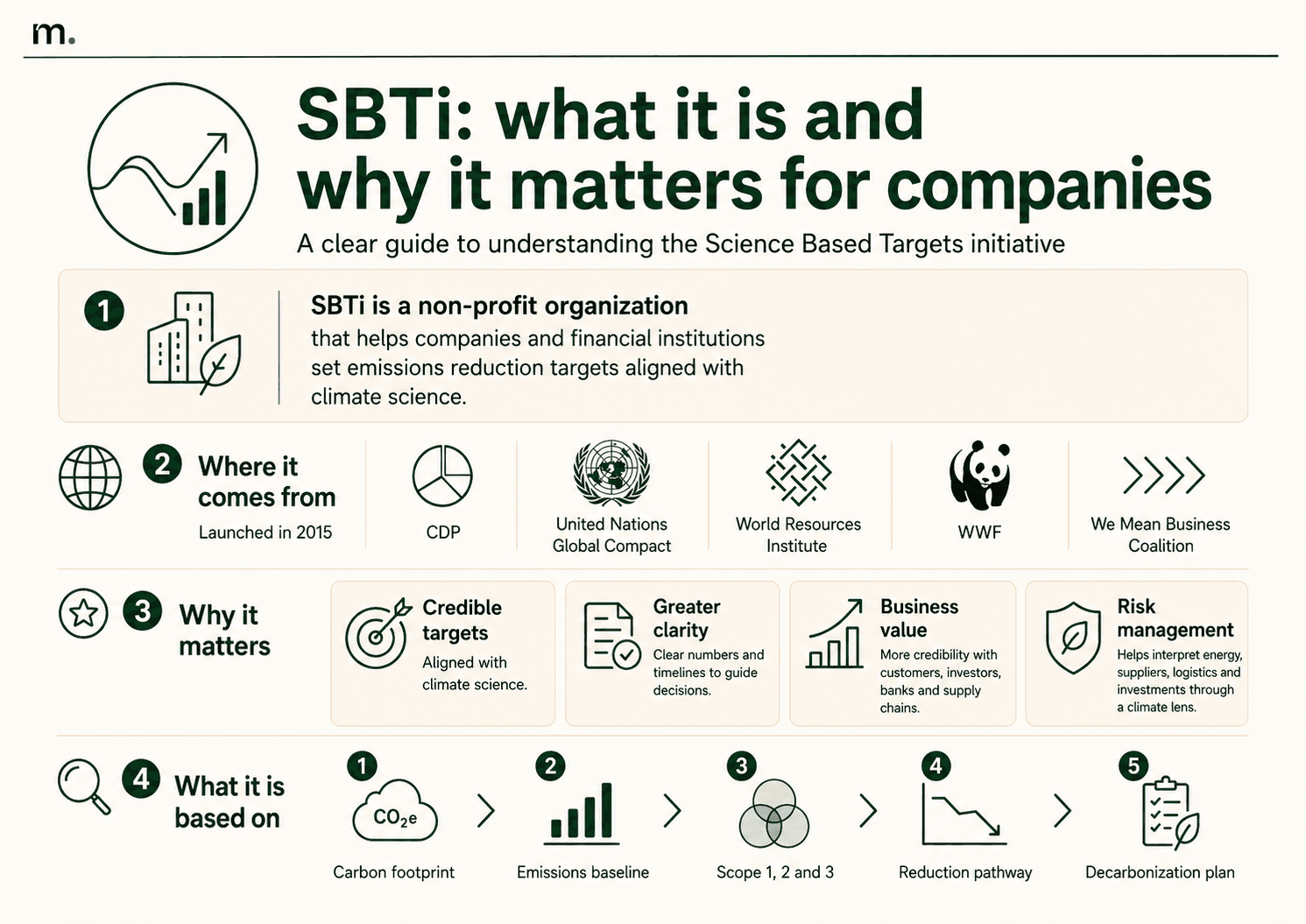
SBTi, short for Science Based Targets initiative, supports companies and financial institutions in setting emissions reduction targets aligned with climate science. Its role is to provide standards, criteria and tools that make climate targets more measurable, comparable and verifiable.
In June 2026, SBTi released the new Corporate Net-Zero Standard V2.0, the updated version of the standard for companies that want to set credible Net Zero targets.
The Corporate Net-Zero Standard V2.0 strengthens the connection between targets, operating plans and monitoring. According to the official Corporate Net-Zero Standard V2 Main Changes document, the revision was carried out between April 2024 and May 2026 to align the standard with the latest science, strengthen the approach to Scope 3 emissions and improve the framework’s applicability for companies.
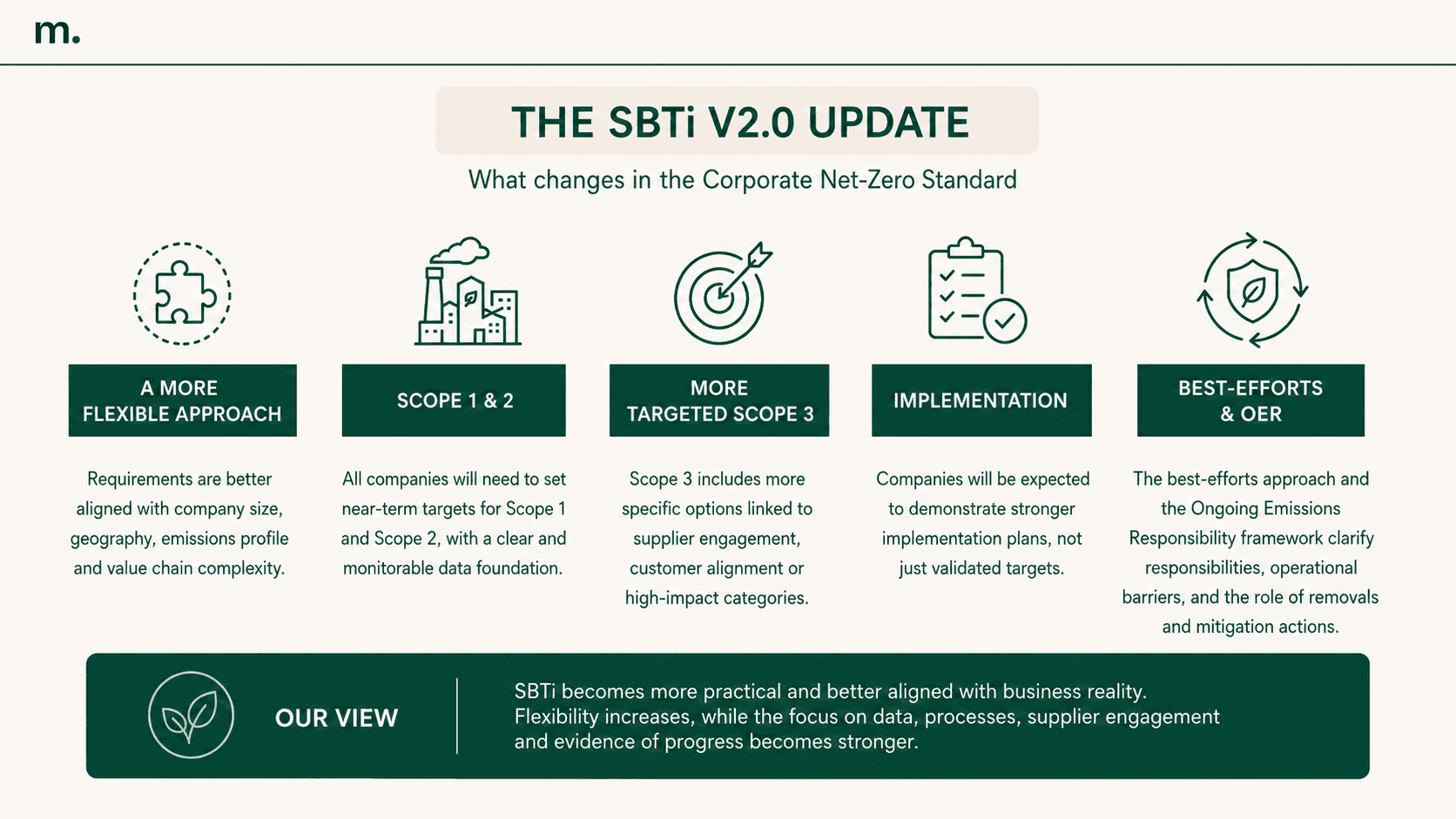
The update introduces a more flexible approach to climate target setting, with requirements that take into account elements such as company size, geography, emissions profile and value chain complexity.
In particular:
→ all companies will need to set near-term targets for Scope 1 and Scope 2;
→ Scope 3 becomes more tailored, with different options based on supplier engagement, customer alignment or specific high-impact emissions categories;
→ companies will be expected to demonstrate stronger implementation plans, not just validated targets;
→ SBTi introduces a “best-efforts” approach, recognizing that some barriers may be outside a company’s direct control;
→ the new Ongoing Emissions Responsibility framework opens the door to a clearer role for removals and mitigation actions.
We believe this update is a positive improvement because it better reflects the operational reality of companies, which can vary significantly from one organization to another. Companies cannot always be placed into the same categories, as they do not all start from the same level of maturity in terms of information systems, data availability, supply chain structure or supply chain complexity.
V2.0 confirms a clear direction: climate targets must be supported by data, plans and operational responsibilities. For a company, starting an SBTi journey means building from a measurable basis: initial emissions, organizational boundary, Scope 1, Scope 2, Scope 3, base year, target year, reduction percentage and monitoring method.
This also makes SBTi relevant from a managerial and financial perspective. A science-based target can guide investments, procurement, logistics, energy choices, product development and supplier engagement. Its value depends on the company’s ability to connect the climate target to the decisions that have a real impact on its carbon footprint.
What it means to set science-based targets
A science-based target is an emissions reduction target built from a measured baseline and trajectories aligned with climate science. Compared to a generic climate target, it requires a GHG inventory, a clear boundary, a documented methodology and a monitoring logic.
The first element is the base year, meaning the reference year against which reductions are calculated. The second is the organizational boundary, which clarifies which companies, sites, business units and activities are included in the calculation. The third is the emissions coverage, with specific attention to Scope 1, Scope 2 and Scope 3.
To better understand the distinction between these categories, it is useful to read the guide on Scope 1, Scope 2 and Scope 3.
Within the SBTi journey, it is useful to distinguish between near-term targets, long-term targets and Net Zero targets. Near-term targets define the reductions to be achieved in the short and medium term and guide operational decisions over the coming years. Long-term targets indicate the trajectory needed to reach a reduction level compatible with the Net Zero objective.
In the SBTi framework, Net Zero requires a deep reduction of emissions across the value chain, which differs from emissions offsetting approaches where the problem is not addressed at its source. Residual emissions are considered after structural reduction measures have been implemented, according to specific criteria. This approach requires energy, materials, suppliers, logistics, production processes and product design to be aligned with the defined trajectory.
With the Corporate Net-Zero Standard V2.0, this logic becomes more operational. All companies will need to set near-term targets for Scope 1 and Scope 2, while Scope 3 is treated with greater granularity, including options linked to supplier engagement, customer alignment or high-impact emissions categories. Greater flexibility helps reflect business reality more accurately, but it also requires stronger processes to demonstrate methodology, accountability and progress.
Carbon footprint, Scope 3 and data quality: where to start
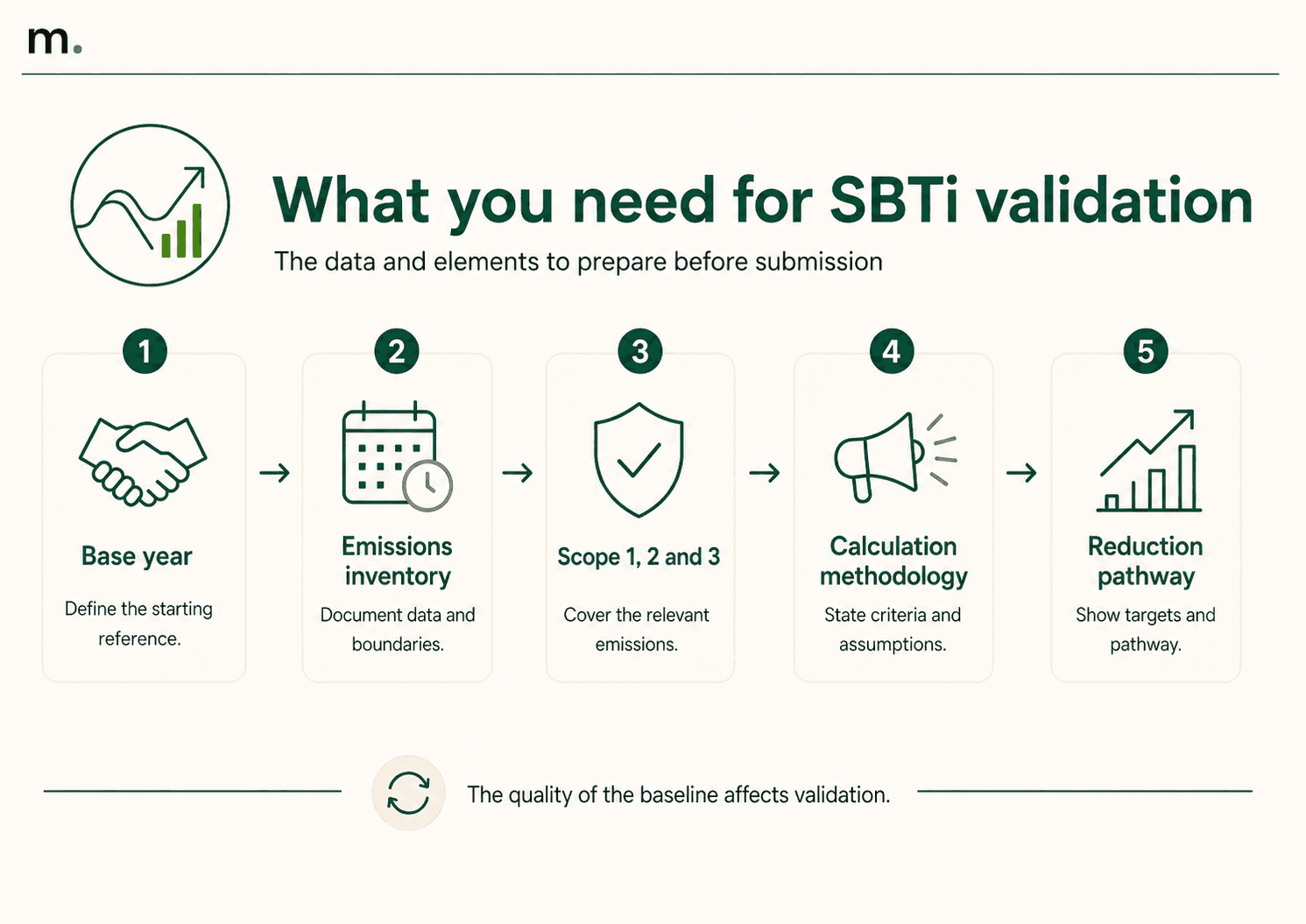
Before setting an SBTi target, a company must build a reliable data foundation. The starting point is the calculation of the corporate carbon footprint, meaning the inventory of GHG emissions generated directly and indirectly by the organization. An incomplete baseline can lead to underestimated targets, unrealistic reductions or validation issues.
The quality of a carbon footprint depends on the organizational boundary, data sources, emission factors, calculation methodology, assumptions used and update frequency. To make the data usable, the company should distinguish between primary data, estimated data and proxies, documenting the reliability level of the information. This step is particularly relevant for groups with multiple sites, business units, markets or suppliers.
Scope 3 is often the most complex component of the SBTi journey. Many emissions are not found in internal company systems, but across the supply chain: purchased materials, transport, distributors, use of sold products, outsourced processes and end-of-life. In sectors such as fashion, food, packaging, chemicals, manufacturing, construction and retail, a significant share of the carbon footprint can sit outside the company’s direct control.
For this reason, Scope 3 requires progressive improvement in data quality. Estimates may be used in the early stages, but a mature pathway requires more specific data on the categories with the greatest emissions weight. The guide on Scope 3 emissions helps connect target setting with practical activities such as data collection, supplier engagement and improvements in carbon accounting.
V2.0 introduces a more pragmatic approach to this complexity. The concept of “best efforts” recognizes that some barriers may depend on external actors, such as suppliers, customers or data availability. This approach does not reduce the company’s responsibility: it requires the company to demonstrate which levers are under its direct control, which depend on the value chain and which actions are being taken to improve progressively.
At this stage, a supplier assessment software can support the collection of information from the supply chain, while an LCA software can be useful when emissions analysis needs to reach the level of product, material or life cycle. For companies exposed to specific obligations on embedded emissions, a CBAM software can also help structure the management of climate data linked to products and suppliers.
How to Build an SBTi Decarbonization Plan
For companies, a science-based target has value when it is supported by a credible decarbonization plan. After measuring emissions and defining the trajectory, the company must identify which actions can concretely reduce the carbon footprint, within which timeframe, with which investments, operational dependencies and internal owners.
Strategies to reduce Scope 1, 2 and 3 emissions may include energy efficiency, process electrification, renewable energy procurement, consumption reduction, logistics optimization, replacement of high-emission materials, product redesign, waste reduction and supplier engagement. Each lever should be assessed based on reduction potential, cost, technical feasibility, implementation timeline and business impact.
A plan aligned with SBTi should include interim milestones, annual KPIs, internal owners and review mechanisms. If Scope 3 represents a large share of the total carbon footprint, the plan should include supplier engagement, supplier selection criteria, primary data collection and progressive improvement targets. In these cases, supplier assessment helps connect emissions, risk and intervention priorities.
Another relevant element of V2.0 is the Ongoing Emissions Responsibility framework, described in the full standard. This framework clarifies the role of removals and mitigation actions for emissions that continue to occur during the transition pathway. Emissions reduction remains the priority, while instruments linked to residual emissions require criteria, transparency and consistency with the net-zero trajectory.
SBTi validation, ESG reporting and mistakes to avoid
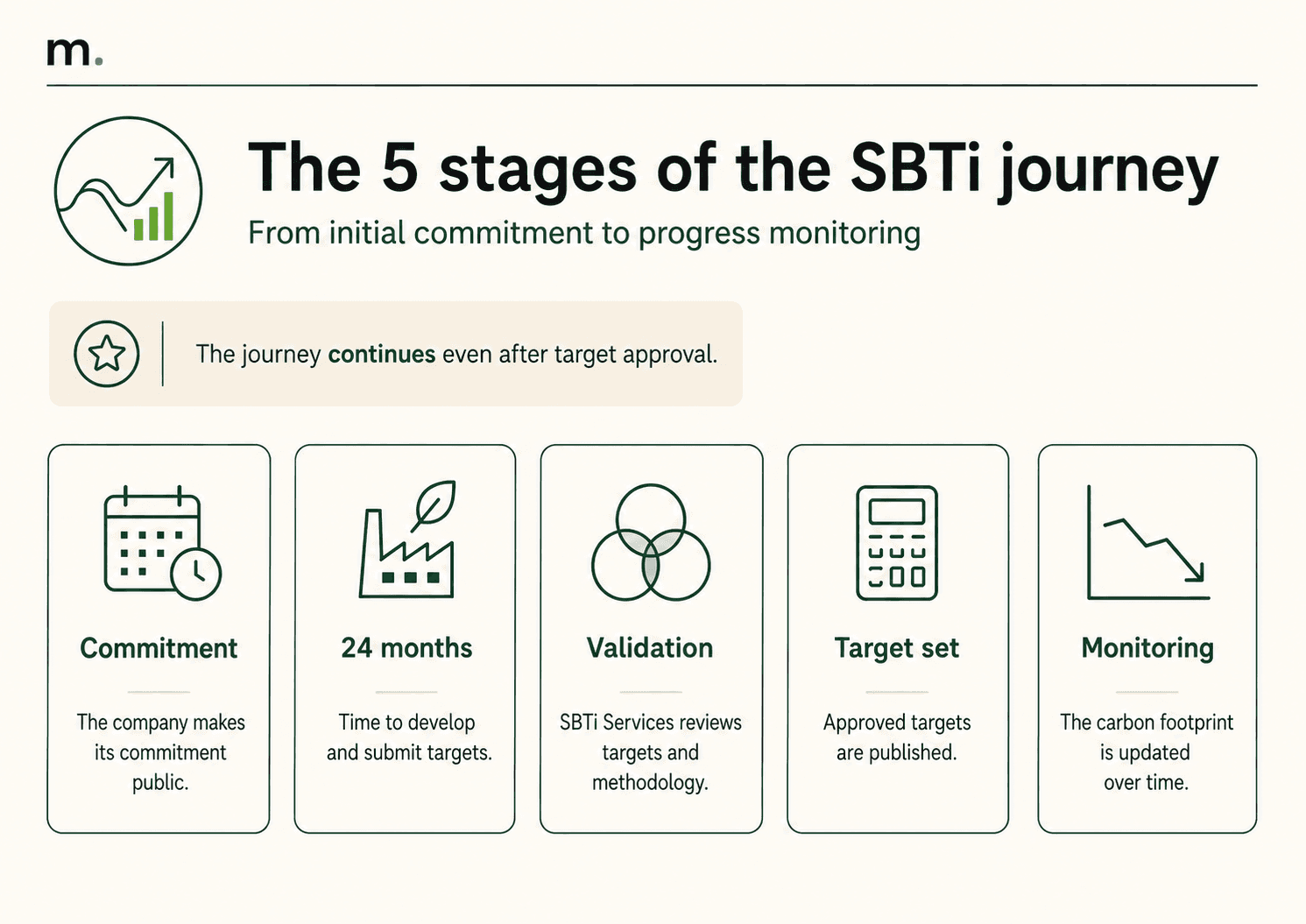
The SBTi process follows a formal sequence. For corporate companies, the first step can be the commitment, meaning the public commitment to develop emissions reduction targets aligned with SBTi criteria. After the commitment, the company is included in the SBTi Target Dashboard with active status and must develop its science-based targets and submit them for validation according to the applicable timelines.
The next phase is target validation. The company submits its targets to SBTi Services together with the required technical information: organizational boundary, base year, emissions inventory, Scope 1, Scope 2 and Scope 3 coverage, calculation methodology and reduction trajectory. SBTi Services operates as a legal entity separate from the Science Based Targets initiative and is responsible for validating climate targets for companies, financial institutions and SMEs.
If validation is successful, the company moves to “target set” status, with approved and published targets. From that point, the work continues through monitoring, carbon footprint updates, assessment of decarbonization levers and consistency between targets, performance and business decisions.
The new standard strengthens this dimension. V2.0 introduces an assurance model designed to support the assessment of continuous improvement along the net-zero pathway. The credibility of the target therefore also depends on the company’s ability to demonstrate progress, updates and consistency over time.
SBTi provides companies with a recognized method for setting measurable climate targets aligned with science. Its usefulness depends on the quality of the preparatory work: complete carbon footprint, reliable baseline, Scope 1, Scope 2 and Scope 3 coverage, supply chain analysis and an operational decarbonization plan.
Validation is an important milestone, but business value comes from execution: solid data, clear responsibilities, adequate tools and decisions aligned with the reduction trajectory.
Conclusion
SBTi provides companies with a recognized framework for setting measurable climate targets aligned with science and connected to emissions reduction. Its usefulness depends on the quality of the preparatory work: complete carbon footprint, reliable baseline, Scope 1, Scope 2 and Scope 3 coverage, supply chain analysis and an operational decarbonization plan.
For companies, the main advantage lies in making climate strategy more concrete. A science-based target helps set priorities, monitor progress, improve data quality and respond more effectively to the expectations of customers, investors and supply chain partners.
SBTi validation is an important milestone, but the real value comes from execution: reliable data, clear responsibilities, appropriate tools and business decisions aligned with the reduction pathway. This is how a Net Zero objective becomes part of the company’s industrial, financial and operational management.
CONTRIBUTOR
Luis Antezana
Sustainability Analyst
Formed as a Chemical Engineer and with a focus on the energy sector, Luis applies a rigorous technical and analytical approach to decarbonisation and emissions measurement. Born in Bolivia and professionally developed across the United States and Europe, he contributes to the design and implementation of Carbon Footprint and Life Cycle Assessment (LCA) methodologies, helping organisations accurately quantify emissions while identifying opportunities to optimise processes, improve resource efficiency, and reduce operational costs. Luis approaches sustainability not only as a compliance exercise, but as a driver of measurable business value—linking environmental performance with economic returns, risk reduction, and long-term competitiveness.He works to make sustainability practical, data-driven, and financially meaningful for organisations and their stakeholders. Topics covered: Decarbonisation, Corporate Carbon Footprint, Life Cycle Assessment (LCA), Scope 1–2–3 accounting, GHG Protocol, Product Carbon Footprint (PCF).
Stay up to date with Metrikflow Insights!
We deliver expert insights, product updates, industry trends, and actionable strategies straight to your inbox. Stay ahead in ESG, GHG, and LCA — one edition at a time.
By submitting this form, you consent to receive the requested resource. For more information on how we process and protect your data, view our Privacy Policy.


