
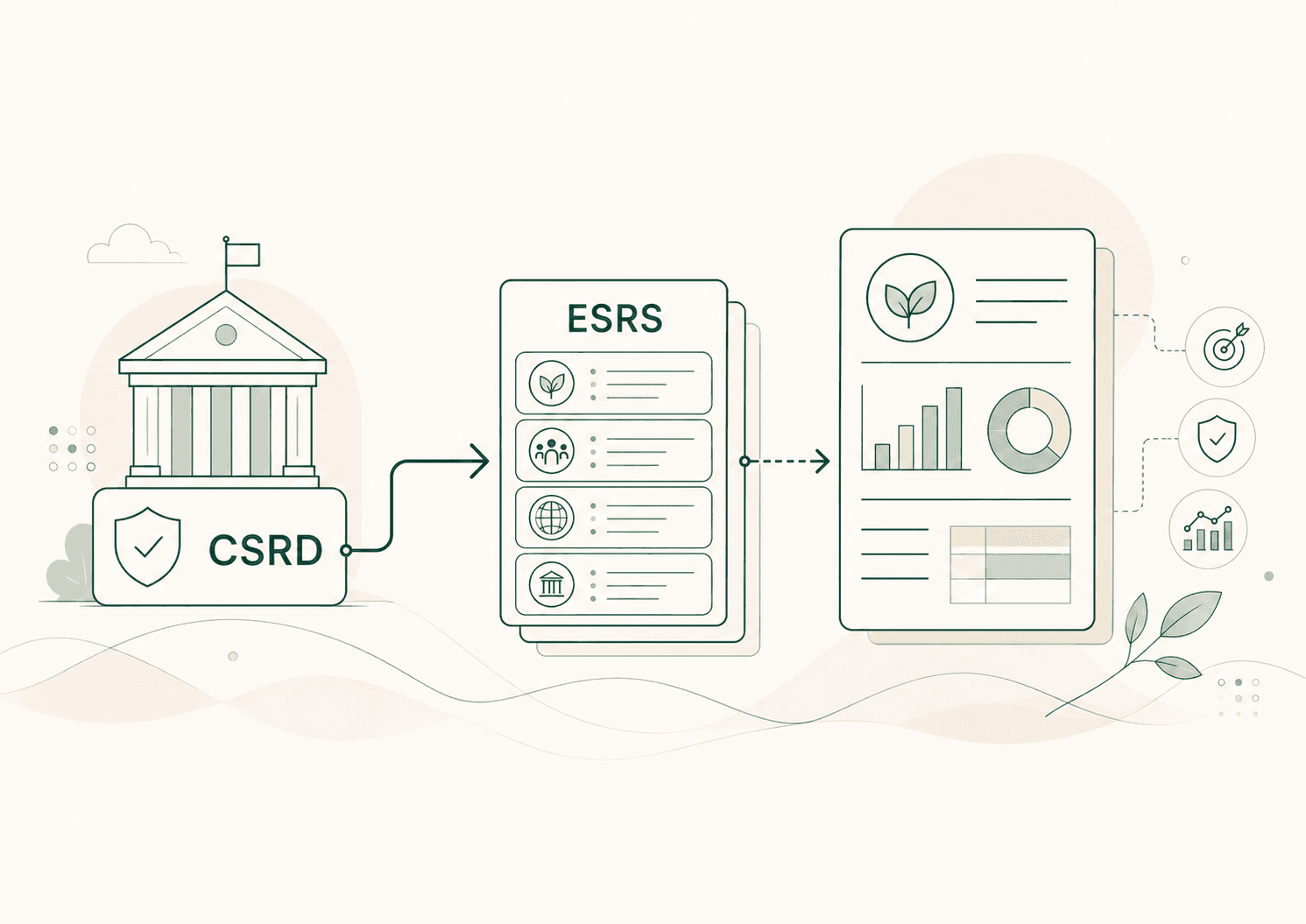
The ESRS, or European Sustainability Reporting Standards, define the sustainability information that companies subject to the CSRD must include in their reporting. They establish which topics must be assessed, which criteria must be applied, and which qualitative and quantitative information should be disclosed.
Reporting under the ESRS first requires companies to define the scope of each data point, apply consistent methodologies and maintain a documented history of the evidence needed to verify the information.
On 3 July 2026, the European Commission adopted a simplified version of the standards. The revision reduces the number of data points, introduces additional flexibility and changes some aspects of the double materiality assessment. The revised ESRS will apply to financial years beginning on or after 1 January 2027, with early adoption available for the 2026 financial year.
What are the ESRS and what does the acronym mean?
ESRS stands for European Sustainability Reporting Standards. They were introduced to create a common structure for corporate sustainability disclosures and make information more comparable across the European Union.

The standards translate the general obligations of the Corporate Sustainability Reporting Directive into specific disclosure requirements. The CSRD defines which companies are subject to reporting and the general principles they must follow. The ESRS establish which information must be assessed, how it should be organized and which explanations must accompany the published data.
Sustainability reporting must enable readers to understand the company’s impacts on people and the environment, as well as the sustainability-related risks and opportunities that may affect its financial performance, cash flows, access to capital and operational continuity.
These two perspectives explain why the ESRS require environmental, social and governance information to be connected with the company’s business model. A numerical value must be accompanied by enough context to understand its scope, calculation methodology, underlying assumptions and relationship with corporate policies, actions and targets.
The technical development of the standards is entrusted to EFRAG, an independent organization that advises the European Commission on financial and sustainability reporting. The Commission then adopts the ESRS through delegated acts. The first set was introduced through Delegated Regulation EU 2023/2772, available in the official text on EUR-Lex.
The relationship between EFRAG and the ESRS is therefore technical rather than legislative: EFRAG develops proposals and implementation material, while the European Commission is responsible for formal adoption. The implementation guidance published by EFRAG covers double materiality, the value chain and the ESRS data point list.
For companies, this structure means that preparation must begin well before the final report is drafted. Responsibilities, data sources, controls and update frequencies should be defined during the reporting year, rather than concentrating the entire collection process in the weeks before publication.
What are the different ESRS standards?
The ESRS structure includes two cross-cutting standards and ten topical standards.
ESRS 1 – General Requirements sets out the principles that companies must follow when preparing their sustainability statement. It covers double materiality, reporting boundaries, the value chain, time horizons, the use of estimates and the qualitative characteristics of reported information.
ESRS 2 – General Disclosures defines the cross-cutting information that companies must provide. It covers governance, strategy, the business model, the materiality assessment process and the way the organization manages impacts, risks and opportunities.
The five environmental standards address the main topics connected with business activities and natural resources:
ESRS E1: Climate change
ESRS E2: Pollution
ESRS E3: Water and marine resources
ESRS E4: Biodiversity and ecosystems
ESRS E5: Resource use and circular economy
The social standards comprise ESRS S1 on the company’s own workforce, ESRS S2 on workers in the value chain, ESRS S3 on affected communities and ESRS S4 on consumers and end users.
Governance is covered by ESRS G1, which focuses on business conduct. It addresses topics such as corporate culture, corruption prevention, supplier relationships and payment practices.
The inclusion of a topic in the ESRS architecture does not automatically require a company to publish every disclosure contained in that standard. The company must first determine which topics are material and then identify the applicable disclosure requirements.
For groups operating through several entities, facilities or geographical areas, the assessment must reflect differences across the organization. A topic may be material for only one part of the reporting boundary. The group must therefore apply consistent consolidation criteria while retaining sufficient detail to explain the specific circumstances that affect the overall result.
The ESRS can also be assessed in relation to other reporting frameworks. The comparison between GRI and ESRS is particularly relevant for organizations that were already using the GRI Standards before the introduction of the CSRD. The two frameworks cover several common topics, although the ESRS include requirements arising from EU regulation and the principle of double materiality.
For companies outside the scope of the CSRD, the VSME reporting standard provides a more proportionate voluntary framework. SMEs can use it to structure ESG information and respond to requests from customers, banks and larger companies in their value chain without applying the full ESRS framework.
The 2026 ESRS revision: what changes?
The revision adopted by the European Commission in July 2026 addresses difficulties identified during the first application of the standards. The revised framework is shorter, reorganizes several requirements and introduces flexibility intended to reduce the administrative burden while preserving relevant, reliable and comparable information.
The revision is part of the broader regulatory simplification process connected with the EU Omnibus Package, which has affected both the scope and timing of sustainability reporting requirements.
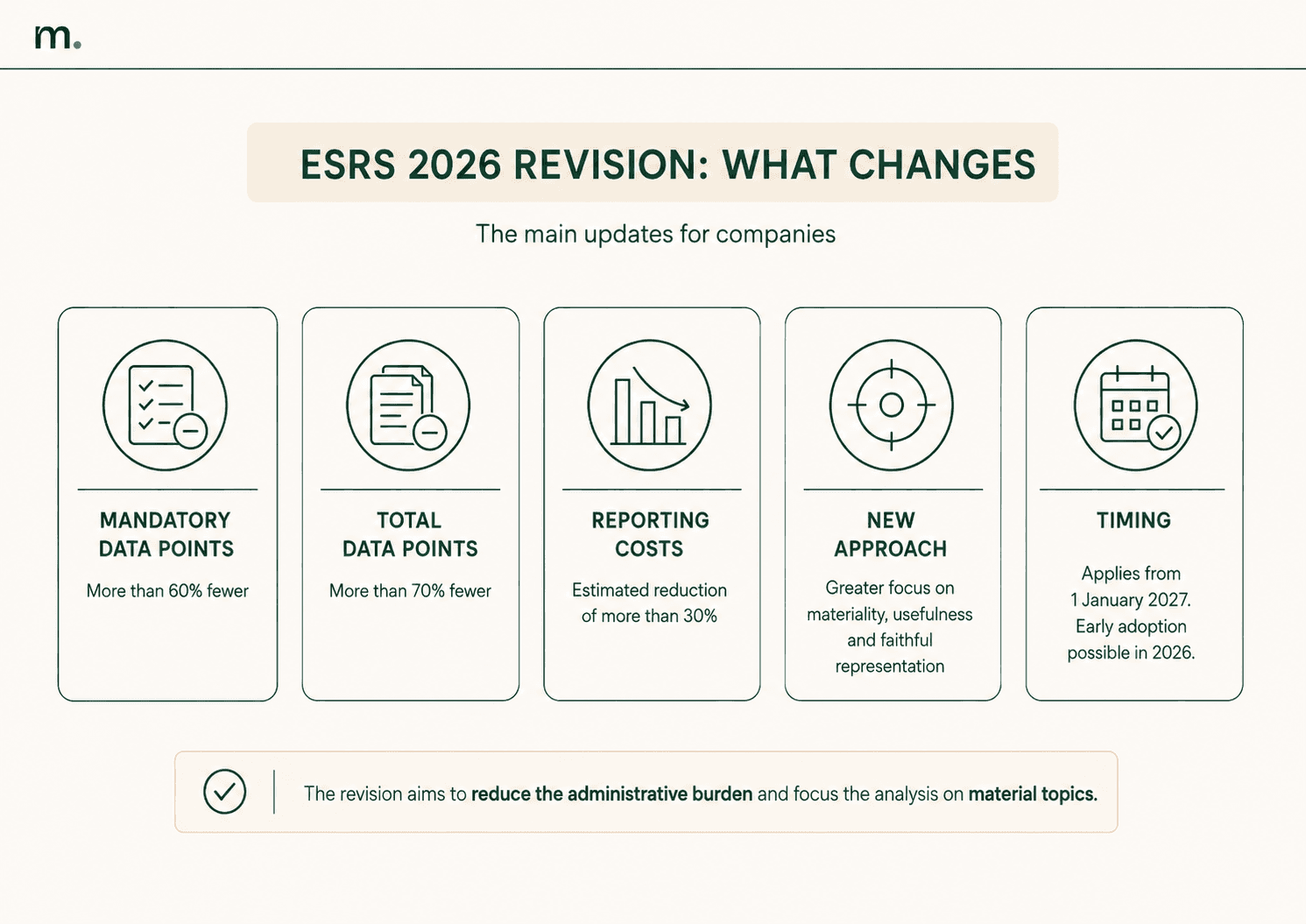
According to the European Commission, the revised standards reduce mandatory data points by more than 60% and the total number of data points by more than 70%. The changes are expected to reduce reporting costs by more than 30% per company.
During a webinar organized by Metrikflow in collaboration with EFRAG, Michele Dicorato from EFRAG highlighted three principles at the centre of the revised framework: materiality, faithful representation and the usefulness of information.
These principles require companies to explain why a disclosure is significant and how it contributes to an accurate understanding of the organization. The revision aims to limit reports built around a sequence of formally correct data points that are poorly connected to the company’s business model and management decisions.
One significant change concerns the double materiality assessment. The revised standards clarify the use of a top-down approach, under which management begins with its knowledge of the company, its activities and its main impacts, risks and opportunities.
Michele Dicorato emphasized that this approach places greater responsibility on management. The assessment cannot be reduced to the mechanical completion of a long checklist. Its conclusions must be supported by information that is faithful, comparable and verifiable.
The revision also introduces simplifications for information that is difficult to obtain from the value chain, acquisitions and disposals completed during the reporting year, and activities that are not significant. Some presentation requirements have also been clarified, including the possibility of adding an executive summary at the beginning of the sustainability statement.
The experience of Evoca Group
The contribution of Giusi Bonini, Chief Sustainability Officer at Evoca Group, illustrates the operational impact of the previous framework. In preparation for the CSRD, the group conducted a double materiality assessment that resulted in more than 1,200 data points requiring analysis and potential disclosure.
For an organization with four production facilities and more than fifteen commercial companies, this level of detail directed a substantial share of available resources towards locating and collecting information. According to Bonini, many of the required disclosures did not improve understanding of the company and its objectives in proportion to the effort required.
Her assessment of the revision is therefore positive because the new framework allows companies to concentrate their analysis on genuinely relevant information. In her experience, reducing the number of data points helps recover an overall view of the company without reducing the importance of measurement and performance indicators.
The work already completed by companies remains valuable. Mapping data in preparation for the CSRD makes it possible to understand which information is available, where it is stored and who is responsible for it. Companies can adapt this system to the revised standards by removing unnecessary activities while retaining the procedures that support management decisions, internal controls and corporate targets.
The revised standards will become mandatory for financial years beginning on or after 1 January 2027. Companies reporting for financial years beginning in 2026 may choose to adopt them early. The applicable transitional provisions and revised text can be consulted in the European Commission delegated act on EUR-Lex.
As of 23 July 2026, the delegated act had been adopted by the Commission and submitted to the European Parliament and the Council for scrutiny. Its definitive application remained subject to the completion of that procedure and publication in the Official Journal of the European Union.
To prepare for the transition, companies can compare the two versions of the standards and classify their data points into four categories: confirmed, amended, consolidated and removed. This analysis makes it possible to update responsibilities and procedures without interrupting the collection of information that remains useful.
Watch the webinar on the revised ESRS
Metrikflow discussed the revision with Michele Dicorato from EFRAG and Giusi Bonini, Chief Sustainability Officer at Evoca Group. The session examines the main changes and their operational consequences for companies that have already started preparing for CSRD reporting.

Watch the full webinar, “Unlock the New ESRS: What Companies Need to Know”
ESRS E1: what does the climate change standard cover?
ESRS E1 covers disclosures related to climate change. For many companies, it is one of the most demanding standards because it connects environmental data, production processes, procurement, logistics, investment and financial planning.
The standard addresses climate change mitigation and adaptation. Companies must describe the policies they have adopted, the actions they are implementing, the resources allocated and the targets established. Where applicable, they must also present their transition plan and explain how it relates to the company’s strategy.
A substantial part of ESRS E1 concerns the measurement of greenhouse gas emissions. Companies must establish a consistent inventory of Scope 1, Scope 2 and Scope 3 emissions, defining organizational boundaries, sources, emission factors and calculation methodologies.
Scope 1 covers direct emissions from sources owned or controlled by the company. Scope 2 covers indirect emissions associated with purchased energy. Scope 3 includes other indirect emissions across the value chain, including those connected with purchased goods and services, transportation, business travel, the use of sold products and end-of-life treatment.
A more detailed explanation of the three categories is available in Metrikflow’s guide to Scope 1, 2 and 3 emissions.
ESRS E1 also includes information on energy consumption, the energy mix, emissions intensity and climate-related risks. Physical risks may result from extreme weather events or long-term changes in climatic conditions. Transition risks may arise from regulation, technology, market developments or the cost of emissions.
The quality of reporting depends on whether changes in performance can be interpreted correctly. A reduction in emissions should be assessed against the baseline year, changes in organizational boundaries, production volumes and actions completed. Without this information, it is difficult to distinguish genuine operational improvement from a reduction caused by the disposal of an activity or a decline in output.
Preparing for ESRS E1 therefore requires up-to-date data that can be traced back to its original source. Energy bills, consumption records, purchased quantities, facility registers and logistics data should be collected using consistent criteria. Estimates may be used where primary data is unavailable, provided that the methodology is documented and applied consistently.
Double materiality and data points: how are the ESRS applied?
The ESRS double materiality assessment identifies which sustainability topics are relevant for reporting. It considers impact materiality and financial materiality.
Impact materiality examines the actual or potential positive and negative effects that the company generates on people and the environment. The assessment considers the severity of the impact and, for potential impacts, the likelihood of occurrence.
Financial materiality examines sustainability-related risks and opportunities that could affect financial performance, financial position, cash flows, access to finance or the cost of capital.
A topic is material when it meets the criteria under at least one of the two perspectives. Water scarcity, for example, may represent an environmental impact connected with the company’s water withdrawals and a financial risk for a production facility located in a water-stressed area.
The analysis must reflect how the organization actually operates. Sector, facility location, raw material dependence, workforce composition and value-chain structure all affect the company’s exposure. A standard materiality matrix cannot replace an assessment of the company’s specific characteristics.
During the webinar on the revised ESRS, Giusi Bonini described materiality as a management exercise that requires the company to take responsibility for its conclusions. This interpretation is consistent with the top-down approach: management identifies the priorities, while operational functions provide the supporting data and evidence.
How to align your company with ESRS step by step
Once the role of double materiality is clear, the process can be translated into a series of concrete activities. Data collection should only begin after the reporting scope has been defined and the company has identified which sustainability matters are actually relevant.
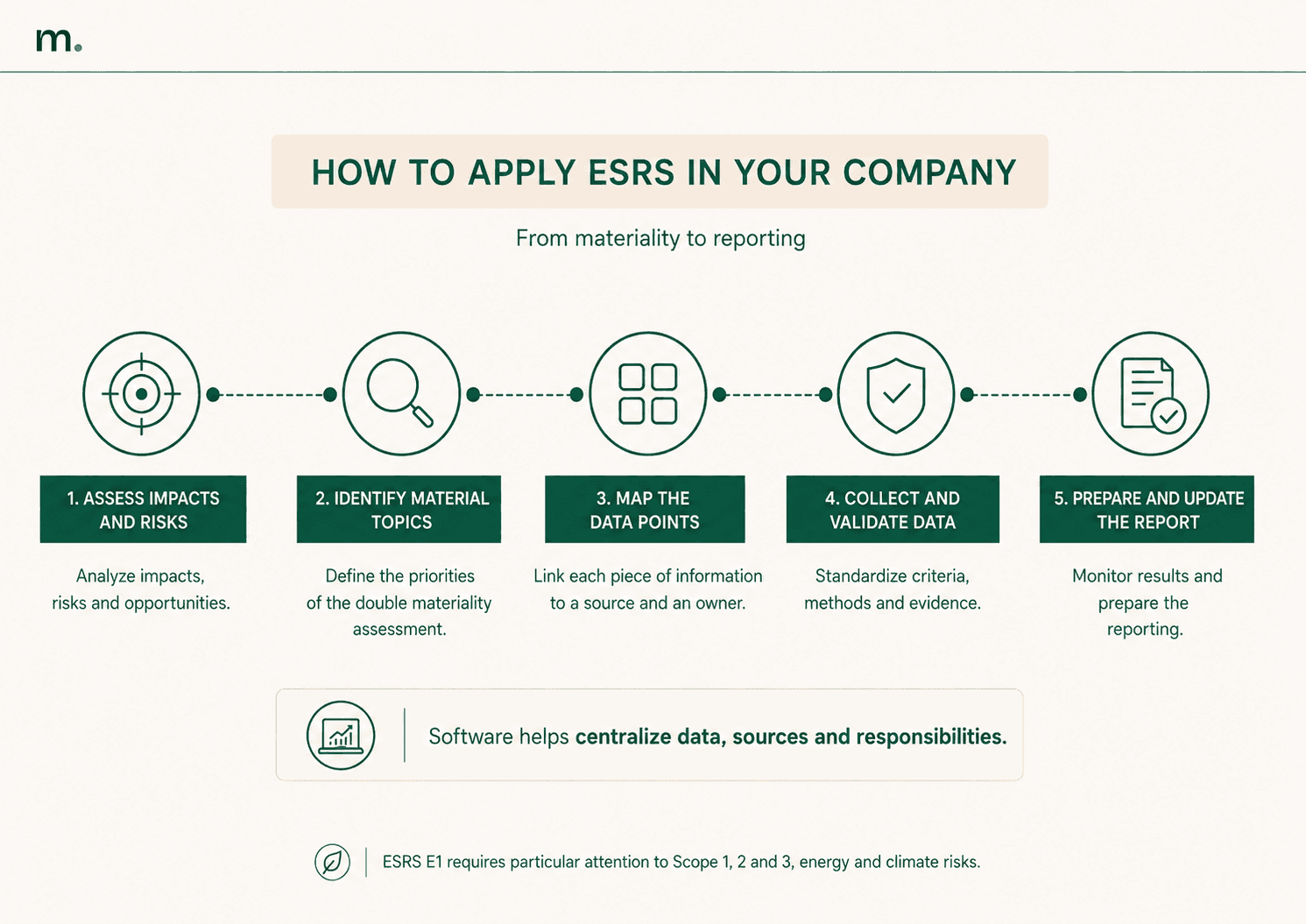
In practice, the work can be organised into five main steps:
Define the reporting scope, identifying which entities, activities, sites and parts of the value chain need to be included.
Map impacts, risks and opportunities connected to the company’s activities and operating context.
Carry out the double materiality assessment, considering both the company’s impacts on people and the environment and the sustainability-related risks and opportunities that may have financial effects.
Identify the relevant disclosures and datapoints, linking them to the information already available within the company and highlighting any missing data, sources and owners.
Structure data collection and validation, using consistent criteria to make information traceable, verifiable and ready for reporting.
Once material topics have been identified, the company determines which information must be reported. ESRS data points are the individual pieces of information contained within the standards. They may consist of numerical values, descriptions, methodologies, policies, actions or targets.
To manage them effectively, each data point should be connected to the relevant standard, reporting entity, responsible function, source, methodology and validation status. This mapping makes it easier to identify missing information, unassigned responsibilities and calculation differences between companies within the same group.
Digitalization can support this process by centralizing information and preserving the relationship between data points, sources, entities and responsible users. Sustainability reporting software can structure data collection around the ESRS, apply consistent methodologies and monitor completion and validation. For groups involving several entities, sites and functions, this reduces manual work, supports consolidation and keeps the evidence required for review and assurance in a traceable environment. (metrikflow.com)
Bonini also noted that much of the information required for sustainability reporting already exists within the organization but is distributed across different systems and functions. The operational challenge often lies in identifying the owner of the information, connecting the sources and verifying that consistent criteria are being applied.
Assurance can help strengthen this process. Evoca Group submitted its second sustainability report to limited assurance even though it was not yet legally required to do so. The process helped the group assess the reliability of the information and clarify responsibility for individual data points.
Sustainability reporting can therefore be used as a periodic management review. It allows companies to compare performance with targets, assess deviations and define priorities for the following year. For this to work, indicators must be connected to decision-making processes rather than treated solely as information required for the final report.
The 2026 revision reduces the volume of disclosures, while methodological consistency, traceability and the ability to explain changes over time remain central. The first practical step is to compare the applicable data points with existing processes. This assessment shows which information can be retained, which must be updated and which activities can be removed or simplified.
CONTRIBUTOR

Sharon Ridolfo
ESG specialist
With a background in international environmental research, Sharon has developed advanced skills in data analysis and emissions monitoring, with a focus on the study of air pollutants and environmental impacts. After coordinating research activities in European Horizon 2020 projects and developing monitoring plans and environmental risk assessments, she now deals with ESG reporting and sustainability reporting, supporting companies in structuring solid, measurable data that is consistent with the main reference standards. Cheerful and energetic, she is passionate about the animal world and environmental protection, values that reinforce her professional commitment. Topics covered: ESG reporting, sustainability reporting, environmental KPIs, emissions monitoring, climate change, environmental data analysis.
Stay up to date with Metrikflow Insights!
We deliver expert insights, product updates, industry trends, and actionable strategies straight to your inbox. Stay ahead in ESG, GHG, and LCA — one edition at a time.
By submitting this form, you consent to receive the requested resource. For more information on how we process and protect your data, view our Privacy Policy.


