
Companies outside the scope of the CSRD are still required to manage specific and recurring ESG data requests. A customer may ask for emissions information, a bank may assess exposure to climate-related risks, and a parent company may need consistent data from all its subsidiaries.
Without a shared framework, these requests are often managed through separate files, different questionnaires and calculations that are difficult to update. The VSME standard provides small and medium-sized enterprises with a European framework for collecting, organizing and communicating sustainability information on a voluntary basis.
VSME allows companies to start with a core set of indicators and progressively expand the level of reporting. Its application still requires a structured process: selecting the right module, identifying data sources, assigning responsibilities and ensuring that data remain comparable over time.
This guide examines the structure of the standard, the information it requires, the process for preparing a VSME report and the features companies should assess when selecting software for voluntary sustainability reporting.
What is the VSME Standard and what changes in 2026?
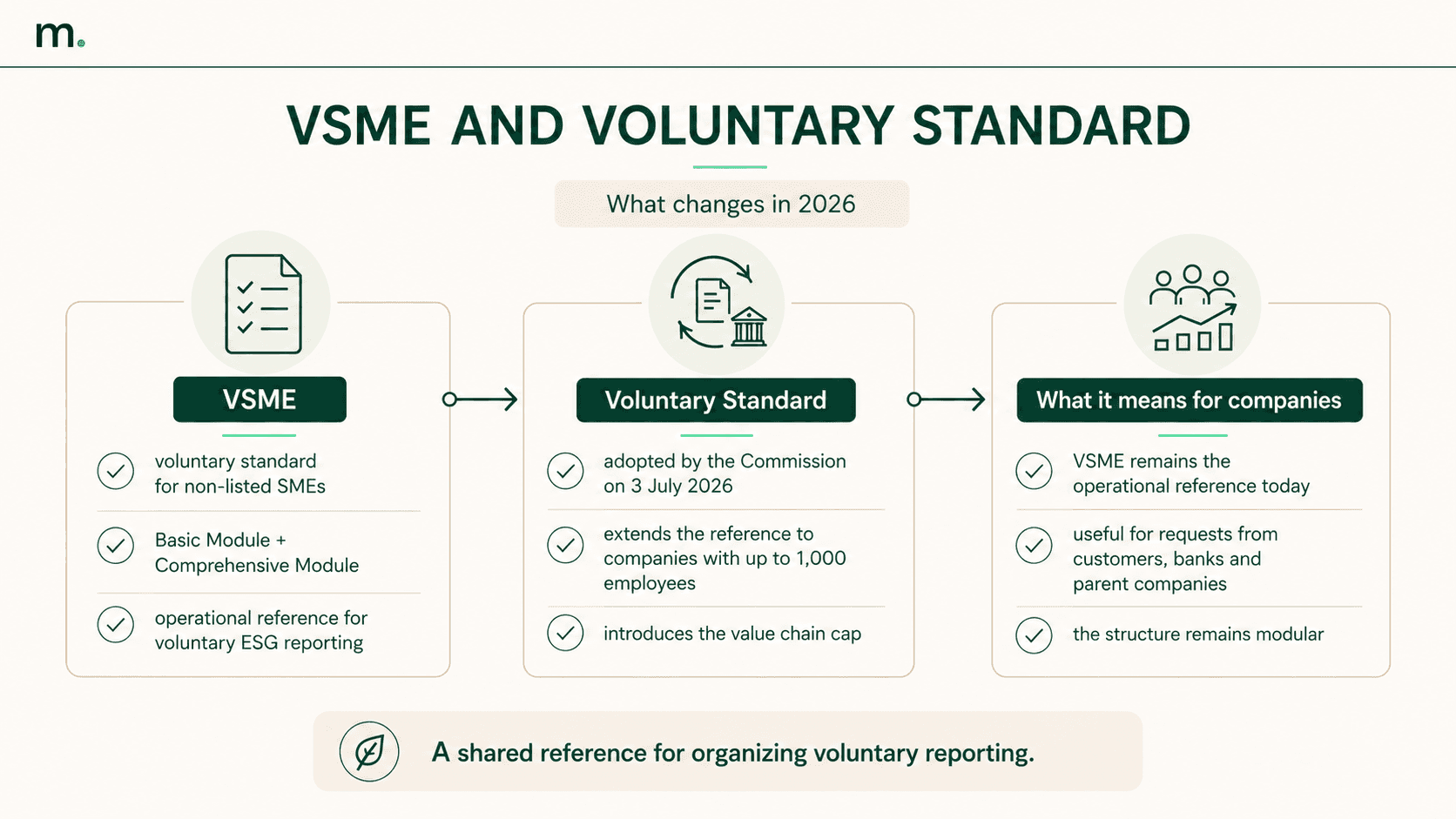
VSME stands for Voluntary Sustainability Reporting Standard for non-listed SMEs. It is the European standard for voluntary sustainability reporting by non-listed micro, small and medium-sized enterprises.
It was developed by EFRAG and endorsed by the European Commission through Recommendation (EU) 2025/1710 of 30 July 2025. The Recommendation encourages SMEs to use VSME and asks large companies and financial institutions to base their ESG information requests on this framework.
VSME is mainly intended for companies that do not fall within the mandatory reporting scope of the CSRD. The distinction between mandatory and voluntary reporting depends on company size and the applicable requirements, as explained in the article on what a sustainability report is and when it matters for companies.
The standard can be used when a company needs to provide environmental and social data to a customer, participate in a tender, respond to a bank request or publish a voluntary sustainability report.
A structured ESG data set can be reused for different recipients, reducing the time spent completing questionnaires based on different formats and definitions.
From VSME to the new voluntary standard
The framework changed on 3 July 2026, when the European Commission adopted the new Voluntary Standard for voluntary reporting by companies outside the scope of the CSRD and protected by the value chain cap. The standard is sometimes referred to as VS, although this abbreviation is not yet used consistently in official communications.
The Voluntary Standard is based on VSME but has a broader scope than SMEs alone. It is intended for companies outside mandatory reporting requirements that did not exceed an average of 1,000 employees during the previous financial year.
The standard also introduces the value chain cap, which limits the information that companies subject to the CSRD may request from protected companies in their value chain. For sustainability reporting purposes, these requests may not exceed the information included in the Voluntary Standard.
The new framework retains the modular structure of VSME, consisting of a Basic Module and a Comprehensive Module. The changes were kept limited to ensure continuity for companies that had already started applying VSME. However, the Commission has:
aligned the content with the revised ESRS;
reduced the overall number of required data points;
clarified which information falls within the value chain cap;
made certain complex disclosures voluntary for companies with ten employees or fewer.
The Delegated Regulation on the Voluntary Standard states that the VSME adopted in 2025 served as a transitional solution pending the introduction of the new regulatory standard.
At the time of this article’s update, the Regulation has been adopted by the Commission but has not yet entered into force. It must complete the scrutiny period of the European Parliament and the Council and be published in the Official Journal of the European Union. The value chain cap will apply to financial years beginning on or after 1 January 2027.
The European Commission summarizes the objectives and implementation process in its announcement on the new reporting standards adopted on 3 July 2026.
During this transition phase, VSME remains the main operational reference for SMEs. Once the Delegated Regulation enters into force, the Voluntary Standard will become the regulatory reference for companies protected by the value chain cap.
Which companies can use VSME?
The 2025 Recommendation identifies non-listed micro, small and medium-sized enterprises as the main users of VSME.
A company is classified as medium-sized when it does not exceed at least two of the following thresholds:
€25 million in total assets;
€50 million in net turnover;
an average of 250 employees during the financial year.
Lower thresholds apply to micro and small enterprises.
The Voluntary Standard adopted in 2026 extends the framework to companies outside the scope of the CSRD that do not exceed an average of 1,000 employees. The 1,000-employee threshold also identifies the companies protected by the value chain cap.
The absence of a legal obligation to publish a sustainability report does not remove the need to provide ESG data. Requests may come from customers analyzing their value chain, banks assessing risks and financing conditions, or corporate groups consolidating information from subsidiaries.
VSME may also be adopted by a company that wants to measure energy consumption, emissions, workforce data and other indicators consistently over time, even when it is not subject to the CSRD.
Compared with the ESRS, which apply to companies subject to mandatory reporting requirements, VSME provides a more proportionate structure. The GRI Standards, on the other hand, follow a broader international approach focused on the organization’s impacts.
Basic module and comprehensive module: how VSME is structured
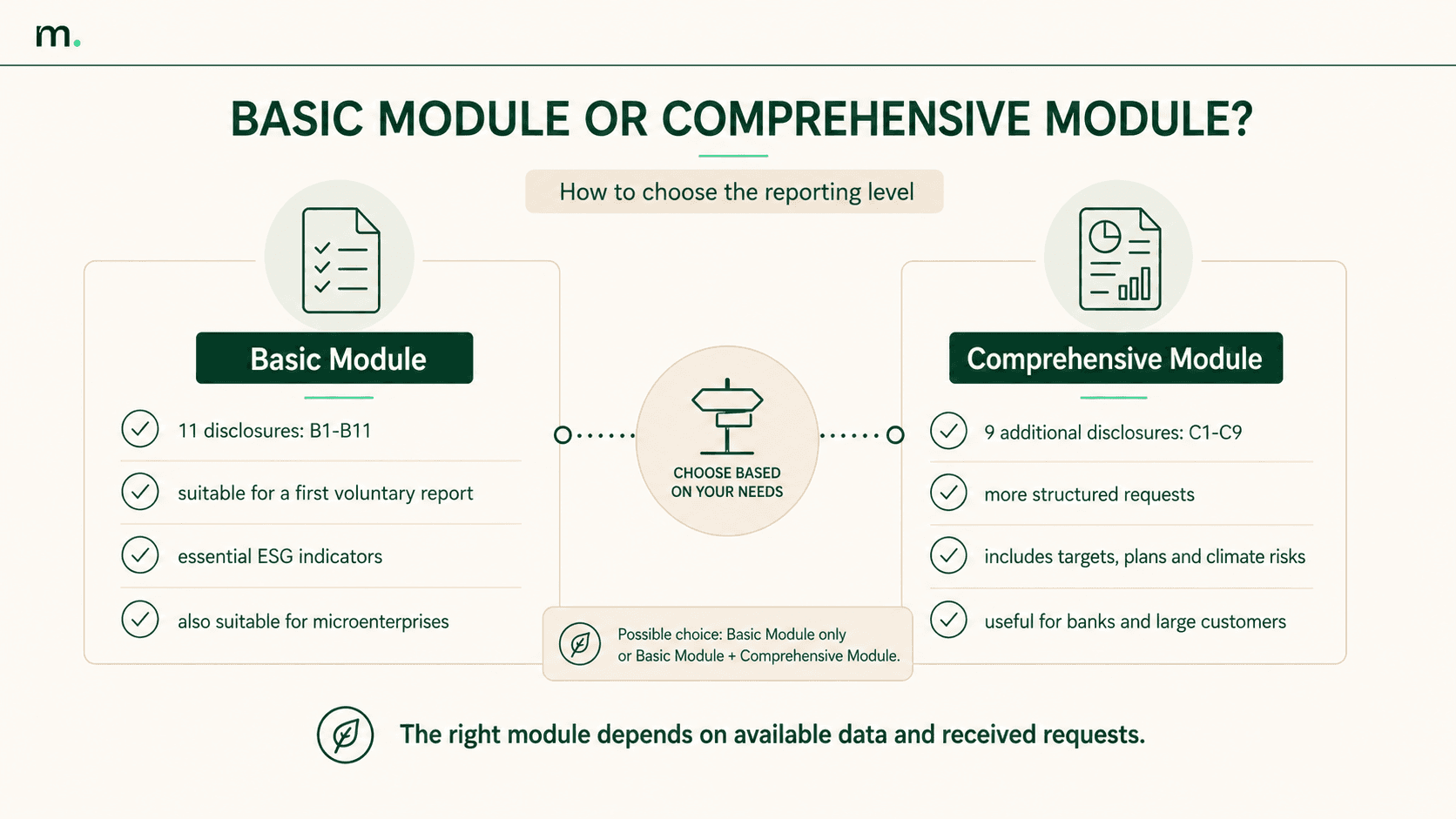
The VSME standard is divided into two levels: the Basic Module and the Comprehensive Module. The Comprehensive Module may only be applied together with the Basic Module.
The selected module determines the amount of information to be collected and the level of detail included in the report. The decision should take into account the company’s size, data availability and the requests actually received from customers, banks and other business partners.
The modular structure has also been retained in the 2026 Voluntary Standard. However, individual data requirements have been amended to reflect the revised ESRS, the reduction in data points and the simplifications introduced for smaller companies.
The 2025 version of the VSME standard in the EFRAG Knowledge Hub contains the disclosures and application guidance used by SMEs during the transitional phase.
The Basic Module
The Basic Module consists of eleven disclosures, identified as B1 to B11. It represents the essential level of VSME reporting and may also be used by microenterprises.
The first disclosures cover the reporting scope, company characteristics and sustainability practices already in place.
The environmental section covers energy consumption, greenhouse gas emissions, pollution, biodiversity, water, resource use, circular economy and waste.
The social disclosures address workforce composition, health and safety, remuneration, collective bargaining and training. The governance section includes any convictions or fines related to corruption or bribery.
The Basic Module is suitable for a company preparing its first voluntary sustainability report or responding to a limited set of information requests. Its application still requires the company to define the reporting scope, document calculation methods and retain evidence supporting the reported data.
Under the Voluntary Standard, certain more complex environmental disclosures become optional for companies with ten employees or fewer. This simplification reflects the limited resources of microenterprises and reduces the information that may be requested from them through the value chain.
The Comprehensive Module
The Comprehensive Module adds nine disclosures, from C1 to C9, to the eleven disclosures included in the Basic Module.
It covers topics that may be requested by banks, investors and large customers. These include the business model, corporate initiatives, emissions reduction targets, transition plans and climate-related risks.
It also requires more detailed information on human rights, the workforce and governance.
The Comprehensive Module may be appropriate when the company receives detailed ESG requests, has already collected the indicators included in the Basic Module or needs to communicate environmental targets, climate risks and emissions reduction plans.
The choice should be based on how the information will actually be used. Collecting data that will not be used increases time and costs, while relying only on the Basic Module may be insufficient when a customer or financial institution requires forward-looking information.
A well-documented Basic Module may provide greater value than a Comprehensive Module based on poorly controlled estimates or outdated information.
How to prepare a VSME-aligned sustainability report
Preparing a sustainability report in accordance with VSME requires the involvement of several business functions. Finance, human resources, procurement, production, facility management and HSE teams may each hold different parts of the required information.
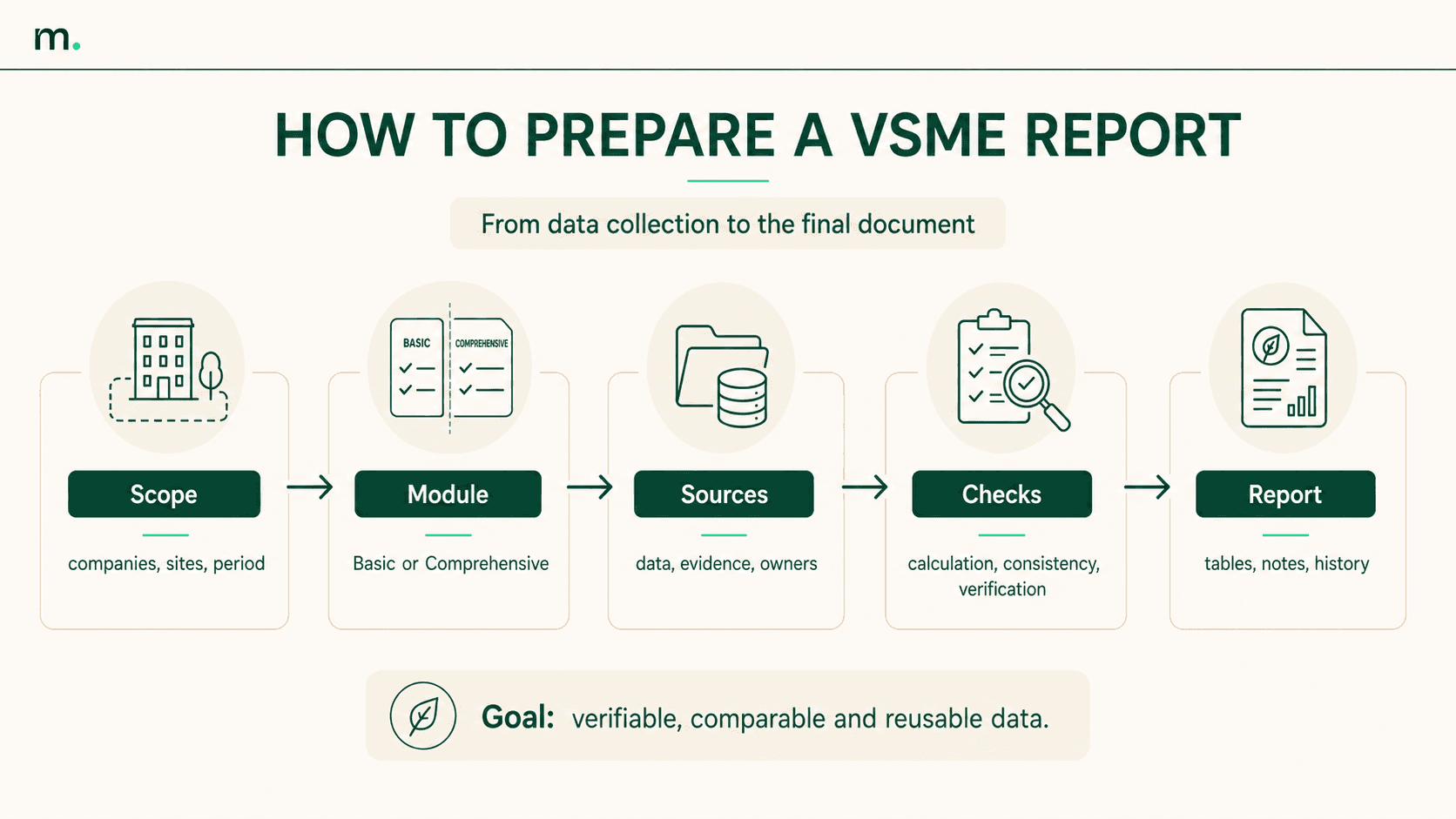
The process should begin by defining the reporting scope and conclude with a formal review of indicators, sources and responsibilities.
Companies beginning the process in 2026 should also consider the transition towards the Voluntary Standard. The continuity between the two frameworks allows companies to retain the work already completed, although individual disclosures will need to be checked against the final applicable version.
Define the scope, reporting period and responsibilities
The first step is to establish which companies, sites and activities are included in the VSME report.
The company must indicate whether the report is prepared on an individual or consolidated basis. Where subsidiaries are present, the company may prepare a report covering both the parent company and its controlled entities.
The reporting period should be aligned with the financial reporting period. This alignment makes it easier to compare financial indicators, operational data and sustainability information.
At this stage, the company should appoint a project owner and define the functions involved, internal collection deadlines, data owners for each area and the required approval level.
A clear allocation of responsibilities reduces delays and duplicate requests. It also identifies who is responsible for reviewing and explaining changes compared with the previous reporting period.
Select the module and map the data
Once the module has been selected, the company can associate each VSME disclosure with an internal source.
Energy data may come from invoices, meters or facility management systems. Workforce information generally comes from human resources systems and health and safety records. Waste, water and pollutants may require input from production, maintenance or HSE teams.
For each indicator, the company should record:
the definition used;
the unit of measurement;
the reporting period;
the relevant company or site;
the data source;
the person responsible;
the calculation method;
the approval status.
This mapping makes it possible to distinguish data that are already available, data that require calculation and data that the company does not yet collect.
The result is a practical assessment of the work required, the functions that need to be involved and the existing information gaps.
Collect data and supporting evidence
Every reported value should be traceable to a source. Invoices, registers, system exports, certificates and workforce records make it possible to verify the data and update calculations in subsequent years.
Traceability is particularly important when the sustainability report is used for a credit assessment, tender or supplier qualification process. A value without supporting evidence may be difficult to confirm even when the calculation itself is correct.
From the second reporting year onwards, the report should also include prior-year comparative data where available. To make these comparisons meaningful, reporting scopes, formulas and units of measurement must remain consistent.
Any methodological changes should be documented. The same applies to acquisitions, disposals, new facilities or other changes affecting the reporting scope.
Calculate and review the indicators
Some information can be extracted directly from company systems. Other indicators require calculations based on shared methodological criteria.
To calculate Scope 1 and Scope 2 emissions, companies must begin with fuel and energy consumption and apply emission factors that are appropriate for the reporting period, energy source and geographical area. The distinction between Scope 1, 2 and 3 emissions helps companies define the correct reporting boundary, while calculating a corporate carbon footprint requires documented activity data, emission factors and methodological criteria.
For each calculation, it is useful to retain the original activity data, the unit of measurement, the emission factor, the source of the factor and the calculated result as separate records.
Social indicators also require precise definitions. Employee turnover, accident rates and training hours should be calculated consistently across sites and legal entities.
Before publication, the report should pass three types of review.
The completeness review confirms that all applicable disclosures have been completed. The consistency review compares reporting periods, boundaries and units of measurement. The reliability review confirms that the required sources and approvals are available.
Significant changes compared with the previous year should be analyzed separately. They may result from operational developments, reporting scope changes or revised calculation methods. An explanation allows readers to interpret the indicator correctly.
Prepare and update the VSME report
The sustainability report may be published as a standalone document or integrated into another corporate report. Where information is already included in a public document, the standard allows the company to reference it clearly.
The report structure should follow the sequence of the VSME disclosures. Tables and charts are useful for quantitative indicators, while concise methodological notes can explain the reporting scope, data sources and any exclusions.
The first reporting cycle generally requires the most work because the company must identify data sources, criteria and responsibilities. In subsequent years, the process becomes more efficient when historical data, calculation rules and supporting documents have been retained.
In preparation for the Voluntary Standard entering into force, companies should maintain a flexible data collection structure. This will allow them to update individual requirements without rebuilding the entire reporting process.
Which software should be used for a VSME-aligned report?
Sustainability reporting software should support data collection, review and updating. Generating the final document covers only a limited part of the ESG reporting process.
The first feature to assess is whether the platform supports both the Basic Module and the Comprehensive Module. The system should indicate which information is required, allow tasks to be assigned to data owners and display the completion status.
Given the regulatory developments introduced in 2026, the software should also allow disclosures and data points to be updated without losing the historical information already collected under VSME.
For companies with multiple entities or operational sites, it is important to keep data from individual units separate while consolidating them into an overall result. This makes it possible to identify missing values, unusual changes or inconsistencies in the methods used.
Traceability is another core requirement. Each indicator should be linked to its source, update date, calculation method and the people who entered and approved it.
For environmental indicators, ESG software should manage conversions, emission factors and calculations while retaining visibility over the original data. Historical records make it possible to compare reporting years and understand the reasons behind changes.
When can excel be sufficient?
A spreadsheet may be sufficient for a microenterprise with one person responsible, a simple reporting scope and a limited number of indicators.
Management becomes more complex when the number of contributors, companies, sites, documents and review steps increases.
In these situations, altered formulas, duplicate files and separately stored sources may reduce the reliability of the report and increase the time needed to update it.
Metrikflow for VSME reporting
Metrikflow is sustainability reporting software that allows companies to manage the information required by VSME within a single environment.
Tasks can be assigned to the relevant business functions, with defined responsibilities and deadlines. The platform supports the consolidation of data from multiple sites or entities, the attachment of supporting evidence and the monitoring of reporting progress.
Calculation functions support the management of environmental indicators, while historical records preserve data, sources and results from previous reporting periods.
The information collected can be reused to respond to customers, banks and other business partners, reducing the need to start a separate data collection process for every request.
The choice of VSME software should therefore begin with the company’s reporting process: the number of people involved, the complexity of the reporting scope, the frequency of requests and the need to update the report over time. A structured platform makes these steps more controlled, measurable and repeatable, while also supporting the transition from VSME to the new Voluntary Standard.
CONTRIBUTOR

Sharon Ridolfo
ESG specialist
With a background in international environmental research, Sharon has developed advanced skills in data analysis and emissions monitoring, with a focus on the study of air pollutants and environmental impacts. After coordinating research activities in European Horizon 2020 projects and developing monitoring plans and environmental risk assessments, she now deals with ESG reporting and sustainability reporting, supporting companies in structuring solid, measurable data that is consistent with the main reference standards. Cheerful and energetic, she is passionate about the animal world and environmental protection, values that reinforce her professional commitment. Topics covered: ESG reporting, sustainability reporting, environmental KPIs, emissions monitoring, climate change, environmental data analysis.
Stay up to date with Metrikflow Insights!
We deliver expert insights, product updates, industry trends, and actionable strategies straight to your inbox. Stay ahead in ESG, GHG, and LCA — one edition at a time.
By submitting this form, you consent to receive the requested resource. For more information on how we process and protect your data, view our Privacy Policy.


