Sustainability Leaders Milan • December 3Roundtables, AI workshops and networking.Discover the event →

Solutions

Resources

Solutions

Resources

ESG Regulations & Compliance

ESG Regulations & Compliance

ESPR: what the new EU Ecodesign Regulation means for companies

ESPR: what the new EU Ecodesign Regulation means for companies

Updated September 2026

Headshot Alessandro Nora
Alessandro Nora
Cover image illustrating the ESPR and Digital Product Passport workflow, showing EU product regulation, sustainable product design, digital product data, supply chain actors and compliance verification.

What is ESPR and what are the objectives of the regulation?

The Ecodesign for Sustainable Products Regulation (ESPR) establishes the framework through which the European Commission can introduce ecodesign requirements for products placed on the market or put into service in the EU.

The ESPR ecodesign regulation replaces Directive 2009/125/EC, which focused primarily on energy-related products. Despite occasional references to an ESPR Directive, ESPR is a regulation and is therefore directly applicable across EU Member States rather than requiring transposition into individual national legislation.

Its potential scope extends to a much broader range of physical goods and brings ESPR ecodesign principles into more stages of the product life cycle.

Depending on the product group concerned, future ESPR requirements may address characteristics such as durability, repairability, reusability, recycled content, energy and resource efficiency, recyclability and environmental or carbon footprint.

For some of these indicators, methodologies such as Life Cycle Assessment (LCA) already allow companies to quantify environmental impacts throughout the entire product life cycle.

From an ESPR sustainability perspective, this creates a closer connection between product design decisions, environmental performance and the evidence required to demonstrate compliance.

For manufacturing companies, certain environmental parameters may therefore progressively become requirements for accessing the European market.

The regulation applies to operators placing products covered by future delegated acts on the EU market, including non-EU manufacturers selling into Europe. Obligations may also involve importers, distributors and other actors across the commercial supply chain.

Which products does ESPR apply to?

ESPR establishes a very broad general scope, but this does not mean that every product must already comply with the same set of requirements.

The system operates by product group.

The European Commission identifies priority categories and develops specific requirements through preparatory studies, impact assessments, consultations and subsequent delegated acts. Requirements may apply to an individual product group or horizontally across several categories with common characteristics.

The process is also supported by the Ecodesign Forum. The Ecodesign Forum under ESPR brings together representatives from EU Member States, industry, civil society and other stakeholders to contribute to the development of priorities and implementing measures.

Assessing the impact of ESPR in Europe therefore starts with a company's product portfolio: organisations need to determine which categories are included in the European working plan and which specific measures have already been adopted.

ESPR performance requirements vs information requirements

The regulation distinguishes, in particular, between performance requirements and information requirements.

Performance requirements may establish minimum levels or criteria related to product characteristics. Information requirements determine which data must be made available and how.

Infographic on ESPR performance and information requirements and their operational impact on companies.

For a specific category, an ESPR delegated act could therefore set thresholds or criteria for recycled content, spare-part availability or durability. It could also require quantified information on carbon footprint, environmental footprint or other parameters relevant to the product.

These ESPR requirements will consequently vary between product groups and will need to be assessed together with the applicable delegated acts.

The operational implication is significant: compliance will depend on a company's ability to demonstrate declared product characteristics through verifiable data, calculation methods and documentation.

Before placing a product covered by a delegated act on the market, manufacturers will need to carry out the required conformity assessment procedure, prepare the necessary technical documentation and ensure that the product meets the applicable performance and information requirements.

For companies managing broad product portfolios or international supply chains, this raises an immediate data question. Bills of materials, material composition, production energy consumption, supplier information, recycled content percentages and end-of-life data are often managed across different departments and systems.

A significant proportion of this information may also depend directly on suppliers. Establishing a structured process for supplier assessment and supply chain data collection helps identify data sources, responsibilities and information gaps before those data become necessary for demonstrating compliance.

ESPR therefore increases the value of a structured and traceable product data foundation, particularly when information needs to be collected and updated by multiple actors.

The ban on destroying unsold products

ESPR also contains specific provisions addressing unsold consumer products.

Since 19 July 2026, large companies have been prohibited from destroying certain unsold apparel, clothing accessories and footwear. The prohibition will apply to medium-sized companies from 19 July 2030, while micro and small enterprises are excluded from the general prohibition under Article 25.

Commission Delegated Regulation (EU) 2026/296 defines specific exemptions, for example for products that are dangerous, damaged or contaminated, cannot be repaired, or infringe intellectual property rights. Companies relying on an exemption must properly document and support it with the relevant evidence.

Companies are also subject to disclosure requirements concerning quantities of unsold consumer products discarded as waste. In February 2026, the Commission adopted a standardised format to make this information comparable. The new rules will apply from 2 March 2027 under Commission Implementing Regulation (EU) 2026/2.

For companies operating in the textile and footwear sectors, this represents one of the first operational applications of ESPR and already requires clear procedures for classifying unsold goods, documenting their destination and retaining the necessary evidence.

ESPR and the Digital Product Passport: what is the connection?

The Digital Product Passport (DPP) is one of the key tools introduced under ESPR to make information associated with a product available in a structured digital format.

The connection between ESPR and the Digital Product Passport is direct. The relationship is also commonly referred to as ESPR DPP: where required by the applicable delegated act, a product may only be placed on the market if a compliant DPP is available. Its data must be accurate, complete and up to date.

Infographic on the link between ESPR and the Digital Product Passport, including product, environmental and compliance data.

The passport will be connected to the product through an electronically readable data carrier, such as a two-dimensional code. Information must use interoperable formats and open standards so that it can be accessed and exchanged between different systems.

There will not be one standard set of information applying identically to every DPP.

Delegated acts will establish, for each product group, which information must be included, which data carrier must be used and whether the passport should apply at model, batch or individual item level. The ESPR Digital Product Passport may therefore contain product identifiers, compliance documentation, manufacturer and importer information, manuals and data linked to applicable environmental requirements.

For companies, preparing for the Digital Product Passport therefore starts with the underlying information structure.

A company needs to determine which data it already has, who is responsible for it, at what level of detail it is collected and how easily it can be updated. Where required information comes from a supplier, the company also needs a reliable process for obtaining and verifying it.

The relationship between the DPP and ESPR therefore brings product data quality and traceability directly into compliance processes.

ESPR 2026: which products are affected and when do the new requirements apply?

In 2026, ESPR is already in force, while specific product requirements continue to be developed progressively.

The ESPR entry into force date was 18 July 2024, following publication of Regulation (EU) 2024/1781 in the Official Journal of the European Union. The full ESPR legal text and subsequent measures can be monitored through EUR-Lex, the EU's official legal database.

Infographic with five steps to prepare for ESPR, from product mapping and data management to supplier engagement and delegated act monitoring.

The European Commission's ESPR and Energy Labelling Working Plan 2025-2030 identifies the product categories on which the first set of requirements will focus.

Priorities include textiles and apparel, furniture, tyres, mattresses, iron and steel, and aluminium. Horizontal measures are also planned for repairability and for the recycled content and recyclability of electrical and electronic equipment.

For the furniture sector, ESPR is therefore particularly relevant, as furniture is one of the priority product groups for which the Commission plans to develop specific requirements.

Being included in the working plan, however, does not mean that new requirements for that category immediately become applicable.

The application dates for individual ESPR regulations, delegated acts and implementing measures depend on the relevant legal instrument and product group.

For each product group, technical requirements, verification methods and application timelines must be developed. Companies therefore need to monitor the regulatory status of their specific product categories separately.

For sustainability, compliance or product development managers, a broad question such as “Does ESPR apply to our company?” may therefore be insufficient.

The assessment should be carried out at least at the level of product family, destination market and the company's position within the value chain.

A manufacturer of steel components, for example, may be affected both by developments concerning the intermediate material and by requirements applying to the final product in which that component is used. Similarly, a non-EU company selling products into the European market must consider the requirements governing the placing of those products on the EU market.

How can companies prepare for ESPR?

For many product groups, part of the technical framework is still under development. Companies can use this period to work on areas that will remain relevant regardless of the final thresholds adopted.

The first step is to map the product portfolio and connect each product family to the categories included in the ESPR working plan. For complex products, relevant materials and components should also be considered to identify potential dependencies on upstream requirements.

The second area is data.

Companies can build a matrix linking each product family to the environmental information already available, its source and the person or function responsible for it. This makes it possible to separate information already stored in internal systems from data that needs to be collected from the supply chain.

Particular attention should be paid to information that may require structured calculations. Carbon footprint, environmental footprint and life cycle indicators cannot be reliably reconstructed at the end of a compliance process if primary data on materials, energy, production, transport or suppliers are missing.

For relevant product groups, tools such as LCA software and Product Carbon Footprint (PCF) can help establish the quantitative foundation needed to manage future product environmental requirements.

Where emissions calculations need to be structured and updated systematically, carbon footprint software can also centralise activity data, emission factors and supporting documentation.

The third area concerns governance. Companies should define who validates information coming from procurement, manufacturing, product development, quality teams and suppliers, how frequently those data are updated and where the supporting evidence is stored.

Finally, companies should monitor the ESPR delegated acts applying to their product categories. These acts will define specific requirements, calculation methods, Digital Product Passport data, conformity assessment procedures and effective application dates.

For regulatory monitoring, the key reference sources remain the European Commission, EUR-Lex, the Official Journal of the European Union and the Ecodesign Forum. The European Commission also publishes an ESPR FAQ covering practical questions on scope, product groups, the Digital Product Passport and implementation. Specialist guidance and ESPR webinars can provide additional context, but final compliance checks should always start from official legal sources.

ESPR is creating a common European framework, while implementation will necessarily remain product-specific. Companies that can connect product master data, environmental information, supplier data and compliance documentation will have a stronger operational foundation for addressing new requirements as they are introduced.

The ESPR, Ecodesign for Sustainable Products Regulation, is the new European framework for setting ecodesign requirements for products placed on the EU market.

Regulation (EU) 2024/1781, which entered into force on 18 July 2024, significantly expands the scope of the previous Ecodesign Directive. The new ESPR regulation can potentially cover almost all physical goods marketed in the EU, including components and intermediate products, with some exclusions such as food, feed and medicinal products.

The current regulation originates from the ESPR proposal presented by the European Commission on 30 March 2022 and replaces the previous framework established under Directive 2009/125/EC.

For companies operating in Europe, the impact of ESPR mainly concerns three areas: product characteristics and environmental performance, availability of life cycle data and compliance documentation.

Specific requirements, however, do not enter into force at the same time for every product. The European Commission will progressively define them through ESPR delegated acts covering different product groups.

Understanding how this mechanism works is therefore essential to distinguish requirements that already apply from measures companies need to start preparing for.
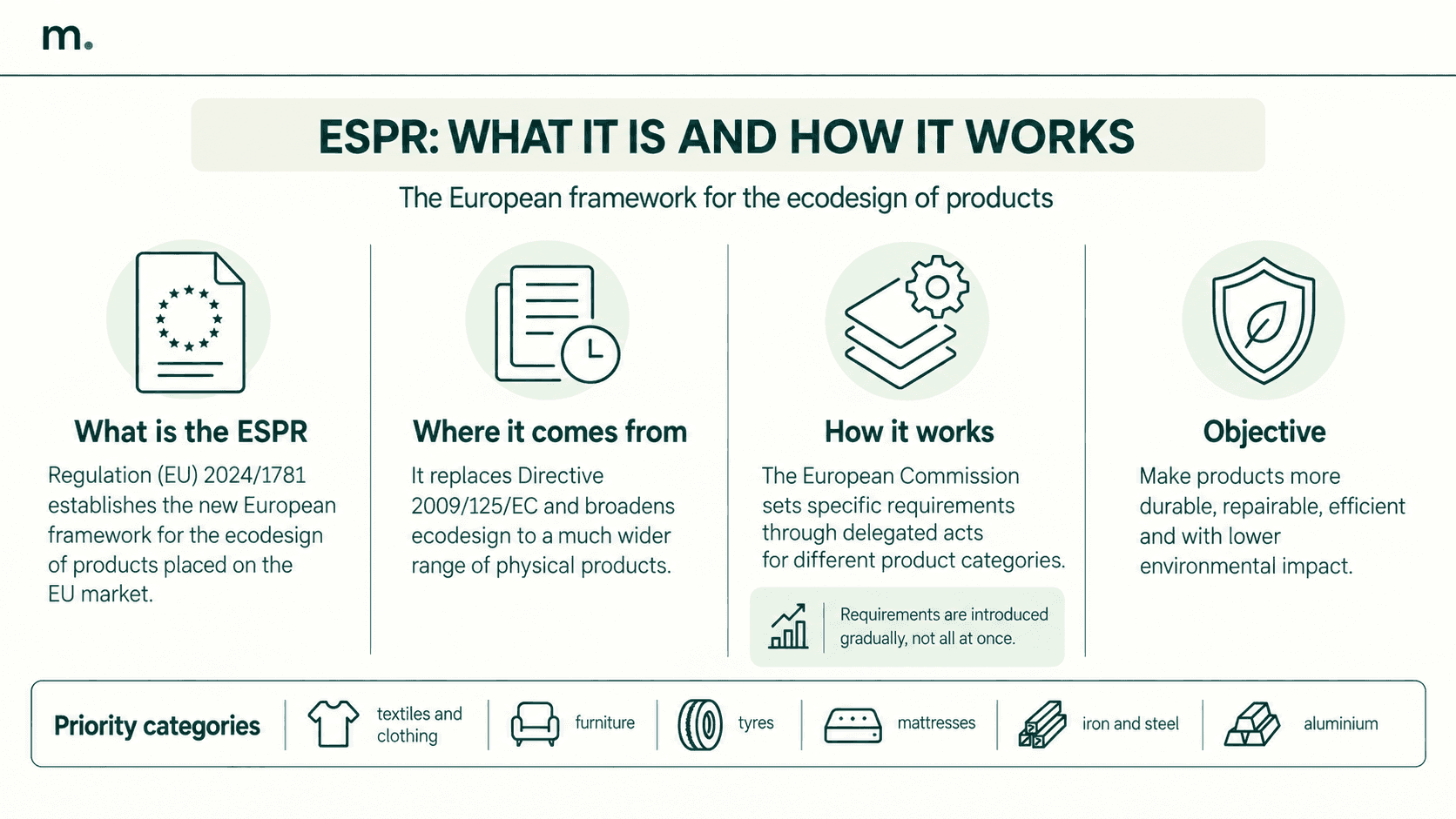
ESPR infographic explaining the regulation, its legal background, delegated acts and priority product categories.

What is ESPR and what are the objectives of the regulation?

The Ecodesign for Sustainable Products Regulation (ESPR) establishes the framework through which the European Commission can introduce ecodesign requirements for products placed on the market or put into service in the EU.

The ESPR ecodesign regulation replaces Directive 2009/125/EC, which focused primarily on energy-related products. Despite occasional references to an ESPR Directive, ESPR is a regulation and is therefore directly applicable across EU Member States rather than requiring transposition into individual national legislation.

Its potential scope extends to a much broader range of physical goods and brings ESPR ecodesign principles into more stages of the product life cycle.

Depending on the product group concerned, future ESPR requirements may address characteristics such as durability, repairability, reusability, recycled content, energy and resource efficiency, recyclability and environmental or carbon footprint.

For some of these indicators, methodologies such as Life Cycle Assessment (LCA) already allow companies to quantify environmental impacts throughout the entire product life cycle.

From an ESPR sustainability perspective, this creates a closer connection between product design decisions, environmental performance and the evidence required to demonstrate compliance.

For manufacturing companies, certain environmental parameters may therefore progressively become requirements for accessing the European market.

The regulation applies to operators placing products covered by future delegated acts on the EU market, including non-EU manufacturers selling into Europe. Obligations may also involve importers, distributors and other actors across the commercial supply chain.

Which products does ESPR apply to?

ESPR establishes a very broad general scope, but this does not mean that every product must already comply with the same set of requirements.

The system operates by product group.

The European Commission identifies priority categories and develops specific requirements through preparatory studies, impact assessments, consultations and subsequent delegated acts. Requirements may apply to an individual product group or horizontally across several categories with common characteristics.

The process is also supported by the Ecodesign Forum. The Ecodesign Forum under ESPR brings together representatives from EU Member States, industry, civil society and other stakeholders to contribute to the development of priorities and implementing measures.

Assessing the impact of ESPR in Europe therefore starts with a company's product portfolio: organisations need to determine which categories are included in the European working plan and which specific measures have already been adopted.

ESPR performance requirements vs information requirements

The regulation distinguishes, in particular, between performance requirements and information requirements.

Performance requirements may establish minimum levels or criteria related to product characteristics. Information requirements determine which data must be made available and how.
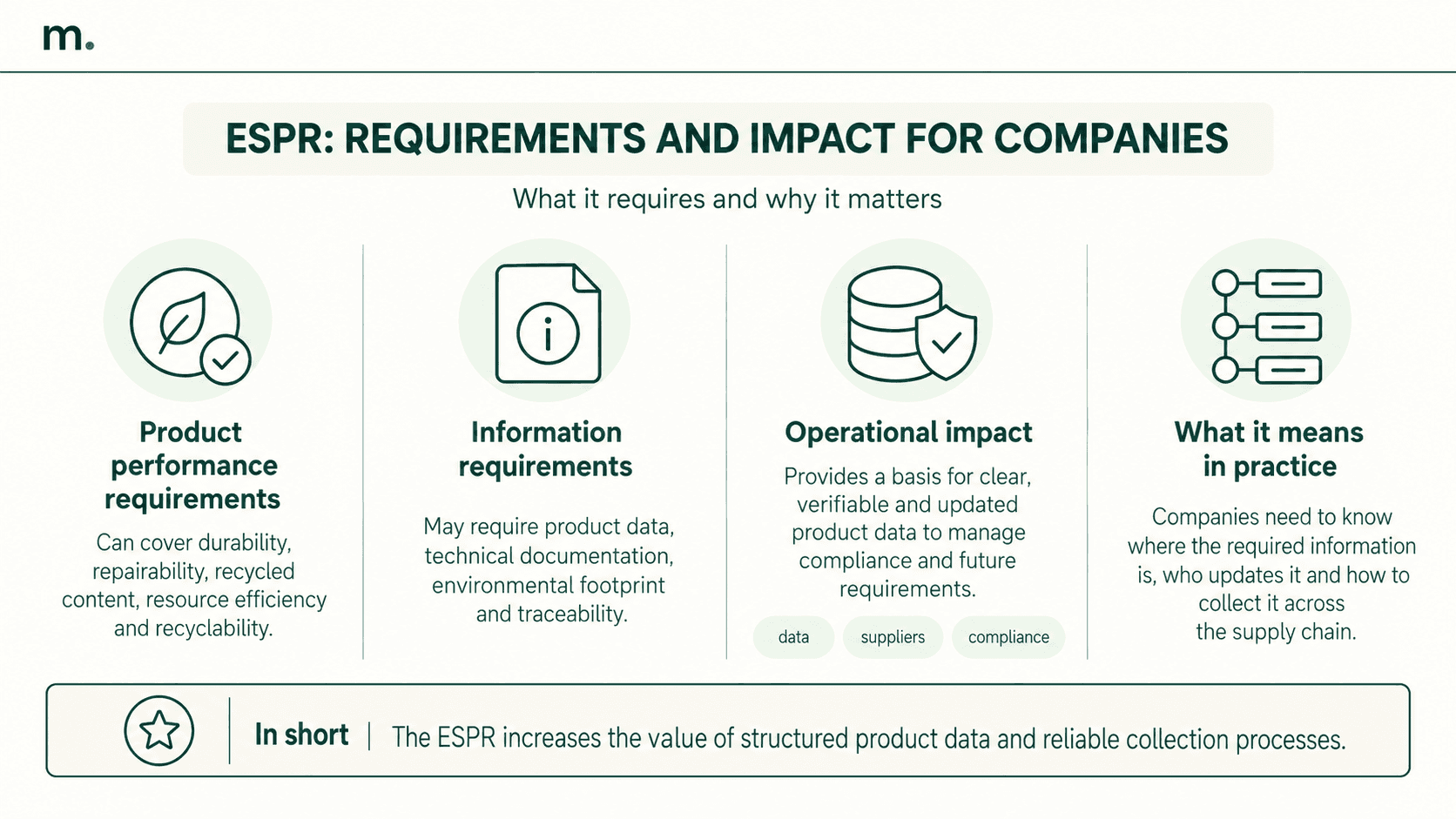
Infographic on ESPR performance and information requirements and their operational impact on companies.

For a specific category, an ESPR delegated act could therefore set thresholds or criteria for recycled content, spare-part availability or durability. It could also require quantified information on carbon footprint, environmental footprint or other parameters relevant to the product.

These ESPR requirements will consequently vary between product groups and will need to be assessed together with the applicable delegated acts.

The operational implication is significant: compliance will depend on a company's ability to demonstrate declared product characteristics through verifiable data, calculation methods and documentation.

Before placing a product covered by a delegated act on the market, manufacturers will need to carry out the required conformity assessment procedure, prepare the necessary technical documentation and ensure that the product meets the applicable performance and information requirements.

For companies managing broad product portfolios or international supply chains, this raises an immediate data question. Bills of materials, material composition, production energy consumption, supplier information, recycled content percentages and end-of-life data are often managed across different departments and systems.

A significant proportion of this information may also depend directly on suppliers. Establishing a structured process for supplier assessment and supply chain data collection helps identify data sources, responsibilities and information gaps before those data become necessary for demonstrating compliance.

ESPR therefore increases the value of a structured and traceable product data foundation, particularly when information needs to be collected and updated by multiple actors.

The ban on destroying unsold products

ESPR also contains specific provisions addressing unsold consumer products.

Since 19 July 2026, large companies have been prohibited from destroying certain unsold apparel, clothing accessories and footwear. The prohibition will apply to medium-sized companies from 19 July 2030, while micro and small enterprises are excluded from the general prohibition under Article 25.

Commission Delegated Regulation (EU) 2026/296 defines specific exemptions, for example for products that are dangerous, damaged or contaminated, cannot be repaired, or infringe intellectual property rights. Companies relying on an exemption must properly document and support it with the relevant evidence.

Companies are also subject to disclosure requirements concerning quantities of unsold consumer products discarded as waste. In February 2026, the Commission adopted a standardised format to make this information comparable. The new rules will apply from 2 March 2027 under Commission Implementing Regulation (EU) 2026/2.

For companies operating in the textile and footwear sectors, this represents one of the first operational applications of ESPR and already requires clear procedures for classifying unsold goods, documenting their destination and retaining the necessary evidence.

ESPR and the Digital Product Passport: what is the connection?

The Digital Product Passport (DPP) is one of the key tools introduced under ESPR to make information associated with a product available in a structured digital format.

The connection between ESPR and the Digital Product Passport is direct. The relationship is also commonly referred to as ESPR DPP: where required by the applicable delegated act, a product may only be placed on the market if a compliant DPP is available. Its data must be accurate, complete and up to date.
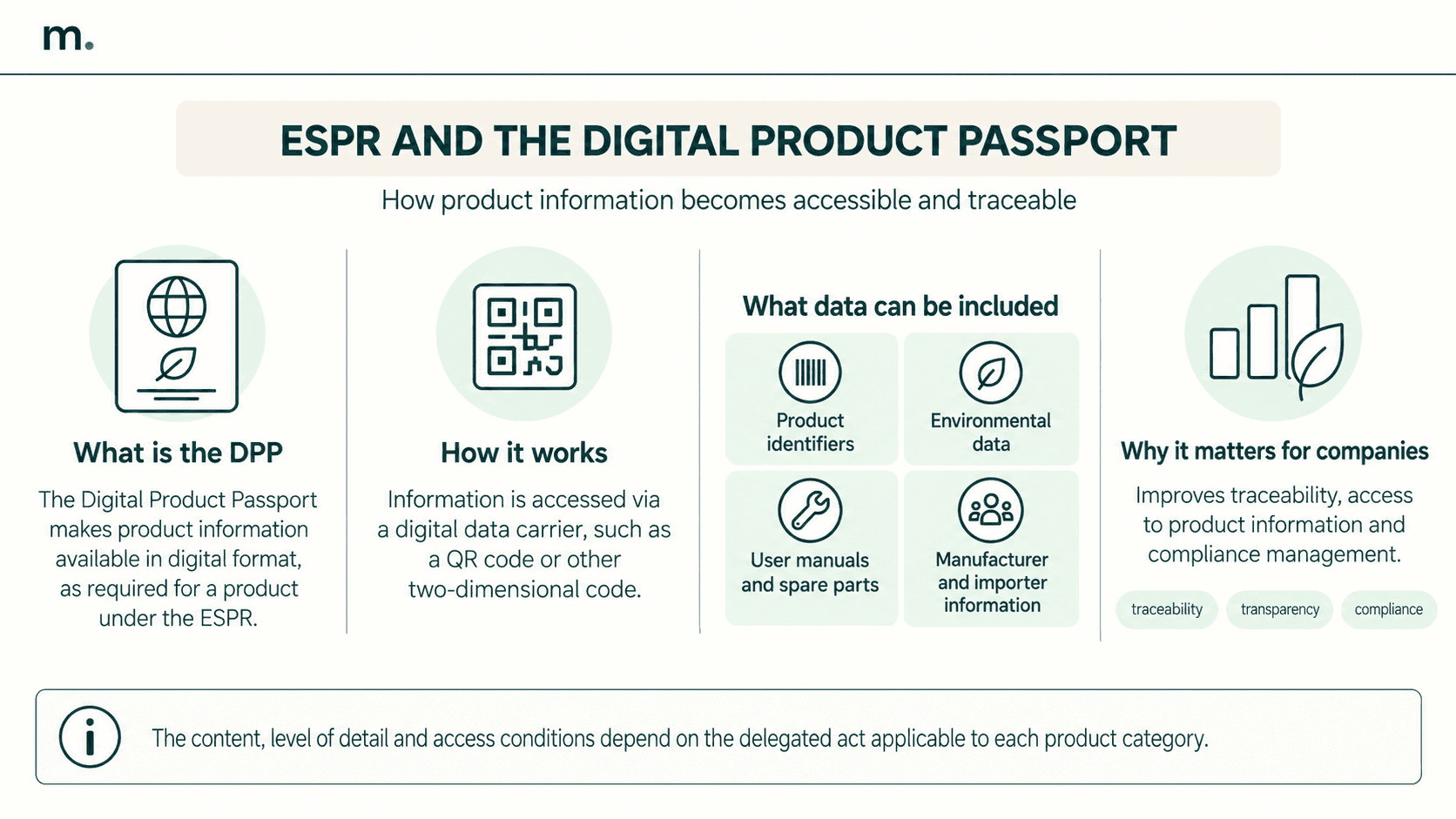
Infographic on the link between ESPR and the Digital Product Passport, including product, environmental and compliance data.

The passport will be connected to the product through an electronically readable data carrier, such as a two-dimensional code. Information must use interoperable formats and open standards so that it can be accessed and exchanged between different systems.

There will not be one standard set of information applying identically to every DPP.

Delegated acts will establish, for each product group, which information must be included, which data carrier must be used and whether the passport should apply at model, batch or individual item level. The ESPR Digital Product Passport may therefore contain product identifiers, compliance documentation, manufacturer and importer information, manuals and data linked to applicable environmental requirements.

For companies, preparing for the Digital Product Passport therefore starts with the underlying information structure.

A company needs to determine which data it already has, who is responsible for it, at what level of detail it is collected and how easily it can be updated. Where required information comes from a supplier, the company also needs a reliable process for obtaining and verifying it.

The relationship between the DPP and ESPR therefore brings product data quality and traceability directly into compliance processes.

ESPR 2026: which products are affected and when do the new requirements apply?

In 2026, ESPR is already in force, while specific product requirements continue to be developed progressively.

The ESPR entry into force date was 18 July 2024, following publication of Regulation (EU) 2024/1781 in the Official Journal of the European Union. The full ESPR legal text and subsequent measures can be monitored through EUR-Lex, the EU's official legal database.
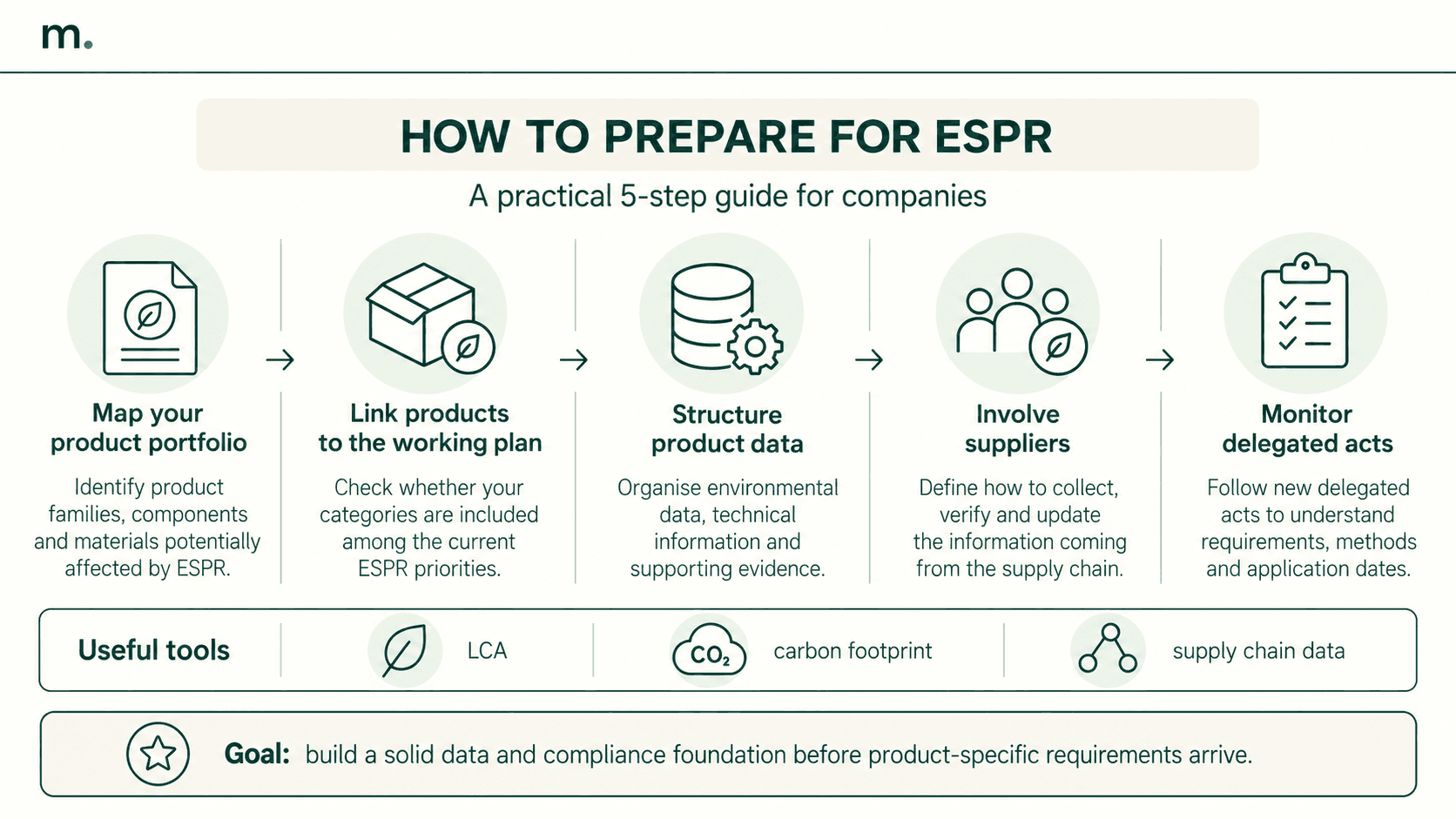
Infographic with five steps to prepare for ESPR, from product mapping and data management to supplier engagement and delegated act monitoring.

The European Commission's ESPR and Energy Labelling Working Plan 2025-2030 identifies the product categories on which the first set of requirements will focus.

Priorities include textiles and apparel, furniture, tyres, mattresses, iron and steel, and aluminium. Horizontal measures are also planned for repairability and for the recycled content and recyclability of electrical and electronic equipment.

For the furniture sector, ESPR is therefore particularly relevant, as furniture is one of the priority product groups for which the Commission plans to develop specific requirements.

Being included in the working plan, however, does not mean that new requirements for that category immediately become applicable.

The application dates for individual ESPR regulations, delegated acts and implementing measures depend on the relevant legal instrument and product group.

For each product group, technical requirements, verification methods and application timelines must be developed. Companies therefore need to monitor the regulatory status of their specific product categories separately.

For sustainability, compliance or product development managers, a broad question such as “Does ESPR apply to our company?” may therefore be insufficient.

The assessment should be carried out at least at the level of product family, destination market and the company's position within the value chain.

A manufacturer of steel components, for example, may be affected both by developments concerning the intermediate material and by requirements applying to the final product in which that component is used. Similarly, a non-EU company selling products into the European market must consider the requirements governing the placing of those products on the EU market.

How can companies prepare for ESPR?

For many product groups, part of the technical framework is still under development. Companies can use this period to work on areas that will remain relevant regardless of the final thresholds adopted.

The first step is to map the product portfolio and connect each product family to the categories included in the ESPR working plan. For complex products, relevant materials and components should also be considered to identify potential dependencies on upstream requirements.

The second area is data.

Companies can build a matrix linking each product family to the environmental information already available, its source and the person or function responsible for it. This makes it possible to separate information already stored in internal systems from data that needs to be collected from the supply chain.

Particular attention should be paid to information that may require structured calculations. Carbon footprint, environmental footprint and life cycle indicators cannot be reliably reconstructed at the end of a compliance process if primary data on materials, energy, production, transport or suppliers are missing.

For relevant product groups, tools such as LCA software and Product Carbon Footprint (PCF) can help establish the quantitative foundation needed to manage future product environmental requirements.

Where emissions calculations need to be structured and updated systematically, carbon footprint software can also centralise activity data, emission factors and supporting documentation.

The third area concerns governance. Companies should define who validates information coming from procurement, manufacturing, product development, quality teams and suppliers, how frequently those data are updated and where the supporting evidence is stored.

Finally, companies should monitor the ESPR delegated acts applying to their product categories. These acts will define specific requirements, calculation methods, Digital Product Passport data, conformity assessment procedures and effective application dates.

For regulatory monitoring, the key reference sources remain the European Commission, EUR-Lex, the Official Journal of the European Union and the Ecodesign Forum. The European Commission also publishes an ESPR FAQ covering practical questions on scope, product groups, the Digital Product Passport and implementation. Specialist guidance and ESPR webinars can provide additional context, but final compliance checks should always start from official legal sources.

ESPR is creating a common European framework, while implementation will necessarily remain product-specific. Companies that can connect product master data, environmental information, supplier data and compliance documentation will have a stronger operational foundation for addressing new requirements as they are introduced.

CONTRIBUTOR

Headshot Alessandro Nora

Alessandro Nora

CEO & Co-founder

Alessandro's goal is to make a real impact on sustainability. After founding a sustainable fashion marketplace, he decided to focus on ESG digitalisation with the aim of making sustainability more concrete, measurable and accessible for companies. A careful and methodical founder, with experience in Genoa, Berlin and Lisbon, Alessandro combines international vision and operational rigour in the development of digital solutions that simplify ESG regulations and compliance, supporting companies in adapting to ESG regulations, certifications and ratings through structured and audit-ready tools. Topics covered: CSRD, CSDDD, EUDR, CBAM ESG ratings, ESG certifications, Ecovadis, sustainability governance, regulatory compliance.

No headings found on page

Stay up to date with Metrikflow Insights!

We deliver expert insights, product updates, industry trends, and actionable strategies straight to your inbox. Stay ahead in ESG, GHG, and LCA — one edition at a time.

By submitting this form, you consent to receive the requested resource. For more information on how we process and protect your data, view our Privacy Policy.

The go-to software solution for
Sustainability Managers.

The go-to software solution for Sustainability Managers.

Customer-Oriented

Data Accurate

Built on Smart Tech

Contact us

Our team is here to help. Feel free to ask us anything.

By submitting this form you consent to our Privacy Policy.

ESG radar: The Metrikflow Newsletter

Everything you need to know about sustainability,
all-in-one email. Weekly insights. Zero spam.

By submitting this form, you consent to receive the requested resource. For more information on how we process and protect your data, view our Privacy Policy.

Ask AI for a summary of Metrikflow

chatgptclaudeperplexity

Contact Us

The only platform you ever need to manage ESG and Compliance.

Data Security

Measurable Impact

AI + ESG Experts

Measurable Impact

AI + ESG Experts

Data Security

Contact us

Our team is here to help. Feel free to ask us anything.

By submitting this form you consent to our Privacy Policy.

ESG radar: The Metrikflow Newsletter

Everything you need to know about sustainability,
all-in-one email. Weekly insights. Zero spam.

By submitting this form, you consent to receive the requested resource. For more information on how we process and protect your data, view our Privacy Policy.

Ask AI for a summary of Metrikflow

chatgptclaudeperplexity