


The Digital Product Passport, or DPP, is one of the tools introduced by the European Union to make technical, environmental and circularity information about products placed on the market more accessible and traceable.
For manufacturing companies, the DPP mainly concerns the ability to organise and keep product data up to date. Information on materials, components, suppliers, performance, environmental characteristics and technical documentation will need to be collected in a structured way and linked to the relevant product.
The main regulatory framework is Regulation (EU) 2024/1781, known as the ESPR, which establishes the European framework for sustainable products. Digital Product Passport requirements will be introduced gradually, with specific obligations depending on each product category.
Preparing for the DPP therefore means starting to understand which information is already available, where it is stored, who manages it, how reliable it is and how it can be kept up to date over time.
What is the Digital Product Passport (DPP) and how does it work?
The Digital Product Passport is a sort of digital identity card for a product. Its purpose is to collect and make available information that can be used to assess sustainability, circularity and compliance throughout the product life cycle.
The DPP will not simply be a document repository. It will need to allow different actors, including companies, authorities, professional customers, repairers, recyclers and supply chain operators, to access the information relevant to their role.
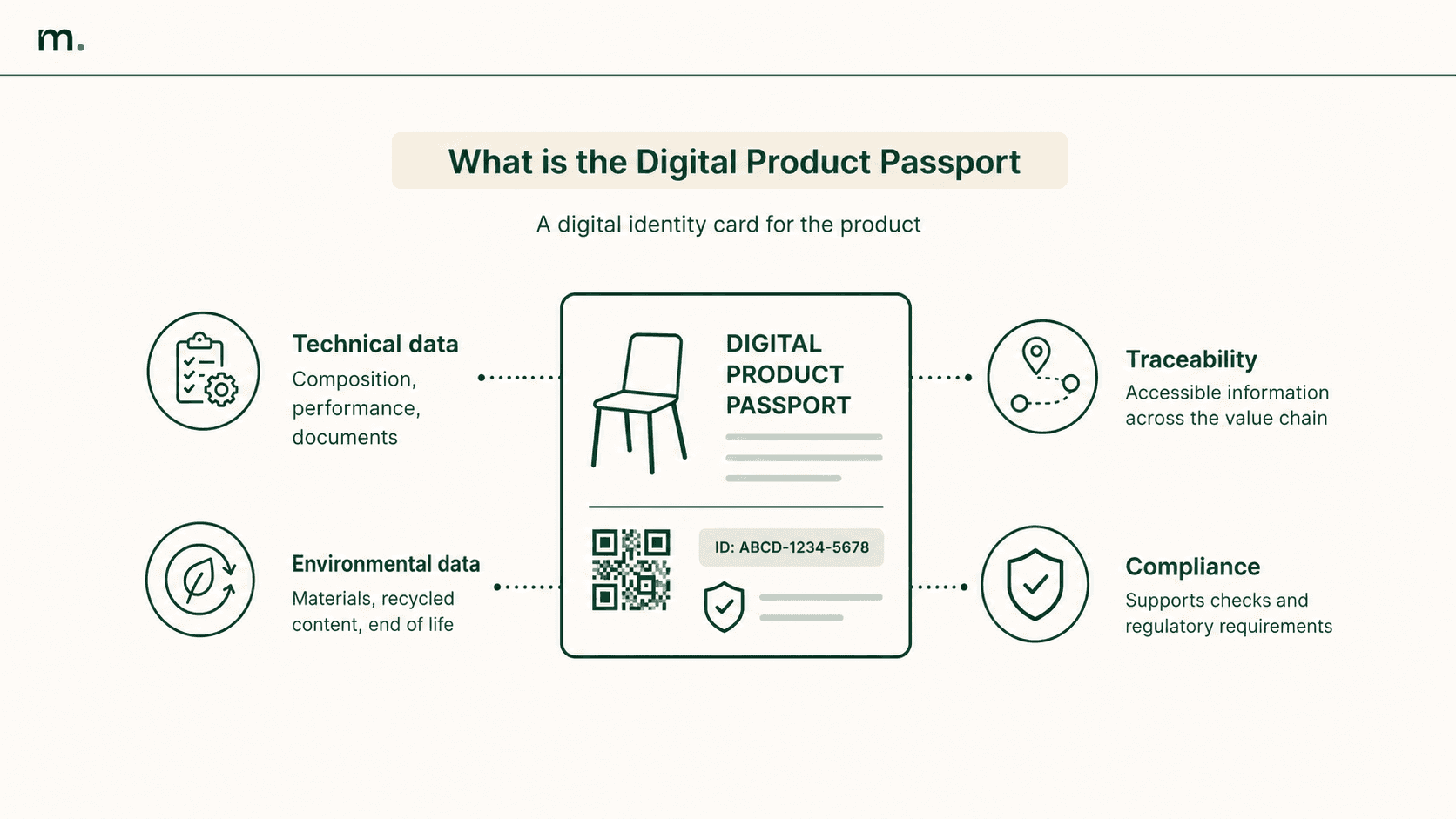
In practical terms, the Digital Product Passport is designed to improve product and data traceability. Each product can be described through information related to its composition, performance, materials, repairability, presence of relevant substances and end-of-life management.
This is particularly important for companies working with complex products, multiple suppliers or distributed production chains. In these cases, a significant part of the required information is not stored in a single company system, but across technical sheets, supplier declarations, certifications, bills of materials, quality documents and environmental analyses.
The operational value of the Digital Product Passport lies in its ability to turn fragmented data into structured, accessible and updatable information. To achieve this, companies need to understand which data is already available, which data is reliable, which information needs to be updated and which data is still missing.
DPP and ESPR: which products will be affected?
The Digital Product Passport is part of the ESPR, the Ecodesign for Sustainable Products Regulation. Regulation (EU) 2024/1781 expands the approach already established under ecodesign legislation, which was previously focused mainly on energy-related products.
Under the ESPR, the European Union can define specific requirements relating to durability, repairability, resource efficiency, recycled content, recyclability, substances of concern and environmental information. The DPP is one of the tools through which this information can be made accessible and verifiable.
The obligation will not apply to all products at the same time. The first 2025–2030 working plan identifies the priority categories on which the European Commission will start working, while specific requirements will be introduced through delegated acts for each product category.
The first priority categories can be divided into two groups.
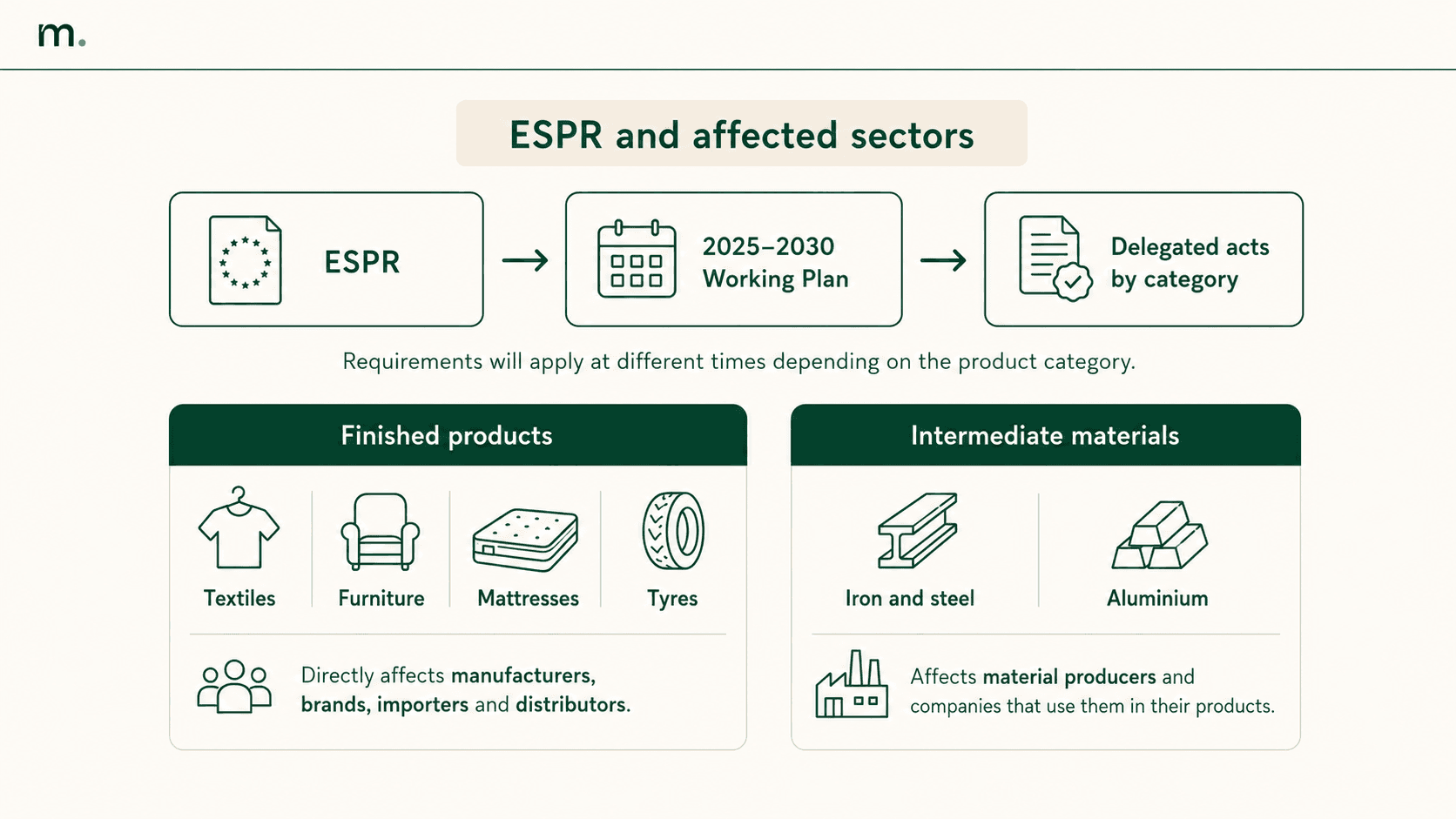
Finished products, where the impact is more direct for manufacturers, brands, importers, distributors and other operators placing products on the European market:
textiles, with a focus on apparel;
furniture;
mattresses;
tyres.
Intermediate materials, where the impact concerns both material producers and downstream companies using them in their own products:
iron and steel;
aluminium.
This distinction matters because it changes the type of preparation required. For a company selling a finished product, the Digital Product Passport will be directly linked to the product placed on the market. For a company producing or using intermediate materials, the focus may instead be on the ability to provide reliable data to industrial customers, manufacturers and supply chains that need to build the passport for the final product.
Even a company that does not directly sell products in a priority category may therefore be indirectly affected. A manufacturer supplying components, materials, semi-finished goods or treatments to a customer subject to the new requirements may receive requests for the data needed to build the Digital Product Passport of the final product.
The obligation will not apply to all products at the same time. The first 2025–2030 working plan identifies the priority categories on which the Commission will start working, but the concrete requirements will be defined through delegated acts specific to each category. For companies, this means that timing, required data and responsibilities will depend on the type of product placed on the market.
The first priority categories can be read in two groups.
Finished products, where the impact is more direct for manufacturers, brands, importers, distributors and operators placing the product on the European market:
textiles, with a focus on apparel;
furniture;
mattresses;
tyres.
Intermediate materials, where the impact concerns both those producing the material and downstream companies using it in their products:
iron and steel;
aluminium.
This distinction matters because it changes the type of preparation required. For a company selling a finished product, the Digital Product Passport will be directly connected to the product placed on the market. For a company producing or using intermediate materials, the issue may instead concern the ability to provide reliable data to industrial customers, manufacturers and supply chains that will need to build the passport for the final product.
When will the Digital Product Passport become mandatory?
There is no single date on which the Digital Product Passport will become mandatory for all products.
The DPP will be introduced progressively. Timelines, required information and the responsibilities of different economic operators will be defined for individual product categories through the delegated acts established under the ESPR.
Companies should therefore assess both whether their own products fall within priority categories and whether they operate as suppliers within value chains that will be affected. This makes it easier to understand when to start preparing, which information needs to be mapped and which internal functions should be involved.
What data will the Digital Product Passport need to contain?
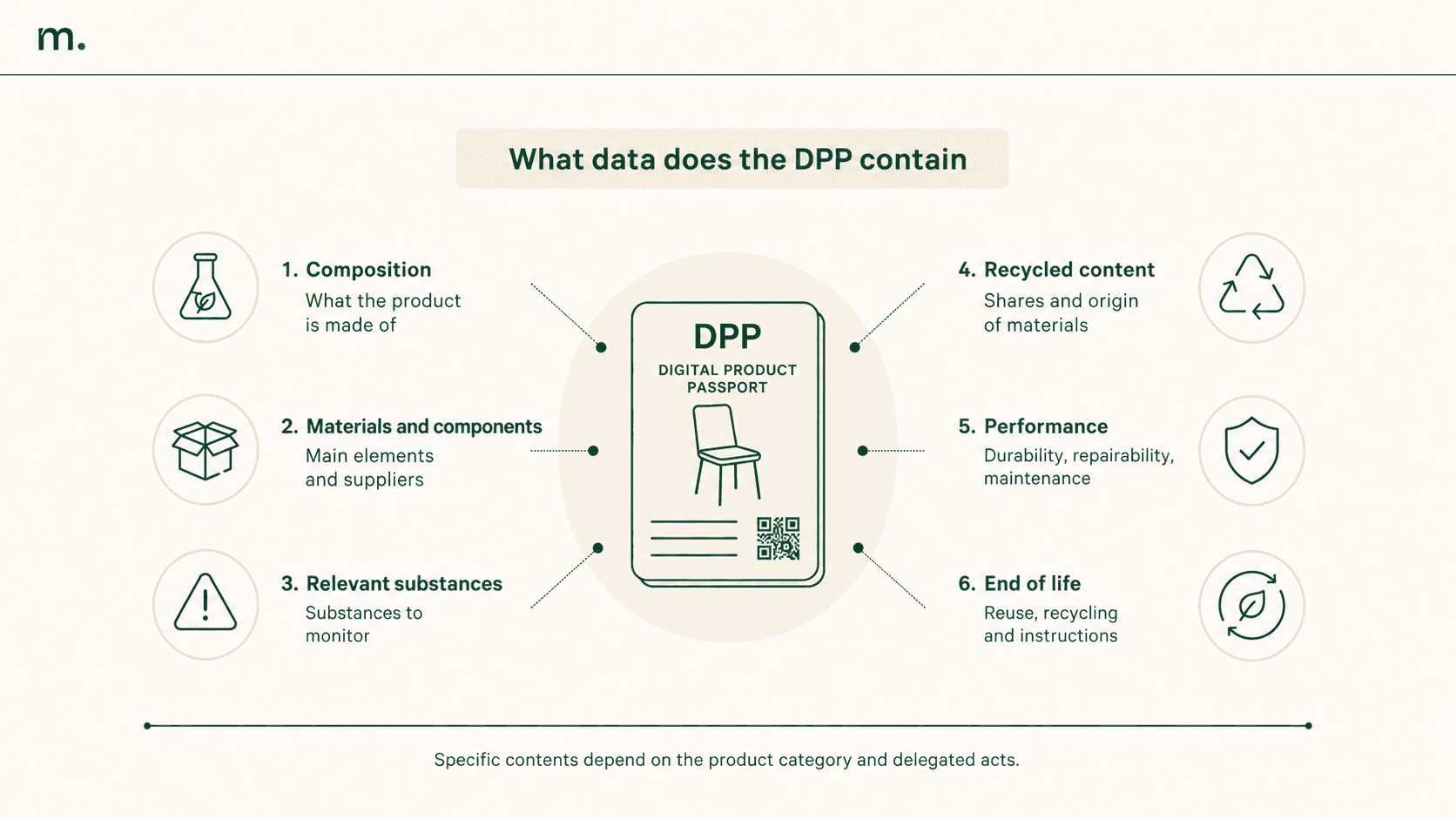
The content of the Digital Product Passport will depend on the delegated acts specific to each category. There will therefore be no single model that applies to every product, but requirements tailored to the characteristics and impacts of the relevant product category.
Some information is likely to recur. This includes product composition, materials used, main components, presence of relevant substances, recycled content, technical performance, durability, repairability, recyclability and instructions for maintenance, reuse or end-of-life management.
Alongside the content itself, the way information is identified, exchanged and made available will also be important. In 2026, the first European harmonised standards dedicated to the DPP infrastructure were published, covering areas such as unique identifiers, data carriers, data exchange protocols, data storage, APIs and interoperability between systems.
For companies, one of the key challenges is connecting each piece of data to the correct level. Some information relates to the individual product, some to a product family, and some to a material, component or supplier. If this structure is unclear, companies risk collecting data that is difficult to use or inconsistent with the applicable requirements.
The Digital Product Passport also requires rigorous source management. A technical data point may come from a product sheet, a certificate, a supplier declaration, a laboratory test or an internal management system. Each piece of information should have a clear source, an update date and an identified owner.
This is essential for compliance. If a supplier updates a data point, a material changes or a production process is modified, the passport needs to reflect that change. A DPP based on static information can quickly become outdated.
The connection with the product life cycle is direct. The required information may cover not only the sales phase but also design, sourcing, production, use, repair, recycling and end of life. The Digital Product Passport therefore requires companies to take a more comprehensive view of the product, from material selection through to post-use management.
This approach is closely related to the logic of LCA, because it requires companies to look at products across several stages of their life cycle. The difference is that the Digital Product Passport does not focus exclusively on measuring environmental impacts: it needs to make updated technical and environmental information accessible to different actors across the value chain.
The link between DPP, LCA and product environmental data
The Digital Product Passport is not the same as an LCA, a Product Carbon Footprint or an Environmental Product Declaration. However, these tools can provide important sources of information for building more robust environmental product data.
A product LCA analyses environmental impacts throughout the life cycle, from raw materials and production through to use and end of life. This type of analysis can help a company understand where the most significant impacts occur and which data is needed to describe the product more accurately. For companies just starting out, a practical guide on how to conduct an LCA can help clarify which information should be collected and how to structure it.
The Product Carbon Footprint focuses specifically on greenhouse gas emissions associated with a product. It can be useful when the passport requires information related to climate impact or when a company needs to connect product data to emissions reduction targets. In this case, the work can also be linked to the calculation of a Product Carbon Footprint, particularly for products with complex supply chains or materials with significant emissions impacts.
The Environmental Product Declaration, or EPD, can also support DPP-related work. An EPD contains environmental information based on product category rules and can provide an already structured documentation base, especially in sectors where product environmental certification is widely used.
The most operational connection concerns the life cycle inventory, often referred to as the Life Cycle Inventory. This phase collects data on materials, energy, transport, processes, waste and emissions. Much of the information used to build a life cycle inventory can also support the Digital Product Passport, provided it is organised consistently and can be updated over time.
For this reason, companies that have already worked on LCA, carbon footprint or EPD often start from a stronger foundation. They have already addressed topics such as system boundaries, data quality, sources, calculation assumptions and the connection between technical and environmental data.
The DPP requires an additional step. Environmental data needs to be linked to the relevant product, updated over time and made available according to defined access rules. Data quality remains essential, but the ability to manage information continuously becomes equally important.
How to implement the Digital Product Passport in your company
Preparing to implement the Digital Product Passport should start with mapping products and product families. The objective is to identify which items may fall under future requirements, which are connected to priority sectors and which data is already available.
The second step concerns information sources. For each product or product family, the company should identify where information on materials, components, substances, suppliers, performance, maintenance, recyclability and end of life is stored. This makes it possible to distinguish between internal data, third-party data and information requiring technical verification.
The supply chain will play a central role. Much of the information required for the DPP depends on suppliers, subcontractors, component manufacturers or logistics partners. Companies should therefore establish clear processes for collecting, checking and updating information, avoiding non-standardised requests or documents that are difficult to compare.
This work may overlap with existing ESG processes. Supplier data requests, for example, can be connected to supply chain assessment or to the collection of information on Scope 3 emissions, particularly where materials, transport and components have a significant impact on the product footprint.
Internal governance is also important. Design, purchasing, quality, sustainability, production and controlling teams may have different responsibilities for the same product. Without clear ownership, the same data may be collected several times, according to different criteria or without anyone responsible for validating it.
A platform or ESG software can support this process by helping companies centralise information, connect it to its sources, assign responsibilities and maintain a history of updates. The same applies to tools connected to LCA, Carbon Footprint and supplier assessment when product data also needs to be connected to other corporate sustainability processes.
The Digital Product Passport will therefore require more structured and easily updatable technical, environmental and supply chain data. Companies that start working now on product mapping, source quality and internal responsibilities can build a stronger foundation for addressing future DPP requirements.
CONTRIBUTOR

Alessandro Nora
CEO & Co-founder
Alessandro's goal is to make a real impact on sustainability. After founding a sustainable fashion marketplace, he decided to focus on ESG digitalisation with the aim of making sustainability more concrete, measurable and accessible for companies. A careful and methodical founder, with experience in Genoa, Berlin and Lisbon, Alessandro combines international vision and operational rigour in the development of digital solutions that simplify ESG regulations and compliance, supporting companies in adapting to ESG regulations, certifications and ratings through structured and audit-ready tools. Topics covered: CSRD, CSDDD, EUDR, CBAM ESG ratings, ESG certifications, Ecovadis, sustainability governance, regulatory compliance.
Stay up to date with Metrikflow Insights!
We deliver expert insights, product updates, industry trends, and actionable strategies straight to your inbox. Stay ahead in ESG, GHG, and LCA — one edition at a time.
By submitting this form, you consent to receive the requested resource. For more information on how we process and protect your data, view our Privacy Policy.


