
Many companies refer to EcoVadis certification, but the term is not entirely accurate.
EcoVadis is not an ESG certification in the technical sense. It is an ESG rating system that assesses the quality of a company’s sustainability management system. The difference is not just formal: a certification confirms compliance with a specific standard, while a rating assigns a score based on an assessment methodology.
This distinction matters because EcoVadis has become one of the most widely used tools in B2B supply chains. More and more companies are invited by their clients to complete an EcoVadis assessment to demonstrate their maturity level across environment, labor and human rights, ethics, and sustainable procurement.
In this article, we’ll explain what EcoVadis is, how the rating works, what scorecards, medals, and badges mean, and how a company can improve its EcoVadis score without confusing the rating with a certification.
What is EcoVadis
EcoVadis is an international corporate sustainability assessment platform, mainly used to evaluate ESG performance across supply chains.
Its goal is to help companies, buyers, and procurement teams assess the sustainability of suppliers and business partners in a more structured way. This means EcoVadis does not only look at a company’s external communication, but evaluates policies, actions, results, and supporting documentation.
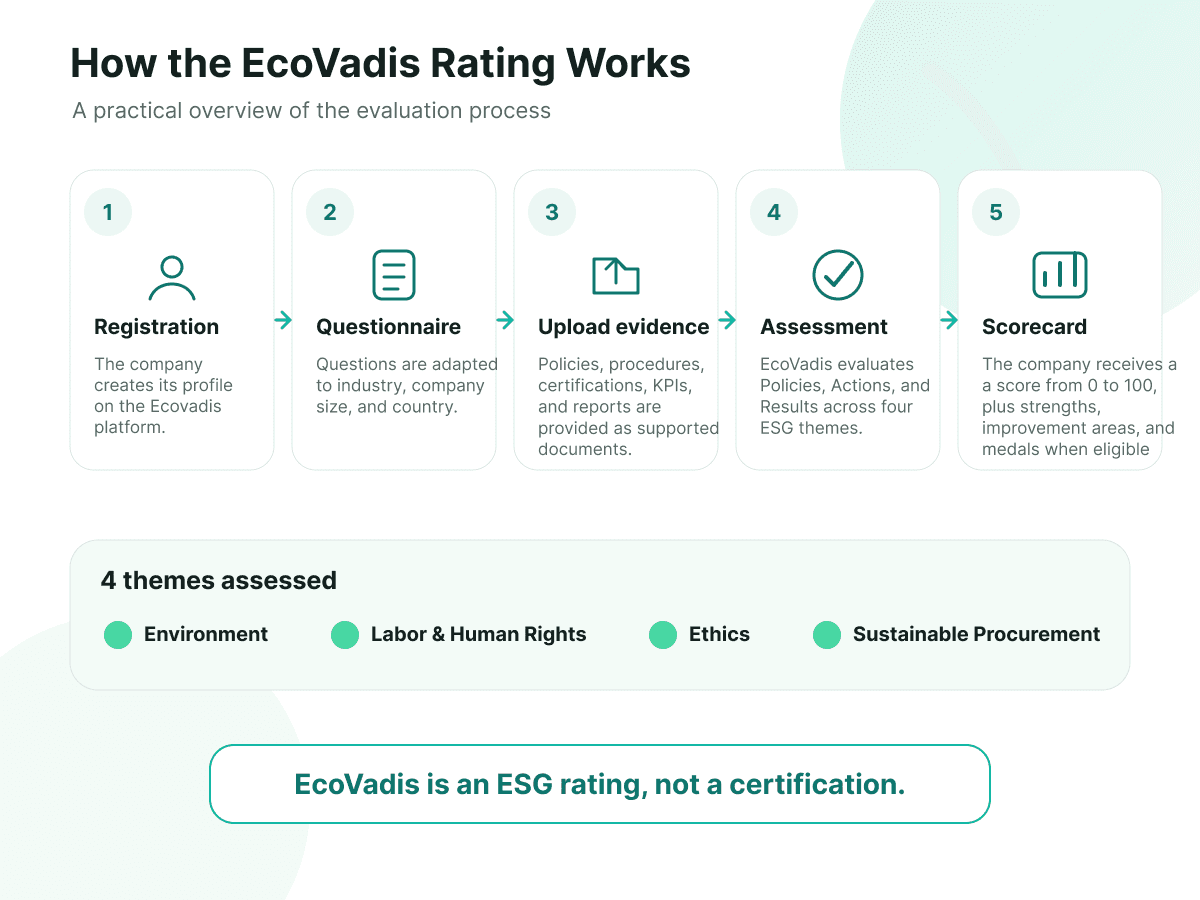
The EcoVadis rating is based on four macro-areas: Environment, Labor & Human Rights, Ethics, and Sustainable Procurement. The EcoVadis methodology also considers three management pillars — Policies, Actions, and Results — and adapts the questionnaire based on the assessed company’s activity, size, and location.
This approach makes EcoVadis particularly relevant in international supply chains, where companies need to evaluate suppliers with very different profiles while using a common language to compare ESG performance.
Why “EcoVadis certification” is an imprecise term
Although many people refer to EcoVadis as a certification, this is not technically correct. Let’s clarify why the term is imprecise.
A certification comes from a verification process against a specific standard and is normally issued by an accredited third-party body. Examples include certifications related to management systems, safety, quality, environmental performance, or carbon footprint. ISO standards are a good example.
EcoVadis, on the other hand, produces an assessment. The company completes a questionnaire, uploads supporting documents, and receives a scorecard with a score from 0 to 100, together with medals or badges if the relevant criteria are met.
EcoVadis itself clarifies that medals and badges do not constitute a certification or product label, and do not certify that a company’s products or services are sustainable or more sustainable than those of other companies.
There is also another important element to consider: as of February 14, 2024, EcoVadis discontinued the “Rating Certificate” associated with medals, introducing new sharing options such as a personalized recognition page.
For this reason, it is more accurate to speak of an EcoVadis rating, EcoVadis assessment, EcoVadis score, or EcoVadis medal, rather than EcoVadis certification in the strict sense.
How the EcoVadis rating works
The EcoVadis assessment process begins with company registration and the completion of a customized questionnaire. Questions vary depending on the organization’s sector, size, and operating country, because ESG risks are not the same for every business.
A manufacturing company, for example, will typically be assessed more closely on environmental aspects, health and safety, supplier management, and production processes. A service company may instead be analyzed more deeply on governance, ethics, data management, or working conditions.
The crucial part is not only answering the questions, but providing evidence. Signed policies, internal procedures, ESG reports, environmental data, thematic certifications, KPIs, and supporting documents are needed to show that the company does not simply declare commitments, but translates them into concrete practices.
EcoVadis therefore evaluates the quality of the sustainability management system, not just the presence of individual initiatives. This is a key point: a company may have interesting ESG activities, but if they are not documented, measured, and structured, the score may not fully reflect the work being done.
What EcoVadis assesses: the four main areas
The EcoVadis assessment focuses on four main ESG areas.
The first is Environment, which includes topics such as energy consumption, greenhouse gas emissions, waste management, resource use, biodiversity, and environmental impacts. For many companies, this is one of the most complex areas because it requires quantitative and traceable data. Tools such as carbon footprint measurement, the classification of Scope 1, 2, and 3 emissions, or Scope 3 analysis can be particularly useful here.
The second area is Labor & Human Rights. Here, EcoVadis analyzes aspects such as health and safety, working conditions, training, inclusion, diversity, and the protection of rights across the organization.
The third area is Ethics, which includes anti-corruption, conflicts of interest, privacy, fair competition, and responsible business practices.
The fourth area is Sustainable Procurement, which is particularly relevant for companies operating in complex supply chains. In this dimension, EcoVadis evaluates how a company integrates ESG criteria into supplier selection, management, and monitoring.
The value of the rating comes from the combination of these areas. EcoVadis does not assess a single aspect of sustainability, but evaluates how structured the company is in managing ESG risks and performance as a whole.
Scorecard, EcoVadis score, medals, and badges
At the end of the assessment, the company receives an EcoVadis scorecard with a score from 0 to 100. This score reflects the quality of the sustainability management system at the time of the assessment.
Depending on the result and eligibility criteria, the company may receive a medal or badge. EcoVadis medals are Platinum, Gold, Silver, and Bronze, and are awarded based on the company’s percentile compared with organizations assessed by EcoVadis over the previous 12 months. According to EcoVadis, Platinum corresponds to the top 1%, Gold to the top 5%, Silver to the top 15%, and Bronze to the top 35%.
This means that EcoVadis medals do not depend only on an absolute score, but also on comparison with other assessed companies. In addition, the percentile ranking is calculated across all companies in all industries, not only within the company’s specific sector.
For this reason, receiving an EcoVadis medal does not mean being “certified.” It means reaching a certain level of performance according to the EcoVadis methodology and relative to the benchmark available at the time the scorecard is published.
Why achieving a good EcoVadis rating matters
A strong EcoVadis rating can have a very concrete impact on commercial relationships.
In many B2B supply chains, large customers ask suppliers to complete the EcoVadis assessment to reduce ESG risk across the value chain. In some cases, a minimum score can become a requirement to remain on vendor lists, participate in tenders, or qualify as a supplier.
This makes EcoVadis a commercial tool, not just a reputational one. A high score can help a company strengthen customer trust, demonstrate a structured approach to sustainability, and differentiate itself from less prepared competitors.
There is also an increasingly strong connection with the regulatory context. Even when a company is not directly subject to requirements such as the CSRD, it may be indirectly involved because larger customers need ESG data from their supply chain. The Omnibus Package has changed some regulatory thresholds, but it has not eliminated market demand for ESG data.
In this scenario, EcoVadis becomes one of the ways companies can demonstrate their ESG maturity in a structured way.
How to prepare for the EcoVadis assessment
Preparing for the EcoVadis assessment means first understanding that the process cannot be improvised.
Many companies start by filling out the questionnaire, but soon realize that the real work lies in collecting evidence. It is not enough to state that the company has an environmental policy or an ethics procedure: these commitments must be demonstrated with coherent, updated, and relevant documents.
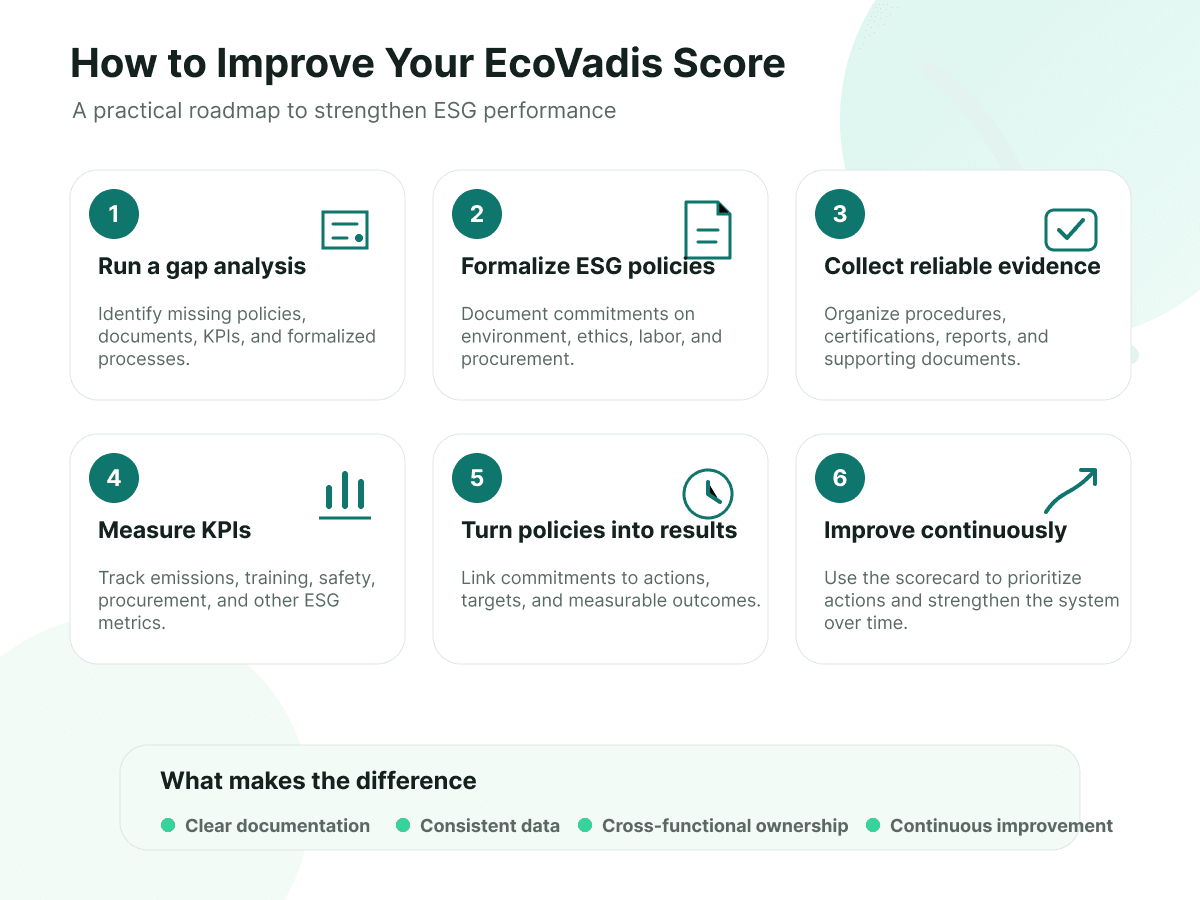
The starting point should be a gap analysis. The company needs to understand which documents it already has, which KPIs it monitors, which processes are formalized, and where gaps exist. This analysis helps avoid a reactive approach and build a stronger preparation plan.
It is important to involve different functions from the beginning: sustainability, HR, legal, procurement, operations, compliance, and finance. EcoVadis evaluates a management system, not the isolated work of a single department.
At this stage, preparing a sustainability report using recognized standards and frameworks such as GRI or VSME can help structure the data and evidence to be presented.
How to improve your EcoVadis score
Improving your EcoVadis score does not mean looking for shortcuts. It means strengthening the company’s ESG system.
The first step is formalizing what already exists. Many companies have sustainable practices, but they have not translated them into policies, procedures, or KPIs. EcoVadis evaluates the quality and traceability of the management system, so documentation is essential.
The second step is connecting policies to actions. An environmental policy, for example, has greater value if it is supported by targets, indicators, action plans, and monitored results. Similarly, a code of ethics becomes more credible when it is backed by training, reporting procedures, and internal controls.
The third element is continuity. EcoVadis rewards mature management systems, not isolated initiatives. For this reason, collecting data regularly and monitoring progress over time is essential.
Finally, companies should use the scorecard as an improvement tool. The improvement areas identified by EcoVadis should not be read as a simple list of weaknesses, but as a roadmap to progressively strengthen the ESG management system.
EcoVadis, ESG ratings, and ESG certifications: key differences
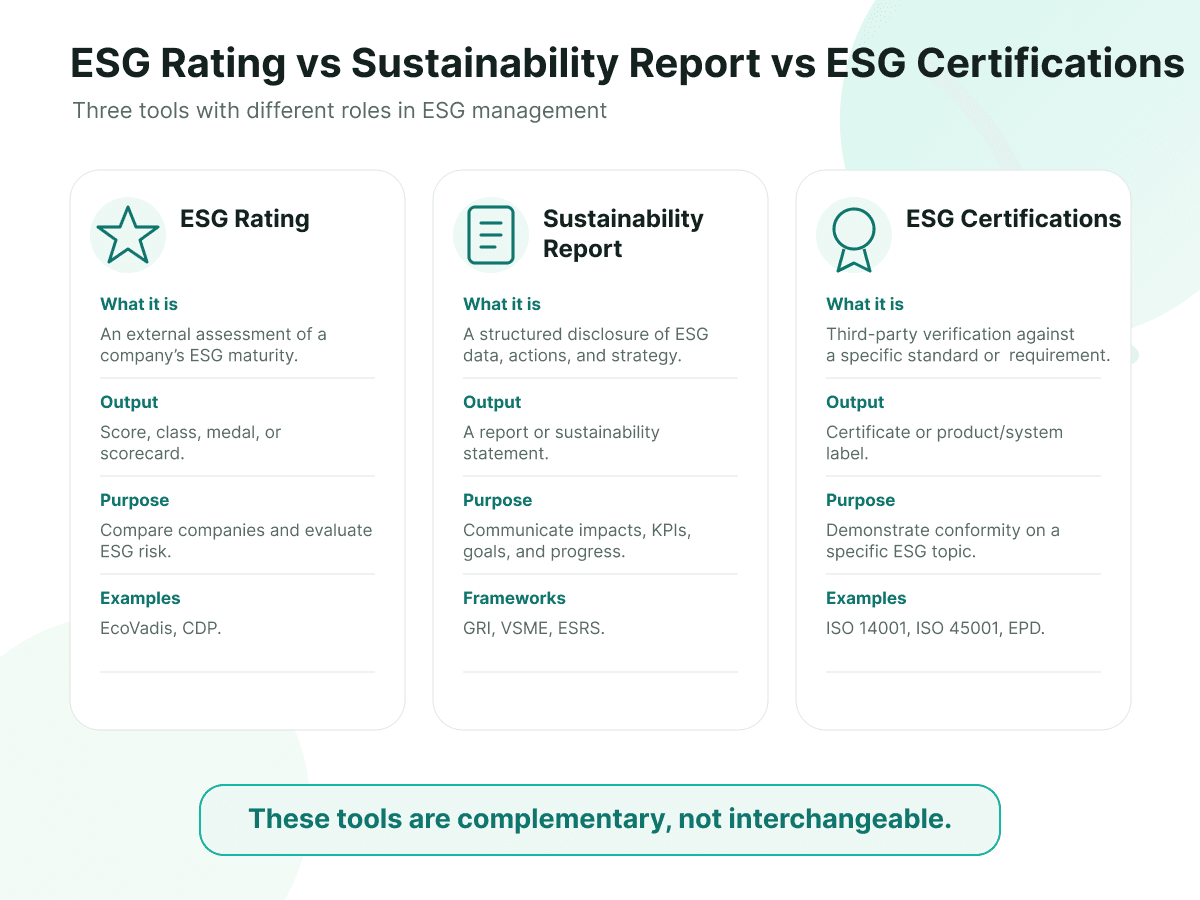
EcoVadis belongs to the world of ESG ratings, not ESG certifications.
An ESG rating assigns a synthetic assessment based on a methodology. It can produce a score, a class, a medal, or a scorecard. It is used to compare companies, assess risks, and communicate ESG maturity.
An ESG certification — or, more accurately, a certification linked to specific ESG topics — confirms compliance with a verifiable standard. It may apply to the entire company, such as B Corp, to a specific product, such as EPD or Ecolabel, or to a process, such as carbon footprint, quality, safety, gender equality, and other specific areas.
EcoVadis does not replace these certifications. On the contrary, some certifications can be used as evidence within the EcoVadis assessment, strengthening the credibility of the questionnaire.
The practical difference is this: a certification verifies a specific requirement; EcoVadis evaluates the overall sustainability management system. For this reason, a company may have an ISO certification and still not automatically obtain a high EcoVadis medal. Likewise, a company may achieve a good EcoVadis rating even without holding every possible certification.
3 examples of companies with an EcoVadis Platinum Medal
The EcoVadis Platinum Medal is awarded to companies that rank in the top 1% of organizations assessed by EcoVadis in the 12 months prior to scorecard publication. It is important to remember that this is a recognition linked to the EcoVadis assessment, not a universal ESG certification. The medal also has temporary validity and depends on the company’s most recent assessment.
Among the companies that have publicly communicated receiving a Platinum Medal is TIM Group, which states that it received the EcoVadis Platinum Medal for ESG performance related to labor, human rights, environment, ethics, and supply chain.
Another example is Engineering, which announced in 2025 that it had received the EcoVadis Platinum Medal, placing it in the top 1% of more than 130,000 companies assessed, with reference to the four areas of environment, labor and human rights, ethics, and sustainable procurement.
Bracco Imaging also announced in 2025 that it had received the EcoVadis Platinum Medal, with an overall score of 83/100 and particularly strong performance in the Environment category.
These examples show that the Platinum Medal is often the result of a mature, documented, and measurable ESG system. Isolated initiatives are not enough: companies need to demonstrate, with data and documents, that sustainability, governance, and supply chain management are embedded into business processes.
EcoVadis software: simplifying data collection and preparation
Preparing for the EcoVadis assessment can become complex if managed through spreadsheets, emails, and shared folders.
The challenge is not only filling out the questionnaire, but maintaining an updated, documented, and reusable ESG data system over time. Each assessment requires evidence, KPIs, policies, and supporting documents. If this information is scattered across different functions, the process becomes slow and prone to errors.
ESG software helps turn EcoVadis preparation into a structured process. It allows companies to centralize data, connect documents to relevant ESG areas, monitor KPIs, and build an information base that can also be reused for other objectives, such as ESG ratings, sustainability reporting, customer requests, or regulatory compliance.
Metrikflow supports companies in managing ESG data, collecting evidence, and preparing consistent and verifiable information for assessments such as EcoVadis. The result is a more efficient, less manual process that helps companies genuinely improve ESG performance over time.
Conclusion
Talking about EcoVadis certification is common, but not entirely correct. EcoVadis is an ESG rating: it evaluates the quality of the sustainability management system and returns a score, a scorecard, and, when applicable, medals or badges.
This distinction is important because it helps companies set up their sustainability journey correctly. The objective is not to obtain a certificate, but to build a credible, documented, and measurable ESG system.
Companies that want to improve their EcoVadis rating must therefore work on data, policies, actions, KPIs, and process continuity.
The value is not only in receiving a medal, but in using the EcoVadis assessment as a lever to improve ESG management and strengthen market positioning.
CONTRIBUTOR

Alessandro Nora
CEO & Co-founder
Alessandro's goal is to make a real impact on sustainability. After founding a sustainable fashion marketplace, he decided to focus on ESG digitalisation with the aim of making sustainability more concrete, measurable and accessible for companies. A careful and methodical founder, with experience in Genoa, Berlin and Lisbon, Alessandro combines international vision and operational rigour in the development of digital solutions that simplify ESG regulations and compliance, supporting companies in adapting to ESG regulations, certifications and ratings through structured and audit-ready tools. Topics covered: CSRD, CSDDD, EUDR, CBAM ESG ratings, ESG certifications, Ecovadis, sustainability governance, regulatory compliance.
Stay up to date with Metrikflow Insights!
We deliver expert insights, product updates, industry trends, and actionable strategies straight to your inbox. Stay ahead in ESG, GHG, and LCA — one edition at a time.
By submitting this form, you consent to receive the requested resource. For more information on how we process and protect your data, view our Privacy Policy.


