
Decarbonization, Carbon Footprint & LCA

Decarbonization, Carbon Footprint & LCA

How to Conduct an LCA: A Practical Guide with an Example for Companies

How to Conduct an LCA: A Practical Guide with an Example for Companies

Data, phases, and workflow to conduct an LCA and support business decisions.

Luis Antazema Headshot
Luis Antazema
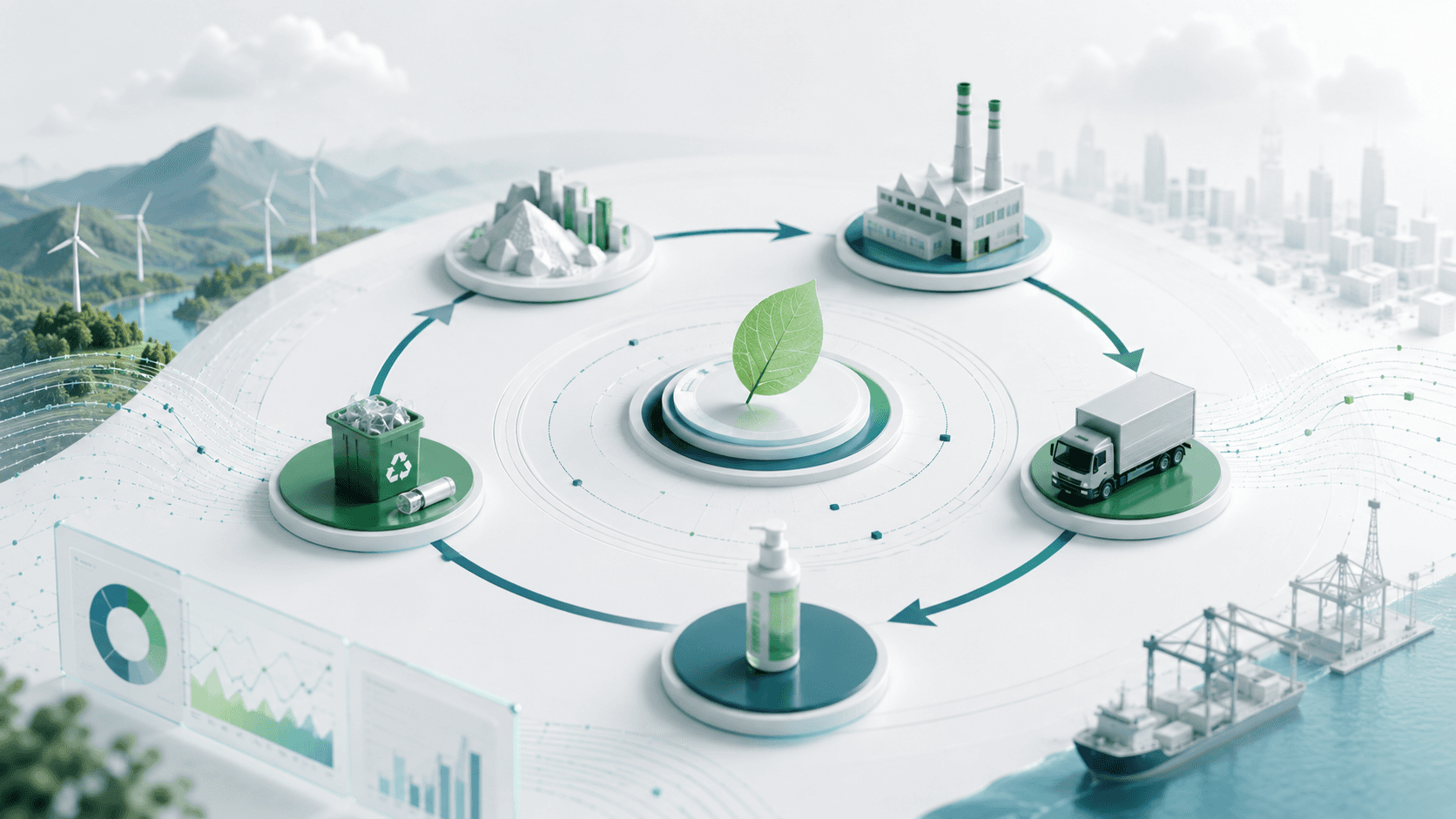
Digital illustration of a sustainable product life cycle, with production, transport, use, and recycling stages connected by circular arrows, combining industrial elements, ESG data, and nature at the center.

How an LCA Works in Practice

Understanding how to conduct an LCA means moving from theory to the practical application of an operating model. After clarifying what Life Cycle Assessment is and why it is useful for companies, the next step is to understand how to set up the analysis in concrete terms: which data to collect, which phases to include, how to build the model, and how to interpret the results.

An LCA is not just an environmental calculation. For a company, it is a tool that connects products, processes, suppliers, logistics, and end-of-life management within a measurable framework. Its value lies in its ability to identify where impacts are concentrated and which decisions can reduce them in a concrete way.

If you want to start from the definition and role of Life Cycle Assessment in corporate strategies, you can read the dedicated article on what LCA is and what it is truly used for by companies. In this guide, we focus instead on the practical side: how to conduct an LCA, step by step, with an example applied to a company product.
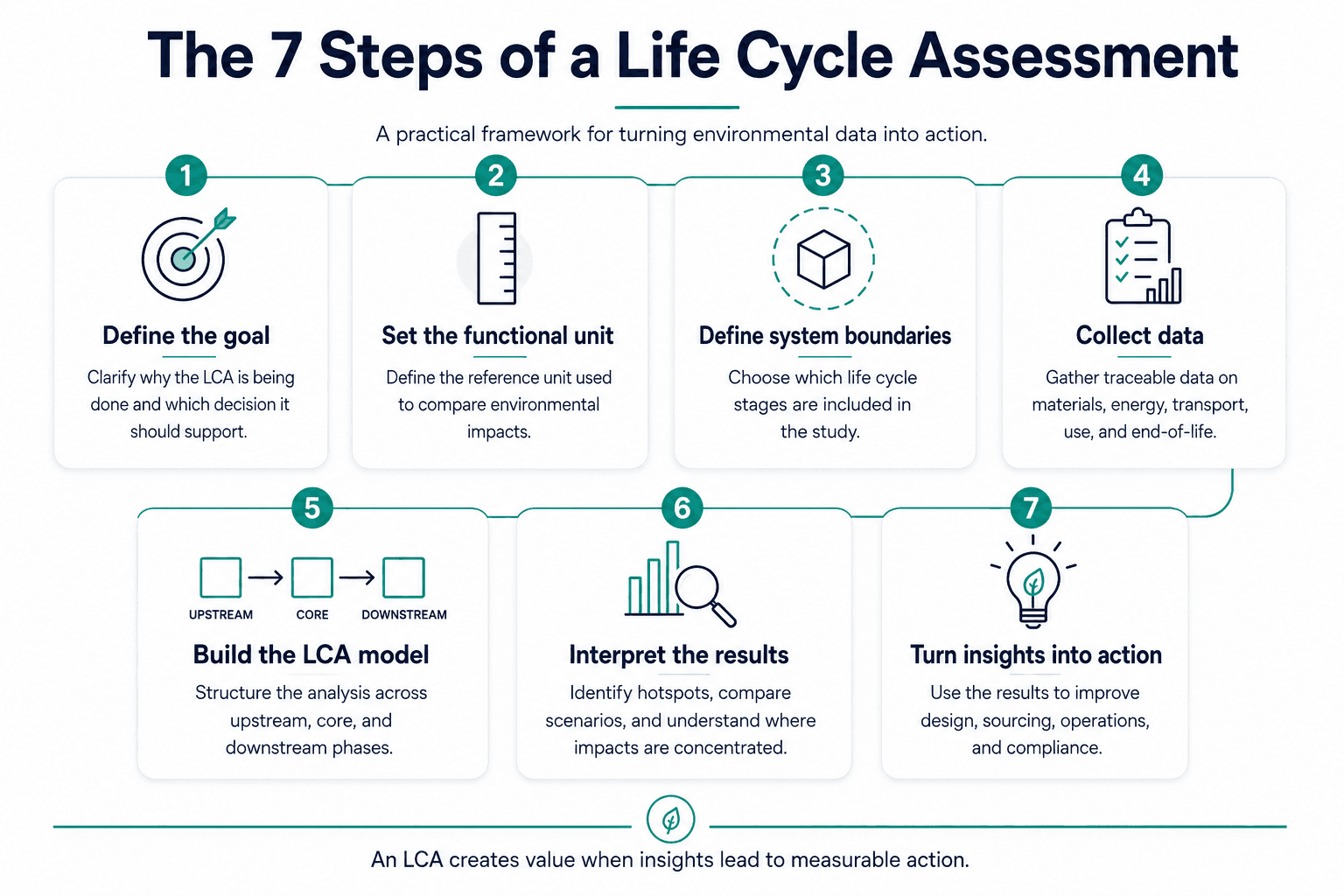
Infographic showing the 7 steps of an LCA, from goal definition and data collection to modeling, results interpretation, and turning insights into measurable actions.

1. Define the Goal of the Study

The first step in conducting an LCA is defining the goal of the study. This choice guides all the work that follows: the level of detail, the data to be collected, the scope of the analysis, and the type of expected results.

A company may conduct an LCA for many reasons. It may want to compare two alternative materials, assess the environmental impact of a product, prepare an Environmental Product Declaration — EPD — respond to a customer request, support eco-design decisions, or identify priorities for impact reduction.

What Is an Environmental Product Declaration — EPD?

An Environmental Product Declaration, or EPD, is a verified environmental declaration that communicates the environmental impacts of a product throughout its life cycle in a transparent and standardized way.

To obtain one, the company must develop the LCA study according to the rules set by a Program Operator, the body that manages the EPD program, publishes the reference rules, and registers verified declarations. Among the most widely used Program Operators are, for example, EPDItaly and The International EPD System. EPDItaly is the Italian program, while The International EPD System is managed by EPD International AB, a Swedish company, and is considered the first and longest-running EPD program internationally, launched in 1998 as the Swedish EPD System.

If the company’s goal is to obtain an EPD, it is therefore important to verify from the outset which Program Operator to use and whether a PCR — Product Category Rule — exists for the reference product. The PCR defines the specific rules for conducting the LCA on a given product category: system boundaries, data to be collected, impact categories to include, and how results must be presented.

This initial check is essential because the EPD must be built according to rules that are consistent with the product category. If a PCR exists, the LCA study must follow its requirements. If it does not, the company must carefully assess the appropriate path and any applicable rules.

The goal, therefore, must be specific. Saying “we want to measure the environmental impact of the product” is too generic. A more useful formulation could be: “we want to assess the environmental impact of the current packaging and compare it with an alternative containing recycled material, in order to support product and procurement decisions.”

This initial precision prevents the collection of unnecessary data or the construction of a model that is too broad for the decision to be made. An effective LCA always starts from a clear business question.

2. Choose the Functional Unit

After defining the goal, the functional unit must be established. This is the quantitative reference that describes the function performed by the analyzed product or service, against which impacts are calculated, allowing different scenarios to be compared consistently.

If the company is analyzing packaging, the functional unit could be: “packaging units used to pack and distribute a specific product.” The reference flow is linked to this functional unit, meaning the specific quantity of packaging needed to perform that function. For example, in the case analyzed, the reference flow could be 1,000 units, indicating that 1,000 units of that specific packaging are needed to fulfill the function.

Choosing the functional unit is fundamental because two alternatives can only be compared if they perform the same function. A lighter material, for example, is not automatically better if it protects the product less effectively and increases waste. Similarly, packaging with lower production emissions may not be the most efficient solution if it worsens logistics or makes recycling more complex.

For this reason, the functional unit must connect the environmental impact to the product’s real function. It does not simply measure “how much” an object impacts, but how much it impacts while performing a specific function.

If, instead, the company is analyzing an industrial component, the functional unit could be: “to enable the correct functioning of the industrial system in which the component is installed, according to the required technical performance and for a defined service life.”

In these contexts, the reference flow corresponds exactly to one unit of the specific component analyzed. In EPDs, for example, the declared unit is frequently used: a quantified physical quantity used as the basis for calculating environmental impacts. Its use is essential when it is not possible to define the product’s final function or intended use in advance.

3. Define the System Boundaries

The third step is defining which phases of the life cycle will be included in the model. This choice is called the definition of system boundaries.

A cradle-to-gate analysis considers the phases from raw material production to the point at which the product leaves the company’s facility. It is useful when the company wants to focus on the processes under its control and on the upstream supply chain. This approach is particularly common in B2B contexts, when the product leaving the company becomes an input or component of another product. In these cases, the environmental information generated by the analysis can be provided to the customer, who can use it as input data for their own LCA calculations.
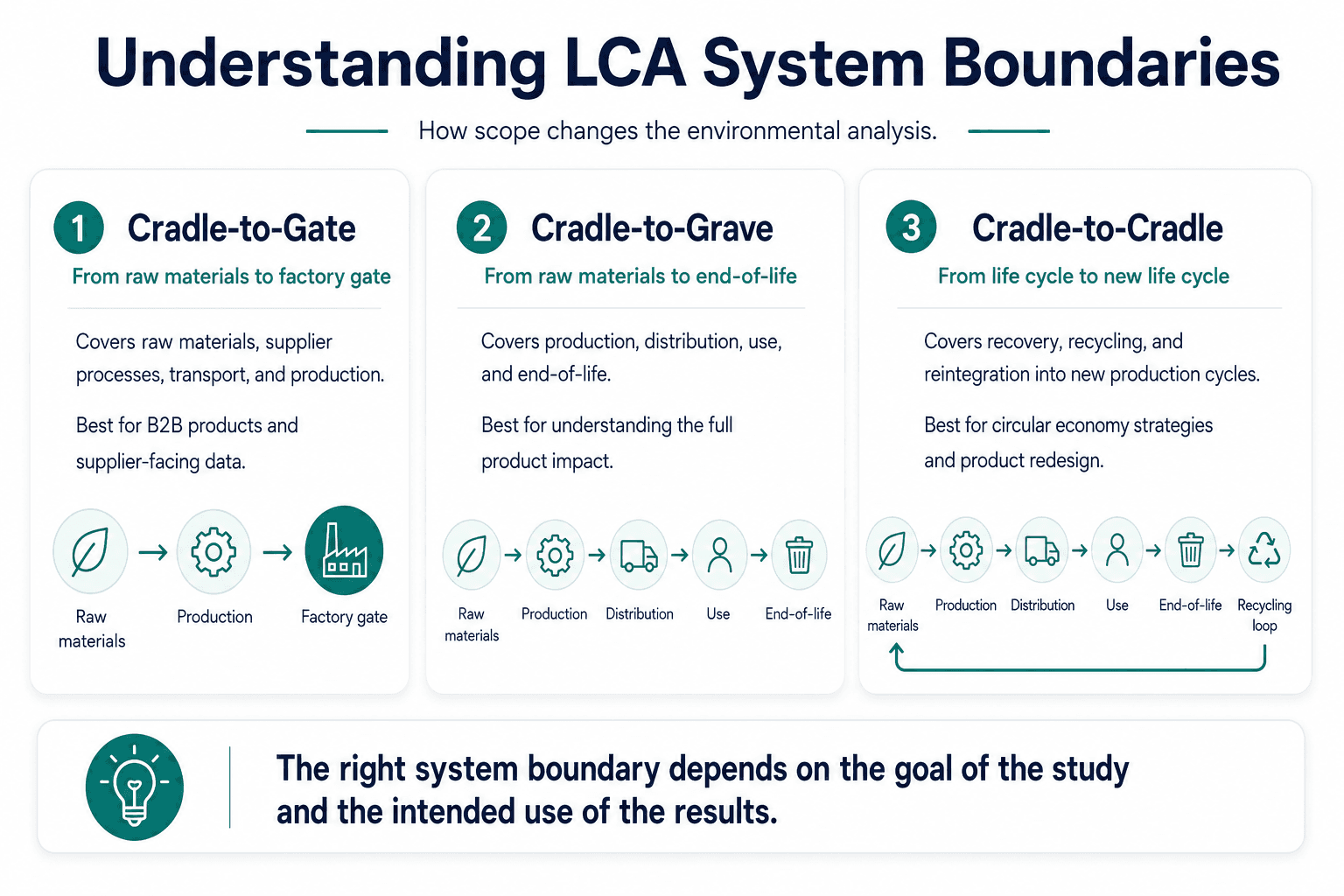
Infographic comparing LCA system boundaries: cradle-to-gate, cradle-to-grave, and cradle-to-cradle, showing the different life cycle stages included in each scope.

A cradle-to-grave analysis also includes distribution, use, and end-of-life. It is more comprehensive and makes it possible to assess the impact across the entire life cycle.

A cradle-to-cradle analysis also considers scenarios of recovery, recycling, or reintegration of materials into new production cycles.

The choice of scope depends on the objective. If the goal is to obtain a certification or communicate environmental data externally, the scope must comply with standards, PCRs, or specific requirements. PCRs — Product Category Rules — are particularly relevant when the LCA is used to develop an Environmental Product Declaration, because they ensure that products belonging to the same category are assessed according to consistent and comparable criteria.

If, instead, the goal is an initial internal assessment to identify hotspots and improvement opportunities, it may be useful to start with a more manageable scope and increase the level of detail at a later stage.

4. Collect the Necessary Data

Data collection is one of the most important and complex phases of an LCA. The model depends on information located in different areas of the company and, often, also with external suppliers.

The main data concern raw materials, purchased components, energy consumption, water consumption, fuels, processing activities, transport, packaging, production waste, direct emissions, use patterns, and end-of-life scenarios.

In a manufacturing company, this means involving procurement, operations, quality, logistics, R&D, sustainability, strategic suppliers, waste managers, and customers or downstream partners in the value chain.

The data must be available, but above all traceable. It is necessary to know where it comes from, which period it refers to, who validated it, and which assumptions were used. This is particularly important when the results of the analysis are used for certifications, tenders, customer requests, or external communications.

When a company works across many products, lines, or facilities, managing this data with separate files quickly becomes inefficient. In these cases, LCA software makes it possible to centralize information, reduce manual work, replicate the model across multiple products in a more structured way, and maintain a historical record of completed analyses in order to compare the evolution of product environmental impacts over time and monitor progress achieved through improvement actions.

5. Build the LCA Model: Upstream, Core, and Downstream Phases

Once the data has been collected, the LCA model can be built. In practice, the life cycle is often organized into three macro-phases: upstream, core, and downstream.

The upstream phase includes everything that happens before materials and components arrive at the company. It includes raw material extraction, production of purchased materials, external processing, and inbound transport.

The core phase concerns the activities directly controlled by the company: production processes, energy and water consumption, fuels, waste, treatments, internal handling, and packaging managed within the facility.

The downstream phase includes what happens after the product leaves the company: distribution, use, maintenance, disposal, recovery, or recycling.

This structure helps interpret the model operationally. If the main impact is in the core phase, actions will concern processes, energy, and production efficiency. If the hotspot is upstream, it will be necessary to work on suppliers, materials, and supply chain data. If the greatest weight is downstream, the issue may concern design, durability, logistics, or end-of-life management.

6. Practical Example: LCA of Industrial Packaging

Let’s imagine a company that produces and distributes a B2B product packaged in primary packaging. The goal of the study is to compare the current packaging with a new alternative containing recycled material, in order to understand whether the change truly reduces the overall environmental impact.

The chosen functional unit is: packaging units used to pack and distribute the specific product to the end customer. For the packaging analyzed, the reference flow needed to fulfill this function is represented by 1,000 packaging units.

The scope of the analysis is cradle-to-grave, so it includes material production, packaging transformation, transport, use, and end-of-life.

In the upstream phase, the company collects data on the amount of material used for each unit, the percentage of recycled material, the suppliers involved, the origin of the material, and transport to the facility.

In the core phase, the energy consumption of the packaging process, any waste generated, auxiliary materials, and secondary packaging used for distribution are considered.

In the downstream phase, the model includes transport to the customer, the behavior of the packaging during use, and the end-of-life scenario: recycling, incineration, landfill, or recovery.

At this point, the model makes it possible to compare two scenarios. The first is the current packaging, produced with virgin material. The second is the new packaging with a share of recycled material.

The result may show that recycled material reduces the impact in the upstream phase because it requires fewer primary resources. However, if the new packaging is heavier, requires more energy during transformation, or worsens logistics performance, the initial benefit may be reduced.

Moreover, by increasing the share of recycled material, the packaging may no longer guarantee the same performance as virgin material and, to perform the same function, more units may be required: for example, 1,200 units instead of 1,000.

Conversely, if it maintains the same functionality, does not increase waste, and improves end-of-life management, the alternative may prove more advantageous.

This is the central point: an LCA is not used to confirm a sustainability hypothesis, but to verify it through measurable data.

7. Interpret the Results: Hotspots and Scenarios

The final result of an LCA should not be read only as an overall number. The main value of the analysis lies in the breakdown of impacts.

If the model shows that most of the impact comes from material production, the company knows that the priority is not marginally optimizing logistics, but working on composition, suppliers, and material alternatives.

If, instead, a significant share comes from transport, the focus can shift to distances, distribution methods, weight, and packaging volume.

Interpretation also makes it possible to simulate scenarios. What happens if the percentage of recycled material increases? What changes if a closer supplier is selected? What is the effect of reducing packaging weight? Which end-of-life scenario generates the best result?

This phase turns the LCA model into a decision-making tool. It does not simply produce environmental data, but a hierarchy of priorities that can guide investments, technical choices, and improvement activities.
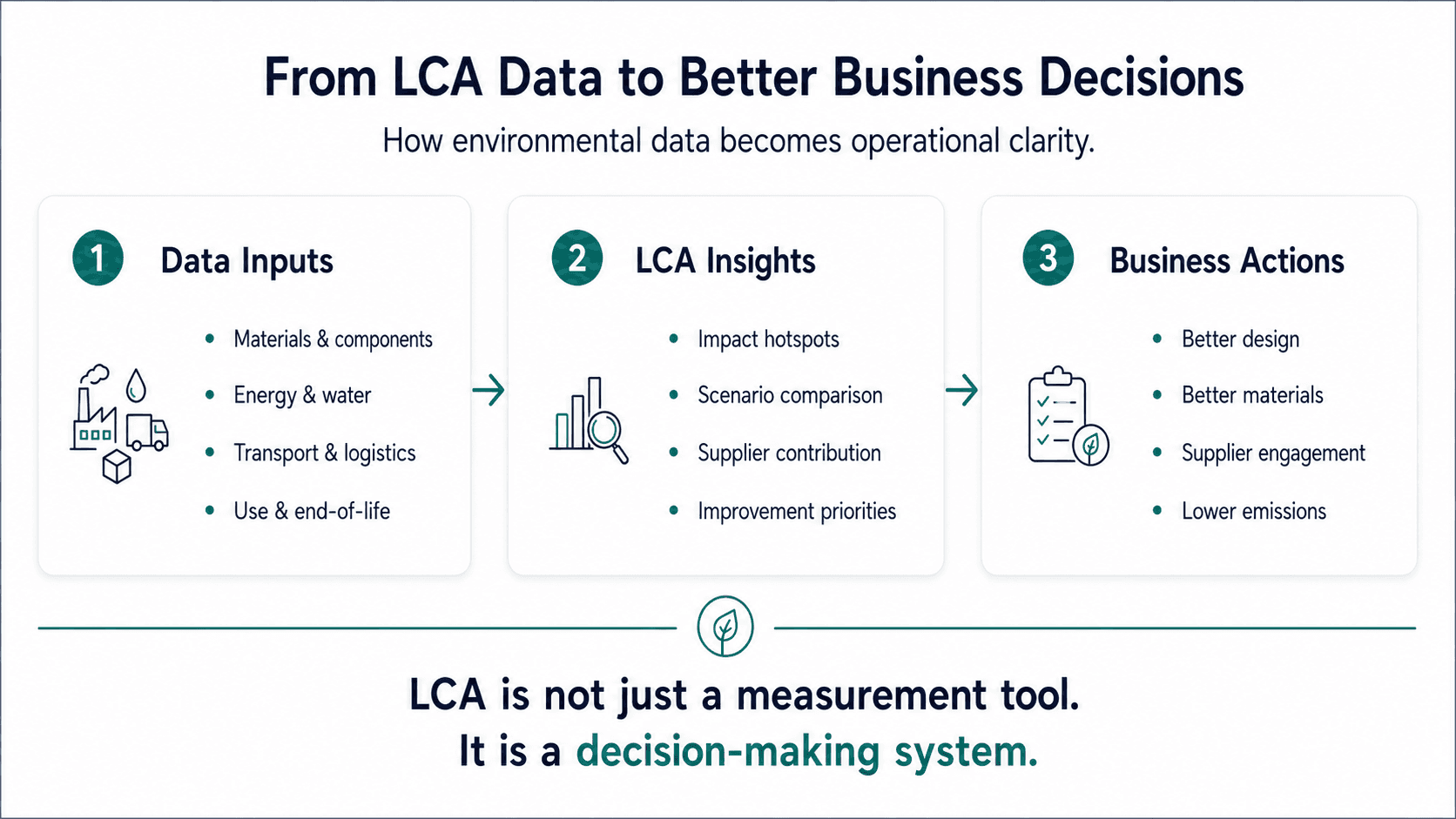
Infographic showing how LCA data turns into insights and business actions, connecting environmental data, impact hotspots, suppliers, product design, and emissions reduction.

How to Use an LCA in the Company

An LCA can support several business functions because it translates complex environmental data into useful information for decision-making. It is not only useful for the sustainability team; it can also become an operational tool for product, procurement, operations, quality, marketing, and company leadership.

For the product team, an LCA helps assess design, material, and component alternatives before choices are finalized. For example, it makes it possible to understand whether a change truly reduces the overall impact or simply shifts the problem from one phase of the life cycle to another.

For procurement, the results can support comparisons between suppliers, raw materials, and external processes. If a significant part of the impact comes from the upstream phase, the company can use the LCA model to identify which data to request from suppliers and which alternatives should be prioritized.

For marketing and communications teams, an LCA is useful to avoid greenwashing. In fact, LCA enables precise green marketing activities and helps avoid generic communications, which are also sanctioned by the Anti-Greenwashing Directive.

For operations and production, the analysis can highlight the weight of energy consumption, waste, processing activities, or process inefficiencies. This makes it possible to connect the reduction of environmental impacts to concrete actions on efficiency, costs, and production performance.

For sustainability, compliance, and reporting, an LCA provides structured and traceable data that can be used for certifications, environmental declarations, customer requests, tenders, ESG assessments, and technical communications.

Its value increases when the results do not remain isolated in a report, but are updated, compared, and integrated into business processes.

In this sense, an LCA is useful not only because it measures the impact of a product, but because it makes it clearer where to act, which alternatives to compare, and which decisions can generate measurable improvement.

Mistakes to Avoid When Conducting an LCA

The first mistake is starting with data collection without having defined the goal, functional unit, and system boundaries. This often leads to unclear models that are difficult to interpret and cannot be compared.

The second mistake is using non-traceable data. If a value comes from an estimate, an outdated file, or an undocumented source, this must be stated. An LCA that is useful for business decisions must be verifiable, especially if it will be used for certifications, tenders, or external communications.

The third mistake is comparing alternatives that do not perform the same function. A material may seem better because it has a lower impact per kilogram, but may be less convenient if a larger quantity is needed to achieve the same performance.

The fourth mistake is stopping at the final result without turning it into action. An LCA has value when it leads to decisions: reducing weight, changing material, modifying a supplier, improving the production process, revising logistics, or preparing a certification.

Conclusion

Conducting an LCA in practice means transforming technical, production, and supply chain data into a decision-making map. The result is not just an environmental indicator, but a tool to understand where to act, with which priority, and with what potential impact.

For companies, the value of Life Cycle Assessment lies in its ability to connect sustainability and operations. A well-built LCA model makes it possible to make stronger decisions on products, materials, suppliers, processes, and certifications.

In a context where customers, regulations, and markets increasingly require reliable environmental data, conducting an LCA does not simply mean measuring the impact of a product. It means building a more structured system to manage sustainability as an integral part of business decision-making.

Whitepaper

A Conversation between EFRAG and Industry

Dolor netus eget suspendisse pellentesque. Diam elit lobortis elementum mi sed turpis quisque feugiat leo. Ipsum purus faucibus sed potenti phasellus duis vestibulum risus sagittis. Sit viverra convallis ultrices netus pulvinar.

Download Now

How an LCA Works in Practice

Understanding how to conduct an LCA means moving from theory to the practical application of an operating model. After clarifying what Life Cycle Assessment is and why it is useful for companies, the next step is to understand how to set up the analysis in concrete terms: which data to collect, which phases to include, how to build the model, and how to interpret the results.

An LCA is not just an environmental calculation. For a company, it is a tool that connects products, processes, suppliers, logistics, and end-of-life management within a measurable framework. Its value lies in its ability to identify where impacts are concentrated and which decisions can reduce them in a concrete way.

If you want to start from the definition and role of Life Cycle Assessment in corporate strategies, you can read the dedicated article on what LCA is and what it is truly used for by companies. In this guide, we focus instead on the practical side: how to conduct an LCA, step by step, with an example applied to a company product.

Infographic showing the 7 steps of an LCA, from goal definition and data collection to modeling, results interpretation, and turning insights into measurable actions.

1. Define the Goal of the Study

The first step in conducting an LCA is defining the goal of the study. This choice guides all the work that follows: the level of detail, the data to be collected, the scope of the analysis, and the type of expected results.

A company may conduct an LCA for many reasons. It may want to compare two alternative materials, assess the environmental impact of a product, prepare an Environmental Product Declaration — EPD — respond to a customer request, support eco-design decisions, or identify priorities for impact reduction.

What Is an Environmental Product Declaration — EPD?

An Environmental Product Declaration, or EPD, is a verified environmental declaration that communicates the environmental impacts of a product throughout its life cycle in a transparent and standardized way.

To obtain one, the company must develop the LCA study according to the rules set by a Program Operator, the body that manages the EPD program, publishes the reference rules, and registers verified declarations. Among the most widely used Program Operators are, for example, EPDItaly and The International EPD System. EPDItaly is the Italian program, while The International EPD System is managed by EPD International AB, a Swedish company, and is considered the first and longest-running EPD program internationally, launched in 1998 as the Swedish EPD System.

If the company’s goal is to obtain an EPD, it is therefore important to verify from the outset which Program Operator to use and whether a PCR — Product Category Rule — exists for the reference product. The PCR defines the specific rules for conducting the LCA on a given product category: system boundaries, data to be collected, impact categories to include, and how results must be presented.

This initial check is essential because the EPD must be built according to rules that are consistent with the product category. If a PCR exists, the LCA study must follow its requirements. If it does not, the company must carefully assess the appropriate path and any applicable rules.

The goal, therefore, must be specific. Saying “we want to measure the environmental impact of the product” is too generic. A more useful formulation could be: “we want to assess the environmental impact of the current packaging and compare it with an alternative containing recycled material, in order to support product and procurement decisions.”

This initial precision prevents the collection of unnecessary data or the construction of a model that is too broad for the decision to be made. An effective LCA always starts from a clear business question.

2. Choose the Functional Unit

After defining the goal, the functional unit must be established. This is the quantitative reference that describes the function performed by the analyzed product or service, against which impacts are calculated, allowing different scenarios to be compared consistently.

If the company is analyzing packaging, the functional unit could be: “packaging units used to pack and distribute a specific product.” The reference flow is linked to this functional unit, meaning the specific quantity of packaging needed to perform that function. For example, in the case analyzed, the reference flow could be 1,000 units, indicating that 1,000 units of that specific packaging are needed to fulfill the function.

Choosing the functional unit is fundamental because two alternatives can only be compared if they perform the same function. A lighter material, for example, is not automatically better if it protects the product less effectively and increases waste. Similarly, packaging with lower production emissions may not be the most efficient solution if it worsens logistics or makes recycling more complex.

For this reason, the functional unit must connect the environmental impact to the product’s real function. It does not simply measure “how much” an object impacts, but how much it impacts while performing a specific function.

If, instead, the company is analyzing an industrial component, the functional unit could be: “to enable the correct functioning of the industrial system in which the component is installed, according to the required technical performance and for a defined service life.”

In these contexts, the reference flow corresponds exactly to one unit of the specific component analyzed. In EPDs, for example, the declared unit is frequently used: a quantified physical quantity used as the basis for calculating environmental impacts. Its use is essential when it is not possible to define the product’s final function or intended use in advance.

3. Define the System Boundaries

The third step is defining which phases of the life cycle will be included in the model. This choice is called the definition of system boundaries.

A cradle-to-gate analysis considers the phases from raw material production to the point at which the product leaves the company’s facility. It is useful when the company wants to focus on the processes under its control and on the upstream supply chain. This approach is particularly common in B2B contexts, when the product leaving the company becomes an input or component of another product. In these cases, the environmental information generated by the analysis can be provided to the customer, who can use it as input data for their own LCA calculations.

Infographic comparing LCA system boundaries: cradle-to-gate, cradle-to-grave, and cradle-to-cradle, showing the different life cycle stages included in each scope.

A cradle-to-grave analysis also includes distribution, use, and end-of-life. It is more comprehensive and makes it possible to assess the impact across the entire life cycle.

A cradle-to-cradle analysis also considers scenarios of recovery, recycling, or reintegration of materials into new production cycles.

The choice of scope depends on the objective. If the goal is to obtain a certification or communicate environmental data externally, the scope must comply with standards, PCRs, or specific requirements. PCRs — Product Category Rules — are particularly relevant when the LCA is used to develop an Environmental Product Declaration, because they ensure that products belonging to the same category are assessed according to consistent and comparable criteria.

If, instead, the goal is an initial internal assessment to identify hotspots and improvement opportunities, it may be useful to start with a more manageable scope and increase the level of detail at a later stage.

4. Collect the Necessary Data

Data collection is one of the most important and complex phases of an LCA. The model depends on information located in different areas of the company and, often, also with external suppliers.

The main data concern raw materials, purchased components, energy consumption, water consumption, fuels, processing activities, transport, packaging, production waste, direct emissions, use patterns, and end-of-life scenarios.

In a manufacturing company, this means involving procurement, operations, quality, logistics, R&D, sustainability, strategic suppliers, waste managers, and customers or downstream partners in the value chain.

The data must be available, but above all traceable. It is necessary to know where it comes from, which period it refers to, who validated it, and which assumptions were used. This is particularly important when the results of the analysis are used for certifications, tenders, customer requests, or external communications.

When a company works across many products, lines, or facilities, managing this data with separate files quickly becomes inefficient. In these cases, LCA software makes it possible to centralize information, reduce manual work, replicate the model across multiple products in a more structured way, and maintain a historical record of completed analyses in order to compare the evolution of product environmental impacts over time and monitor progress achieved through improvement actions.

5. Build the LCA Model: Upstream, Core, and Downstream Phases

Once the data has been collected, the LCA model can be built. In practice, the life cycle is often organized into three macro-phases: upstream, core, and downstream.

The upstream phase includes everything that happens before materials and components arrive at the company. It includes raw material extraction, production of purchased materials, external processing, and inbound transport.

The core phase concerns the activities directly controlled by the company: production processes, energy and water consumption, fuels, waste, treatments, internal handling, and packaging managed within the facility.

The downstream phase includes what happens after the product leaves the company: distribution, use, maintenance, disposal, recovery, or recycling.

This structure helps interpret the model operationally. If the main impact is in the core phase, actions will concern processes, energy, and production efficiency. If the hotspot is upstream, it will be necessary to work on suppliers, materials, and supply chain data. If the greatest weight is downstream, the issue may concern design, durability, logistics, or end-of-life management.

6. Practical Example: LCA of Industrial Packaging

Let’s imagine a company that produces and distributes a B2B product packaged in primary packaging. The goal of the study is to compare the current packaging with a new alternative containing recycled material, in order to understand whether the change truly reduces the overall environmental impact.

The chosen functional unit is: packaging units used to pack and distribute the specific product to the end customer. For the packaging analyzed, the reference flow needed to fulfill this function is represented by 1,000 packaging units.

The scope of the analysis is cradle-to-grave, so it includes material production, packaging transformation, transport, use, and end-of-life.

In the upstream phase, the company collects data on the amount of material used for each unit, the percentage of recycled material, the suppliers involved, the origin of the material, and transport to the facility.

In the core phase, the energy consumption of the packaging process, any waste generated, auxiliary materials, and secondary packaging used for distribution are considered.

In the downstream phase, the model includes transport to the customer, the behavior of the packaging during use, and the end-of-life scenario: recycling, incineration, landfill, or recovery.

At this point, the model makes it possible to compare two scenarios. The first is the current packaging, produced with virgin material. The second is the new packaging with a share of recycled material.

The result may show that recycled material reduces the impact in the upstream phase because it requires fewer primary resources. However, if the new packaging is heavier, requires more energy during transformation, or worsens logistics performance, the initial benefit may be reduced.

Moreover, by increasing the share of recycled material, the packaging may no longer guarantee the same performance as virgin material and, to perform the same function, more units may be required: for example, 1,200 units instead of 1,000.

Conversely, if it maintains the same functionality, does not increase waste, and improves end-of-life management, the alternative may prove more advantageous.

This is the central point: an LCA is not used to confirm a sustainability hypothesis, but to verify it through measurable data.

7. Interpret the Results: Hotspots and Scenarios

The final result of an LCA should not be read only as an overall number. The main value of the analysis lies in the breakdown of impacts.

If the model shows that most of the impact comes from material production, the company knows that the priority is not marginally optimizing logistics, but working on composition, suppliers, and material alternatives.

If, instead, a significant share comes from transport, the focus can shift to distances, distribution methods, weight, and packaging volume.

Interpretation also makes it possible to simulate scenarios. What happens if the percentage of recycled material increases? What changes if a closer supplier is selected? What is the effect of reducing packaging weight? Which end-of-life scenario generates the best result?

This phase turns the LCA model into a decision-making tool. It does not simply produce environmental data, but a hierarchy of priorities that can guide investments, technical choices, and improvement activities.

Infographic showing how LCA data turns into insights and business actions, connecting environmental data, impact hotspots, suppliers, product design, and emissions reduction.

How to Use an LCA in the Company

An LCA can support several business functions because it translates complex environmental data into useful information for decision-making. It is not only useful for the sustainability team; it can also become an operational tool for product, procurement, operations, quality, marketing, and company leadership.

For the product team, an LCA helps assess design, material, and component alternatives before choices are finalized. For example, it makes it possible to understand whether a change truly reduces the overall impact or simply shifts the problem from one phase of the life cycle to another.

For procurement, the results can support comparisons between suppliers, raw materials, and external processes. If a significant part of the impact comes from the upstream phase, the company can use the LCA model to identify which data to request from suppliers and which alternatives should be prioritized.

For marketing and communications teams, an LCA is useful to avoid greenwashing. In fact, LCA enables precise green marketing activities and helps avoid generic communications, which are also sanctioned by the Anti-Greenwashing Directive.

For operations and production, the analysis can highlight the weight of energy consumption, waste, processing activities, or process inefficiencies. This makes it possible to connect the reduction of environmental impacts to concrete actions on efficiency, costs, and production performance.

For sustainability, compliance, and reporting, an LCA provides structured and traceable data that can be used for certifications, environmental declarations, customer requests, tenders, ESG assessments, and technical communications.

Its value increases when the results do not remain isolated in a report, but are updated, compared, and integrated into business processes.

In this sense, an LCA is useful not only because it measures the impact of a product, but because it makes it clearer where to act, which alternatives to compare, and which decisions can generate measurable improvement.

Mistakes to Avoid When Conducting an LCA

The first mistake is starting with data collection without having defined the goal, functional unit, and system boundaries. This often leads to unclear models that are difficult to interpret and cannot be compared.

The second mistake is using non-traceable data. If a value comes from an estimate, an outdated file, or an undocumented source, this must be stated. An LCA that is useful for business decisions must be verifiable, especially if it will be used for certifications, tenders, or external communications.

The third mistake is comparing alternatives that do not perform the same function. A material may seem better because it has a lower impact per kilogram, but may be less convenient if a larger quantity is needed to achieve the same performance.

The fourth mistake is stopping at the final result without turning it into action. An LCA has value when it leads to decisions: reducing weight, changing material, modifying a supplier, improving the production process, revising logistics, or preparing a certification.

Conclusion

Conducting an LCA in practice means transforming technical, production, and supply chain data into a decision-making map. The result is not just an environmental indicator, but a tool to understand where to act, with which priority, and with what potential impact.

For companies, the value of Life Cycle Assessment lies in its ability to connect sustainability and operations. A well-built LCA model makes it possible to make stronger decisions on products, materials, suppliers, processes, and certifications.

In a context where customers, regulations, and markets increasingly require reliable environmental data, conducting an LCA does not simply mean measuring the impact of a product. It means building a more structured system to manage sustainability as an integral part of business decision-making.

CONTRIBUTOR

Luis Antazema Headshot

Luis Antazema

Sustainability Analyst

Formed as a Chemical Engineer and with a focus on the energy sector, Luis applies a rigorous technical and analytical approach to decarbonisation and emissions measurement. Born in Bolivia and professionally developed across the United States and Europe, he contributes to the design and implementation of Carbon Footprint and Life Cycle Assessment (LCA) methodologies, helping organisations accurately quantify emissions while identifying opportunities to optimise processes, improve resource efficiency, and reduce operational costs. Luis approaches sustainability not only as a compliance exercise, but as a driver of measurable business value—linking environmental performance with economic returns, risk reduction, and long-term competitiveness.He works to make sustainability practical, data-driven, and financially meaningful for organisations and their stakeholders. Topics covered: Decarbonisation, Corporate Carbon Footprint, Life Cycle Assessment (LCA), Scope 1–2–3 accounting, GHG Protocol, Product Carbon Footprint (PCF).

No headings found on page

Stay up to date with Metrikflow Insights!

We deliver expert insights, product updates, industry trends, and actionable strategies straight to your inbox. Stay ahead in ESG, GHG, and LCA — one edition at a time.

By submitting this form, you consent to receive the requested resource. For more information on how we process and protect your data, view our Privacy Policy.

The go-to software solution for Sustainability Managers.

Customer-Oriented

Data Accurate

Built on Smart Tech

ESG radar: The Metrikflow Newsletter

Everything you need to know about sustainability,
all-in-one email. Weekly insights. Zero spam.

By submitting this form, you consent to receive the requested resource. For more information on how we process and protect your data, view our Privacy Policy.

ESG radar: The Metrikflow Newsletter

Everything you need to know about sustainability, all-in-one email. Weekly insights. Zero spam.

By submitting this form, you consent to receive the requested resource. For more information on how we process and protect your data, view our Privacy Policy.

The go-to software solution for Sustainability Managers.

Customer-Oriented

Data Accurate

Built on Smart Tech

The go-to software solution for Sustainability Managers.

Customer-Oriented

Data Accurate

Built on Smart Tech

ESG radar: The Metrikflow Newsletter

Everything you need to know about sustainability,
all-in-one email. Weekly insights. Zero spam.

By submitting this form, you consent to receive the requested resource. For more information on how we process and protect your data, view our Privacy Policy.