

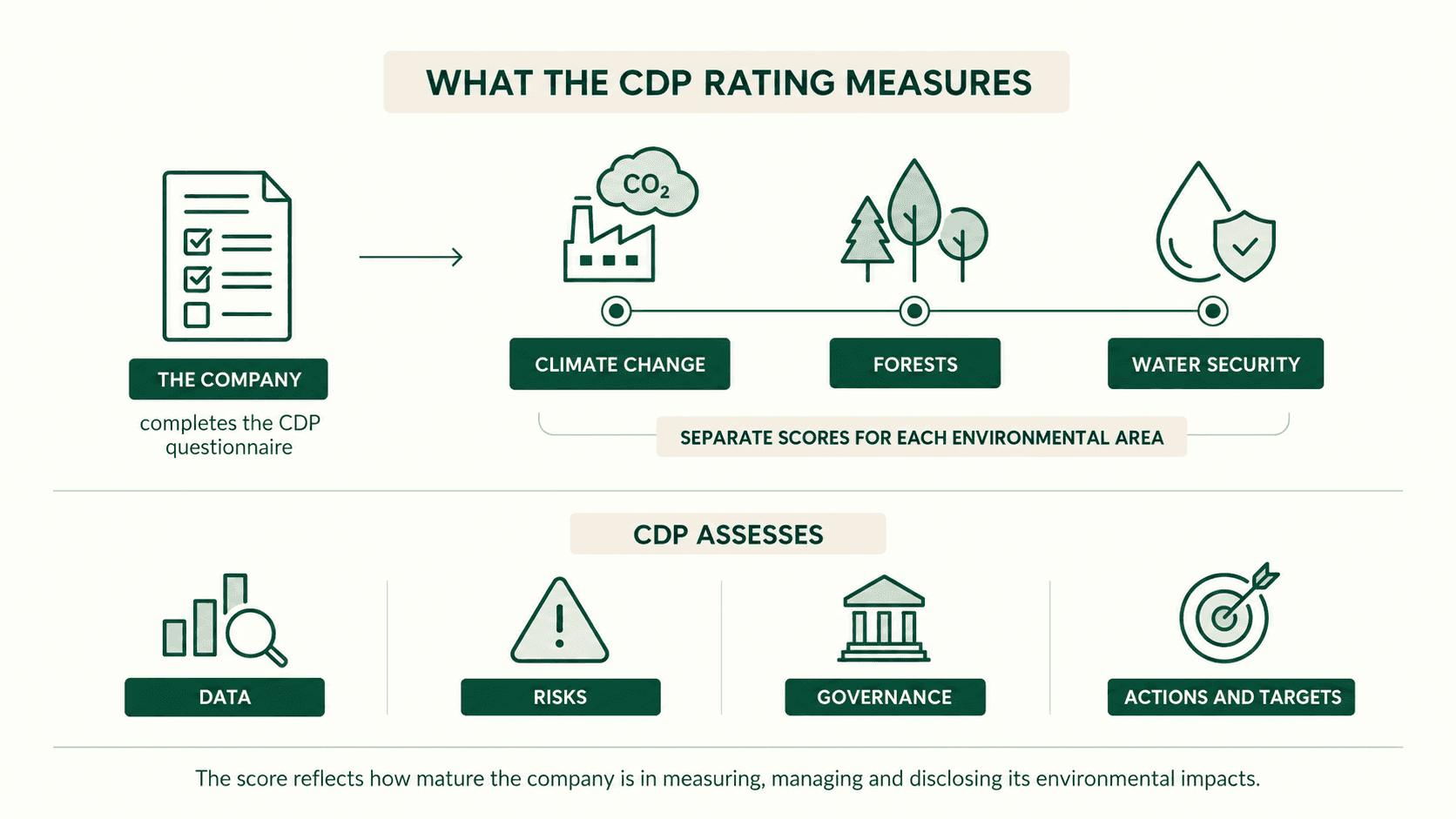
The CDP rating allows companies to assess the level of maturity they have reached in managing and disclosing their environmental impacts. The score is based on the information provided through the CDP questionnaire and follows a public scoring methodology that is updated periodically.
For companies, the CDP score is primarily a benchmarking tool. It helps identify which processes are already sufficiently structured, where data or procedures are missing, and which areas need to improve in order to reach a higher scoring level.
CDP scores companies completing the full corporate questionnaire on climate change, forests and water security. Plastics, biodiversity and oceans are also covered within CDP disclosure, but are not currently scored.
Understanding how the rating works therefore helps companies interpret their results correctly and organise the data, responsibilities and actions needed for subsequent disclosure cycles.
What is the CDP rating and what does it measure?
CDP, originally known as the Carbon Disclosure Project, operates an international environmental disclosure system through which organizations report information on how they manage environmental impacts.
The CDP rating is the result of the assessment of the information submitted through the questionnaire. It does not simply measure how much a company emits, nor does it automatically assign a better score to organizations with lower absolute emissions.
The assessment considers how mature the organization is in identifying, measuring and managing environmental issues. CDP therefore looks at factors such as the completeness of the information provided, awareness of environmental risks, the existence of management processes and the company’s ability to demonstrate results and advanced practices.
The expressions CDP ESG rating and CDP sustainability rating are often used in online searches, although neither is CDP’s official terminology. In practice, they refer to the scores CDP assigns across specific environmental topics. CDP can therefore be considered a specific assessment system within the broader landscape of ESG ratings.
Two companies with very different emissions profiles may receive similar scores if they show comparable levels of governance, data quality and management maturity. Likewise, a company may have several environmental initiatives in place and still receive a limited score if the required information is not properly documented or reported according to the methodology.
For a company using its CDP score as an internal performance indicator, the rating can also highlight operational gaps. A lower score may point to incomplete data, unclear responsibilities, a lack of measurable targets or climate risk assessment processes that are still insufficiently structured.
The assessment also varies depending on the environmental area considered. Within the full questionnaire, CDP assigns separate scores for climate change, forests and water security. The CDP climate rating, also commonly searched as the CDP climate change rating, therefore refers specifically to the company’s performance on climate-related disclosure rather than to an overall ESG score.
Which companies is CDP most relevant for?
CDP is used by companies of different sizes and across multiple industries, but it is particularly relevant for organizations that need to respond to structured requests for environmental data from customers, investors or other actors in their value chain.
In some respects, it can be compared with systems such as EcoVadis, because both require companies to provide structured information that is then used to assess their level of maturity. Their focus, however, is different. EcoVadis is widely used to assess ESG performance across supply chains, while CDP is more specifically focused on environmental disclosure and is particularly common among large corporate groups, listed companies and organizations exposed to the information needs of investors and financial markets.
This makes CDP particularly relevant for companies with an international presence, formal climate targets, complex corporate structures or significant exposure to environmental transparency requirements.
The system is also accessible to small and medium-sized enterprises, for which CDP provides a dedicated SME questionnaire. In 2026, the SME questionnaire is scored on climate change, while information related to forests and water security does not yet contribute to the score.
For an SME, disclosure may become especially relevant when requested by a strategic customer or when the company wants to build a more structured environmental data management process before such requirements become more frequent.
From an operational perspective, CDP is therefore particularly relevant for companies with a complex supply chain, formal climate targets, an international footprint or recurring requests for environmental data from customers and investors.
It can also be useful for organizations that want to track the maturity of their environmental processes over time. Comparing one disclosure cycle with the next helps identify which areas have improved and which continue to constrain the overall score.
How does the CDP rating scale work?
The CDP rating scale runs from D- to A. Scores are organized across four levels of maturity: Disclosure, Awareness, Management and Leadership. CDP describes these levels in its official corporate scoring methodology.

D and D- correspond to the Disclosure level. At this stage, the assessment mainly considers the company’s ability to provide the requested information with an adequate level of completeness. It represents the entry level of the scoring system and reflects the availability of the data required to describe the company’s environmental profile.
C and C- correspond to the Awareness level. To reach this level, the organization must demonstrate a stronger understanding of its environmental impacts, risks and opportunities. The quality of the response therefore depends on the ability to explain how environmental issues affect the business, rather than simply providing data.
B and B- correspond to the Management level. At this stage, CDP places greater emphasis on the existence of processes and concrete actions for managing the environmental issues identified. Policies, targets, responsibilities, action plans and monitoring systems become increasingly important.
A and A- represent the Leadership level. These are the scores associated with the most advanced practices included in the CDP methodology, where the organization is expected to demonstrate a high level of management, transparency and measurable results.
The progression across these levels is one of the key elements for understanding the CDP rating meaning. A company is not assessed through a simple final sum of all the points collected throughout the questionnaire. The methodology instead follows a progression across different levels of maturity.
To move between levels, an organization must reach the required thresholds and, where applicable, meet specific essential criteria, which vary depending on the environmental topic and the level being assessed.
If these requirements are not met, the score may remain at the previous level even when the company performs well in other areas.
For this reason, the rating is best interpreted together with the results of the individual scoring categories. The overall score shows the level reached, while the category-level results make it easier to identify where weaknesses are concentrated.
How is the CDP rating calculated?
The CDP rating methodology is based on the responses submitted by the company through the questionnaire. The score is calculated using the information provided directly in the response. External links and attachments are not generally considered unless explicitly required by the methodology. It is therefore important to provide each piece of information in the correct field and with the expected level of detail.
Each question can contribute to one or more scoring categories. In the case of the CDP climate change rating, for example, the questionnaire may include information on governance, targets, emissions, climate risks, corporate policies and value chain engagement.
A significant part of this assessment depends on the availability of reliable emissions data. A structured corporate carbon footprint helps companies identify their main emission sources and organize the information required for environmental disclosure.
The scoring categories do not necessarily carry the same weight. At the Management and Leadership levels, CDP applies weightings that reflect the importance of different areas within the overall assessment. These weightings may also vary depending on the organization’s sector.
A manufacturing company and a financial institution may therefore be assessed according to the same general logic, while different categories may carry greater or lesser weight depending on their relevance to the sector.
The process follows the four levels described above: Disclosure, Awareness, Management and Leadership. The response is assessed starting from the first level and can progress when the relevant thresholds are reached and, where applicable, essential criteria are met.
For companies, this has an important practical implication: strong performance in one area does not necessarily compensate for a significant gap in another area that is considered fundamental by the methodology.
For example, an organization may have a detailed emissions inventory but still be unable to reach the next level if its climate risk management processes are insufficiently developed or if another essential criterion has not been met.
Alongside the main rating, CDP also uses specific assessment tools. The Supplier Engagement Assessment, previously known as the CDP Supplier Engagement Rating, evaluates how companies engage their suppliers on climate-related topics. This assessment is separate from the main CDP score.
How to improve your CDP rating
Improving a CDP rating starts with understanding which categories are limiting the current result. The overall score shows the level of maturity reached, while category-level results help identify where improvement efforts should be focused.

For a company with a C rating, for example, simply completing more fields in the next questionnaire does not guarantee a move to B. The Awareness level indicates that the organization has started to understand its impacts and risks. To reach the Management level, it needs to show that this information is embedded into structured processes, responsibilities, targets and actions.
One of the first areas to address is data quality. Incomplete information, different methodologies across sites or manually updated data without adequate controls can create inconsistencies. For emissions, this means clearly defining organizational boundaries, data sources, calculation methodologies and responsibilities, while retaining sufficient evidence to reconstruct the reported figures. A correct classification of Scope 1, 2 and 3 emissions provides an important foundation for organizing emissions data consistently.
A second area concerns target management. A general commitment carries a different weight from a measurable target with a defined base year, scope, deadline and progress monitoring process. The same principle applies to emissions reduction plans: actions, owners, investment requirements and results should be clearly connected.
Climate risk analysis is another important area. An effective process should allow the company to identify physical and transition risks, define relevant time horizons, quantify financial impacts where possible and connect the results to business decisions. This makes it possible to feed CDP responses with information already used in corporate risk management, rather than building the analysis solely for the disclosure cycle.
For companies with a significant share of emissions across the value chain, it is also important to structure the collection of supplier data. Primary data, shared assessment criteria, targets and engagement processes can progressively improve the quality of Scope 3 emissions data and demonstrate greater control over the value chain. A supplier assessment software can help centralize requests, evidence and results when the number of suppliers involved increases.
Finally, preparing a CDP response should be treated as a cross-functional process. Sustainability, procurement, operations, energy, finance and risk management teams may each be responsible for different information. Defining data owners, deadlines, sources and approval steps in advance reduces last-minute checks and makes it easier to maintain continuity between disclosure cycles.
An ESG software platform can support this process by centralizing information from different functions, maintaining traceability of sources, assigning responsibilities and monitoring indicators, targets and actions.
Metrikflow supports companies in managing and improving their CDP rating, helping them review available documentation, identify improvement areas, structure the required information and strengthen the consistency of data collection and validation processes.
One example is Eurostampa, an Italian company founded in 1966 and now operating internationally in the production of premium labels for the wine & spirits, food & beverage and cosmetics industries. With production sites across Europe, the United Kingdom, North America, Mexico and India, the Group needed to extend its CDP reporting beyond its Italian headquarters and better reflect its international footprint.
With Metrikflow’s support, Eurostampa extended the CDP reporting perimeter to the entire Group and improved its rating from C to B, working on the quality and consistency of the information submitted.
“Metrikflow helped us approach ESG ratings with greater clarity and direction. Beyond improving our EcoVadis and CDP scores, the process allowed us to identify concrete areas for improvement and build a more complete picture of our sustainability performance across the Group.”
Fabio Colli Medaglia, Sustainability, Innovation & Business Development at Eurostampa
The Eurostampa case shows how a structured approach to reporting boundaries, documentation and data quality can contribute both to a stronger CDP rating and to a more complete representation of the organization’s environmental performance.
CONTRIBUTOR

Alessandro Nora
CEO & Co-founder
Alessandro's goal is to make a real impact on sustainability. After founding a sustainable fashion marketplace, he decided to focus on ESG digitalisation with the aim of making sustainability more concrete, measurable and accessible for companies. A careful and methodical founder, with experience in Genoa, Berlin and Lisbon, Alessandro combines international vision and operational rigour in the development of digital solutions that simplify ESG regulations and compliance, supporting companies in adapting to ESG regulations, certifications and ratings through structured and audit-ready tools. Topics covered: CSRD, CSDDD, EUDR, CBAM ESG ratings, ESG certifications, Ecovadis, sustainability governance, regulatory compliance.
Stay up to date with Metrikflow Insights!
We deliver expert insights, product updates, industry trends, and actionable strategies straight to your inbox. Stay ahead in ESG, GHG, and LCA — one edition at a time.
By submitting this form, you consent to receive the requested resource. For more information on how we process and protect your data, view our Privacy Policy.


