
Decarbonization, Carbon Footprint & LCA

Decarbonization, Carbon Footprint & LCA

Best LCA tools: 5 top LCA software solutions for companies

Best LCA tools: 5 top LCA software solutions for companies

A practical comparison to choose the right LCA tool

Luis Antazema Headshot
Luis Antazema
Metrikflow-style cover image representing LCA software with a digital dashboard, product environmental data, life cycle stages, CO2e emissions, comparison scenarios and reporting outputs.

Life Cycle Assessment, or LCA, measures the environmental impacts of a product, process or service across its main life cycle stages: raw material sourcing, production, distribution, use and end of life.
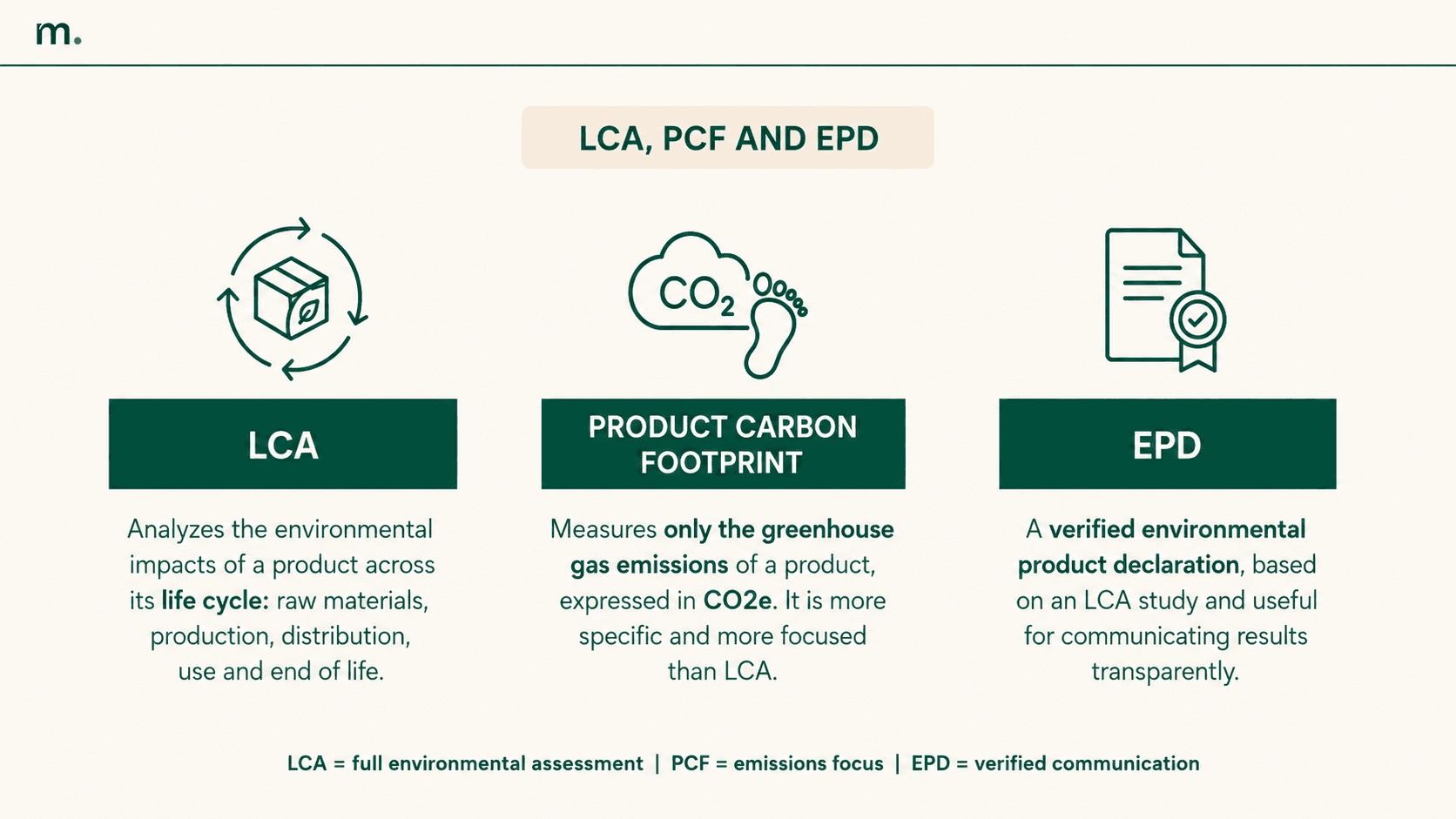
Infographic comparing LCA, Product Carbon Footprint and EPD, explaining the differences between a full environmental impact assessment, a focus on greenhouse gas emissions and a verified environmental product declaration.

In a business context, LCA is used to identify the life cycle stages with the highest environmental impact and define the most relevant improvement levers. LCA software supports this process by structuring data, calculations and assumptions in a more organized way than spreadsheets or manual analyses. In many cases, it also enables scenario analysis, helping companies assess how impacts would change if a specific variable changed, such as a material, supplier, production process or logistics choice.

LCA is broader than Product Carbon Footprint. Both assess the environmental impact of a product, but Product Carbon Footprint focuses on greenhouse gas emissions, expressed in CO₂ equivalent. LCA can include multiple impact categories, such as water consumption, resource use, waste generation and other environmental effects across the product life cycle.

An LCA study can also be used as the technical basis to obtain an EPD, or Environmental Product Declaration. An EPD is a voluntary certification that communicates the verified environmental impacts of a product across its life cycle. The process is managed through specific Program Operators, which define rules, requirements and verification procedures according to the product category.

For this reason, when choosing LCA software, companies should assess whether the tool is limited to Product Carbon Footprint calculations or whether it can support a more complete analysis aligned with the requirements of EPD pathways. A suitable software should help structure data, assumptions, system boundaries and results in a traceable way, making the analysis more robust and usable during verification.

The main difference between LCA software solutions lies in how each platform manages technical complexity, usability and scalability. Some tools are designed for LCA specialists and consultants, with advanced models and steep learning curves. Others are better suited to operational needs: data collection, cross-functional collaboration, information updates, management of multiple products and scenario modelling.

For companies, the selection criteria should start from how the data will be used. A standalone technical study requires different features from a system designed to support multiple products, users, suppliers and sustainability workflows. When LCA needs to connect with corporate carbon footprint, Product Carbon Footprint, ESG reporting and scenario analysis, modularity, traceability and structured data management become essential.

LCA software comparison

LCA software

Best for

Key strength

Best use case

Metrikflow

Companies that want to manage LCA analyses in an intuitive, scalable way, with optional integration into ESG workflows

Clear interface, structured data, scenario modelling and modularity

Sustainability, product, procurement and operations teams

SimaPro

Advanced LCA studies and detailed technical analyses

Methodological depth and specialist modelling

LCA consultants, researchers and expert users

Sphera / GaBi

Enterprise LCA and complex industrial modelling

Strong databases and structured approach for large organizations

Large companies and mature technical teams

openLCA

Open-source LCA modelling

Flexibility and free access to the software

Researchers, students, analysts and technical users

One Click LCA

LCA for construction, buildings and infrastructure

Vertical focus on construction materials and building projects

Construction, real estate and infrastructure

The table highlights an operational distinction: LCA software solutions are not interchangeable. The right choice depends on internal expertise, the number of products to analyse, data update frequency, supplier involvement and the tool’s ability to connect life cycle assessment with other business processes.

The 5 best LCA software solutions
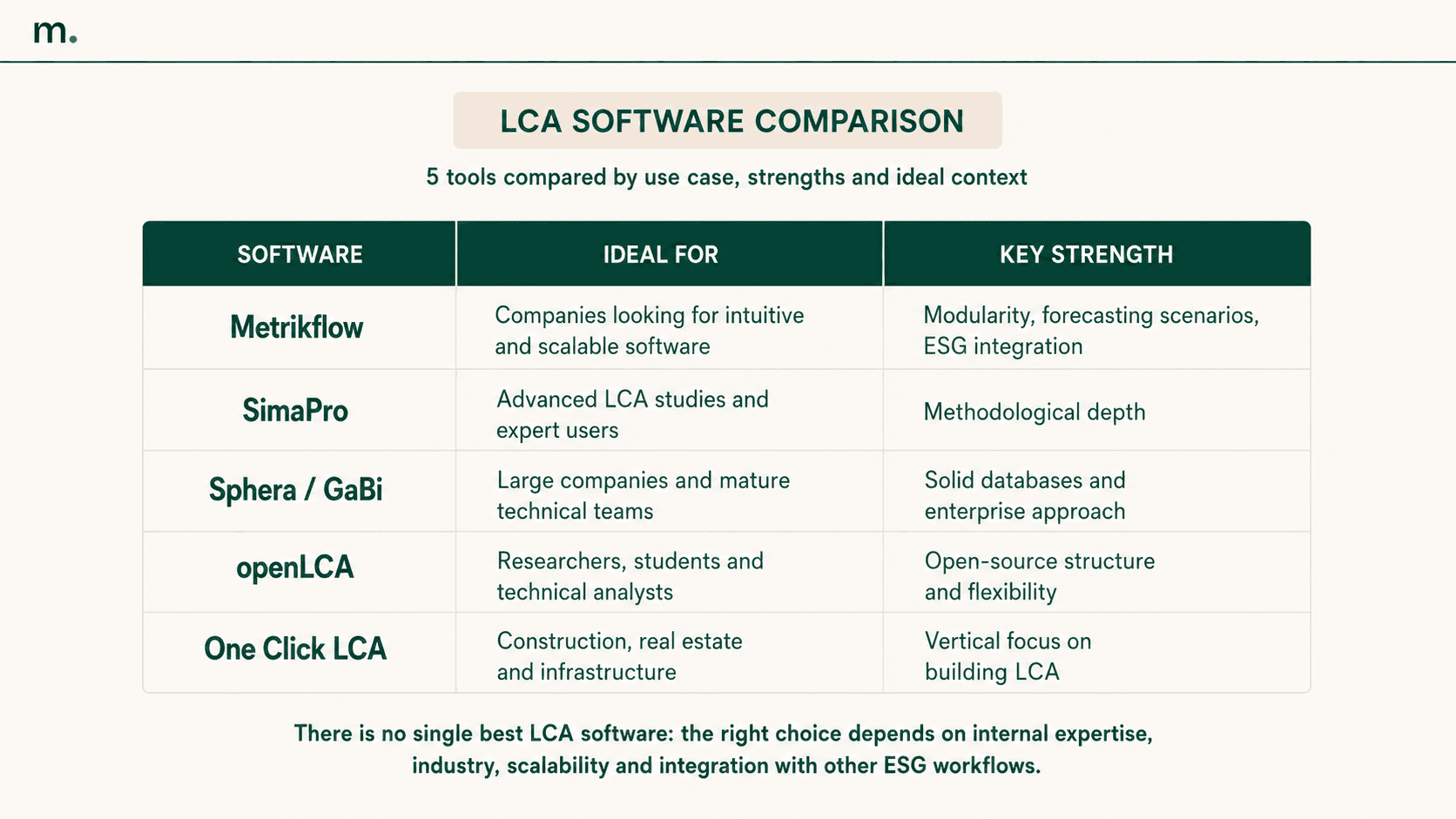
Comparison table of five LCA software solutions for companies, comparing Metrikflow, SimaPro, Sphera/GaBi, openLCA and One Click LCA by ideal use case and key strengths.

1. Metrikflow

Metrikflow’s LCA software is intuitive, modular and designed for companies that want to manage life cycle assessment with an operational, scalable approach that can also be used by non-technical teams. The LCA module can be adopted as a standalone solution to analyse products, structure environmental data, compare scenarios and support decisions on materials, suppliers and processes. The Metrikflow LCA software enables cradle-to-grave, cradle-to-gate or cradle-to-cradle analyses.

The interface is designed to simplify the management of complex data. Materials, processes, suppliers and emission factors can be organized clearly, avoiding dispersion across Excel files, local versions and separate documents. This reduces the time required to collect information and makes the entire analysis process more controllable.

Metrikflow is integrated with multiple data sources and databases, updated annually, including EcoInvent, BEIS, Exiobase, ISPRA, DEFRA and EPA. EcoInvent supports broader LCA analyses through life cycle inventory data, while BEIS and EPA provide emission factors used for GHG calculations, carbon footprint and Product Carbon Footprint assessments. Based on the company’s sector, production processes, materials and type of analysis, the platform makes the most relevant data sources selectable for the company.

The value of the software becomes clear when a company needs to extend the work beyond a single assessment. A team can start from one product, one product line or one specific LCA scope, then expand the analysis to other products, plants, suppliers or business units. The modular structure allows the system to adapt to the organization’s maturity level without forcing the company to adopt an overly complex setup from the beginning.

Metrikflow also enables scenario modelling. Companies can assess how changes in materials, suppliers, production processes or logistics choices affect future environmental impacts. This functionality makes LCA useful for decisions related to product development, procurement, operations and impact reduction across the supply chain.

Metrikflow is a comprehensive ESG software platform where the LCA module can also connect with other modules, such as carbon footprint and ESG reporting, when the company needs a more integrated system. In this case, data that has already been collected can be reused across multiple workflows, reducing duplication and inconsistencies. This integration is an additional advantage, not a requirement: the LCA software remains valuable as a standalone module.

Compared with highly technical traditional tools, Metrikflow offers a more user-friendly and accessible user experience. This makes internal adoption easier and facilitates the involvement of different business functions, making environmental data more usable across internal processes.

Metrikflow is suitable for companies looking for clear, modular and scalable LCA software that can support product analyses, decision-making scenarios and progressive integration with other sustainability data.

Best for: companies looking for intuitive and scalable LCA software.

Key strengths: clear interface, modularity, structured data, scenario modelling, optional integration with carbon footprint and ESG.

Potential limitation: for extremely specialist LCA modelling conducted exclusively by technical experts, companies may want to compare it with software focused on advanced modelling.

2. SimaPro

SimaPro is one of the most established LCA software solutions on the market. It is mainly used by consultants, researchers and specialists who are familiar with databases, system boundaries, allocation methods and environmental impact categories.

Its key strength is methodological depth. The software allows users to build detailed analyses, manage complex models and work with a high level of technical control. For specialist LCA studies, research projects or analyses conducted by experienced professionals, SimaPro is a robust solution.

The same depth can make adoption more difficult for non-specialist corporate teams. The interface is often perceived as less modern than newer platforms, and the learning curve can slow down adoption by functions outside the technical team. This can limit internal collaboration when a company wants to integrate LCA into operational processes.

Access models and costs can also affect scalability. For a single expert or one-off studies, the investment may be justified by the technical quality of the tool. For companies that want to involve multiple users and make environmental analysis a continuous process, the cost per access and complexity of use should be carefully assessed.

SimaPro remains a strong choice for companies looking for advanced modelling and technical control. It is less immediate when the goal is to make LCA data accessible to multiple business departments.

Best for: LCA consultants, researchers and technical users.

Key strengths: advanced modelling, methodological depth, strong recognition in the LCA field.

Potential limitation: less modern interface, steep learning curve and potentially significant cost for multiple users.

3. Sphera / GaBi

Sphera / GaBi is a solution designed for large organizations with complex LCA requirements. It is often used in industrial contexts where companies need structured databases, detailed modelling and management of complex processes.

Its main advantage is the strength of its enterprise approach. For companies with broad product portfolios, complex production processes and dedicated technical teams, Sphera / GaBi can provide a structured environment to analyse environmental impacts at scale.

The enterprise structure can be demanding for companies that want to start from a more limited scope. Many organizations begin with one product line, a Product Carbon Footprint or a specific carbon accounting module, then gradually expand the work over time.

In these cases, flexibility becomes an important operational criterion. A highly structured platform can require more configuration time, more internal expertise and more mature data governance. For companies gradually building their ESG and environmental processes, a modular solution may be easier to adopt.

Sphera / GaBi is therefore suitable for large organizations with advanced technical needs and dedicated resources. For companies looking for a more adaptable path, the evaluation should focus on implementation time, modular scalability and ease of use for internal teams.

Best for: large companies and technical teams with advanced LCA requirements.

Key strengths: enterprise approach, structured databases, industrial modelling.

Potential limitation: less immediate for companies that want to start gradually and modularly.

4. openLCA

openLCA is a free and open-source LCA software. It is used by researchers, students, analysts and technical users looking for a flexible tool without a commercial licence.

Its main advantage is accessibility. The software can be a good option to explore LCA methodology, create custom models and conduct technical analyses with a good level of control. For universities, research centres or teams with solid internal expertise, openLCA provides a useful environment for developing detailed analyses.

However, the cost of the software does not reflect the real cost of the process. To use openLCA effectively, teams need expertise in databases, assumptions, system boundaries, allocation rules, life cycle inventory and impact assessment methods. Without these skills, results may be difficult to interpret or not very usable at business level.

For a company, the evaluation should also include collaboration, data management, information updates and the ability to integrate results with other processes. openLCA can work well for technical teams, but may be less suitable when multiple departments need to contribute to data collection or use the outputs for operational decisions.

Its strength is technical flexibility. Its main limitation in a corporate context is the lack of a guided workflow designed to scale LCA use beyond a small group of expert users.

Best for: researchers, students, analysts and technical users.

Key strengths: free access, open-source structure, modelling flexibility.

Potential limitation: requires technical expertise and may be less suitable for non-specialist corporate teams.

5. One Click LCA

One Click LCA is a software solution focused on construction, real estate and infrastructure. The platform is designed to assess the environmental impacts of buildings, construction materials and projects related to the built environment.

Its main value lies in its vertical specialization. For companies operating in construction, a platform built around sector-specific data, standards and workflows can reduce the time required to structure relevant environmental analyses. Its focus on construction materials and building projects makes it more targeted than generalist LCA software.

This specialization is an advantage when the company’s scope is aligned with the sector. It can support teams that need to assess buildings, infrastructure, materials and environmental performance of real estate projects.

For manufacturing companies or groups with products very different from the built environment, this vertical focus may be less suitable. If the need involves heterogeneous product lines, supplier data collection, Product Carbon Footprint and integration with corporate carbon footprint or ESG reporting, it is useful to evaluate more flexible solutions.

One Click LCA is therefore an effective choice for companies in the construction sector. Outside that scope, the decision should depend on the software’s ability to adapt to specific product and process requirements.

Best for: construction, real estate and infrastructure.

Key strengths: building LCA, construction material data, sector-specific workflows.

Potential limitation: less relevant for companies outside the built environment.

How to choose the right LCA software

The choice of LCA software should start from how the company intends to use the data. A one-off technical study requires different features from a system designed to manage environmental data across multiple products, suppliers and business functions.
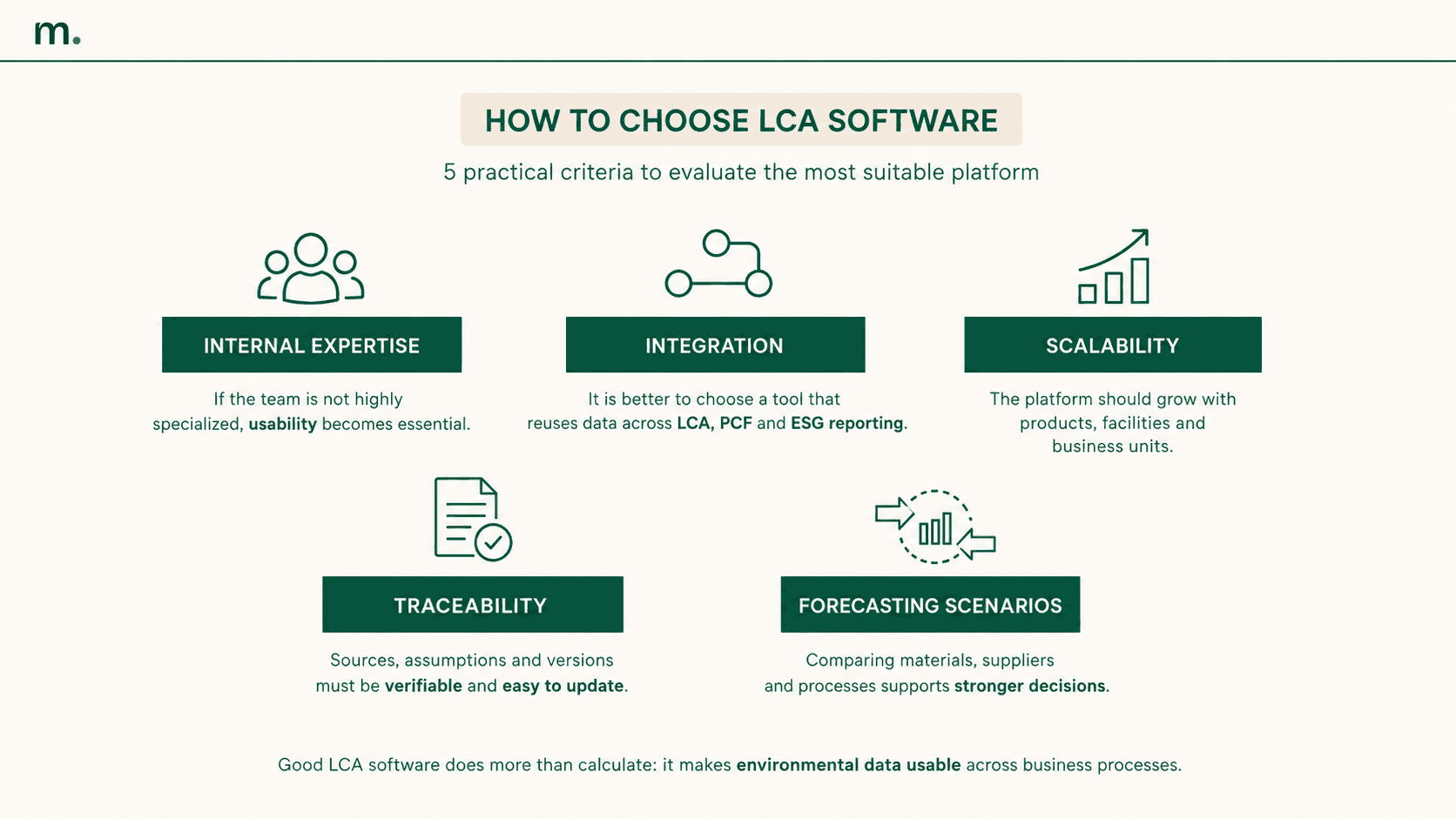
Infographic showing five criteria for choosing LCA software: internal expertise, integration, scalability, traceability and forecasting scenarios to make environmental data usable across business processes.

The first criterion is the level of internal expertise available. Specialist software offers advanced modelling capabilities, but requires expert users. If the company wants to involve sustainability managers, procurement, operations or product teams, usability becomes a key factor to reduce adoption time and dependence on external consultants.

The second criterion is integration between processes. In many companies, the same data on materials, consumption, transport, emission factors and suppliers is used for multiple activities: LCA, Product Carbon Footprint, Scope 1, 2 and 3, ESG reporting and scenario analysis. Software that enables data reuse reduces duplication and improves consistency across outputs.

The third criterion is scalability. An organization may start with one product or one line, then extend the work to multiple plants, markets or business units. The chosen platform should support this growth without requiring a new data architecture every time.

The fourth criterion is traceability. LCA results need to be explainable, updatable and verifiable. This requires clear management of data sources, assumptions, versions and calculation criteria.

The fifth criterion is the ability to support scenario modelling. Companies need to compare alternatives: different materials, suppliers, production processes and energy mixes. Software that enables these simulations makes LCA more useful for planning, procurement, product development and impact reduction.

For companies setting up the process from scratch, it can be useful to start from an operational guide on how to conduct an LCA, in order to clarify required data, work phases and internal responsibilities before choosing the software.

LCA software or LCA calculator: what is the difference?

An LCA calculator is designed to provide a quick estimate of environmental impact or Product Carbon Footprint. It can be useful in the early evaluation stages, when the company needs a preliminary indication and the analysis scope is limited.

LCA software offers more structured management. It allows companies to organize product data, define system boundaries, manage databases, model life cycle stages, document assumptions and compare scenarios. This level of control becomes necessary when the analysis needs to be updated, replicated across multiple products or used to support business decisions.

The difference therefore lies in the level of reliability, traceability and scalability required. A calculator can respond to a specific one-off need. LCA software is more suitable when the company wants to build a stable process for managing environmental data.

For corporate teams, the main risk is treating LCA as an isolated calculation. Materials, suppliers, volumes, processes and market requirements change. Without a structured system, every update can become manual work, increasing time spent and exposure to errors.

FAQ about LCA software

What is the best LCA software for companies?

It depends on the use case. SimaPro and Sphera / GaBi are suitable for advanced modelling and technical teams. openLCA is suitable for expert users looking for an open-source solution. One Click LCA is strong in the construction sector. Metrikflow is suitable for companies looking for intuitive, modular and scalable LCA software, with the option to integrate it with Product Carbon Footprint, carbon footprint and ESG data.

What is LCA software used for?

LCA software is used to measure and analyse the environmental impacts of products, processes or services across their life cycle. In companies, it can support product development, procurement, supplier assessment, Product Carbon Footprint, EPD, scenario analysis and impact reduction decisions.

What is the difference between LCA and Product Carbon Footprint?

Product Carbon Footprint measures the climate impact of a product, expressed in CO₂ equivalent. LCA can include multiple environmental impact categories, such as water consumption, resource use, acidification, eutrophication and climate change.

Can LCA software support EPD pathways?

Yes, some LCA software solutions can support data collection and modelling for EPD pathways. Companies should check compatibility with standards, databases, Product Category Rules and verification requirements applicable to their product category.

Are there free LCA software solutions?

Yes. openLCA is a free and open-source LCA software. It can be useful for technical users, researchers and teams with internal expertise. For scalable business use, companies should also consider configuration time, required skills, data management and collaboration between departments.

Conclusion

The best LCA software for a company depends on internal expertise, product complexity, the number of users involved and the level of integration required with other sustainability processes.

Tools such as SimaPro, Sphera / GaBi and openLCA offer relevant capabilities for technical users and specialist analyses. One Click LCA addresses vertical needs in the construction sector. Metrikflow is designed for companies that want to manage LCA analyses in an intuitive and scalable way, with the option to connect the module to other workflows such as Product Carbon Footprint, carbon footprint and ESG software.

The choice should be based on operational criteria: time required to collect data, ability to reuse it, ease of updates, calculation traceability, team collaboration and scenario modelling. These elements determine how usable the software will be beyond the first analysis.

An effective LCA process helps companies compare alternatives, reduce duplication, improve data quality and make more robust decisions on products, suppliers and processes. The chosen technology should support this work continuously, keeping environmental data updatable, verifiable and usable across business processes.

Whitepaper

A Conversation between EFRAG and Industry

Dolor netus eget suspendisse pellentesque. Diam elit lobortis elementum mi sed turpis quisque feugiat leo. Ipsum purus faucibus sed potenti phasellus duis vestibulum risus sagittis. Sit viverra convallis ultrices netus pulvinar.

Download Now

Life Cycle Assessment, or LCA, measures the environmental impacts of a product, process or service across its main life cycle stages: raw material sourcing, production, distribution, use and end of life.

Infographic comparing LCA, Product Carbon Footprint and EPD, explaining the differences between a full environmental impact assessment, a focus on greenhouse gas emissions and a verified environmental product declaration.

In a business context, LCA is used to identify the life cycle stages with the highest environmental impact and define the most relevant improvement levers. LCA software supports this process by structuring data, calculations and assumptions in a more organized way than spreadsheets or manual analyses. In many cases, it also enables scenario analysis, helping companies assess how impacts would change if a specific variable changed, such as a material, supplier, production process or logistics choice.

LCA is broader than Product Carbon Footprint. Both assess the environmental impact of a product, but Product Carbon Footprint focuses on greenhouse gas emissions, expressed in CO₂ equivalent. LCA can include multiple impact categories, such as water consumption, resource use, waste generation and other environmental effects across the product life cycle.

An LCA study can also be used as the technical basis to obtain an EPD, or Environmental Product Declaration. An EPD is a voluntary certification that communicates the verified environmental impacts of a product across its life cycle. The process is managed through specific Program Operators, which define rules, requirements and verification procedures according to the product category.

For this reason, when choosing LCA software, companies should assess whether the tool is limited to Product Carbon Footprint calculations or whether it can support a more complete analysis aligned with the requirements of EPD pathways. A suitable software should help structure data, assumptions, system boundaries and results in a traceable way, making the analysis more robust and usable during verification.

The main difference between LCA software solutions lies in how each platform manages technical complexity, usability and scalability. Some tools are designed for LCA specialists and consultants, with advanced models and steep learning curves. Others are better suited to operational needs: data collection, cross-functional collaboration, information updates, management of multiple products and scenario modelling.

For companies, the selection criteria should start from how the data will be used. A standalone technical study requires different features from a system designed to support multiple products, users, suppliers and sustainability workflows. When LCA needs to connect with corporate carbon footprint, Product Carbon Footprint, ESG reporting and scenario analysis, modularity, traceability and structured data management become essential.

LCA software comparison

LCA software

Best for

Key strength

Best use case

Metrikflow

Companies that want to manage LCA analyses in an intuitive, scalable way, with optional integration into ESG workflows

Clear interface, structured data, scenario modelling and modularity

Sustainability, product, procurement and operations teams

SimaPro

Advanced LCA studies and detailed technical analyses

Methodological depth and specialist modelling

LCA consultants, researchers and expert users

Sphera / GaBi

Enterprise LCA and complex industrial modelling

Strong databases and structured approach for large organizations

Large companies and mature technical teams

openLCA

Open-source LCA modelling

Flexibility and free access to the software

Researchers, students, analysts and technical users

One Click LCA

LCA for construction, buildings and infrastructure

Vertical focus on construction materials and building projects

Construction, real estate and infrastructure

The table highlights an operational distinction: LCA software solutions are not interchangeable. The right choice depends on internal expertise, the number of products to analyse, data update frequency, supplier involvement and the tool’s ability to connect life cycle assessment with other business processes.

The 5 best LCA software solutions

Comparison table of five LCA software solutions for companies, comparing Metrikflow, SimaPro, Sphera/GaBi, openLCA and One Click LCA by ideal use case and key strengths.

1. Metrikflow

Metrikflow’s LCA software is intuitive, modular and designed for companies that want to manage life cycle assessment with an operational, scalable approach that can also be used by non-technical teams. The LCA module can be adopted as a standalone solution to analyse products, structure environmental data, compare scenarios and support decisions on materials, suppliers and processes. The Metrikflow LCA software enables cradle-to-grave, cradle-to-gate or cradle-to-cradle analyses.

The interface is designed to simplify the management of complex data. Materials, processes, suppliers and emission factors can be organized clearly, avoiding dispersion across Excel files, local versions and separate documents. This reduces the time required to collect information and makes the entire analysis process more controllable.

Metrikflow is integrated with multiple data sources and databases, updated annually, including EcoInvent, BEIS, Exiobase, ISPRA, DEFRA and EPA. EcoInvent supports broader LCA analyses through life cycle inventory data, while BEIS and EPA provide emission factors used for GHG calculations, carbon footprint and Product Carbon Footprint assessments. Based on the company’s sector, production processes, materials and type of analysis, the platform makes the most relevant data sources selectable for the company.

The value of the software becomes clear when a company needs to extend the work beyond a single assessment. A team can start from one product, one product line or one specific LCA scope, then expand the analysis to other products, plants, suppliers or business units. The modular structure allows the system to adapt to the organization’s maturity level without forcing the company to adopt an overly complex setup from the beginning.

Metrikflow also enables scenario modelling. Companies can assess how changes in materials, suppliers, production processes or logistics choices affect future environmental impacts. This functionality makes LCA useful for decisions related to product development, procurement, operations and impact reduction across the supply chain.

Metrikflow is a comprehensive ESG software platform where the LCA module can also connect with other modules, such as carbon footprint and ESG reporting, when the company needs a more integrated system. In this case, data that has already been collected can be reused across multiple workflows, reducing duplication and inconsistencies. This integration is an additional advantage, not a requirement: the LCA software remains valuable as a standalone module.

Compared with highly technical traditional tools, Metrikflow offers a more user-friendly and accessible user experience. This makes internal adoption easier and facilitates the involvement of different business functions, making environmental data more usable across internal processes.

Metrikflow is suitable for companies looking for clear, modular and scalable LCA software that can support product analyses, decision-making scenarios and progressive integration with other sustainability data.

Best for: companies looking for intuitive and scalable LCA software.

Key strengths: clear interface, modularity, structured data, scenario modelling, optional integration with carbon footprint and ESG.

Potential limitation: for extremely specialist LCA modelling conducted exclusively by technical experts, companies may want to compare it with software focused on advanced modelling.

2. SimaPro

SimaPro is one of the most established LCA software solutions on the market. It is mainly used by consultants, researchers and specialists who are familiar with databases, system boundaries, allocation methods and environmental impact categories.

Its key strength is methodological depth. The software allows users to build detailed analyses, manage complex models and work with a high level of technical control. For specialist LCA studies, research projects or analyses conducted by experienced professionals, SimaPro is a robust solution.

The same depth can make adoption more difficult for non-specialist corporate teams. The interface is often perceived as less modern than newer platforms, and the learning curve can slow down adoption by functions outside the technical team. This can limit internal collaboration when a company wants to integrate LCA into operational processes.

Access models and costs can also affect scalability. For a single expert or one-off studies, the investment may be justified by the technical quality of the tool. For companies that want to involve multiple users and make environmental analysis a continuous process, the cost per access and complexity of use should be carefully assessed.

SimaPro remains a strong choice for companies looking for advanced modelling and technical control. It is less immediate when the goal is to make LCA data accessible to multiple business departments.

Best for: LCA consultants, researchers and technical users.

Key strengths: advanced modelling, methodological depth, strong recognition in the LCA field.

Potential limitation: less modern interface, steep learning curve and potentially significant cost for multiple users.

3. Sphera / GaBi

Sphera / GaBi is a solution designed for large organizations with complex LCA requirements. It is often used in industrial contexts where companies need structured databases, detailed modelling and management of complex processes.

Its main advantage is the strength of its enterprise approach. For companies with broad product portfolios, complex production processes and dedicated technical teams, Sphera / GaBi can provide a structured environment to analyse environmental impacts at scale.

The enterprise structure can be demanding for companies that want to start from a more limited scope. Many organizations begin with one product line, a Product Carbon Footprint or a specific carbon accounting module, then gradually expand the work over time.

In these cases, flexibility becomes an important operational criterion. A highly structured platform can require more configuration time, more internal expertise and more mature data governance. For companies gradually building their ESG and environmental processes, a modular solution may be easier to adopt.

Sphera / GaBi is therefore suitable for large organizations with advanced technical needs and dedicated resources. For companies looking for a more adaptable path, the evaluation should focus on implementation time, modular scalability and ease of use for internal teams.

Best for: large companies and technical teams with advanced LCA requirements.

Key strengths: enterprise approach, structured databases, industrial modelling.

Potential limitation: less immediate for companies that want to start gradually and modularly.

4. openLCA

openLCA is a free and open-source LCA software. It is used by researchers, students, analysts and technical users looking for a flexible tool without a commercial licence.

Its main advantage is accessibility. The software can be a good option to explore LCA methodology, create custom models and conduct technical analyses with a good level of control. For universities, research centres or teams with solid internal expertise, openLCA provides a useful environment for developing detailed analyses.

However, the cost of the software does not reflect the real cost of the process. To use openLCA effectively, teams need expertise in databases, assumptions, system boundaries, allocation rules, life cycle inventory and impact assessment methods. Without these skills, results may be difficult to interpret or not very usable at business level.

For a company, the evaluation should also include collaboration, data management, information updates and the ability to integrate results with other processes. openLCA can work well for technical teams, but may be less suitable when multiple departments need to contribute to data collection or use the outputs for operational decisions.

Its strength is technical flexibility. Its main limitation in a corporate context is the lack of a guided workflow designed to scale LCA use beyond a small group of expert users.

Best for: researchers, students, analysts and technical users.

Key strengths: free access, open-source structure, modelling flexibility.

Potential limitation: requires technical expertise and may be less suitable for non-specialist corporate teams.

5. One Click LCA

One Click LCA is a software solution focused on construction, real estate and infrastructure. The platform is designed to assess the environmental impacts of buildings, construction materials and projects related to the built environment.

Its main value lies in its vertical specialization. For companies operating in construction, a platform built around sector-specific data, standards and workflows can reduce the time required to structure relevant environmental analyses. Its focus on construction materials and building projects makes it more targeted than generalist LCA software.

This specialization is an advantage when the company’s scope is aligned with the sector. It can support teams that need to assess buildings, infrastructure, materials and environmental performance of real estate projects.

For manufacturing companies or groups with products very different from the built environment, this vertical focus may be less suitable. If the need involves heterogeneous product lines, supplier data collection, Product Carbon Footprint and integration with corporate carbon footprint or ESG reporting, it is useful to evaluate more flexible solutions.

One Click LCA is therefore an effective choice for companies in the construction sector. Outside that scope, the decision should depend on the software’s ability to adapt to specific product and process requirements.

Best for: construction, real estate and infrastructure.

Key strengths: building LCA, construction material data, sector-specific workflows.

Potential limitation: less relevant for companies outside the built environment.

How to choose the right LCA software

The choice of LCA software should start from how the company intends to use the data. A one-off technical study requires different features from a system designed to manage environmental data across multiple products, suppliers and business functions.

Infographic showing five criteria for choosing LCA software: internal expertise, integration, scalability, traceability and forecasting scenarios to make environmental data usable across business processes.

The first criterion is the level of internal expertise available. Specialist software offers advanced modelling capabilities, but requires expert users. If the company wants to involve sustainability managers, procurement, operations or product teams, usability becomes a key factor to reduce adoption time and dependence on external consultants.

The second criterion is integration between processes. In many companies, the same data on materials, consumption, transport, emission factors and suppliers is used for multiple activities: LCA, Product Carbon Footprint, Scope 1, 2 and 3, ESG reporting and scenario analysis. Software that enables data reuse reduces duplication and improves consistency across outputs.

The third criterion is scalability. An organization may start with one product or one line, then extend the work to multiple plants, markets or business units. The chosen platform should support this growth without requiring a new data architecture every time.

The fourth criterion is traceability. LCA results need to be explainable, updatable and verifiable. This requires clear management of data sources, assumptions, versions and calculation criteria.

The fifth criterion is the ability to support scenario modelling. Companies need to compare alternatives: different materials, suppliers, production processes and energy mixes. Software that enables these simulations makes LCA more useful for planning, procurement, product development and impact reduction.

For companies setting up the process from scratch, it can be useful to start from an operational guide on how to conduct an LCA, in order to clarify required data, work phases and internal responsibilities before choosing the software.

LCA software or LCA calculator: what is the difference?

An LCA calculator is designed to provide a quick estimate of environmental impact or Product Carbon Footprint. It can be useful in the early evaluation stages, when the company needs a preliminary indication and the analysis scope is limited.

LCA software offers more structured management. It allows companies to organize product data, define system boundaries, manage databases, model life cycle stages, document assumptions and compare scenarios. This level of control becomes necessary when the analysis needs to be updated, replicated across multiple products or used to support business decisions.

The difference therefore lies in the level of reliability, traceability and scalability required. A calculator can respond to a specific one-off need. LCA software is more suitable when the company wants to build a stable process for managing environmental data.

For corporate teams, the main risk is treating LCA as an isolated calculation. Materials, suppliers, volumes, processes and market requirements change. Without a structured system, every update can become manual work, increasing time spent and exposure to errors.

FAQ about LCA software

What is the best LCA software for companies?

It depends on the use case. SimaPro and Sphera / GaBi are suitable for advanced modelling and technical teams. openLCA is suitable for expert users looking for an open-source solution. One Click LCA is strong in the construction sector. Metrikflow is suitable for companies looking for intuitive, modular and scalable LCA software, with the option to integrate it with Product Carbon Footprint, carbon footprint and ESG data.

What is LCA software used for?

LCA software is used to measure and analyse the environmental impacts of products, processes or services across their life cycle. In companies, it can support product development, procurement, supplier assessment, Product Carbon Footprint, EPD, scenario analysis and impact reduction decisions.

What is the difference between LCA and Product Carbon Footprint?

Product Carbon Footprint measures the climate impact of a product, expressed in CO₂ equivalent. LCA can include multiple environmental impact categories, such as water consumption, resource use, acidification, eutrophication and climate change.

Can LCA software support EPD pathways?

Yes, some LCA software solutions can support data collection and modelling for EPD pathways. Companies should check compatibility with standards, databases, Product Category Rules and verification requirements applicable to their product category.

Are there free LCA software solutions?

Yes. openLCA is a free and open-source LCA software. It can be useful for technical users, researchers and teams with internal expertise. For scalable business use, companies should also consider configuration time, required skills, data management and collaboration between departments.

Conclusion

The best LCA software for a company depends on internal expertise, product complexity, the number of users involved and the level of integration required with other sustainability processes.

Tools such as SimaPro, Sphera / GaBi and openLCA offer relevant capabilities for technical users and specialist analyses. One Click LCA addresses vertical needs in the construction sector. Metrikflow is designed for companies that want to manage LCA analyses in an intuitive and scalable way, with the option to connect the module to other workflows such as Product Carbon Footprint, carbon footprint and ESG software.

The choice should be based on operational criteria: time required to collect data, ability to reuse it, ease of updates, calculation traceability, team collaboration and scenario modelling. These elements determine how usable the software will be beyond the first analysis.

An effective LCA process helps companies compare alternatives, reduce duplication, improve data quality and make more robust decisions on products, suppliers and processes. The chosen technology should support this work continuously, keeping environmental data updatable, verifiable and usable across business processes.

CONTRIBUTOR

Luis Antazema Headshot

Luis Antazema

Sustainability Analyst

Formed as a Chemical Engineer and with a focus on the energy sector, Luis applies a rigorous technical and analytical approach to decarbonisation and emissions measurement. Born in Bolivia and professionally developed across the United States and Europe, he contributes to the design and implementation of Carbon Footprint and Life Cycle Assessment (LCA) methodologies, helping organisations accurately quantify emissions while identifying opportunities to optimise processes, improve resource efficiency, and reduce operational costs. Luis approaches sustainability not only as a compliance exercise, but as a driver of measurable business value—linking environmental performance with economic returns, risk reduction, and long-term competitiveness.He works to make sustainability practical, data-driven, and financially meaningful for organisations and their stakeholders. Topics covered: Decarbonisation, Corporate Carbon Footprint, Life Cycle Assessment (LCA), Scope 1–2–3 accounting, GHG Protocol, Product Carbon Footprint (PCF).

No headings found on page

Stay up to date with Metrikflow Insights!

We deliver expert insights, product updates, industry trends, and actionable strategies straight to your inbox. Stay ahead in ESG, GHG, and LCA — one edition at a time.

By submitting this form, you consent to receive the requested resource. For more information on how we process and protect your data, view our Privacy Policy.

The go-to software solution for Sustainability Managers.

Customer-Oriented

Data Accurate

Built on Smart Tech

ESG radar: The Metrikflow Newsletter

Everything you need to know about sustainability,
all-in-one email. Weekly insights. Zero spam.

By submitting this form, you consent to receive the requested resource. For more information on how we process and protect your data, view our Privacy Policy.

ESG radar: The Metrikflow Newsletter

Everything you need to know about sustainability, all-in-one email. Weekly insights. Zero spam.

By submitting this form, you consent to receive the requested resource. For more information on how we process and protect your data, view our Privacy Policy.

The go-to software solution for Sustainability Managers.

Customer-Oriented

Data Accurate

Built on Smart Tech

The go-to software solution for Sustainability Managers.

Customer-Oriented

Data Accurate

Built on Smart Tech

ESG radar: The Metrikflow Newsletter

Everything you need to know about sustainability,
all-in-one email. Weekly insights. Zero spam.

By submitting this form, you consent to receive the requested resource. For more information on how we process and protect your data, view our Privacy Policy.