

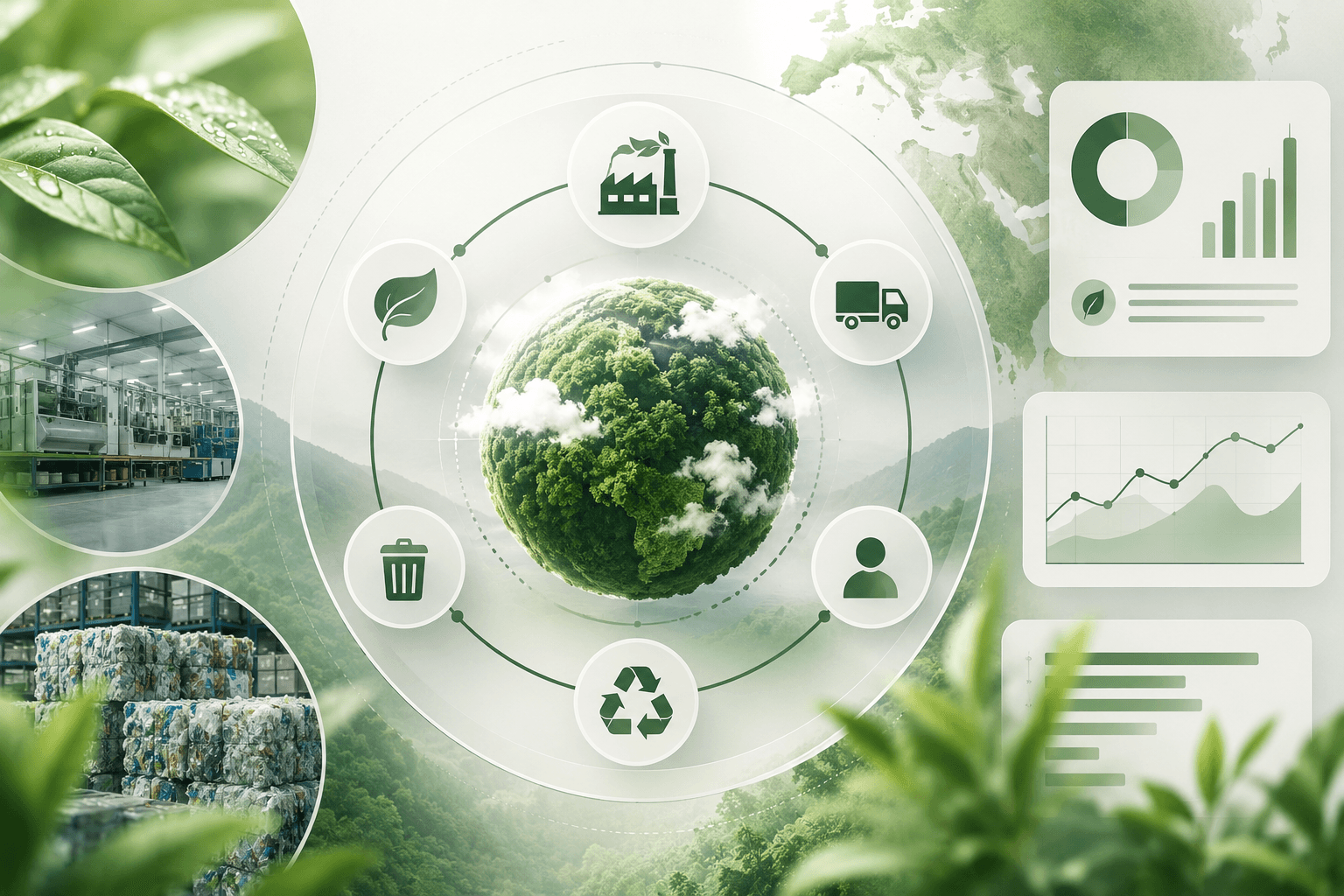
As emissões de Escopo 3 representam a maior e mais complexa parcela da pegada de carbono de uma empresa.
Definidas pelo Protocolo de Gases de Efeito Estufa (GHG Protocol Scope 3 Standard), elas abrangem todas as emissões indiretas geradas ao longo da cadeia de suprimentos e da cadeia de valor de uma organização, tanto a montante (upstream) quanto a jusante (downstream).
Ao contrário das emissões de Escopo 1 e Escopo 2, o Escopo 3 não se refere a atividades controladas diretamente pela empresa, mas sim a todas aquelas conectadas às suas operações — como fornecedores, transporte, uso de produtos e descarte final.
Por essa razão, o Escopo 3 tornou-se a área de foco crítica para as empresas que buscam compreender e gerenciar plenamente seu impacto ambiental.
Mas o que exatamente as emissões de Escopo 3 incluem e como elas podem ser calculadas de forma confiável?
Neste guia, exploraremos as categorias do Escopo 3, os principais desafios operacionais e os métodos utilizados para medir e gerenciar as emissões em toda a cadeia de valor.
What are Scope 3 emissions
Scope 3 emissions include all indirect greenhouse gas (GHG) emissions that are not part of Scope 1 or Scope 2, but are still linked to a company’s activities.
According to the GHG Protocol Scope 3 Standard, these emissions occur across the entire value chain and include both upstream activities (such as suppliers) and downstream activities (such as product use).
Unlike other scopes, Scope 3 is characterized by three key aspects:
it is not under direct company control
it involves multiple external stakeholders
it requires distributed and often unstructured data
This makes Scope 3 essential for a complete carbon footprint assessment, but also significantly more difficult to manage accurately.
The 15 Scope 3 categories
To make these emissions measurable, the GHG Protocol divides Scope 3 into 15 categories, covering all activities across the value chain.
This classification is not just theoretical—it provides a practical structure for calculating Scope 3 emissions and identifying where the greatest impact lies.
The categories are grouped into two main areas:
Upstream activities
These include everything that happens before the company’s operations, such as:
purchased goods and services
inbound transportation and logistics
waste generated in operations
business travel and employee commuting
Downstream activities
These include everything that happens after the product is sold:
distribution
use of sold products
end-of-life treatment
investments (Category 15)
👉 This structure enables companies to analyze their supply chain in a systematic way and identify high-impact areas.
Why Scope 3 emissions matter most
In most organizations, Scope 3 emissions represent the largest share of total emissions—often exceeding 70–80% of the company’s carbon footprint.
This is because environmental impact extends far beyond internal operations, covering the entire product lifecycle and the network of suppliers and partners.
In particular:
a significant portion of emissions originates in the supply chain
products continue to generate emissions during use and disposal
indirect emissions often exceed those directly controlled
Ignoring Scope 3 leads to an incomplete and underestimated view of GHG emissions, affecting both reporting and ESG strategy.
Why Scope 3 is the most complex to calculate
Scope 3 emissions are the most complex to calculate because they require data collection outside the company’s direct boundaries.
Unlike Scope 1 and 2, where data is internally available, Scope 3 involves suppliers, partners, and multiple stakeholders across the value chain.
Key challenges include:
fragmented data across different stakeholders
limited data availability, especially from less mature suppliers
reliance on estimates when primary data is not available
high variability, making comparisons over time difficult
This is where manual or unstructured approaches tend to fail.
How to calculate Scope 3 emissions
Scope 3 emissions are calculated based on the GHG Protocol Scope 3 Standard, using different methodologies depending on data availability and company maturity.
The main approaches include:
Spend-based method
Uses financial data (spend) combined with sector-based emission factors.
It is quick and useful in early stages but less accurate.
Activity-based method
Uses actual operational data (quantities, consumption, transport), providing higher accuracy.
However, it requires more structured data collection.
Hybrid method
Combines real data and estimates, offering a balance between accuracy and feasibility.
Over time, companies typically evolve from estimated approaches to more data-driven models.
Scope 3 and supply chain: the role of suppliers
Scope 3 emissions are closely linked to the supply chain, making supplier management a central element of any sustainability strategy.
In many cases, the largest share of emissions comes from external activities such as material production, transportation, and purchased services.
For this reason, companies need a structured approach to supplier evaluation, integrating ESG criteria into procurement processes.
This includes:
collecting emissions data from suppliers
identifying high-impact areas
engaging suppliers in improvement initiatives
integrating sustainability into purchasing decisions
This approach is the foundation of sustainable procurement and enables companies to act where impact is greatest.
Scope 3 Category 15: financed emissions
Among the Scope 3 categories, Category 15 – Investments is one of the most complex and relevant, especially for financial institutions.
These emissions arise from financed activities such as investments and loans, and correspond to the Scope 1 and Scope 2 emissions of the invested companies.
In this case, the organization does not directly generate emissions but contributes indirectly through capital allocation.
Calculation can be based on:
actual emissions data from investees (more accurate)
estimates based on sector and revenue (less precise)
Managing financed emissions is becoming increasingly critical for alignment with global climate goals.
Key challenges in Scope 3 management
Beyond calculation complexity, managing Scope 3 emissions presents significant operational challenges.
Companies often face:
complex and low-transparency supply chains
difficulties in data collection and validation
lack of standardization across suppliers
time-consuming manual processes
Without a structured approach, the risk is generating incomplete or unreliable data, undermining both reporting and strategic decision-making.
Scope 3 software: improving the process
The complexity of Scope 3 makes it difficult to manage using manual or disconnected tools.
For this reason, more companies are adopting carbon footprint software to transform a fragmented process into a structured and scalable system.
A dedicated platform enables companies to:
centralize supply chain data
automate GHG emissions calculation
engage suppliers in data collection
improve data quality and traceability
generate reports compliant with CSRD and ESRS
Digitalization is now essential to manage Scope 3 effectively and reliably.
How Metrikflow supports Scope 3
Metrikflow simplifies Scope 3 emissions management by transforming a complex process into a structured, automated, and audit-ready workflow.
With Metrikflow, you can:
collect data from suppliers and partners
automate emissions calculation
monitor performance across the supply chain
integrate ESG evaluation into procurement processes
generate audit-ready reports and ensure compliance
The result:
greater visibility across the supply chain, more accurate data, and full control over indirect emissions.
COLABORADOR
Luis Antazema
Analista de Sustentabilidade
Graduado em Engenharia Química e com sólida atuação no setor de energia, Luis aplica uma abordagem técnica e analítica rigorosa para a descarbonização e mensuração de emissões. Nascido na Bolívia e com trajetória profissional desenvolvida nos Estados Unidos e na Europa, ele contribui para o desenvolvimento e aplicação de metodologias de Pegada de Carbono e Avaliação do Ciclo de Vida (ACV), auxiliando organizações a quantificarem suas emissões com precisão, ao mesmo tempo em que identifica oportunidades para otimização de processos, aumento da eficiência dos recursos e redução de custos operacionais. Luis enxerga a sustentabilidade não apenas como um mero exercício de conformidade, mas como um vetor de valor empresarial mensurável — conectando o desempenho ambiental com retornos econômicos, mitigação de riscos e competitividade de longo prazo. Seu trabalho visa tornar a sustentabilidade prática, fundamentada em dados e relevante sob a perspectiva financeira para as organizações e seus stakeholders. Temas de especialidade: Descarbonização, Pegada de Carbono Corporativa, Avaliação do Ciclo de Vida (ACV), Contabilidade de Escopo 1-2-3, GHG Protocol, Pegada de Carbono de Produto (PCP).
Fique atualizado com Metrikflow Insights!
Fornecemos insights especializados, atualizações de produtos, tendências do setor e estratégias acionáveis diretamente na sua caixa de entrada. Mantenha-se à frente em ESG, GHG e LCA — uma edição de cada vez.
Ao enviar este formulário, você consente em receber o recurso solicitado. Para mais informações sobre como processamos e protegemos seus dados, veja nossa Política de Privacidade.


