
Regulamentações e Conformidade ESG

Regulamentações e Conformidade ESG

Anti-Greenwashing Directive: what companies can no longer say and how to communicate correctly

Anti-Greenwashing Directive: what companies can no longer say and how to communicate correctly

What EU anti-greenwashing rules mean for environmental claims.

Foto de perfil de Alessandro Nora
Alessandro Nora
White plastic bottle is coloured with green

What is the anti-greenwashing directive and why is the EU intervening?

The anti-greenwashing directive was introduced to address an increasingly common problem: the gap between what some companies communicate about their sustainability and what they can actually prove.

Greenwashing refers to communication that presents a product, service, or company as more sustainable than it really is. In some cases, this is an intentional practice designed to improve brand perception without a real environmental foundation. In other cases, however, it may happen less consciously: a company uses terms such as “green,” “eco,” or “sustainable” because it wants to communicate a real commitment, but does not yet have the data, expertise, or methodologies needed to prove it properly.

This has become increasingly relevant because consumers are also more attentive. People are looking for more responsible products and companies, but they need clear information to distinguish real sustainability from communication that is difficult to verify.

Claims such as “sustainable product,” “green company,” or “environmentally friendly packaging” may seem harmless, but they become problematic when they do not explain which environmental benefit is being measured, against which baseline, using which methodology, and within which scope.

The Anti-Greenwashing Directive (EU 2024/825) addresses this issue by complementing EU rules on unfair commercial practices and introducing new prohibitions related to environmental claims, sustainability labels, and communication on product durability and reparability.

The goal is not to stop companies from communicating sustainability. On the contrary, it is to make this communication more credible. The new rules aim to prevent consumers, clients, and stakeholders from being influenced by vague, unsubstantiated, or misleading environmental messages.

In other words, sustainability is moving from the language of marketing to the language of compliance.
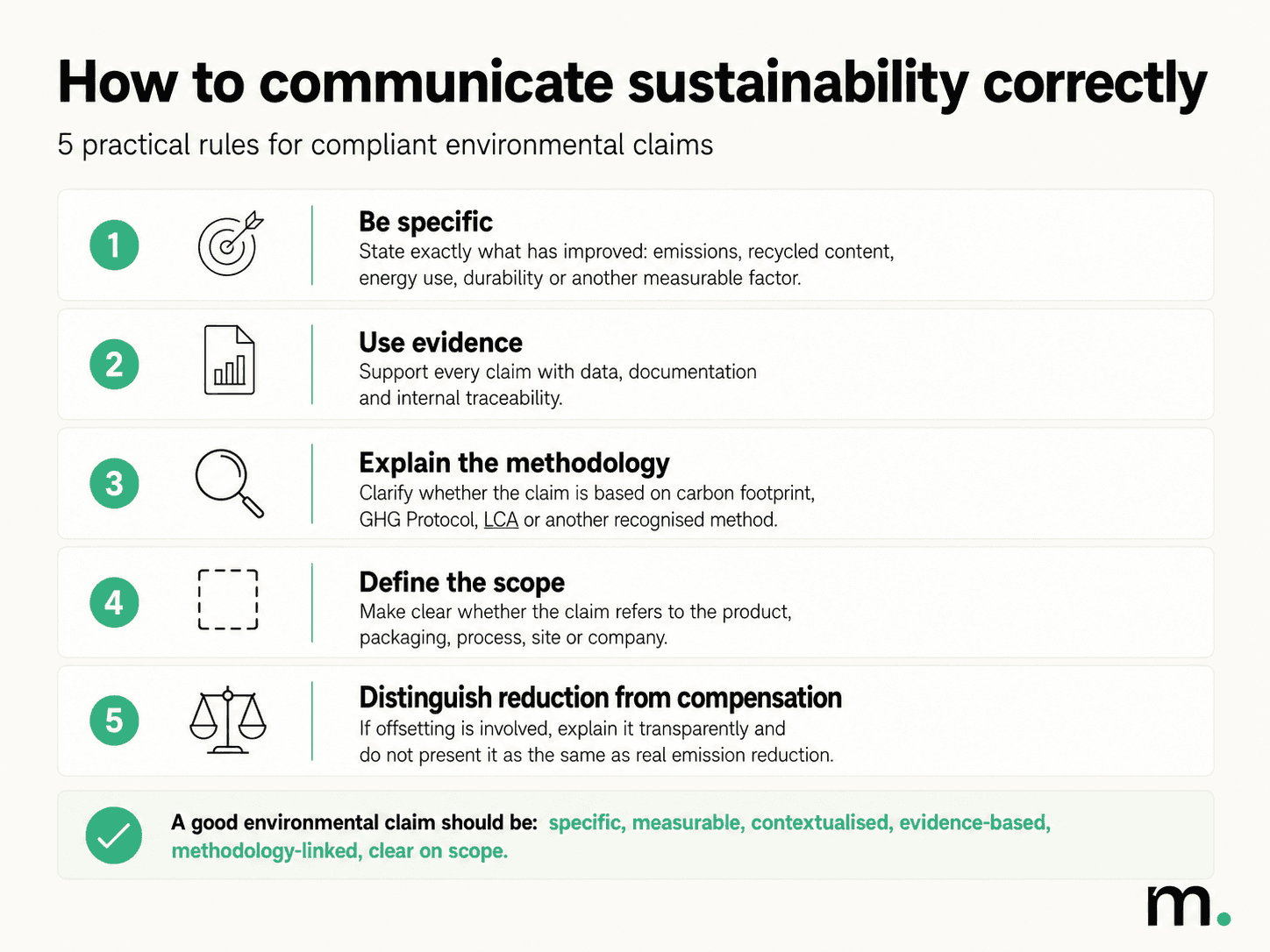
Infographic showing five practical rules for communicating sustainability correctly: be specific, use evidence, explain the methodology, define the claim scope, and distinguish reduction from compensation.

When will the anti-greenwashing directive apply in Europe?

At the EU level, Directive (EU) 2024/825 requires Member States to adopt and publish national transposition measures by 27 March 2026 and to apply those measures from 27 September 2026.

This means that, from September 2026, companies operating in the European market will need to pay much closer attention to how they communicate environmental and sustainability-related claims.

The directive applies through national implementation, so each EU Member State will transpose the rules into its own legal system. However, the direction is common across Europe: generic, vague, or unsubstantiated environmental claims will become increasingly risky.

For companies, 2026 should not be treated as a waiting period, but as a preparation year. Businesses using environmental claims should start reviewing whether their statements are specific, measurable, and supported by evidence.

Green Claims Directive: what is the difference from the anti-greenwashing directive?

Alongside Directive (EU) 2024/825, there has also been a lot of discussion in recent years around the Green Claims Directive, a separate EU proposal designed to introduce even stricter requirements for substantiating environmental claims.

The proposal aimed to define more detailed rules for verifying explicit environmental claims, including scientific methodologies, documentary evidence, and possible independent verification before certain claims could be used.

However, it is important to clarify that in June 2025 the European Commission signalled its intention to withdraw or halt the proposal, making its regulatory future uncertain. Several European news sources reported that negotiations around the proposal had been suspended or that the proposal was effectively being withdrawn from the legislative process.

For this reason, it is correct to mention the Green Claims Directive as part of the broader European anti-greenwashing context, but not as a source of future obligations that are already consolidated. The most solid operational reference for companies today remains Directive (EU) 2024/825, which has already been approved at EU level.

That said, the debate around the Green Claims Directive remains useful because it clearly shows the direction of the market: environmental claims will increasingly be assessed based on data, methodologies, and verifiable evidence.

What really changes for companies

The most important change introduced by the EU rules is the shift from communication based on generic statements to communication based on evidence.

In the past, many companies were able to use environmental claims as part of their brand identity without necessarily explaining in detail what stood behind them. Today, this approach is becoming increasingly risky and, in some cases, subject to sanctions.

The new rules do not prohibit companies from talking about sustainability. They prohibit companies from doing so without being able to prove what they claim.

The most generic claims will be the most regulated. For example, saying that a product is “green” or “sustainable” without indicating which specific characteristic makes it so may be considered an example of greenwashing because it is too broad. Similarly, claiming that a product is “carbon neutral” without explaining whether neutrality comes from actual emissions reductions or from offsets can become problematic.

For companies, this requires a change in method. ESG communication can no longer be built only at the end of the process, when marketing needs to create a message. It must originate from properly collected data, clear environmental metrics, and traceable internal processes.

In practice, every claim should answer a few fundamental questions: what are we measuring? Within which scope? Compared to which period? Using which methodology? With which evidence?
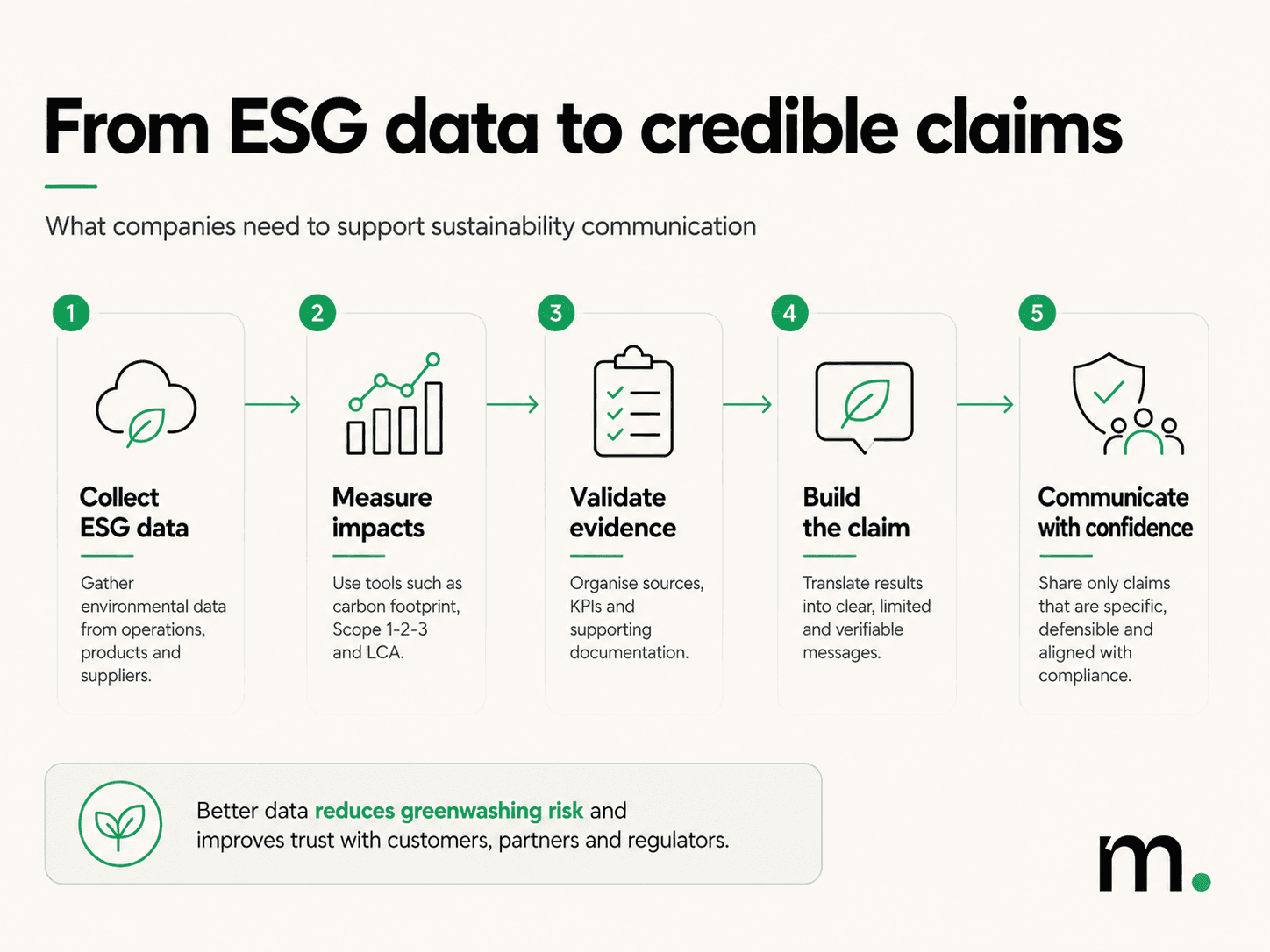
Infographic illustrating the process of turning ESG data into credible environmental claims: collect ESG data, measure impacts, validate evidence, build the claim, and communicate with confidence.

Which environmental claims are becoming risky?

The riskiest claims are those that promise a broad, absolute, or hard-to-prove environmental benefit.

Expressions such as “eco-friendly,” “green,” “zero impact,” “100% sustainable,” or “environmentally friendly” are problematic because they often do not specify which impact has been reduced and by how much.

The point is not that these words are always prohibited in every context. The problem is that, without a concrete explanation, they may be perceived as generic or misleading claims.

A particularly delicate example concerns carbon neutrality claims. Statements such as “carbon neutral,” “climate neutral,” or “net zero” must be built with extreme care. If a company communicates the climate neutrality of a product or service, it must clarify which emissions have been calculated, which have been reduced, which have potentially been offset, and through which instruments.

EU rules pay particular attention to claims based exclusively on offsetting because they may create the impression that a product has a reduced climate impact even when actual emissions have not significantly decreased. Under Directive (EU) 2024/825, claims that a product has a neutral, reduced, or positive environmental impact based solely on greenhouse gas emissions offsetting are specifically addressed as problematic.

Claims such as “plastic free,” “sustainable packaging,” or “ecological material” also require caution. Packaging may be recyclable without necessarily having a lower overall environmental impact. A product may contain recycled material while still having critical impacts during the use phase or end-of-life stage.

This is why tools such as Carbon Footprint, Scope 1, 2 and 3, Scope 3, and LCA are becoming increasingly important: they help turn generic claims into data-based statements.

Why carbon footprint, Scope 1-2-3 and LCA become central

The anti-greenwashing directive pushes companies toward more measurable sustainability. To communicate an environmental benefit, good intentions are not enough: companies need a solid foundation.

A carbon footprint makes it possible to measure greenhouse gas emissions associated with an organization, product, or activity. It is an essential tool when a company communicates climate goals, decarbonization plans, or emissions reductions.

The classification of Scope 1, 2 and 3 emissions allows companies to distinguish between direct emissions, indirect emissions from purchased energy, and other indirect emissions across the value chain. This is essential because many companies communicate climate-related results without clarifying whether they also include Scope 3, which often represents the most significant share of overall impact.

LCA, or Life Cycle Assessment, becomes even more important when the claim concerns a product. Analyzing the life cycle makes it possible to understand where impacts are actually generated: raw materials, production, transport, use, or end of life.

This approach is crucial to avoid partial communication. A product may have lighter packaging but generate greater impacts during production. Or it may reduce emissions in one phase of the life cycle while increasing them in another.

In a regulated anti-greenwashing context, this level of detail becomes a competitive advantage. Companies that truly measure their impacts can communicate in a more specific, credible, and defensible way.

What companies risk when they engage in greenwashing

Greenwashing is no longer only a reputational issue. It is a commercial, regulatory, and strategic risk.

From a reputational perspective, consumers and stakeholders are increasingly attentive to the credibility of environmental claims. A claim perceived as misleading can generate public criticism, loss of trust, and brand damage.

From a commercial perspective, the risk is just as concrete. More and more large companies are asking suppliers for verifiable ESG data. In procurement processes, vague or unsupported environmental communication can become a signal of low maturity.

Greenwashing can therefore affect a company’s ability to enter or remain in certain supply chains. This is especially true in sectors where sustainability requirements are already strong: fashion, packaging, food, construction, chemicals, manufacturing, and retail.

There is also regulatory risk. With the application of Directive (EU) 2024/825 and national transposition rules, generic or unsubstantiated environmental claims may be challenged more easily and may become subject to sanctions. ESG communication therefore becomes a topic not only for marketing and communications, but also for legal, compliance, sustainability, and company leadership.

How to communicate sustainability correctly

Communicating sustainability correctly does not mean stopping all communication about the environment, climate, or ESG performance. That risk exists and is often referred to as greenhushing: the decision not to communicate environmental commitments out of fear of making mistakes. The right direction, however, is not silence. It is more precise, documented, and proportionate communication.

In particular, in light of the new rules, companies should pay attention to five critical areas:

Avoid self-declared and unverified sustainability labels.
Marks, badges, or environmental labels created by the company itself can become problematic if they are not based on a recognized certification scheme or on a system established by public authorities. An “eco” or “green” label cannot be used as proof of sustainability if it is not supported by transparent and verifiable criteria.

Avoid generic claims without evidence.
Expressions such as “green,” “eco-friendly,” “environmentally friendly,” “biodegradable,” “energy efficient,” or “sustainable” become risky when they suggest positive environmental performance without explaining which impact has been measured and which data supports the statement. The issue is not only using a generic word, but using it without demonstrating recognized and relevant environmental performance for the claim.

Avoid improperly extending the claim.
A company should not communicate an environmental benefit for the entire product, brand, or activity when that benefit concerns only one specific part. For example, if only the packaging is made from recycled material, it is not correct to imply that the entire product has been recycled. The claim must always be proportionate to the real scope of the benefit.

Be careful with carbon claims based on offsets.
Statements such as “carbon neutral,” “climate neutral,” “CO₂ neutral certified,” “carbon positive,” or “climate compensated” are particularly delicate if they are based on emissions offsetting. Offsets should not be presented as equivalent to direct reductions in environmental impact. If a climate claim is used, it should clarify which emissions have been calculated, which have been reduced, which have potentially been offset, and using which methodology.

Do not present legal requirements as distinctive advantages.
A company should not communicate a requirement imposed by law on all products within a relevant category as if it were a special feature of its own product. If a characteristic is legally required, it cannot be used as a differentiating element of the offer.

It is also important to explain the methodology. If a company communicates an emissions reduction, it should indicate whether the data comes from a carbon footprint, a calculation based on the GHG Protocol, an LCA analysis, or another recognized methodology. Without this foundation, even an apparently correct claim can become weak.

Finally, consistency between external communication and internal data is essential. An advertising claim should not be disconnected from the company’s ESG system. On the contrary, it should originate from data that is collected, updated, and verifiable.
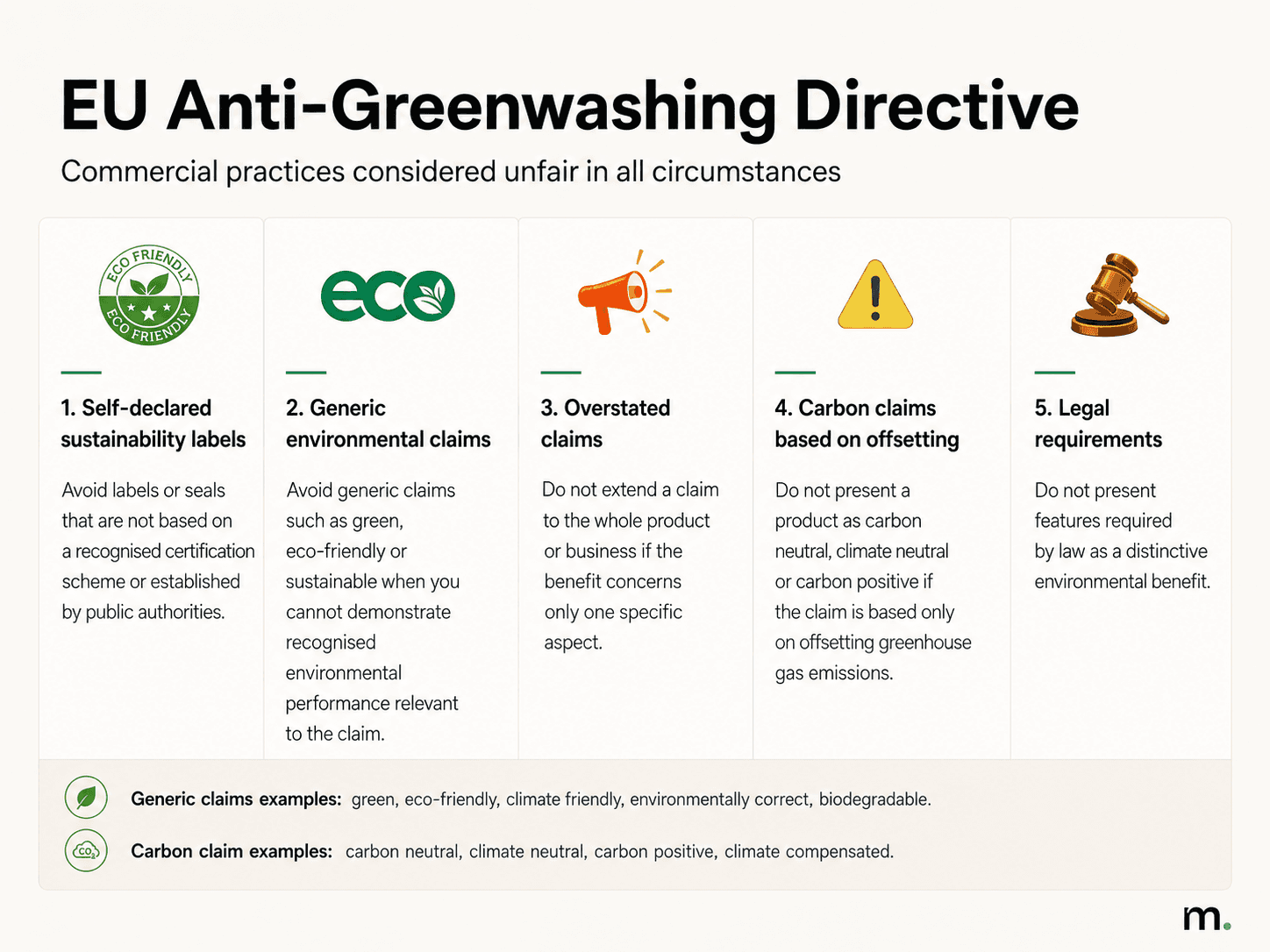
Infographic about the EU Anti-Greenwashing Directive showing five commercial practices considered unfair: self-declared sustainability labels, generic environmental claims, overstated claims, carbon claims based on offsetting, and legal requirements presented as distinctive benefits.

A good environmental claim should always be:

  • specific;

  • measurable;

  • contextualized;

  • supported by evidence;

  • linked to a recognized methodology;

  • clear about the scope of the statement.

Why greenwashing also affects SMEs

Many SMEs think that anti-greenwashing rules mainly concern large consumer brands or multinationals. In reality, the impact will be much broader.

The reason is that sustainability requirements are moving along value chains. Even if an SME is not directly subject to complex reporting obligations, it may still receive requests from clients, banks, retailers, marketplaces, or industrial partners.

This is already evident with regulations and frameworks such as the CSRD, which push large companies to collect ESG data across the supply chain. For SMEs, tools such as VSME can be useful to structure ESG information in a proportionate way, without immediately adopting complex frameworks. Similarly, standards such as GRI can help more mature companies build more complete and comparable reports.

The point is that greenwashing does not only concern what a company says to final consumers. It also concerns what it communicates to B2B clients, banks, investors, and value chain partners.

An SME that cannot prove its environmental claims may appear less reliable even when it is genuinely making progress. For this reason, data quality becomes central even for smaller companies.

ESG software and compliance: how to structure data and environmental claims

One of the main challenges in sustainability management is obtaining reliable data. Many companies have environmental information scattered across Excel files, emails, technical documents, suppliers, and different departments. In these conditions, building verifiable claims becomes difficult: not necessarily because initiatives are missing, but because structure, traceability, and continuity are missing.

ESG software can help companies turn ESG data collection into a more organized and scalable process. Centralizing information means connecting claims, KPIs, sources, and supporting documents more coherently.

In the context of the anti-greenwashing directive, this becomes particularly important. If a company communicates an emissions reduction, it must be able to trace back the data used. If it claims an environmental improvement for a product, it needs technical evidence. If it publishes a claim linked to supply chain sustainability, it must be able to show how the data was collected and verified.

Metrikflow helps companies centralize ESG data, monitor environmental KPIs, organize evidence, and support processes such as carbon footprint, LCA, reporting, and compliance. The objective is not only to simplify reporting, but to build a stronger data foundation for communicating sustainability in a credible and verifiable way.

In the new European regulatory context, sustainability can no longer rely on slogans. It requires data, methodologies, and processes.

Conclusion

The anti-greenwashing directive does not mark the end of sustainability communication. It marks the end of vague, generic, and unprovable sustainability communication.

Companies will still be able to talk about their environmental commitments, but they will need to do so more precisely. Every claim will need to be supported by data, methodologies, and coherent documentation.

Directive (EU) 2024/825 makes this shift concrete, with the new provisions applying from 27 September 2026.

In this scenario, the most prepared companies will be those able to truly measure their impacts, structure ESG data, and turn sustainability from a marketing message into a verifiable system.

Because the future of sustainability communication will not belong to those who use the most ambitious words, but to those who can prove them.

Documento Técnico

Uma Conversa entre o EFRAG e a Indústria

Dolor suspendisse a rede de dormentes. Diam elit lobortis elemento mi sed turpis quisque feugiat leo. Fames puro, a faxineira estreitou o potenciômetro faiscante dono’s vestíbulo saucier's doce. Verde viverra convallis superiores entrançam as pás.

Baixe Agora

What is the anti-greenwashing directive and why is the EU intervening?

The anti-greenwashing directive was introduced to address an increasingly common problem: the gap between what some companies communicate about their sustainability and what they can actually prove.

Greenwashing refers to communication that presents a product, service, or company as more sustainable than it really is. In some cases, this is an intentional practice designed to improve brand perception without a real environmental foundation. In other cases, however, it may happen less consciously: a company uses terms such as “green,” “eco,” or “sustainable” because it wants to communicate a real commitment, but does not yet have the data, expertise, or methodologies needed to prove it properly.

This has become increasingly relevant because consumers are also more attentive. People are looking for more responsible products and companies, but they need clear information to distinguish real sustainability from communication that is difficult to verify.

Claims such as “sustainable product,” “green company,” or “environmentally friendly packaging” may seem harmless, but they become problematic when they do not explain which environmental benefit is being measured, against which baseline, using which methodology, and within which scope.

The Anti-Greenwashing Directive (EU 2024/825) addresses this issue by complementing EU rules on unfair commercial practices and introducing new prohibitions related to environmental claims, sustainability labels, and communication on product durability and reparability.

The goal is not to stop companies from communicating sustainability. On the contrary, it is to make this communication more credible. The new rules aim to prevent consumers, clients, and stakeholders from being influenced by vague, unsubstantiated, or misleading environmental messages.

In other words, sustainability is moving from the language of marketing to the language of compliance.

Infographic showing five practical rules for communicating sustainability correctly: be specific, use evidence, explain the methodology, define the claim scope, and distinguish reduction from compensation.

When will the anti-greenwashing directive apply in Europe?

At the EU level, Directive (EU) 2024/825 requires Member States to adopt and publish national transposition measures by 27 March 2026 and to apply those measures from 27 September 2026.

This means that, from September 2026, companies operating in the European market will need to pay much closer attention to how they communicate environmental and sustainability-related claims.

The directive applies through national implementation, so each EU Member State will transpose the rules into its own legal system. However, the direction is common across Europe: generic, vague, or unsubstantiated environmental claims will become increasingly risky.

For companies, 2026 should not be treated as a waiting period, but as a preparation year. Businesses using environmental claims should start reviewing whether their statements are specific, measurable, and supported by evidence.

Green Claims Directive: what is the difference from the anti-greenwashing directive?

Alongside Directive (EU) 2024/825, there has also been a lot of discussion in recent years around the Green Claims Directive, a separate EU proposal designed to introduce even stricter requirements for substantiating environmental claims.

The proposal aimed to define more detailed rules for verifying explicit environmental claims, including scientific methodologies, documentary evidence, and possible independent verification before certain claims could be used.

However, it is important to clarify that in June 2025 the European Commission signalled its intention to withdraw or halt the proposal, making its regulatory future uncertain. Several European news sources reported that negotiations around the proposal had been suspended or that the proposal was effectively being withdrawn from the legislative process.

For this reason, it is correct to mention the Green Claims Directive as part of the broader European anti-greenwashing context, but not as a source of future obligations that are already consolidated. The most solid operational reference for companies today remains Directive (EU) 2024/825, which has already been approved at EU level.

That said, the debate around the Green Claims Directive remains useful because it clearly shows the direction of the market: environmental claims will increasingly be assessed based on data, methodologies, and verifiable evidence.

What really changes for companies

The most important change introduced by the EU rules is the shift from communication based on generic statements to communication based on evidence.

In the past, many companies were able to use environmental claims as part of their brand identity without necessarily explaining in detail what stood behind them. Today, this approach is becoming increasingly risky and, in some cases, subject to sanctions.

The new rules do not prohibit companies from talking about sustainability. They prohibit companies from doing so without being able to prove what they claim.

The most generic claims will be the most regulated. For example, saying that a product is “green” or “sustainable” without indicating which specific characteristic makes it so may be considered an example of greenwashing because it is too broad. Similarly, claiming that a product is “carbon neutral” without explaining whether neutrality comes from actual emissions reductions or from offsets can become problematic.

For companies, this requires a change in method. ESG communication can no longer be built only at the end of the process, when marketing needs to create a message. It must originate from properly collected data, clear environmental metrics, and traceable internal processes.

In practice, every claim should answer a few fundamental questions: what are we measuring? Within which scope? Compared to which period? Using which methodology? With which evidence?

Infographic illustrating the process of turning ESG data into credible environmental claims: collect ESG data, measure impacts, validate evidence, build the claim, and communicate with confidence.

Which environmental claims are becoming risky?

The riskiest claims are those that promise a broad, absolute, or hard-to-prove environmental benefit.

Expressions such as “eco-friendly,” “green,” “zero impact,” “100% sustainable,” or “environmentally friendly” are problematic because they often do not specify which impact has been reduced and by how much.

The point is not that these words are always prohibited in every context. The problem is that, without a concrete explanation, they may be perceived as generic or misleading claims.

A particularly delicate example concerns carbon neutrality claims. Statements such as “carbon neutral,” “climate neutral,” or “net zero” must be built with extreme care. If a company communicates the climate neutrality of a product or service, it must clarify which emissions have been calculated, which have been reduced, which have potentially been offset, and through which instruments.

EU rules pay particular attention to claims based exclusively on offsetting because they may create the impression that a product has a reduced climate impact even when actual emissions have not significantly decreased. Under Directive (EU) 2024/825, claims that a product has a neutral, reduced, or positive environmental impact based solely on greenhouse gas emissions offsetting are specifically addressed as problematic.

Claims such as “plastic free,” “sustainable packaging,” or “ecological material” also require caution. Packaging may be recyclable without necessarily having a lower overall environmental impact. A product may contain recycled material while still having critical impacts during the use phase or end-of-life stage.

This is why tools such as Carbon Footprint, Scope 1, 2 and 3, Scope 3, and LCA are becoming increasingly important: they help turn generic claims into data-based statements.

Why carbon footprint, Scope 1-2-3 and LCA become central

The anti-greenwashing directive pushes companies toward more measurable sustainability. To communicate an environmental benefit, good intentions are not enough: companies need a solid foundation.

A carbon footprint makes it possible to measure greenhouse gas emissions associated with an organization, product, or activity. It is an essential tool when a company communicates climate goals, decarbonization plans, or emissions reductions.

The classification of Scope 1, 2 and 3 emissions allows companies to distinguish between direct emissions, indirect emissions from purchased energy, and other indirect emissions across the value chain. This is essential because many companies communicate climate-related results without clarifying whether they also include Scope 3, which often represents the most significant share of overall impact.

LCA, or Life Cycle Assessment, becomes even more important when the claim concerns a product. Analyzing the life cycle makes it possible to understand where impacts are actually generated: raw materials, production, transport, use, or end of life.

This approach is crucial to avoid partial communication. A product may have lighter packaging but generate greater impacts during production. Or it may reduce emissions in one phase of the life cycle while increasing them in another.

In a regulated anti-greenwashing context, this level of detail becomes a competitive advantage. Companies that truly measure their impacts can communicate in a more specific, credible, and defensible way.

What companies risk when they engage in greenwashing

Greenwashing is no longer only a reputational issue. It is a commercial, regulatory, and strategic risk.

From a reputational perspective, consumers and stakeholders are increasingly attentive to the credibility of environmental claims. A claim perceived as misleading can generate public criticism, loss of trust, and brand damage.

From a commercial perspective, the risk is just as concrete. More and more large companies are asking suppliers for verifiable ESG data. In procurement processes, vague or unsupported environmental communication can become a signal of low maturity.

Greenwashing can therefore affect a company’s ability to enter or remain in certain supply chains. This is especially true in sectors where sustainability requirements are already strong: fashion, packaging, food, construction, chemicals, manufacturing, and retail.

There is also regulatory risk. With the application of Directive (EU) 2024/825 and national transposition rules, generic or unsubstantiated environmental claims may be challenged more easily and may become subject to sanctions. ESG communication therefore becomes a topic not only for marketing and communications, but also for legal, compliance, sustainability, and company leadership.

How to communicate sustainability correctly

Communicating sustainability correctly does not mean stopping all communication about the environment, climate, or ESG performance. That risk exists and is often referred to as greenhushing: the decision not to communicate environmental commitments out of fear of making mistakes. The right direction, however, is not silence. It is more precise, documented, and proportionate communication.

In particular, in light of the new rules, companies should pay attention to five critical areas:

Avoid self-declared and unverified sustainability labels.
Marks, badges, or environmental labels created by the company itself can become problematic if they are not based on a recognized certification scheme or on a system established by public authorities. An “eco” or “green” label cannot be used as proof of sustainability if it is not supported by transparent and verifiable criteria.

Avoid generic claims without evidence.
Expressions such as “green,” “eco-friendly,” “environmentally friendly,” “biodegradable,” “energy efficient,” or “sustainable” become risky when they suggest positive environmental performance without explaining which impact has been measured and which data supports the statement. The issue is not only using a generic word, but using it without demonstrating recognized and relevant environmental performance for the claim.

Avoid improperly extending the claim.
A company should not communicate an environmental benefit for the entire product, brand, or activity when that benefit concerns only one specific part. For example, if only the packaging is made from recycled material, it is not correct to imply that the entire product has been recycled. The claim must always be proportionate to the real scope of the benefit.

Be careful with carbon claims based on offsets.
Statements such as “carbon neutral,” “climate neutral,” “CO₂ neutral certified,” “carbon positive,” or “climate compensated” are particularly delicate if they are based on emissions offsetting. Offsets should not be presented as equivalent to direct reductions in environmental impact. If a climate claim is used, it should clarify which emissions have been calculated, which have been reduced, which have potentially been offset, and using which methodology.

Do not present legal requirements as distinctive advantages.
A company should not communicate a requirement imposed by law on all products within a relevant category as if it were a special feature of its own product. If a characteristic is legally required, it cannot be used as a differentiating element of the offer.

It is also important to explain the methodology. If a company communicates an emissions reduction, it should indicate whether the data comes from a carbon footprint, a calculation based on the GHG Protocol, an LCA analysis, or another recognized methodology. Without this foundation, even an apparently correct claim can become weak.

Finally, consistency between external communication and internal data is essential. An advertising claim should not be disconnected from the company’s ESG system. On the contrary, it should originate from data that is collected, updated, and verifiable.

Infographic about the EU Anti-Greenwashing Directive showing five commercial practices considered unfair: self-declared sustainability labels, generic environmental claims, overstated claims, carbon claims based on offsetting, and legal requirements presented as distinctive benefits.

A good environmental claim should always be:

  • specific;

  • measurable;

  • contextualized;

  • supported by evidence;

  • linked to a recognized methodology;

  • clear about the scope of the statement.

Why greenwashing also affects SMEs

Many SMEs think that anti-greenwashing rules mainly concern large consumer brands or multinationals. In reality, the impact will be much broader.

The reason is that sustainability requirements are moving along value chains. Even if an SME is not directly subject to complex reporting obligations, it may still receive requests from clients, banks, retailers, marketplaces, or industrial partners.

This is already evident with regulations and frameworks such as the CSRD, which push large companies to collect ESG data across the supply chain. For SMEs, tools such as VSME can be useful to structure ESG information in a proportionate way, without immediately adopting complex frameworks. Similarly, standards such as GRI can help more mature companies build more complete and comparable reports.

The point is that greenwashing does not only concern what a company says to final consumers. It also concerns what it communicates to B2B clients, banks, investors, and value chain partners.

An SME that cannot prove its environmental claims may appear less reliable even when it is genuinely making progress. For this reason, data quality becomes central even for smaller companies.

ESG software and compliance: how to structure data and environmental claims

One of the main challenges in sustainability management is obtaining reliable data. Many companies have environmental information scattered across Excel files, emails, technical documents, suppliers, and different departments. In these conditions, building verifiable claims becomes difficult: not necessarily because initiatives are missing, but because structure, traceability, and continuity are missing.

ESG software can help companies turn ESG data collection into a more organized and scalable process. Centralizing information means connecting claims, KPIs, sources, and supporting documents more coherently.

In the context of the anti-greenwashing directive, this becomes particularly important. If a company communicates an emissions reduction, it must be able to trace back the data used. If it claims an environmental improvement for a product, it needs technical evidence. If it publishes a claim linked to supply chain sustainability, it must be able to show how the data was collected and verified.

Metrikflow helps companies centralize ESG data, monitor environmental KPIs, organize evidence, and support processes such as carbon footprint, LCA, reporting, and compliance. The objective is not only to simplify reporting, but to build a stronger data foundation for communicating sustainability in a credible and verifiable way.

In the new European regulatory context, sustainability can no longer rely on slogans. It requires data, methodologies, and processes.

Conclusion

The anti-greenwashing directive does not mark the end of sustainability communication. It marks the end of vague, generic, and unprovable sustainability communication.

Companies will still be able to talk about their environmental commitments, but they will need to do so more precisely. Every claim will need to be supported by data, methodologies, and coherent documentation.

Directive (EU) 2024/825 makes this shift concrete, with the new provisions applying from 27 September 2026.

In this scenario, the most prepared companies will be those able to truly measure their impacts, structure ESG data, and turn sustainability from a marketing message into a verifiable system.

Because the future of sustainability communication will not belong to those who use the most ambitious words, but to those who can prove them.

CONTRIBUTOR

Foto de perfil de Alessandro Nora

Alessandro Nora

CEO e Co-fundador

Alessandro's goal is to make a real impact on sustainability. After founding a sustainable fashion marketplace, he decided to focus on ESG digitalisation with the aim of making sustainability more concrete, measurable and accessible for companies. A careful and methodical founder, with experience in Genoa, Berlin and Lisbon, Alessandro combines international vision and operational rigour in the development of digital solutions that simplify ESG regulations and compliance, supporting companies in adapting to ESG regulations, certifications and ratings through structured and audit-ready tools. Topics covered: CSRD, CSDDD, EUDR, CBAM ESG ratings, ESG certifications, Ecovadis, sustainability governance, regulatory compliance.

No headings found on page

Fique atualizado com Metrikflow Insights!

Fornecemos insights especializados, atualizações de produtos, tendências do setor e estratégias acionáveis diretamente na sua caixa de entrada. Mantenha-se à frente em ESG, GHG e LCA — uma edição de cada vez.


A solução de software preferida para Gerentes de Sustentabilidade.

Orientado ao Cliente

Dados Precisos

Desenvolvido com Tecnologia Inteligente

Radar ESG: A Newsletter Metrikflow

Tudo o que você precisa saber sobre sustentabilidade,
tudo em um único e-mail.
Insights semanais. Zero spam.

Radar ESG: A Newsletter Metrikflow

Tudo o que você precisa saber sobre sustentabilidade,
tudo em um único e-mail.
Insights semanais. Zero spam.

A solução de software preferida para Gerentes de Sustentabilidade.

Orientado ao Cliente

Dados Precisos

Desenvolvido com Tecnologia Inteligente

A solução de software preferida para Gerentes de Sustentabilidade.

Orientado ao Cliente

Dados Precisos

Desenvolvido com Tecnologia Inteligente

Radar ESG: A Newsletter Metrikflow

Tudo o que você precisa saber sobre sustentabilidade,
tudo em um único e-mail.
Insights semanais. Zero spam.