

The PPWR, acronym for Packaging and Packaging Waste Regulation, is the new European regulation on packaging and packaging waste. The correct legal reference is Regulation EU 2025/40 PPWR, published in the Official Journal of the European Union on 22 January 2025. The regulation entered into force on 11 February 2025 and will generally apply from 12 August 2026.
For companies, the PPWR introduces a relevant operational shift in packaging management. The regulation does not only concern packaging producers, but all companies placing packaged products on the European market, either directly or through their supply chain. This includes producers, importers, distributors, brands, logistics operators and companies using primary, secondary or tertiary packaging.
The PPWR regulation has a clear objective: to reduce packaging waste, increase recyclability, limit the unnecessary use of materials and create more uniform rules across Member States. For companies, the topic is not purely regulatory. It becomes a matter of packaging design, data collection, supplier control, technical documentation and consistency between product, packaging and environmental communication. This is why many companies are already working to structure this information in a software, connecting environmental data, technical documents and internal processes in a more organized way.

PPWR timeline with the key dates of EU Regulation 2025/40
PPWR: Meaning and Objectives of the Packaging and Packaging Waste Regulation
PPWR stands for Packaging and Packaging Waste Regulation, the European regulation on packaging and packaging waste. The regulation replaces the previous Directive 94/62/EC and introduces a framework that is directly applicable in all European Union Member States. This is worth clarifying because many people still refer to a “PPWR directive”, but the approved text is a European regulation.
The difference is not just formal. A directive requires transposition by individual Member States, while a regulation applies directly. This reduces the margin for national interpretation and makes it more important for companies to work with processes and data that can be managed consistently across multiple European markets.
The PPWR packaging regulation covers the entire packaging life cycle: design, production, distribution, use, collection and waste management. According to the official EUR-Lex summary, Regulation EU 2025/40 sets sustainability and labelling requirements for packaging throughout its life cycle, from production to end-of-life management.
For a company, this means that packaging will need to be assessed more precisely from the early stages of material selection, product development and supplier qualification. Packaging can no longer be considered adequate only because it protects the product or meets commercial requirements. It will also need to comply with documentable requirements on composition, recoverability, recyclability, reuse, labelling and, where applicable, recycled content. When packaging has a significant impact on the product’s overall footprint, it may be useful to integrate these assessments with an LCA software or with more specific life cycle analyses.
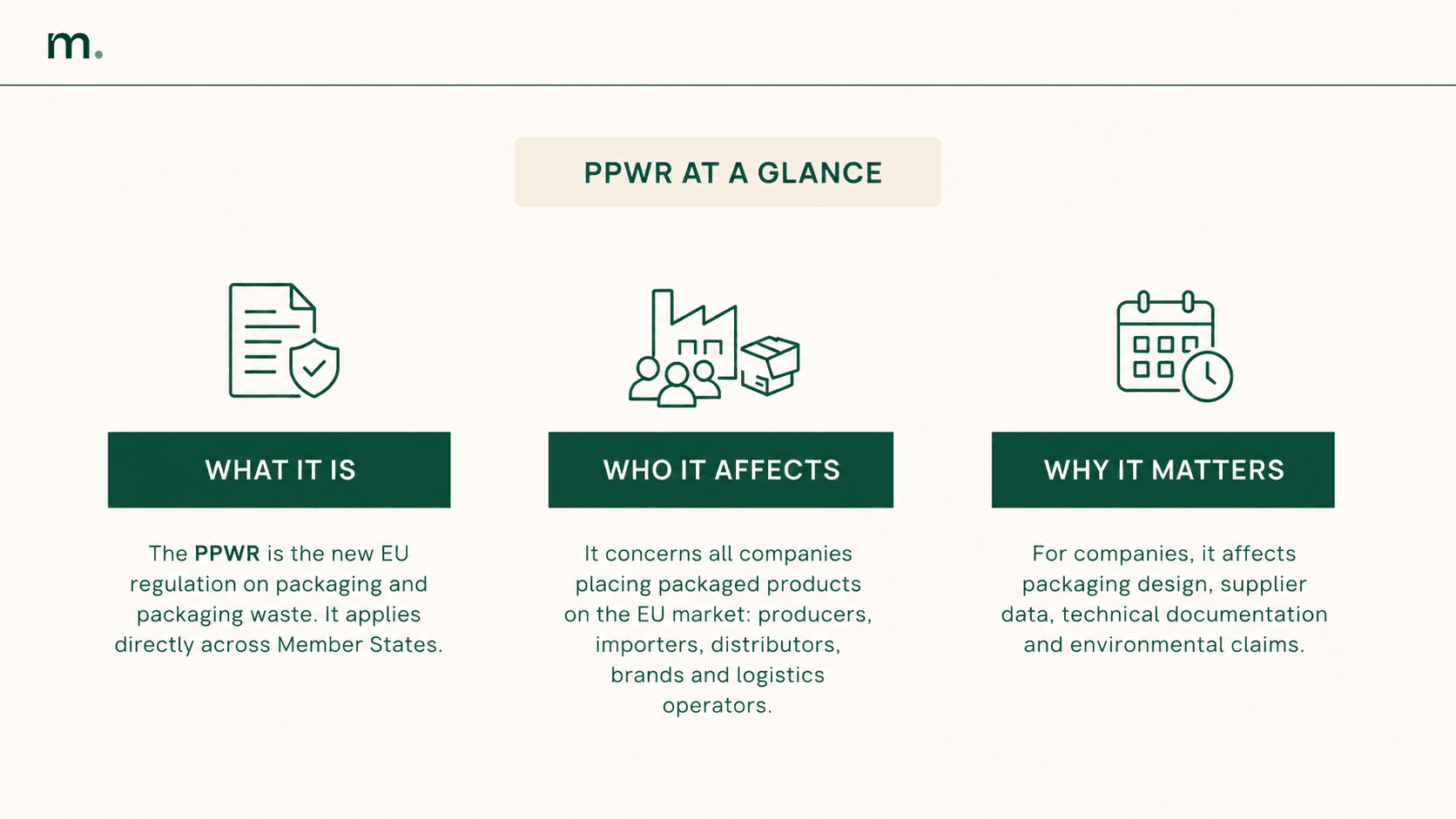
Summary infographic of the PPWR: what EU Regulation 2025/40 is, which companies it affects and when it will apply.
PPWR 2025/40: What Changes for Packaging, Reuse and Recyclability
PPWR 2025/40 introduces requirements that affect several areas of packaging management. The first concerns the reduction of unnecessary packaging. Companies will need to assess weight, volume, empty space and additional components more carefully, especially when these elements do not have a clearly justified technical, logistical or protective function.
The second area concerns recyclability. The PPWR regulation aims to make packaging easier to recycle and to improve the quality of collection and recovery streams. For companies, this requires a more detailed assessment of materials used, material combinations, adhesives, labels, surface treatments and all elements that can affect the actual recyclability of packaging.
Another central topic is reuse. The new PPWR packaging regulation sets objectives and conditions for certain categories of reusable packaging, with particular attention to sectors where reuse can be organized at scale. For the companies involved, this is not limited to changing the packaging format. It requires systems to track use cycles, returns, cleaning, durability, losses, logistics costs and overall environmental performance.
The PPWR also addresses recycled content, particularly for certain types of plastic packaging. This directly affects procurement, supplier qualification and the availability of updated technical data. Declaring a percentage of recycled material requires verifiable evidence, not only commercial information received from the supplier.
Finally, the regulation introduces new information and labelling requirements. The objective is to make packaging disposal clearer and support more uniform management across European countries. For companies selling in multiple markets, this can affect graphics, coding, approval processes, packaging versioning and the management of already printed stock.
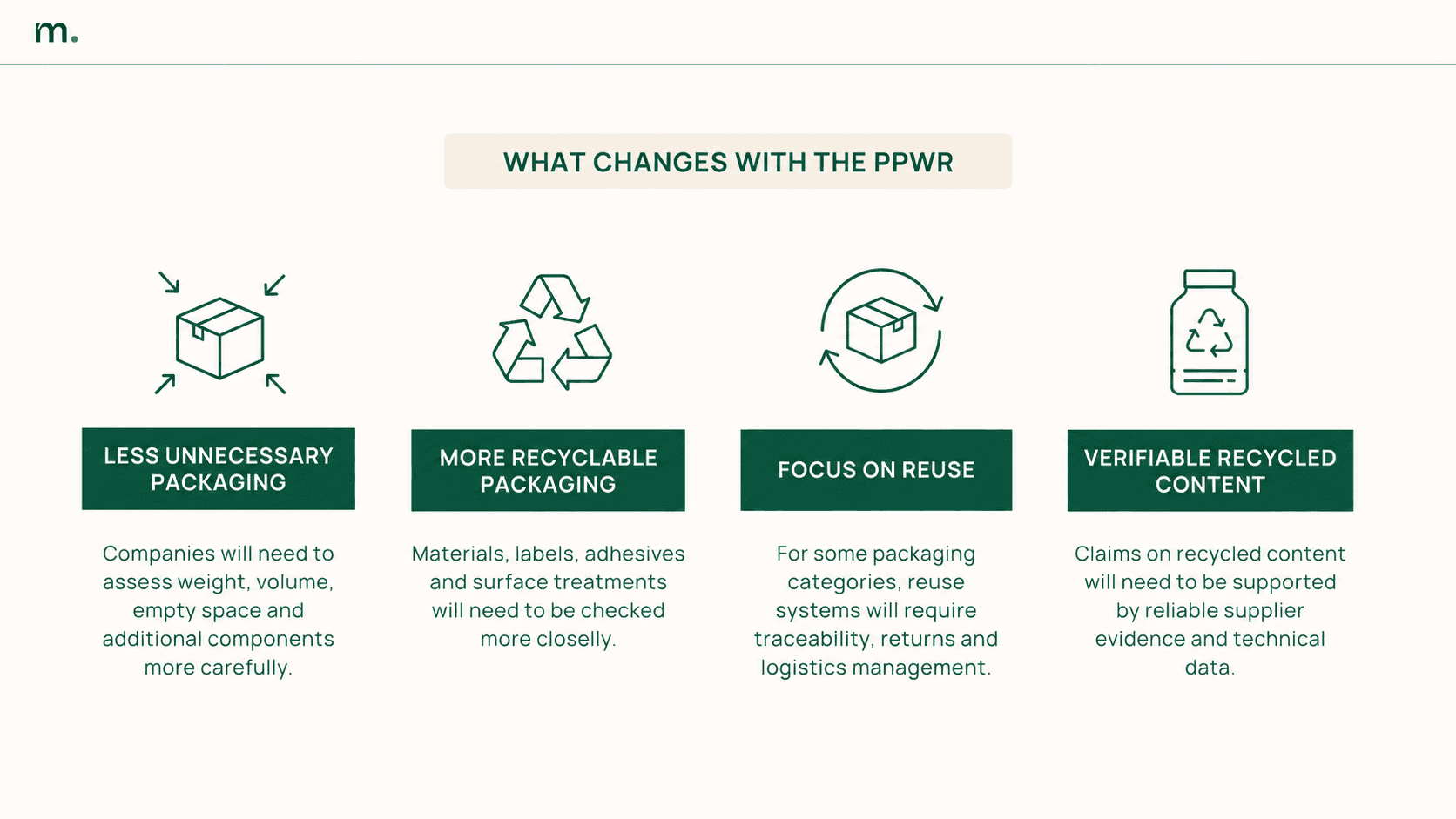
Infographic showing the main PPWR requirements for packaging
PPWR Implementation Timeline: Key Dates and Updates
The PPWR timeline is progressive. Regulation EU 2025/40 was adopted on 19 December 2024, published in the Official Journal of the EU on 22 January 2025 and entered into force on 11 February 2025. The general application date is 12 August 2026.
This date is the first operational reference point for companies, but it does not cover the full implementation timeline. The PPWR includes obligations distributed over several years, with requirements entering into application at different times depending on the topic: recyclability, reuse, recycled content, labelling, information systems and further implementing acts or guidelines.
In March 2026, the European Commission published guidelines and supporting materials to support uniform application of the regulation by economic operators and Member States. These documents are important because they help clarify practical aspects that emerged after the adoption of the PPWR.
For companies, the priority is to avoid reading 12 August 2026 as a single isolated deadline. The adaptation process requires preliminary activities: packaging inventory, material analysis, collection of technical sheets, verification of supplier declarations, label checks and assessment of impacts on procurement, quality, sustainability, logistics and marketing.
In Italy, CONAI has also activated dedicated PPWR resources and published a vademecum on prevention measures, designed as an operational support tool for companies in relation to the new packaging regulation.
PPWR in the EU Framework: Green Deal, Circular Economy and Green Claims
The PPWR is part of the European circular economy framework. CONAI presents it as a European regulation connected to the EU’s circular economy policies, while the European Commission links the new packaging rules to waste reduction, lower use of primary raw materials and the transition toward a more circular and competitive economy.
The connection with the European Green Deal is relevant for companies because many regulations approved in recent years follow a common direction: making products, materials and information more traceable. The Ecodesign for Sustainable Products Regulation, for example, introduces the digital product passport and creates a framework for ecodesign requirements, with attention to durability, repairability, reusability, recyclability, recycled content and reduction of environmental impacts. To explore the topic of product traceability in more detail, it may be useful to read the article on the Digital Product Passport.
From this perspective, the PPWR should also be read together with Directive EU 2024/825, known as the Empowering Consumers for the Green Transition directive. The directive addresses unfair commercial practices and environmental information provided to consumers, strengthening the scrutiny of generic or insufficiently substantiated claims.
The connection with green claims remains important, but it should not be treated only as a communication issue. Claims such as “recyclable”, “reusable”, “made with recycled material”, “compostable” or “sustainable packaging” become more sensitive when the regulatory framework requires more precise information on packaging. On this topic, the article dedicated to the Anti-Greenwashing Directive helps clarify what changes for companies when communicating environmental benefits related to products, materials or processes.
For companies, the practical issue is consistency between technical data and communication. If a company communicates environmental benefits related to packaging, it must be able to connect the claim to a solid documentary basis: material composition, percentage of recycled content, recyclability requirements, certifications, tests, supplier declarations and end-of-life instructions. This reduces the risk of inconsistencies between marketing, quality, procurement, sustainability and product documentation. The same principle also applies to the sustainability report, where environmental information must be collected and managed consistently with the available evidence.
The reference to PPWR and Omnibus should also be handled carefully. Omnibus initiatives are part of the broader European debate on simplifying sustainability obligations, but they do not replace Regulation EU 2025/40. For companies, the operational reference remains the PPWR text, together with European Commission guidelines, implementing acts and tools made available by competent bodies. For a broader view of regulatory simplification, the focus on the EU Omnibus Package may be useful.
How to Prepare for the PPWR: Packaging Data, Suppliers and Traceability
Preparing for the PPWR first requires a complete mapping of the packaging used by the company. The inventory should connect each packaging item to the product, material, format, supplier, target market and intended function. Without this foundation, it becomes difficult to understand which obligations apply, which packaging items are most exposed and which data points are missing.
The second step concerns the quality of supplier data. Technical sheets, declarations on recycled content, information on composition, certifications and recyclability indications should be collected in a structured and updateable way. Many companies already have part of this information, but it is often spread across procurement, quality, research and development, sustainability, logistics and external suppliers. This is why it can be useful to work with tools dedicated to supplier assessment, to centralize data, documents and responses along the supply chain.
The third step is connecting packaging data to operational decisions. Changing a material can affect cost, availability, technical performance, shelf life, transport resistance, graphic yield, packaging systems and end-of-life management. For this reason, PPWR adaptation should not be managed as an isolated compliance activity, but as cross-functional work across business teams.
Another important element is evidence traceability. Companies should be able to reconstruct why a given packaging item was considered compliant, which data were used, who provided them, when they were updated and which product or market versions they refer to. This becomes particularly important in case of audits, customer requests, internal controls, regulatory updates or revision of environmental claims.

Infographic on how to prepare for the PPWR
In practice, effective PPWR preparation can start from a few concrete activities: building a packaging inventory, identifying the most relevant categories, collecting technical data from suppliers, verifying recyclability and recycled content, checking labels and claims, defining internal responsibilities and monitoring PPWR guidelines published by the European Commission and CONAI.
For many companies, the most complex work will not be reading the regulation, but turning it into a reliable data management system. The PPWR requires information that is updated, comparable and accessible to multiple functions. Companies that work in advance on data collection, supplier traceability and document control will be better positioned to manage deadlines, customer requests and future regulatory updates.
CONTRIBUTOR

Alessandro Nora
CEO & Co-founder
Alessandro's goal is to make a real impact on sustainability. After founding a sustainable fashion marketplace, he decided to focus on ESG digitalisation with the aim of making sustainability more concrete, measurable and accessible for companies. A careful and methodical founder, with experience in Genoa, Berlin and Lisbon, Alessandro combines international vision and operational rigour in the development of digital solutions that simplify ESG regulations and compliance, supporting companies in adapting to ESG regulations, certifications and ratings through structured and audit-ready tools. Topics covered: CSRD, CSDDD, EUDR, CBAM ESG ratings, ESG certifications, Ecovadis, sustainability governance, regulatory compliance.
Stay up to date with Metrikflow Insights!
We deliver expert insights, product updates, industry trends, and actionable strategies straight to your inbox. Stay ahead in ESG, GHG, and LCA — one edition at a time.
By submitting this form, you consent to receive the requested resource. For more information on how we process and protect your data, view our Privacy Policy.


