Solutions

Resources

ESG Certifications, Ratings & Assessment

ESG Certifications, Ratings & Assessment

EPD certification: what it is, what it is used for and how to get it

EPD certification: what it is, what it is used for and how to get it

Data, LCA and verification for credible product environmental information.

Headshot Alessandro Nora
Alessandro Nora
EPD certification illustration showing a verified environmental product declaration connected to lifecycle stages, materials, transport, buildings and environmental impact indicators.

What is EPD certification and what information does it contain?

An EPD is an Environmental Product Declaration governed by ISO 14025. The new ISO 14025:2026, published in June 2026 to replace the 2006 edition, establishes principles, requirements and guidance for EPD programs and declarations, while referring to ISO 14040 and ISO 14044 for life cycle assessment.

The term EPD certification is widely used in business and online searches, although technically an EPD is an environmental declaration subject to independent verification. This distinction also explains the EPD certificate meaning: the document does not certify that a product has achieved a predetermined environmental performance level. The verification process checks whether the methodology, data, calculations and information included in the declaration comply with the applicable rules.
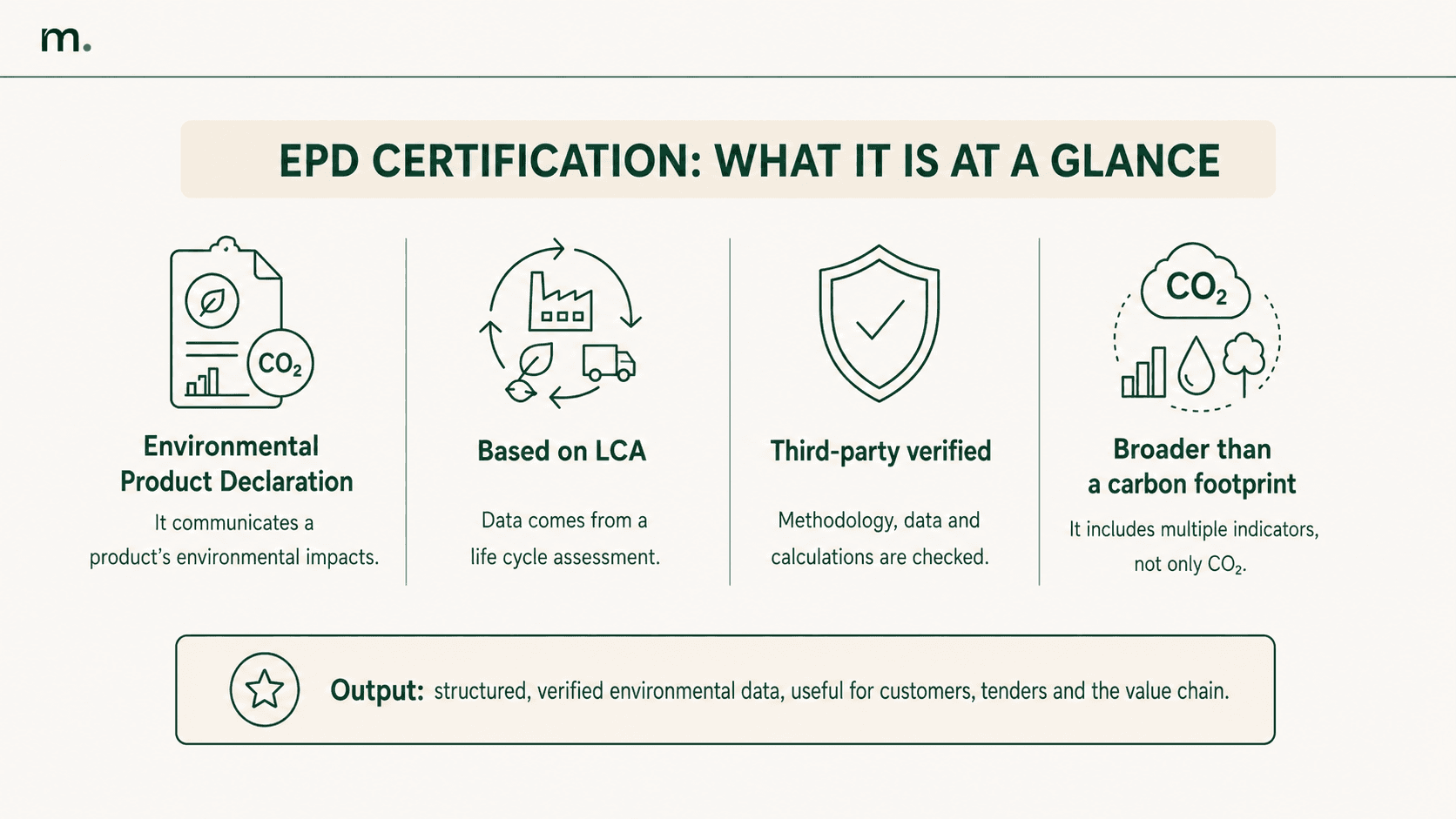
Infographic on EPD certification: an Environmental Product Declaration based on LCA, third-party verified and broader than a carbon footprint.

An EPD does not assign a single sustainability score to a product. Instead, it makes environmental impacts measurable through documented EPD indicators. Depending on the applicable rules, these may cover climate change, resource and energy use, water consumption, waste generation and other environmental impact categories. This is why the relationship between EPD and sustainability is based on quantitative environmental information rather than a generic sustainability claim.

An EPD example may therefore report, for a defined quantity of product, the impacts associated with raw material production, manufacturing, transportation and the additional life cycle stages included within the assessment boundaries. Companies looking at EPD examples should check that the declarations refer to comparable products and use compatible methodological rules before interpreting differences in their results.

An EPD and a Product Carbon Footprint are not the same. A Product Carbon Footprint (PCF) measures greenhouse gas emissions associated with a product's life cycle and expresses them in CO₂ equivalent. An EPD carbon footprint result, often searched for as EPD CO2, is one part of the broader assessment because an EPD generally reports several environmental indicators rather than climate impact alone.

EPDs are particularly common in industries where customers, designers and procurement teams need quantitative product and material information. EPD materials can include a wide range of construction and industrial products. Common examples include EPD steel, EPD concrete, EPD cement, EPD insulation and EPDs for bricks, aluminium products, cables and flooring systems. Searches such as EPD building or EPD cable therefore usually refer to declarations used within specific construction or infrastructure supply chains rather than to a separate type of EPD.

An EPD should also be distinguished from an environmental EPD label in the conventional sense. The declaration provides structured environmental data; it does not work as a simple badge indicating that one product is environmentally preferable to another.

EPD and LCA: how product environmental impacts are calculated

The relationship between EPD and LCA, frequently searched as EPD LCA, is fundamental: an LCA study is the quantitative foundation of EPD certification.

The company maps the material, energy, transportation and process flows associated with the product within the defined system boundaries. The model combines primary data collected directly from the organization with recognized secondary datasets where specific information is not available.

For an industrial product, the analysis may require information on the type and quantity of raw materials, production volumes, facility energy consumption, manufacturing processes, packaging and logistics. Depending on the assessment boundaries, distribution, use and end-of-life scenarios may also be included.

The quality of an EPD depends directly on the quality and traceability of the underlying data. Information scattered across bills of materials, ERP systems, spreadsheets and supplier documentation increases reconciliation work and can lead to additional requests during verification.

For companies developing declarations for multiple EPD products, structuring this information consistently allows part of the dataset to be reused in future LCAs and updated when materials, processes, manufacturing sites or suppliers change. An LCA software platform can support this process by centralizing product data, datasets and calculation models across multiple assessments.

The role of Product Category Rules

The LCA used to prepare an EPD must comply with specific Product Category Rules (PCR). The expressions EPD PCR and EPD Product Category Rules refer to these methodological rules for a defined product category.

PCR can establish the functional or declared unit, system boundaries, life cycle stages to be included, calculation rules and environmental indicators that must be reported. Their purpose is to create a consistent methodological basis for declarations covering comparable types of products.

For construction products, EN 15804 is particularly relevant as a core standard for Environmental Product Declarations in this sector. EPD programs may then apply specific PCR or complementary rules for individual product groups.

These requirements form part of the broader EPD guidelines a company must follow. Identifying the applicable PCR before collecting and modelling the data is a critical step, because selecting an inappropriate or outdated rule may affect the scope of the study, the required environmental indicators and the structure of the final declaration.

How do you obtain EPD certification?

The EPD certification process, also searched as EPD process or EPD process certification, starts with identifying the applicable rules and ends with registration and publication under an EPD program. Between these stages, the company collects data, performs the LCA, prepares the EPD document and completes independent verification.

The amount of work required depends on the complexity of the product, the number of manufacturing sites involved and, in particular, how structured and accessible the company's data already is.

Infographic showing how to obtain EPD certification: PCR selection, data collection, LCA study, verification, registration and publication.

Identifying the applicable PCR

The first step is to identify the product category and determine which PCR are available under the selected EPD program.

This decision establishes the assessment boundaries and methodological requirements to be followed throughout the project. The organization should therefore consider the intended EPD Program Operator at an early stage rather than waiting until the declaration is ready for publication.

Data collection and the LCA study

Once the methodology has been defined, the company collects the required information and builds the LCA model.

Several business functions are normally involved. Operations and energy teams provide facility and production data, procurement contributes information on materials and suppliers, while logistics and product development complete the dataset with transportation, composition and technical information.

Where energy consumption represents a significant share of product impacts, connecting LCA information with structured energy management data can make facility consumption easier to allocate, document and update.

Well-documented data collection reduces corrections and verification work later in the process. Each data point should be traceable to its source, reporting period and the method used to process or allocate it.

Preparing and verifying the EPD report

The results of the assessment are then transferred into the EPD product declaration, which identifies the product and organization, describes the methodology and reports the required environmental indicators.

The EPD report is subsequently reviewed by an independent verifier. The EPD auditor, more precisely referred to as an EPD verifier, examines the consistency of the LCA study, data sources, application of the PCR and information reported in the declaration.

Missing evidence, inconsistencies or insufficiently documented assumptions can lead to requests for clarification before the process can move forward. For companies managing several declarations, consistent EPD reporting also makes it easier to maintain and update multiple EPD reports over time.

The underlying principle is similar to other corporate assurance processes: traceable evidence, clear responsibilities and structured documentation make verification more efficient. The same information management discipline is useful when companies coordinate broader ISO compliance and certification processes.

Registration, EPD databases and publication

Once verification has been completed, the declaration is registered through an EPD Program Operator, the organization responsible for managing an EPD program and its rules. Different markets are served by different EPD Program Operators, so companies should establish the intended publication route early in the project.

The declaration is then published in the relevant EPD database, together with information such as the registration number, EPD owner, product, applicable PCR and validity period. An EPD website or public program database can therefore be used to verify published declarations, review competing products and identify examples within a product category.

For The International EPD System, the official EPD development process covers the selection of PCR, completion of the LCA, EPD preparation, independent verification and registration followed by publication in its EPD Library. Searches for Environdec EPD or EPD Environdec generally refer to declarations and resources available through this system.

Publication does not make the document permanent. Significant changes to the product, manufacturing process or underlying data may require the EPD to be updated, depending on the applicable program rules.

Choosing an EPD Program Operator: International EPD System, EPDItaly and other programs

Companies can choose among different EPD Program Operators, depending on their products, markets and customer requirements.

The International EPD System, sometimes searched for as EPD International, is an international program used by companies across multiple countries and industries. It provides PCR, verification requirements and a public database for registered declarations and is one of the options available to companies seeking an EPD global publication route.

EPDItaly, also referred to as EPD Italy, is an Italian Program Operator that publishes independently verified Environmental Product Declarations. It can be relevant for companies operating in or supplying the Italian market, particularly where customers or procurement specifications refer to that program.

It is one example of a national or regional EPD program rather than a mandatory choice for companies internationally. Its official EPDItaly program documentation sets out the requirements and procedures applicable to declarations registered under the scheme.

The same principle applies across EPD Europe. Markets may have established national programs or sector-specific practices, which is why searches for EPD Germany, EPD France or EPD Ireland can lead to different Program Operators, databases and requirements. Companies selling across Europe should identify which program is accepted by their target market rather than selecting one solely on geographic proximity.

For a company, the choice of Program Operator should reflect the target market, customer and tender requirements, product category, available PCR and recognition of the program in the relevant industry.

EPDs published through different programs should also not be assumed to be automatically comparable. A valid comparison requires alignment on factors such as PCR, product function, functional or declared unit, life cycle stages and environmental impact assessment methods.

When is EPD certification required?

A common question is whether EPD certification is mandatory. As a general rule, an EPD is a voluntary environmental declaration. In practice, however, it can become a commercial or contractual requirement when requested by customers, procurement specifications, tenders or product qualification schemes.

The decision to develop an EPD should therefore be based on identifiable business requirements. If strategic customers request verified environmental information, a tender rewards environmental declarations, or downstream companies require LCA data to assess their own products and buildings, an EPD can have direct commercial value.
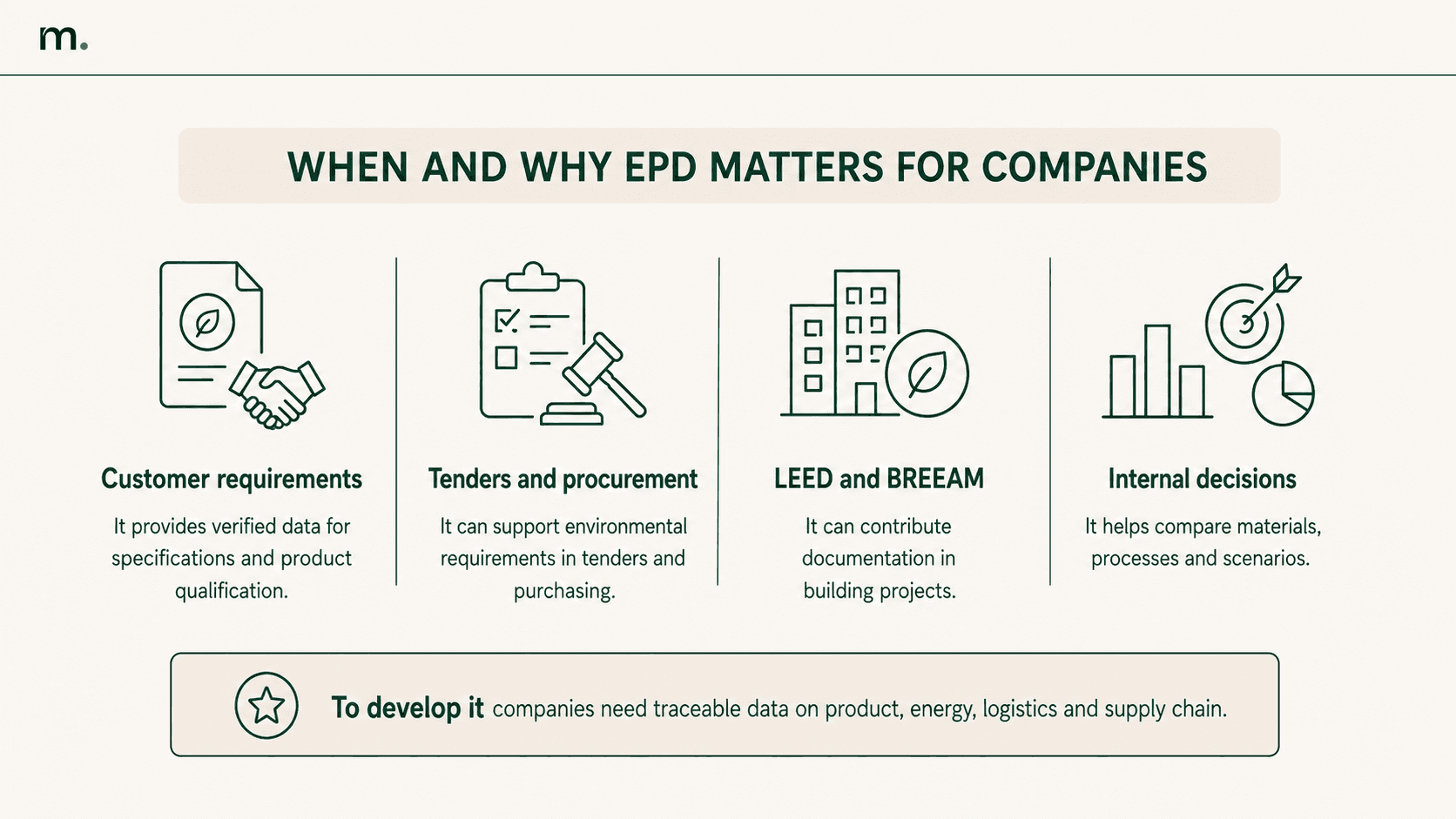
Infographic on key business uses of EPDs: customer requirements, tenders and procurement, LEED and BREEAM, and internal decision-making.

For an EPD company, meaning a manufacturer or supplier developing declarations for its product portfolio, the relevant question is therefore how frequently verified product-level data is required across its markets and customer base. This determines whether EPD development should be handled as a one-off project or as a repeatable internal process.

EPDs in green public procurement

Environmental product information is increasingly incorporated into public and private procurement processes, although the exact requirements vary significantly by country, sector and contracting authority.

Within the European Union, for example, Green Public Procurement provides a framework for public authorities to consider the life cycle environmental performance of goods, services and works. Specific sectoral rules and national procurement criteria may then determine which evidence can be used to demonstrate environmental performance.

An EPD may be accepted or requested as part of this evidence where the applicable procurement criteria allow it. Holding an EPD does not automatically demonstrate compliance with every green procurement requirement, because procurement criteria can include additional technical, environmental or performance conditions.

Companies selling across multiple markets should therefore check the tender requirements and applicable national rules rather than assuming that the same EPD will provide the same procurement advantage in every jurisdiction.

EPDs in LEED and BREEAM

Environmental Product Declarations are also used within major green building assessment systems such as LEED and BREEAM. Searches such as EPD LEED and BREEAM EPD generally relate to the role that verified product declarations can play within their materials and life cycle assessment requirements.

In these schemes, product-level environmental information can contribute to specific materials and life cycle assessment criteria. BREEAM, for example, explicitly addresses Environmental Product Declarations for construction products within its materials assessment framework.

An EPD does not automatically generate a specific credit or building rating. Its contribution depends on the applicable version of the certification scheme, the type of declaration and how the product is used within the project.

For manufacturers supplying the construction sector, this makes the EPD relevant as structured product data that designers, contractors and building assessment teams can use within their own calculations and documentation.

How to organize data, tools and expertise for an EPD

One of the most resource-intensive parts of an EPD project is often building a dataset that is complete, consistent and suitable for verification.

Before calculations begin, the company should define the products covered, manufacturing sites included, reporting period, data sources and internal responsibilities. This provides an early view of which information is already available and where data gaps need to be addressed.

Materials and components should be traceable to bills of materials. Energy consumption should be attributable to the relevant facilities or production processes. Transportation, production waste and other assumptions should be documented consistently with the LCA model.

When an organization does not have the necessary methodological expertise internally, it may use EPD consulting services or specialist LCA consultants to support PCR selection, data collection, modelling and preparation of the declaration. The verifier, however, must retain the independence required by the relevant program.

EPD software, an EPD tool or other environmental data management solutions can improve efficiency when the number of products, facilities or updates increases. Companies may also encounter terms such as EPD generator or EPD platform when evaluating digital solutions. In practice, these tools still depend on the quality of the underlying LCA methodology, PCR selection and company data: software cannot replace the methodological requirements or independent verification needed for publication.

For companies that need to produce and maintain multiple EPDs, the operational impact can be measured directly: reducing manual data collection, keeping sources traceable and reusing validated information can shorten update cycles and reduce the risk of inconsistent results.

The final output of the process is the published declaration available through the selected EPD program or database. The more reusable asset, however, is the underlying quantitative model: product data, manufacturing processes and LCA results can be updated over time and used to compare materials, suppliers, energy sources, logistics and production scenarios using measurable environmental indicators.

EPD certification enables companies to communicate verified data on the environmental impacts associated with a product throughout its life cycle. EPD stands for Environmental Product Declaration, a standardized document used to report quantitative information on product environmental performance.

The EPD meaning, or EPD definition, is therefore closely linked to measurement. An EPD declaration reports environmental indicators calculated through a Life Cycle Assessment (LCA) and structured according to specific rules for the product category being assessed.

For a company, obtaining an EPD means having environmental information that has been independently verified and presented according to a recognized framework. An EPD certificate, a commonly used term for the declaration, may be requested by customers, included in procurement requirements or tenders, and used as a data source across the value chain. Companies may also encounter the plural EPD certificates, although each declaration refers to a defined product, product family or scope established by the applicable rules.

What is EPD certification and what information does it contain?

An EPD is an Environmental Product Declaration governed by ISO 14025. The new ISO 14025:2026, published in June 2026 to replace the 2006 edition, establishes principles, requirements and guidance for EPD programs and declarations, while referring to ISO 14040 and ISO 14044 for life cycle assessment.

The term EPD certification is widely used in business and online searches, although technically an EPD is an environmental declaration subject to independent verification. This distinction also explains the EPD certificate meaning: the document does not certify that a product has achieved a predetermined environmental performance level. The verification process checks whether the methodology, data, calculations and information included in the declaration comply with the applicable rules.

Infographic on EPD certification: an Environmental Product Declaration based on LCA, third-party verified and broader than a carbon footprint.

An EPD does not assign a single sustainability score to a product. Instead, it makes environmental impacts measurable through documented EPD indicators. Depending on the applicable rules, these may cover climate change, resource and energy use, water consumption, waste generation and other environmental impact categories. This is why the relationship between EPD and sustainability is based on quantitative environmental information rather than a generic sustainability claim.

An EPD example may therefore report, for a defined quantity of product, the impacts associated with raw material production, manufacturing, transportation and the additional life cycle stages included within the assessment boundaries. Companies looking at EPD examples should check that the declarations refer to comparable products and use compatible methodological rules before interpreting differences in their results.

An EPD and a Product Carbon Footprint are not the same. A Product Carbon Footprint (PCF) measures greenhouse gas emissions associated with a product's life cycle and expresses them in CO₂ equivalent. An EPD carbon footprint result, often searched for as EPD CO2, is one part of the broader assessment because an EPD generally reports several environmental indicators rather than climate impact alone.

EPDs are particularly common in industries where customers, designers and procurement teams need quantitative product and material information. EPD materials can include a wide range of construction and industrial products. Common examples include EPD steel, EPD concrete, EPD cement, EPD insulation and EPDs for bricks, aluminium products, cables and flooring systems. Searches such as EPD building or EPD cable therefore usually refer to declarations used within specific construction or infrastructure supply chains rather than to a separate type of EPD.

An EPD should also be distinguished from an environmental EPD label in the conventional sense. The declaration provides structured environmental data; it does not work as a simple badge indicating that one product is environmentally preferable to another.

EPD and LCA: how product environmental impacts are calculated

The relationship between EPD and LCA, frequently searched as EPD LCA, is fundamental: an LCA study is the quantitative foundation of EPD certification.

The company maps the material, energy, transportation and process flows associated with the product within the defined system boundaries. The model combines primary data collected directly from the organization with recognized secondary datasets where specific information is not available.

For an industrial product, the analysis may require information on the type and quantity of raw materials, production volumes, facility energy consumption, manufacturing processes, packaging and logistics. Depending on the assessment boundaries, distribution, use and end-of-life scenarios may also be included.

The quality of an EPD depends directly on the quality and traceability of the underlying data. Information scattered across bills of materials, ERP systems, spreadsheets and supplier documentation increases reconciliation work and can lead to additional requests during verification.

For companies developing declarations for multiple EPD products, structuring this information consistently allows part of the dataset to be reused in future LCAs and updated when materials, processes, manufacturing sites or suppliers change. An LCA software platform can support this process by centralizing product data, datasets and calculation models across multiple assessments.

The role of Product Category Rules

The LCA used to prepare an EPD must comply with specific Product Category Rules (PCR). The expressions EPD PCR and EPD Product Category Rules refer to these methodological rules for a defined product category.

PCR can establish the functional or declared unit, system boundaries, life cycle stages to be included, calculation rules and environmental indicators that must be reported. Their purpose is to create a consistent methodological basis for declarations covering comparable types of products.

For construction products, EN 15804 is particularly relevant as a core standard for Environmental Product Declarations in this sector. EPD programs may then apply specific PCR or complementary rules for individual product groups.

These requirements form part of the broader EPD guidelines a company must follow. Identifying the applicable PCR before collecting and modelling the data is a critical step, because selecting an inappropriate or outdated rule may affect the scope of the study, the required environmental indicators and the structure of the final declaration.

How do you obtain EPD certification?

The EPD certification process, also searched as EPD process or EPD process certification, starts with identifying the applicable rules and ends with registration and publication under an EPD program. Between these stages, the company collects data, performs the LCA, prepares the EPD document and completes independent verification.

The amount of work required depends on the complexity of the product, the number of manufacturing sites involved and, in particular, how structured and accessible the company's data already is.

Infographic showing how to obtain EPD certification: PCR selection, data collection, LCA study, verification, registration and publication.

Identifying the applicable PCR

The first step is to identify the product category and determine which PCR are available under the selected EPD program.

This decision establishes the assessment boundaries and methodological requirements to be followed throughout the project. The organization should therefore consider the intended EPD Program Operator at an early stage rather than waiting until the declaration is ready for publication.

Data collection and the LCA study

Once the methodology has been defined, the company collects the required information and builds the LCA model.

Several business functions are normally involved. Operations and energy teams provide facility and production data, procurement contributes information on materials and suppliers, while logistics and product development complete the dataset with transportation, composition and technical information.

Where energy consumption represents a significant share of product impacts, connecting LCA information with structured energy management data can make facility consumption easier to allocate, document and update.

Well-documented data collection reduces corrections and verification work later in the process. Each data point should be traceable to its source, reporting period and the method used to process or allocate it.

Preparing and verifying the EPD report

The results of the assessment are then transferred into the EPD product declaration, which identifies the product and organization, describes the methodology and reports the required environmental indicators.

The EPD report is subsequently reviewed by an independent verifier. The EPD auditor, more precisely referred to as an EPD verifier, examines the consistency of the LCA study, data sources, application of the PCR and information reported in the declaration.

Missing evidence, inconsistencies or insufficiently documented assumptions can lead to requests for clarification before the process can move forward. For companies managing several declarations, consistent EPD reporting also makes it easier to maintain and update multiple EPD reports over time.

The underlying principle is similar to other corporate assurance processes: traceable evidence, clear responsibilities and structured documentation make verification more efficient. The same information management discipline is useful when companies coordinate broader ISO compliance and certification processes.

Registration, EPD databases and publication

Once verification has been completed, the declaration is registered through an EPD Program Operator, the organization responsible for managing an EPD program and its rules. Different markets are served by different EPD Program Operators, so companies should establish the intended publication route early in the project.

The declaration is then published in the relevant EPD database, together with information such as the registration number, EPD owner, product, applicable PCR and validity period. An EPD website or public program database can therefore be used to verify published declarations, review competing products and identify examples within a product category.

For The International EPD System, the official EPD development process covers the selection of PCR, completion of the LCA, EPD preparation, independent verification and registration followed by publication in its EPD Library. Searches for Environdec EPD or EPD Environdec generally refer to declarations and resources available through this system.

Publication does not make the document permanent. Significant changes to the product, manufacturing process or underlying data may require the EPD to be updated, depending on the applicable program rules.

Choosing an EPD Program Operator: International EPD System, EPDItaly and other programs

Companies can choose among different EPD Program Operators, depending on their products, markets and customer requirements.

The International EPD System, sometimes searched for as EPD International, is an international program used by companies across multiple countries and industries. It provides PCR, verification requirements and a public database for registered declarations and is one of the options available to companies seeking an EPD global publication route.

EPDItaly, also referred to as EPD Italy, is an Italian Program Operator that publishes independently verified Environmental Product Declarations. It can be relevant for companies operating in or supplying the Italian market, particularly where customers or procurement specifications refer to that program.

It is one example of a national or regional EPD program rather than a mandatory choice for companies internationally. Its official EPDItaly program documentation sets out the requirements and procedures applicable to declarations registered under the scheme.

The same principle applies across EPD Europe. Markets may have established national programs or sector-specific practices, which is why searches for EPD Germany, EPD France or EPD Ireland can lead to different Program Operators, databases and requirements. Companies selling across Europe should identify which program is accepted by their target market rather than selecting one solely on geographic proximity.

For a company, the choice of Program Operator should reflect the target market, customer and tender requirements, product category, available PCR and recognition of the program in the relevant industry.

EPDs published through different programs should also not be assumed to be automatically comparable. A valid comparison requires alignment on factors such as PCR, product function, functional or declared unit, life cycle stages and environmental impact assessment methods.

When is EPD certification required?

A common question is whether EPD certification is mandatory. As a general rule, an EPD is a voluntary environmental declaration. In practice, however, it can become a commercial or contractual requirement when requested by customers, procurement specifications, tenders or product qualification schemes.

The decision to develop an EPD should therefore be based on identifiable business requirements. If strategic customers request verified environmental information, a tender rewards environmental declarations, or downstream companies require LCA data to assess their own products and buildings, an EPD can have direct commercial value.

Infographic on key business uses of EPDs: customer requirements, tenders and procurement, LEED and BREEAM, and internal decision-making.

For an EPD company, meaning a manufacturer or supplier developing declarations for its product portfolio, the relevant question is therefore how frequently verified product-level data is required across its markets and customer base. This determines whether EPD development should be handled as a one-off project or as a repeatable internal process.

EPDs in green public procurement

Environmental product information is increasingly incorporated into public and private procurement processes, although the exact requirements vary significantly by country, sector and contracting authority.

Within the European Union, for example, Green Public Procurement provides a framework for public authorities to consider the life cycle environmental performance of goods, services and works. Specific sectoral rules and national procurement criteria may then determine which evidence can be used to demonstrate environmental performance.

An EPD may be accepted or requested as part of this evidence where the applicable procurement criteria allow it. Holding an EPD does not automatically demonstrate compliance with every green procurement requirement, because procurement criteria can include additional technical, environmental or performance conditions.

Companies selling across multiple markets should therefore check the tender requirements and applicable national rules rather than assuming that the same EPD will provide the same procurement advantage in every jurisdiction.

EPDs in LEED and BREEAM

Environmental Product Declarations are also used within major green building assessment systems such as LEED and BREEAM. Searches such as EPD LEED and BREEAM EPD generally relate to the role that verified product declarations can play within their materials and life cycle assessment requirements.

In these schemes, product-level environmental information can contribute to specific materials and life cycle assessment criteria. BREEAM, for example, explicitly addresses Environmental Product Declarations for construction products within its materials assessment framework.

An EPD does not automatically generate a specific credit or building rating. Its contribution depends on the applicable version of the certification scheme, the type of declaration and how the product is used within the project.

For manufacturers supplying the construction sector, this makes the EPD relevant as structured product data that designers, contractors and building assessment teams can use within their own calculations and documentation.

How to organize data, tools and expertise for an EPD

One of the most resource-intensive parts of an EPD project is often building a dataset that is complete, consistent and suitable for verification.

Before calculations begin, the company should define the products covered, manufacturing sites included, reporting period, data sources and internal responsibilities. This provides an early view of which information is already available and where data gaps need to be addressed.

Materials and components should be traceable to bills of materials. Energy consumption should be attributable to the relevant facilities or production processes. Transportation, production waste and other assumptions should be documented consistently with the LCA model.

When an organization does not have the necessary methodological expertise internally, it may use EPD consulting services or specialist LCA consultants to support PCR selection, data collection, modelling and preparation of the declaration. The verifier, however, must retain the independence required by the relevant program.

EPD software, an EPD tool or other environmental data management solutions can improve efficiency when the number of products, facilities or updates increases. Companies may also encounter terms such as EPD generator or EPD platform when evaluating digital solutions. In practice, these tools still depend on the quality of the underlying LCA methodology, PCR selection and company data: software cannot replace the methodological requirements or independent verification needed for publication.

For companies that need to produce and maintain multiple EPDs, the operational impact can be measured directly: reducing manual data collection, keeping sources traceable and reusing validated information can shorten update cycles and reduce the risk of inconsistent results.

The final output of the process is the published declaration available through the selected EPD program or database. The more reusable asset, however, is the underlying quantitative model: product data, manufacturing processes and LCA results can be updated over time and used to compare materials, suppliers, energy sources, logistics and production scenarios using measurable environmental indicators.

CONTRIBUTOR

Headshot Alessandro Nora

Alessandro Nora

CEO & Co-founder

Alessandro's goal is to make a real impact on sustainability. After founding a sustainable fashion marketplace, he decided to focus on ESG digitalisation with the aim of making sustainability more concrete, measurable and accessible for companies. A careful and methodical founder, with experience in Genoa, Berlin and Lisbon, Alessandro combines international vision and operational rigour in the development of digital solutions that simplify ESG regulations and compliance, supporting companies in adapting to ESG regulations, certifications and ratings through structured and audit-ready tools. Topics covered: CSRD, CSDDD, EUDR, CBAM ESG ratings, ESG certifications, Ecovadis, sustainability governance, regulatory compliance.

No headings found on page

Stay up to date with Metrikflow Insights!

We deliver expert insights, product updates, industry trends, and actionable strategies straight to your inbox. Stay ahead in ESG, GHG, and LCA — one edition at a time.

By submitting this form, you consent to receive the requested resource. For more information on how we process and protect your data, view our Privacy Policy.

The go-to software solution for
Sustainability Managers.

The go-to software solution for Sustainability Managers.

Customer-Oriented

Data Accurate

Built on Smart Tech

Contact us

Our team is here to help. Feel free to ask us anything.

By submitting this form you consent to our Privacy Policy.

ESG radar: The Metrikflow Newsletter

Everything you need to know about sustainability,
all-in-one email. Weekly insights. Zero spam.

By submitting this form, you consent to receive the requested resource. For more information on how we process and protect your data, view our Privacy Policy.

Ask AI for a summary of Metrikflow

chatgptclaudeperplexity

Contact Us

The only platform you ever need to manage ESG and Compliance.

Data Security

Measurable Impact

AI + ESG Experts

Measurable Impact

AI + ESG Experts

Data Security

Contact us

Our team is here to help. Feel free to ask us anything.

By submitting this form you consent to our Privacy Policy.

ESG radar: The Metrikflow Newsletter

Everything you need to know about sustainability,
all-in-one email. Weekly insights. Zero spam.

By submitting this form, you consent to receive the requested resource. For more information on how we process and protect your data, view our Privacy Policy.

Ask AI for a summary of Metrikflow

chatgptclaudeperplexity