

Why measuring emissions matters in the fashion industry
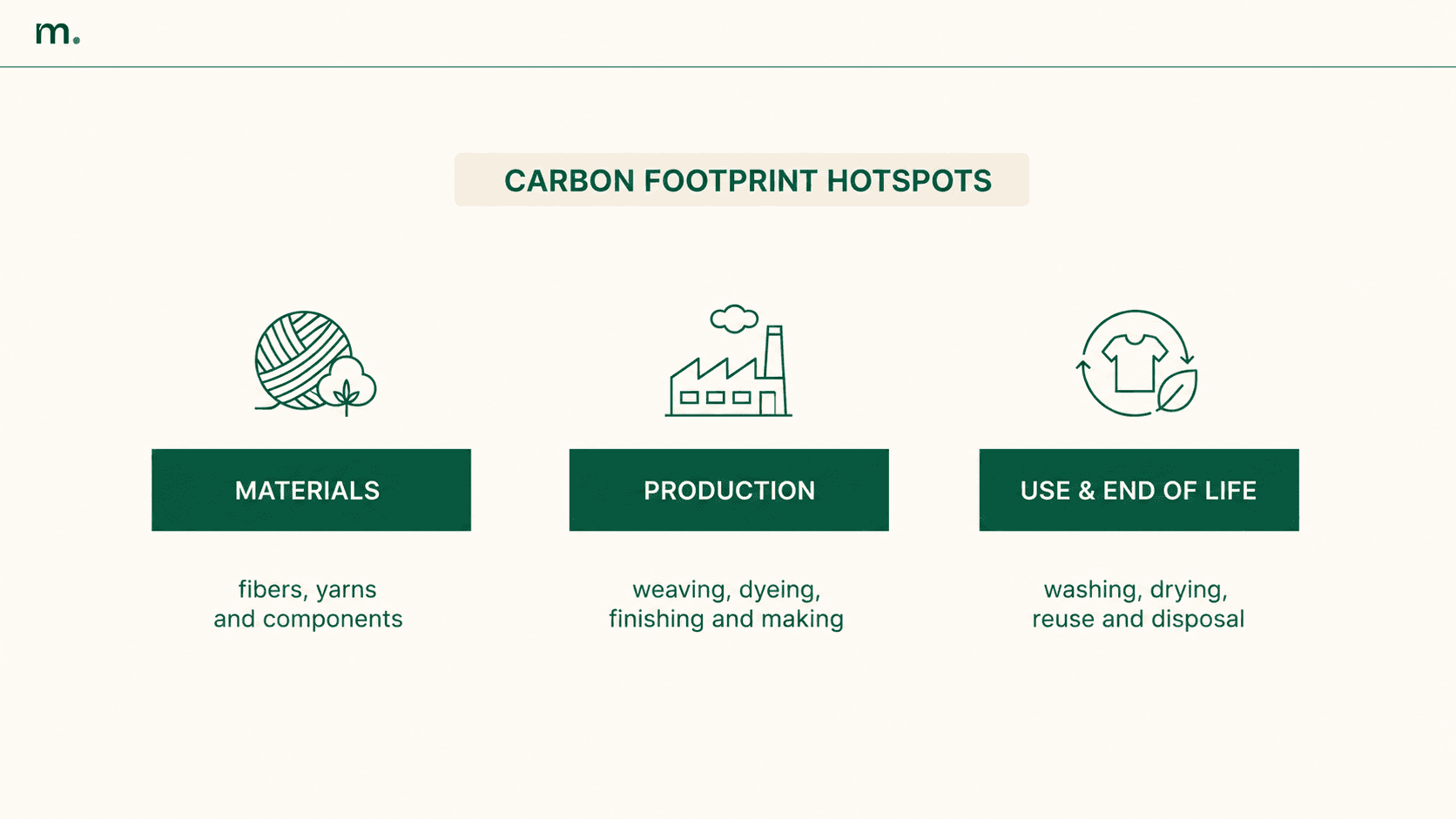
Fashion is one of the most complex value chains to measure from an environmental perspective. A garment can move across multiple countries, suppliers, production processes and distribution channels before reaching the final customer. Raw materials, spinning, weaving, dyeing, finishing, garment manufacturing, packaging, logistics, retail, use phase and end of life all contribute differently to the carbon footprint of fashion.
For companies, measuring emissions is not only a response to sustainability requests. It helps identify where impacts are concentrated, which suppliers or materials contribute the most, which operational choices can reduce emissions costs and which data are needed for ESG reporting, ratings, tenders, B2B requests and accurate environmental communication.
The topic is increasingly relevant at European level. The EU Strategy for Sustainable and Circular Textiles recognizes the importance of the textile sector and the need to address environmental impacts linked to production and consumption. For fashion brands, this means preparing for a market where traceability, durability, circularity and the quality of environmental data will play a growing role.
The Ellen MacArthur Foundation has also highlighted the need to move beyond the linear model of the fashion system, where garments are produced, used for short periods and rarely reintroduced into value cycles. This perspective reinforces the link between impact measurement, product design, circular models and supply chain management.
For a fashion brand, manufacturer or supplier, the question is no longer only “how much do we emit?”, but “which data do we need to explain, reduce and monitor the impacts of our products?”. This is where carbon footprint, Scope 1, Scope 2, Scope 3 and Life Cycle Assessment become management tools, not just sustainability indicators.
Scope 1, Scope 2 and Scope 3 in fashion: what to include
The GHG Protocol divides corporate emissions into Scope 1, Scope 2 and Scope 3. In the fashion sector, this classification helps companies understand which emissions are directly controlled by the business and which depend on purchased energy, suppliers, materials, logistics and product use.
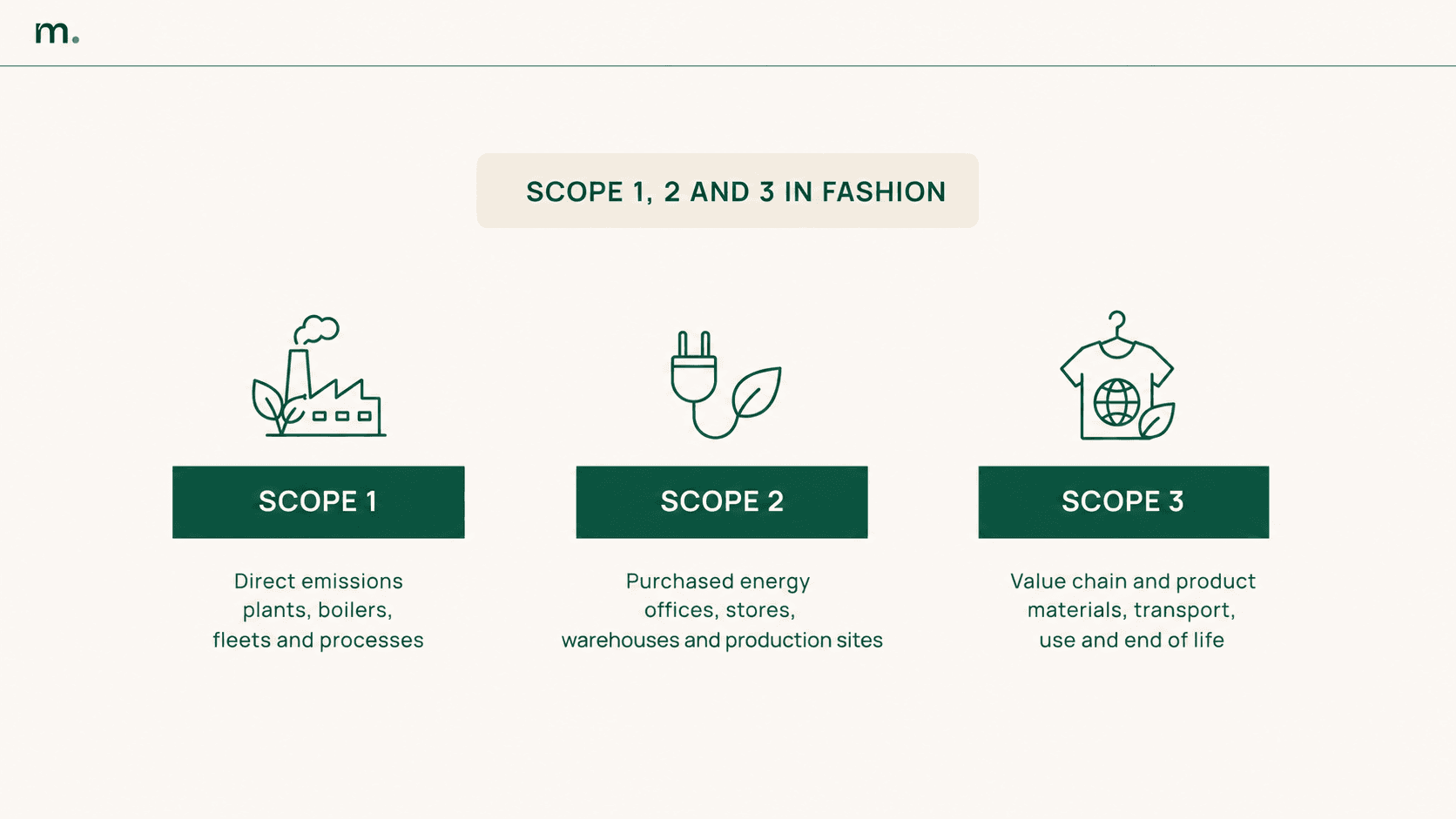
Scope 1 emissions in fashion are direct emissions generated by sources owned or controlled by the company. They can include fuels used in plants, boilers, production facilities, company fleets or industrial processes directly controlled by the business. For textile manufacturers, dyeing facilities or companies with their own production sites, Scope 1 can include natural gas consumption, fuels, process emissions and fugitive emissions from plants or equipment.
Scope 2 emissions in fashion come from purchased electricity, heat, steam or cooling. They relate to offices, stores, warehouses, production facilities and sites controlled by the company. The weight of Scope 2 varies significantly depending on the company’s role in the value chain: for a brand without direct production, it may be lower than Scope 3, while for a garment factory, spinning facility or dyeing plant it can represent a significant share of the overall footprint.
Scope 3 emissions in fashion cover all indirect emissions along the value chain. This includes purchased materials, outsourced production, transport and distribution, packaging, use of sold products, end-of-life treatment, business travel, capital goods and supplier activities. The Corporate Value Chain Scope 3 Standard by the GHG Protocol is the main reference for measuring and reporting these emissions across the value chain.
This distinction is useful only when applied to the company’s actual business model. A retail brand, a contract manufacturer, a dyeing facility, a yarn supplier and a marketplace will have different emissions profiles. Before calculating emissions, companies need to define the organizational boundary, included sites, controlled activities, relevant Scope 3 categories and the level of detail required. To explore the topic further, companies can start from the Metrikflow guide on Scope 1, 2 and 3.
Why Scope 3 is the most complex area for fashion brands and supply chains
Scope 3 in fashion is complex because it requires data that are often not available in the company’s internal systems. Information may sit with suppliers, sub-suppliers, contractors, transport providers, distributors or commercial partners. In some cases, the brand knows its direct supplier but has limited visibility over fiber origin, process energy consumption, energy mix, country of processing or specific data on dyeing and finishing.
The most relevant categories vary depending on the business model, but for many fashion companies they include purchased goods and services, outsourced production, transport and distribution, packaging, use of sold products and end of life. Materials such as cotton, polyester, leather, wool or man-made fibers have different impacts, and the profile also changes between a lightweight garment, a technical product, an accessory or a garment with complex finishing.
Measuring Scope 3 therefore requires a progressive strategy. In the early stages, a company may use secondary data, databases and average emission factors. Over time, however, the most relevant categories should be supported by more specific data: material composition, garment weight, production countries, supplier energy consumption, transport modes, packaging and use scenarios. This improves the quality of carbon accounting and makes reduction targets more reliable. For a dedicated overview, companies can link to the Metrikflow article on Scope 3 emissions.
Supplier collaboration becomes central. Reducing Scope 3 emissions depends on the ability to engage the value chain, collect primary data, compare alternatives and guide procurement decisions. A carbon footprint software can help fashion companies connect environmental performance, emissions data, materials, production countries and intervention priorities.
Carbon footprint and LCA of a garment: from corporate data to product data
The corporate carbon footprint measures the overall emissions of the organization. It is useful for ESG reporting, climate targets, decarbonization plans and annual monitoring. In fashion, however, many relevant decisions happen at product level: material choice, garment weight, processing, durability, packaging, transport, use and end of life. This is why corporate measurement is increasingly complemented by Product Carbon Footprint and Life Cycle Assessment. To clarify the difference between corporate footprint and emissions measurement, companies can refer to the Metrikflow guide on carbon footprint.
LCA in fashion makes it possible to assess the environmental impacts of a garment across its life cycle. Two products that look similar can have very different impacts if fiber, material origin, processing, supplier energy mix, transport or washing behavior change. LCA therefore brings environmental data into design, sourcing and communication decisions. To introduce the method, companies can link to the article on what Life Cycle Assessment is, while a more operational angle can be supported by the guide on how to conduct an LCA.
This approach is particularly useful when a brand needs to compare alternatives: virgin or recycled fiber, local or overseas production, traditional dyeing or lower-consumption processes, different packaging, higher durability or different end-of-life scenarios. The value is not only in the final calculation, but in the ability to identify hotspots and simulate improvements.
A concrete example comes from the collaboration between Metrikflow and the Phygital Sustainability Expo. Within the Sfilata Narrata®, a format that presents innovations, supply chains, technologies and sustainable features of garments on the runway, Metrikflow supports the calculation of the impacts of the garments showcased. This makes it possible to turn data on materials, processes and supply chain into understandable environmental information, connecting the creative dimension of the product with technical impact measurement.

For companies that want to apply this approach in a structured way, an LCA software can support data collection, life cycle modeling, scenario comparison and the development of results that can be used for product design, reporting and communication.
How to reduce emissions in fashion: operational levers
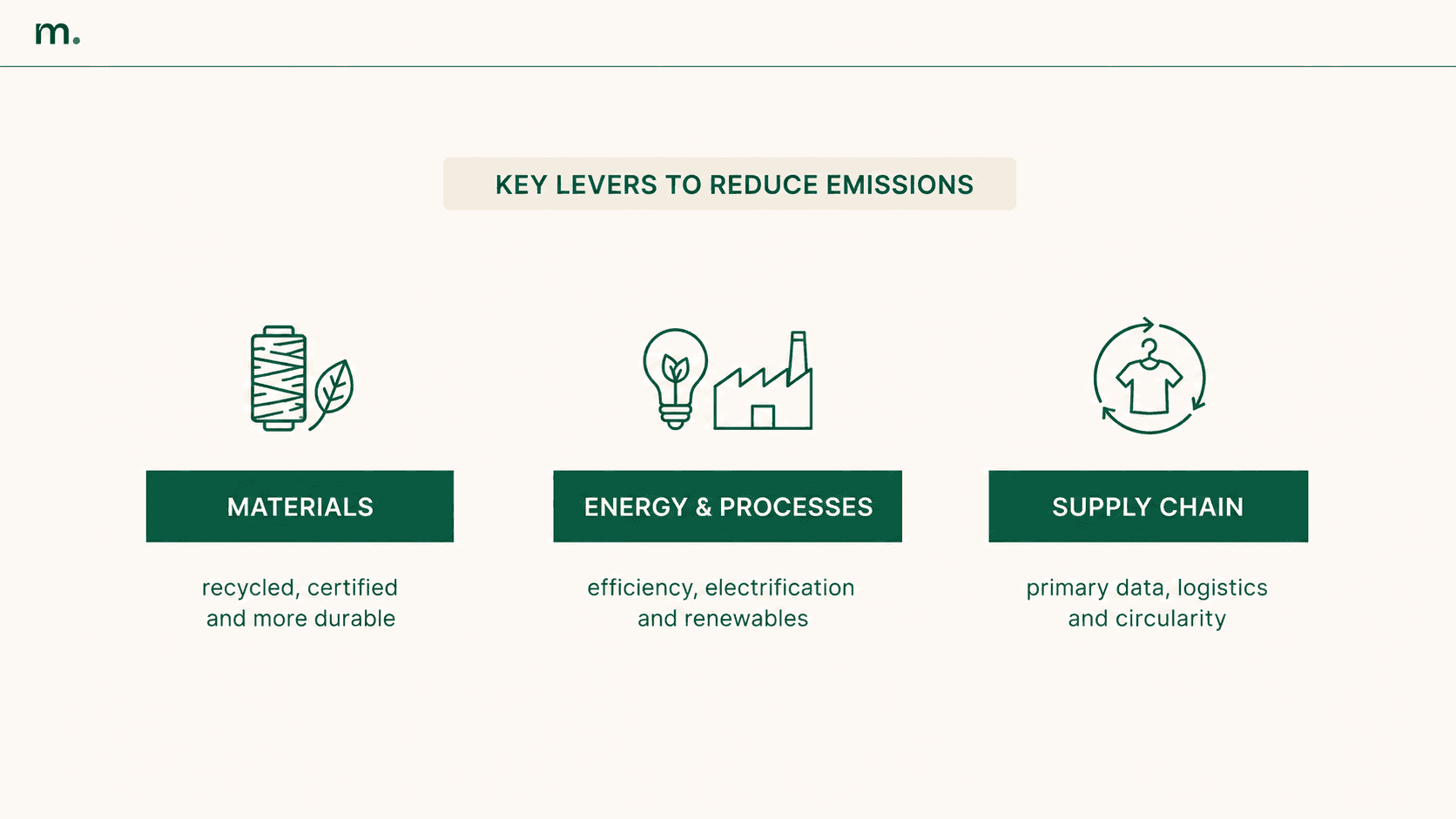
Reducing the carbon footprint in fashion requires action on multiple levels. The first lever concerns materials. Choosing lower-impact fibers, recycled materials, certified alternatives or innovative solutions can reduce upstream emissions, but the assessment should always consider quality, durability, availability, required processing and impacts across the life cycle.
The second lever concerns energy and production processes. Energy efficiency, electrification, renewable energy procurement, optimization of dyeing and finishing, waste reduction and improved consumption across production sites can affect Scope 1 and Scope 2, as well as Scope 3 when processes are outsourced. For brands, this means working with strategic suppliers and setting priorities based on the emissions weight of each process.
The third lever concerns logistics, packaging and distribution. Consolidating shipments, reducing air freight, optimizing warehouses, redesigning packaging and improving the management of returns and e-commerce flows can reduce both emissions and operational inefficiencies. Here too, data are essential: without measuring routes, volumes, transport modes and flow frequency, it is difficult to understand where to act.
The fourth lever concerns the product life cycle. Durability, repairability, reuse, recycling, modular design, take-back programs and circular models can reduce impact per use and limit emissions linked to end of life. To work properly, these strategies must be connected to real data: materials used, disassembly potential, use behavior, collection channels and recycling quality.
Fashion decarbonization cannot rely on a single action. It requires a combination of measurement, priorities, supplier engagement, interim targets and monitoring. For a corporate perspective, companies can link to the Metrikflow guide on decarbonization and strategies to reduce Scope 1, 2 and 3 emissions. An ESG platform can help connect carbon footprint, LCA, supplier data and action tracking, making the transition from data to reduction more consistent.
How to build a data system for sustainability in fashion
For fashion companies, the main challenge is not calculating a figure once, but building a system that keeps environmental information updated and usable over time. Materials, suppliers, production countries, energy mixes, volumes, collections and processes change quickly. A system based on separate spreadsheets or manual data collection can become fragile, especially as requests from customers, retailers, investors, auditors and regulations increase.
An effective data system should connect corporate carbon footprint, Scope 1, Scope 2, Scope 3, Product Carbon Footprint, LCA and supplier assessment. This allows companies to use the same data across multiple processes: ESG reporting, sustainability reporting, product design, procurement, decarbonization, communication and supply chain risk management.
For companies subject or close to sustainability reporting requirements, fashion environmental data can also support the sustainability report, stronger disclosures and responses to increasingly detailed B2B requests. This section can also link to the guide on CSRD, especially to reinforce the connection between environmental data, reporting and governance.
Data quality is also relevant for communication. When a brand makes claims about sustainable materials, lower-impact products or emissions reductions, it must be able to support those claims with coherent and verifiable data. For this reason, a useful link here is the article on the Green Claims Directive, which connects environmental measurement with responsible communication.
The final value of measurement lies in its ability to guide decisions. A well-built carbon footprint helps identify where to act; an LCA helps design products with lower impacts; an ESG data system helps make reporting, procurement and communication more consistent. For fashion, this means moving from generic claims to measurable management of environmental impacts across the entire value chain.
CONTRIBUTOR

Alessandro Nora
CEO & Co-founder
Alessandro's goal is to make a real impact on sustainability. After founding a sustainable fashion marketplace, he decided to focus on ESG digitalisation with the aim of making sustainability more concrete, measurable and accessible for companies. A careful and methodical founder, with experience in Genoa, Berlin and Lisbon, Alessandro combines international vision and operational rigour in the development of digital solutions that simplify ESG regulations and compliance, supporting companies in adapting to ESG regulations, certifications and ratings through structured and audit-ready tools. Topics covered: CSRD, CSDDD, EUDR, CBAM ESG ratings, ESG certifications, Ecovadis, sustainability governance, regulatory compliance.
Stay up to date with Metrikflow Insights!
We deliver expert insights, product updates, industry trends, and actionable strategies straight to your inbox. Stay ahead in ESG, GHG, and LCA — one edition at a time.
By submitting this form, you consent to receive the requested resource. For more information on how we process and protect your data, view our Privacy Policy.


