
Décarbonisation, empreinte carbone et ACV

Décarbonisation, empreinte carbone et ACV

Déchiffrer le monde complexe des émissions financées ou des émissions de « portefeuille »

Déchiffrer le monde complexe des émissions financées ou des émissions de « portefeuille »

Une plongée approfondie dans la Catégorie 15 des émissions de Scope 3 et ses conséquences
Portrait de Luis Antazema
Luis Antazema
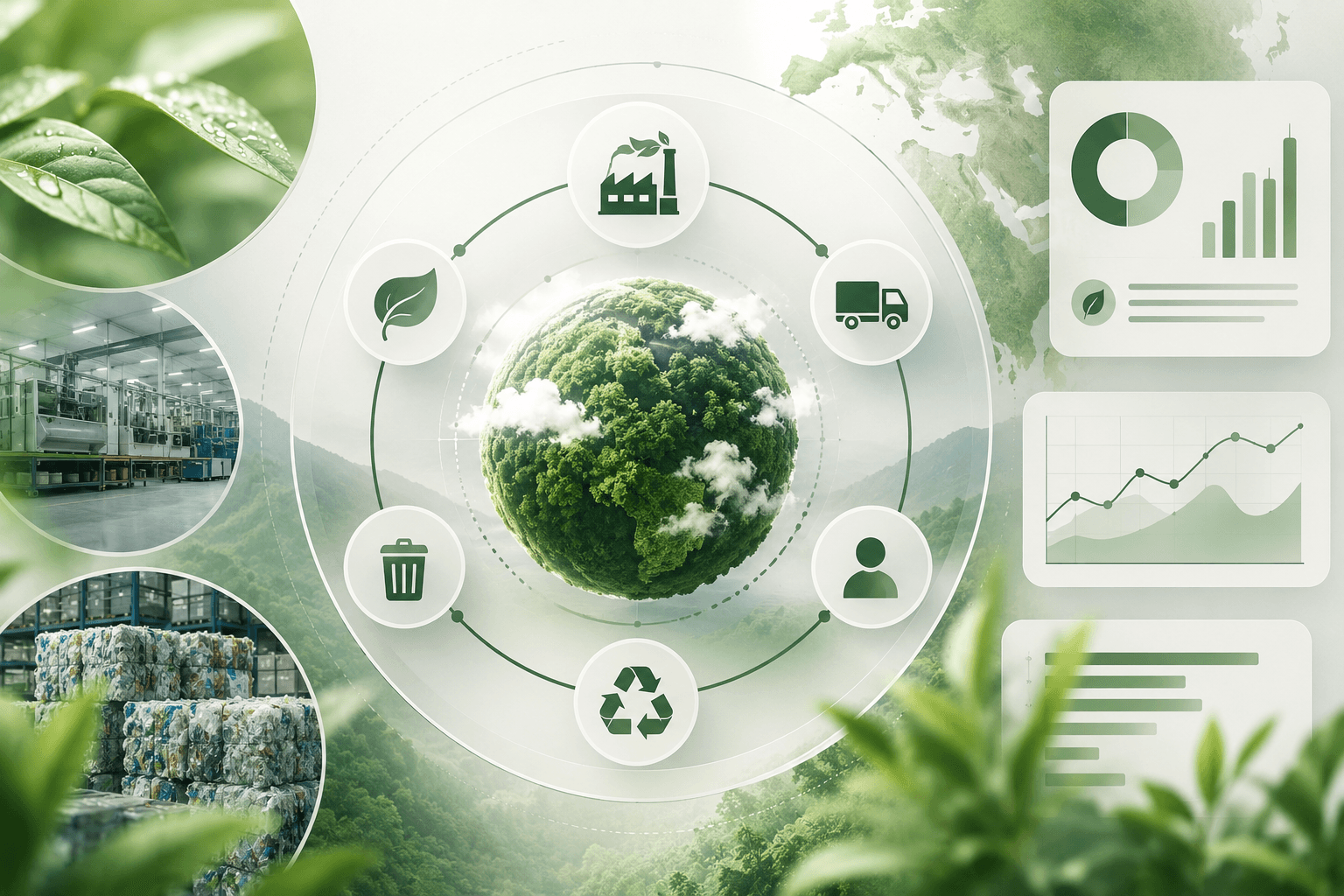
Image de couverture montrant une chaîne de valeur circulaire du Scope 3 avec des icônes pour la production, le transport, l'utilisation des produits, les déchets et le recyclage, entourée de tableaux de bord de durabilité et de visualisations de données vertes.

What are Scope 3 emissions

Scope 3 emissions include all indirect greenhouse gas (GHG) emissions that are not part of Scope 1 or Scope 2, but are still linked to a company’s activities.

According to the GHG Protocol Scope 3 Standard, these emissions occur across the entire value chain and include both upstream activities (such as suppliers) and downstream activities (such as product use).

Unlike other scopes, Scope 3 is characterized by three key aspects:

  • it is not under direct company control

  • it involves multiple external stakeholders

  • it requires distributed and often unstructured data

This makes Scope 3 essential for a complete carbon footprint assessment, but also significantly more difficult to manage accurately.

The 15 Scope 3 categories

To make these emissions measurable, the GHG Protocol divides Scope 3 into 15 categories, covering all activities across the value chain.

This classification is not just theoretical—it provides a practical structure for calculating Scope 3 emissions and identifying where the greatest impact lies.

The categories are grouped into two main areas:

Upstream activities

These include everything that happens before the company’s operations, such as:

  • purchased goods and services

  • inbound transportation and logistics

  • waste generated in operations

  • business travel and employee commuting

Downstream activities

These include everything that happens after the product is sold:

  • distribution

  • use of sold products

  • end-of-life treatment

  • investments (Category 15)

👉 This structure enables companies to analyze their supply chain in a systematic way and identify high-impact areas.

Why Scope 3 emissions matter most

In most organizations, Scope 3 emissions represent the largest share of total emissions—often exceeding 70–80% of the company’s carbon footprint.

This is because environmental impact extends far beyond internal operations, covering the entire product lifecycle and the network of suppliers and partners.

In particular:

  • a significant portion of emissions originates in the supply chain

  • products continue to generate emissions during use and disposal

  • indirect emissions often exceed those directly controlled

Ignoring Scope 3 leads to an incomplete and underestimated view of GHG emissions, affecting both reporting and ESG strategy.

Why Scope 3 is the most complex to calculate

Scope 3 emissions are the most complex to calculate because they require data collection outside the company’s direct boundaries.

Unlike Scope 1 and 2, where data is internally available, Scope 3 involves suppliers, partners, and multiple stakeholders across the value chain.

Key challenges include:

  • fragmented data across different stakeholders

  • limited data availability, especially from less mature suppliers

  • reliance on estimates when primary data is not available

  • high variability, making comparisons over time difficult

This is where manual or unstructured approaches tend to fail.

How to calculate Scope 3 emissions

Scope 3 emissions are calculated based on the GHG Protocol Scope 3 Standard, using different methodologies depending on data availability and company maturity.

The main approaches include:

Spend-based method

Uses financial data (spend) combined with sector-based emission factors.
It is quick and useful in early stages but less accurate.

Activity-based method

Uses actual operational data (quantities, consumption, transport), providing higher accuracy.
However, it requires more structured data collection.

Hybrid method

Combines real data and estimates, offering a balance between accuracy and feasibility.

Over time, companies typically evolve from estimated approaches to more data-driven models.

Scope 3 and supply chain: the role of suppliers

Scope 3 emissions are closely linked to the supply chain, making supplier management a central element of any sustainability strategy.

In many cases, the largest share of emissions comes from external activities such as material production, transportation, and purchased services.

For this reason, companies need a structured approach to supplier evaluation, integrating ESG criteria into procurement processes.

This includes:

  • collecting emissions data from suppliers

  • identifying high-impact areas

  • engaging suppliers in improvement initiatives

  • integrating sustainability into purchasing decisions

This approach is the foundation of sustainable procurement and enables companies to act where impact is greatest.

Scope 3 Category 15: financed emissions

Among the Scope 3 categories, Category 15 – Investments is one of the most complex and relevant, especially for financial institutions.

These emissions arise from financed activities such as investments and loans, and correspond to the Scope 1 and Scope 2 emissions of the invested companies.

In this case, the organization does not directly generate emissions but contributes indirectly through capital allocation.

Calculation can be based on:

  • actual emissions data from investees (more accurate)

  • estimates based on sector and revenue (less precise)

Managing financed emissions is becoming increasingly critical for alignment with global climate goals.

Key challenges in Scope 3 management

Beyond calculation complexity, managing Scope 3 emissions presents significant operational challenges.

Companies often face:

  • complex and low-transparency supply chains

  • difficulties in data collection and validation

  • lack of standardization across suppliers

  • time-consuming manual processes

Without a structured approach, the risk is generating incomplete or unreliable data, undermining both reporting and strategic decision-making.

Scope 3 software: improving the process

The complexity of Scope 3 makes it difficult to manage using manual or disconnected tools.

For this reason, more companies are adopting carbon footprint software to transform a fragmented process into a structured and scalable system.

A dedicated platform enables companies to:

  • centralize supply chain data

  • automate GHG emissions calculation

  • engage suppliers in data collection

  • improve data quality and traceability

  • generate reports compliant with CSRD and ESRS

Digitalization is now essential to manage Scope 3 effectively and reliably.

How Metrikflow supports Scope 3

Metrikflow simplifies Scope 3 emissions management by transforming a complex process into a structured, automated, and audit-ready workflow.

With Metrikflow, you can:

  • collect data from suppliers and partners

  • automate emissions calculation

  • monitor performance across the supply chain

  • integrate ESG evaluation into procurement processes

  • generate audit-ready reports and ensure compliance

The result:
greater visibility across the supply chain, more accurate data, and full control over indirect emissions.

Livre blanc

Une conversation entre l'EFRAG et l'industrie

La douleur netus eget suspendisse pellentesque. Diam elit lobortis elementum mi sed turpis quisque feugiat leo. Ipsum purus faucibus sed potenti phasellus duis vestibulum risus sagittis. Sit viverra convallis ultrices netus pulvinar.

Télécharger maintenant

Les émissions du Scope 3 représentent la composante la plus importante et la plus complexe de l'empreinte carbone d'une entreprise.

Définies par le Greenhouse Gas Protocol (norme Scope 3 du GHG Protocol), elles incluent toutes les émissions indirectes générées tout au long de la chaîne d'approvisionnement et de la chaîne de valeur d'une organisation, tant en amont qu'en aval.

Contrairement aux émissions du Scope 1 et du Scope 2, le Scope 3 ne concerne pas les activités directement contrôlées par l'entreprise, mais toutes celles liées à ses opérations : fournisseurs, transport, utilisation des produits et fin de vie.

C'est pourquoi le Scope 3 est désormais le domaine d'action crucial pour les entreprises qui cherchent à comprendre et à gérer pleinement leur impact environnemental.

Mais que comprennent exactement les émissions du Scope 3 et comment les calculer de manière fiable ?

Dans ce guide, nous explorerons les catégories du Scope 3, les principaux défis opérationnels et les méthodes utilisées pour mesurer et gérer les émissions sur l'ensemble de la chaîne de valeur.

What are Scope 3 emissions

Scope 3 emissions include all indirect greenhouse gas (GHG) emissions that are not part of Scope 1 or Scope 2, but are still linked to a company’s activities.

According to the GHG Protocol Scope 3 Standard, these emissions occur across the entire value chain and include both upstream activities (such as suppliers) and downstream activities (such as product use).

Unlike other scopes, Scope 3 is characterized by three key aspects:

  • it is not under direct company control

  • it involves multiple external stakeholders

  • it requires distributed and often unstructured data

This makes Scope 3 essential for a complete carbon footprint assessment, but also significantly more difficult to manage accurately.

The 15 Scope 3 categories

To make these emissions measurable, the GHG Protocol divides Scope 3 into 15 categories, covering all activities across the value chain.

This classification is not just theoretical—it provides a practical structure for calculating Scope 3 emissions and identifying where the greatest impact lies.

The categories are grouped into two main areas:

Upstream activities

These include everything that happens before the company’s operations, such as:

  • purchased goods and services

  • inbound transportation and logistics

  • waste generated in operations

  • business travel and employee commuting

Downstream activities

These include everything that happens after the product is sold:

  • distribution

  • use of sold products

  • end-of-life treatment

  • investments (Category 15)

👉 This structure enables companies to analyze their supply chain in a systematic way and identify high-impact areas.

Why Scope 3 emissions matter most

In most organizations, Scope 3 emissions represent the largest share of total emissions—often exceeding 70–80% of the company’s carbon footprint.

This is because environmental impact extends far beyond internal operations, covering the entire product lifecycle and the network of suppliers and partners.

In particular:

  • a significant portion of emissions originates in the supply chain

  • products continue to generate emissions during use and disposal

  • indirect emissions often exceed those directly controlled

Ignoring Scope 3 leads to an incomplete and underestimated view of GHG emissions, affecting both reporting and ESG strategy.

Why Scope 3 is the most complex to calculate

Scope 3 emissions are the most complex to calculate because they require data collection outside the company’s direct boundaries.

Unlike Scope 1 and 2, where data is internally available, Scope 3 involves suppliers, partners, and multiple stakeholders across the value chain.

Key challenges include:

  • fragmented data across different stakeholders

  • limited data availability, especially from less mature suppliers

  • reliance on estimates when primary data is not available

  • high variability, making comparisons over time difficult

This is where manual or unstructured approaches tend to fail.

How to calculate Scope 3 emissions

Scope 3 emissions are calculated based on the GHG Protocol Scope 3 Standard, using different methodologies depending on data availability and company maturity.

The main approaches include:

Spend-based method

Uses financial data (spend) combined with sector-based emission factors.
It is quick and useful in early stages but less accurate.

Activity-based method

Uses actual operational data (quantities, consumption, transport), providing higher accuracy.
However, it requires more structured data collection.

Hybrid method

Combines real data and estimates, offering a balance between accuracy and feasibility.

Over time, companies typically evolve from estimated approaches to more data-driven models.

Scope 3 and supply chain: the role of suppliers

Scope 3 emissions are closely linked to the supply chain, making supplier management a central element of any sustainability strategy.

In many cases, the largest share of emissions comes from external activities such as material production, transportation, and purchased services.

For this reason, companies need a structured approach to supplier evaluation, integrating ESG criteria into procurement processes.

This includes:

  • collecting emissions data from suppliers

  • identifying high-impact areas

  • engaging suppliers in improvement initiatives

  • integrating sustainability into purchasing decisions

This approach is the foundation of sustainable procurement and enables companies to act where impact is greatest.

Scope 3 Category 15: financed emissions

Among the Scope 3 categories, Category 15 – Investments is one of the most complex and relevant, especially for financial institutions.

These emissions arise from financed activities such as investments and loans, and correspond to the Scope 1 and Scope 2 emissions of the invested companies.

In this case, the organization does not directly generate emissions but contributes indirectly through capital allocation.

Calculation can be based on:

  • actual emissions data from investees (more accurate)

  • estimates based on sector and revenue (less precise)

Managing financed emissions is becoming increasingly critical for alignment with global climate goals.

Key challenges in Scope 3 management

Beyond calculation complexity, managing Scope 3 emissions presents significant operational challenges.

Companies often face:

  • complex and low-transparency supply chains

  • difficulties in data collection and validation

  • lack of standardization across suppliers

  • time-consuming manual processes

Without a structured approach, the risk is generating incomplete or unreliable data, undermining both reporting and strategic decision-making.

Scope 3 software: improving the process

The complexity of Scope 3 makes it difficult to manage using manual or disconnected tools.

For this reason, more companies are adopting carbon footprint software to transform a fragmented process into a structured and scalable system.

A dedicated platform enables companies to:

  • centralize supply chain data

  • automate GHG emissions calculation

  • engage suppliers in data collection

  • improve data quality and traceability

  • generate reports compliant with CSRD and ESRS

Digitalization is now essential to manage Scope 3 effectively and reliably.

How Metrikflow supports Scope 3

Metrikflow simplifies Scope 3 emissions management by transforming a complex process into a structured, automated, and audit-ready workflow.

With Metrikflow, you can:

  • collect data from suppliers and partners

  • automate emissions calculation

  • monitor performance across the supply chain

  • integrate ESG evaluation into procurement processes

  • generate audit-ready reports and ensure compliance

The result:
greater visibility across the supply chain, more accurate data, and full control over indirect emissions.

CONTRIBUTOR

Portrait de Luis Antazema

Luis Antazema

Analyste en durabilité

Ingénieur chimiste de formation et spécialisé dans le secteur de l'énergie, Luis applique une approche technique et analytique rigoureuse à la décarbonation et à la mesure des émissions. Né en Bolivie et ayant évolué professionnellement entre les États-Unis et l'Europe, il contribue à la conception et à la mise en œuvre de méthodologies d'empreinte carbone et d'analyse du cycle de vie (ACV). Il aide ainsi les organisations à quantifier avec précision leurs émissions tout en identifiant des opportunités pour optimiser les processus, améliorer l'efficacité des ressources et réduire les coûts opérationnels. Luis considère la durabilité non pas seulement comme un exercice de conformité, mais comme un moteur de valeur commerciale mesurable, reliant la performance environnementale aux rendements économiques, à la réduction des risques et à la compétitivité à long terme. Il s'efforce de rendre la durabilité pratique, axée sur les données et financièrement significative pour les organisations et leurs parties prenantes. Sujets abordés : Décarbonation, Empreinte Carbone d'Entreprise, Analyse du Cycle de Vie (ACV), Comptabilisation des Scopes 1-2-3, GHG Protocol, Empreinte Carbone Produit (PCF).

No headings found on page

Restez à jour avec Metrikflow Insights!

Nous livrons des analyses expertes, des mises à jour de produits, des tendances du secteur et des stratégies exploitables directement dans votre boîte de réception. Restez en avance sur l'ESG, les GES et l'AAC — une édition à la fois.

En soumettant ce formulaire, vous consentez à recevoir la ressource demandée. Pour plus d'informations sur la façon dont nous traitons et protégeons vos données, consultez notre Politique de confidentialité.

La solution logicielle incontournable pour les responsables de la durabilité.

Orienté vers le client

Données Précises

Construit sur la technologie intelligente

Radar ESG : La newsletter Metrikflow

Tout ce qu’il faut savoir sur la durabilité,
dans un seul e-mail. Des insights chaque semaine. Zéro spam.

En soumettant ce formulaire, vous consentez à recevoir la ressource demandée. Pour plus d'informations sur la façon dont nous traitons et protégeons vos données, consultez notre Politique de confidentialité.

Radar ESG : La newsletter Metrikflow

Tout ce que vous devez savoir sur la durabilité, tout-en-un email. Informations hebdomadaires. Zéro spam.

En soumettant ce formulaire, vous consentez à recevoir la ressource demandée. Pour plus d'informations sur la façon dont nous traitons et protégeons vos données, consultez notre Politique de confidentialité.

La solution logicielle incontournable pour les gestionnaires de durabilité.

Orienté vers le client

Données Précises

Construit sur la technologie intelligente

La solution logicielle incontournable pour les gestionnaires de durabilité.

Orienté vers le client

Données Précises

Construit sur la technologie intelligente

Radar ESG : La newsletter Metrikflow

Tout ce qu’il faut savoir sur la durabilité,
dans un seul e-mail. Des insights chaque semaine. Zéro spam.

En soumettant ce formulaire, vous consentez à recevoir la ressource demandée. Pour plus d'informations sur la façon dont nous traitons et protégeons vos données, consultez notre Politique de confidentialité.