
A sustainability report is one of the main tools companies use to organize and communicate ESG information. For some companies, it is a regulatory obligation. For others, it is a voluntary choice linked to requests from customers, banks, investors or industrial groups.
The difference between a strong sustainability report and a weak one depends on the quality of the process behind it. Before writing the report, companies need available data, clear internal responsibilities, a standard aligned with their profile and a defined reporting scope.
In this guide, we explain what a sustainability report is, which companies need to prepare one, which standards to consider between ESRS, VSME and GRI, how it differs from a social report, and how to get started.
What is a sustainability report?
A sustainability report is a corporate report that describes how a company manages the environmental, social and governance (ESG) topics that are relevant to its business. It may also be called an ESG report, sustainability disclosure or sustainability statement, but the objective remains the same: to present data, policies, results and targets in an organized and verifiable way.
Examples of information included in sustainability reports are energy consumption, greenhouse gas emissions, waste management, training, diversity, supply chain and business ethics. The content depends on the company’s profile, sector, reporting scope and chosen reporting standard.
The difference between a sustainability report and generic ESG communication lies in the level of method. A website page or sales presentation can describe individual initiatives. A sustainability report should explain which topics were considered, which data were used, where the information comes from and how performance changed over the reporting period.
For example, stating that energy consumption has decreased has limited value if the company does not indicate the period, sites included, baseline data and calculation method. In a sustainability report, that result should be linked to an indicator, an internal source and a clear time comparison.
This approach also makes the report useful for business management. When ESG information is collected continuously, companies can compare sites or departments, identify inefficiencies, respond faster to customer questionnaires and prepare more effectively for future regulatory obligations.
For companies that want to structure this work on an ongoing basis, sustainability reporting software can help centralize data, evidence, standards and responsibilities in a single working environment.
Who needs to prepare a sustainability report: mandatory or voluntary?
The question “who needs to prepare a sustainability report?” depends on two elements: regulatory obligations and market requests. In Europe, the main reference is the CSRD, the Corporate Sustainability Reporting Directive, which expanded the scope of corporate sustainability reporting compared to the previous framework.
With the latest updates introduced by the Omnibus package, the individual reporting obligation has been narrowed to companies that exceed both thresholds: more than 1,000 employees and more than €450 million in net turnover. These companies must prepare their sustainability report according to the ESRS, the European Sustainability Reporting Standards.
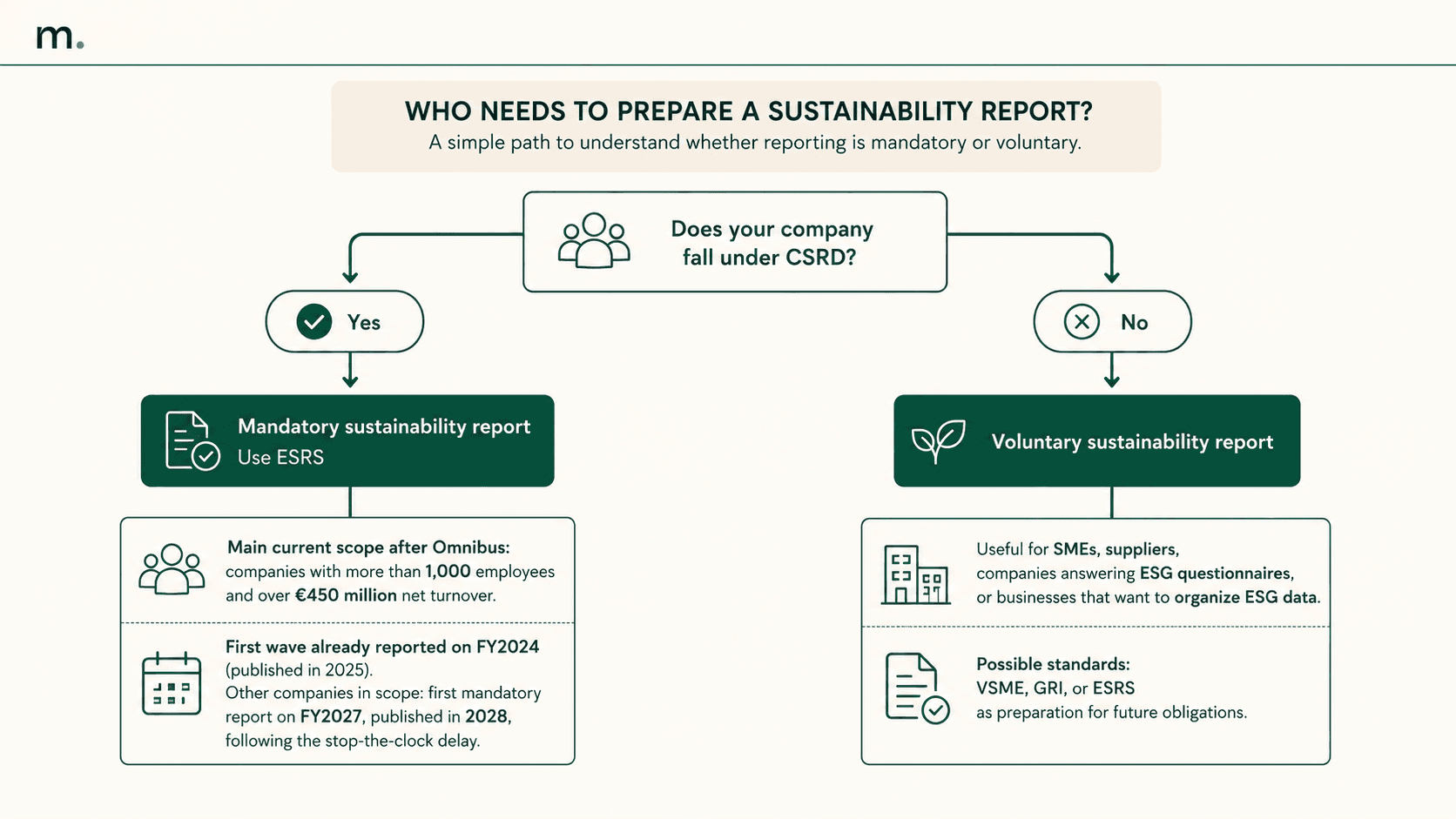
Companies already included in the first CSRD wave, meaning large public-interest entities with more than 500 employees already subject to previous non-financial reporting requirements, started reporting on financial year 2024, with publication in 2025.
For the other large companies falling within the new CSRD scope, application has been postponed by two years through the “Stop-the-clock” Directive. This means that the first mandatory reporting cycle will cover financial year 2027, with publication in 2028. Listed SMEs, initially expected to be included in a later phase of the CSRD, have also been affected by the postponement and by the reduction of the regulatory scope.
Alongside direct obligations, many companies prepare sustainability reports voluntarily. This may be the case for SMEs, suppliers of large groups, companies receiving ESG questionnaires from customers or banks, or businesses that want to start measuring their environmental, social and governance performance in a more structured way.
In these cases, the report is not driven by a legal obligation, but by the need to provide reliable and consistent data. For example, for an SME supplying a large group, ESG reporting can become relevant even without a direct regulatory obligation: the customer may request data on emissions, energy consumption, labour policies, safety, governance or supplier management.
For voluntary reporting, companies can use standards that are less demanding than the ESRS, such as VSME or the GRI Standards. Some companies that are not legally required to report still choose to use the ESRS, or to move progressively closer to their structure, especially when they expect to fall within the CSRD scope in the future, belong to a larger group or receive very detailed ESG requests.
For companies just starting out, voluntary reporting can help build a first ESG data baseline. The scope can be gradual: main sites, energy consumption, Scope 1 and Scope 2 emissions, workforce data, health and safety, governance policies and key supply chain information. The first year is often used to understand which data exist, who owns them, how reliable they are and which information is missing.
When the report also includes emissions calculation, carbon footprint software can help collect emissions data, calculate Scope 1, Scope 2 and Scope 3 and maintain traceability over the sources used.
ESRS, VSME, SASB and GRI: which standard should companies choose?
The choice of standard depends first on the objective of the report. If the company is subject to the CSRD, the reference is the ESRS. If the report is voluntary, the choice can be more flexible and depend on company size, sector, external requests and the maturity of available data.
The ESRS are suitable for companies required to report under the CSRD or for companies that want to prepare for more structured reporting. They require a high level of detail and connect sustainability to impacts, risks, opportunities, governance, metrics and targets. For a company that is not legally required to report, they can be useful, but only if the level of work required is manageable for internal teams.
The SASB Standards are designed to identify sustainability information that is financially material to specific sectors. The framework is particularly useful for companies that want to link ESG issues to financial performance or meet investors’ disclosure needs.
The VSME is more suitable for non-listed SMEs and companies that want to build a first voluntary report with a more proportionate structure. It allows companies to start from essential information and respond more clearly to requests from customers, banks or business partners, without immediately adopting a framework designed for large companies.
The GRI Standards can be a good choice for companies that want to use an internationally recognized reference. They are particularly useful when the report needs to explain the company’s impacts in a way that is understandable outside the European regulatory perimeter, or when the company already has a history of voluntary reporting based on this standard.
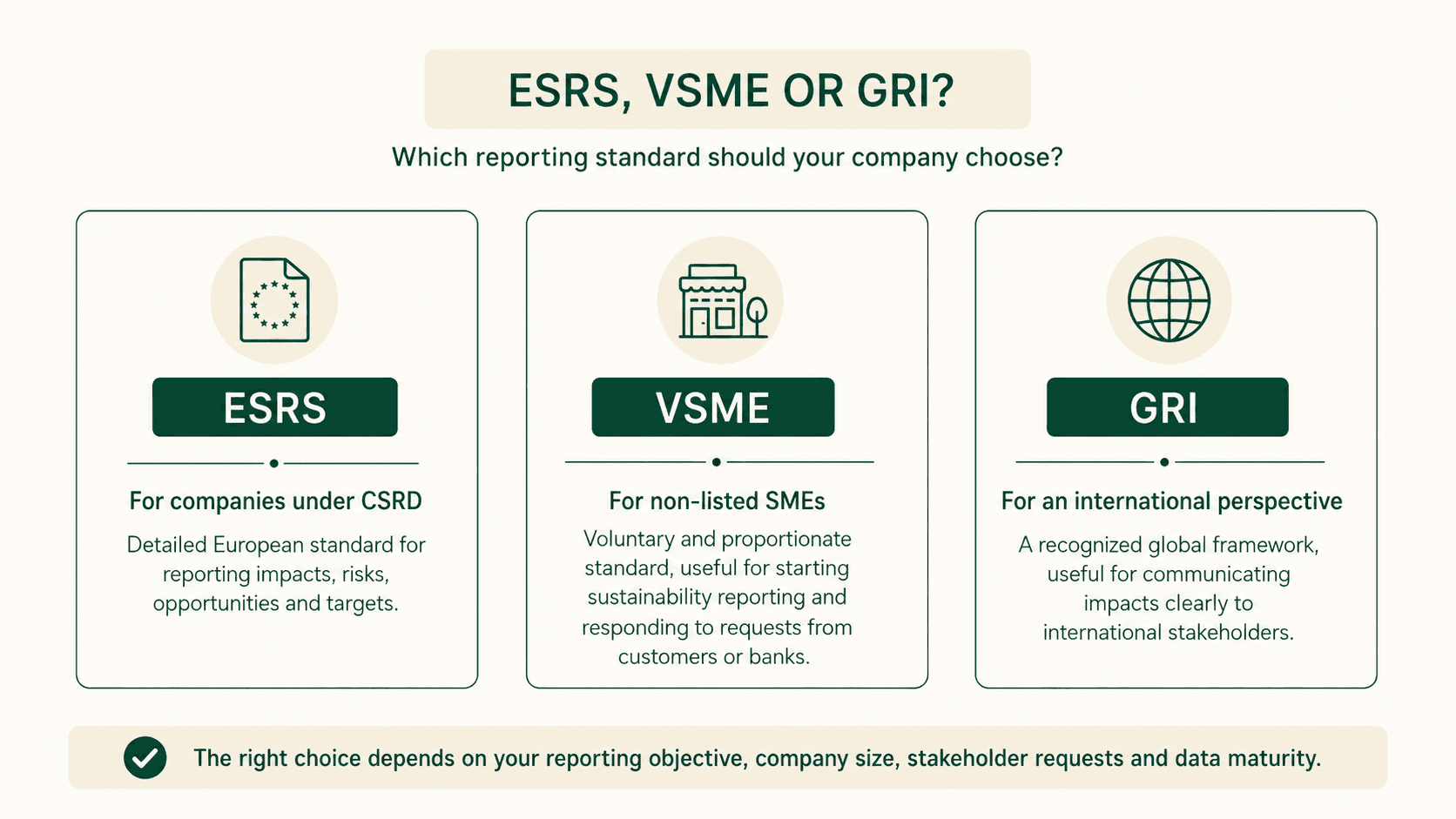
The final choice should also consider the company’s ability to collect reliable data, update information over time and maintain consistency between reports, ESG questionnaires, customer requests and external communication. A standard that is too complex can slow down the work; one that is too light may not be enough for more advanced requests.
Social report and sustainability report: what is the difference?
Social report and sustainability report are often used as similar expressions, but they do not refer to the same document. The difference concerns both the content scope and the rules of application.
A social report is traditionally linked to the reporting of the social value generated by an organization. In Italy, however, for certain entities it is not only a voluntary choice: it is an obligation under the regulation of the Third Sector and social enterprises.
In particular, the social report is mandatory for Third Sector Entities with revenues, income, proceeds or receipts above €1 million. It must be prepared according to the Guidelines of the Italian Ministry of Labour, filed with the RUNTS and published on the entity’s website. The obligation also applies to Volunteer Service Centres, regardless of their economic size.
The social report is also mandatory for social enterprises, including social cooperatives and their consortia, which automatically acquire the status of social enterprise. In this case, the document must be filed with the Companies Register and published on the organization’s website, in line with the rules on social enterprises.
A sustainability report, instead, is the document through which a company reports its broader ESG information: environment, people, governance, risks, targets and performance. For companies subject to the CSRD, it follows the rules of European sustainability reporting; for companies that are not legally required to report, it can be prepared voluntarily by choosing the standard that best fits their profile.
For a for-profit company, the practical difference is this: the social report is mainly relevant when the organization falls within the categories covered by Third Sector or social enterprise rules; the sustainability report is the more suitable reference when the objective is to report ESG performance to customers, banks, investors, industrial groups or business partners.
How to start preparing a sustainability report
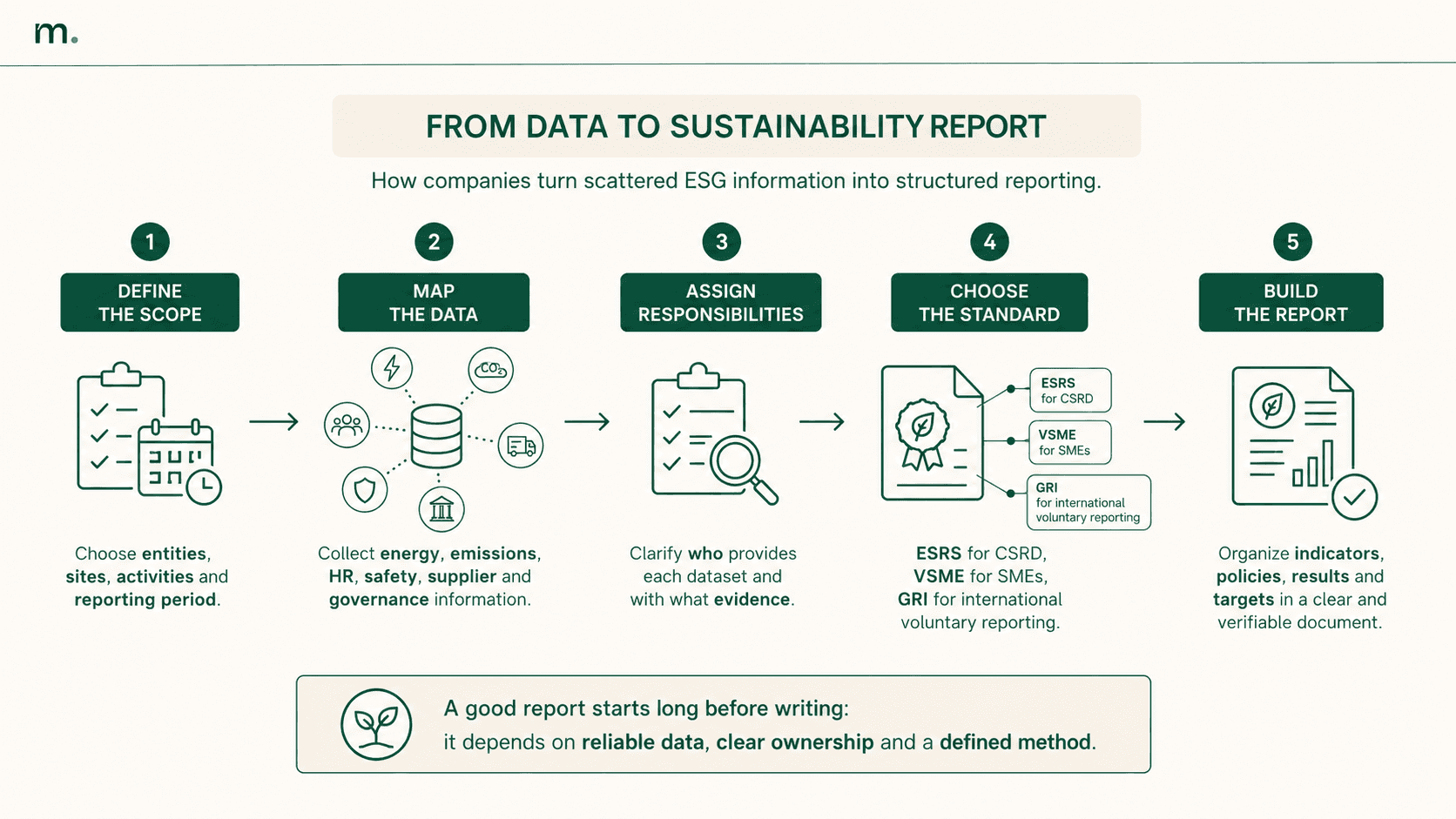
To start preparing a sustainability report, the first step is to define the reporting scope. The company needs to clarify which legal entities, sites, activities and periods are included in the report. This choice affects the data to be collected, the functions involved and the possibility of comparing results over the following years.
The second step is the reporting standard. A non-obligated SME may consider a voluntary report aligned with the VSME. A company subject to the CSRD must report according to the ESRS. A company that wants to maintain an international approach may consider the GRI Standards, especially if it already has reporting experience or stakeholders familiar with that framework.
The third step is data mapping. Before writing the report, the company needs to understand which information it already has and what is missing. Data may be found in utility bills, management systems, spreadsheets, HR documents, safety records, quality software, supplier questionnaires or environmental reports. Without this mapping, the reporting process risks becoming manual and fragmented.
The fourth step is assigning responsibilities. Each business area should know which data it needs to provide, how often and with which supporting evidence. This reduces the risk of collecting information at the last minute, without control over the source or the quality of the data.
The fifth step is building the report. At this stage, the company can organize content, indicators and comments coherently. The document should explain performance without overloading the reader, distinguishing between consolidated data, targets, actions already started and areas that still need improvement.
Sustainability reporting software can help especially with data collection, control and updates. The benefit lies in the ability to centralize ESG information, connect it to the selected standards, maintain traceable evidence and reduce repetitive work from one year to the next.
CONTRIBUTOR

Sharon Ridolfo
ESG specialist
With a background in international environmental research, Sharon has developed advanced skills in data analysis and emissions monitoring, with a focus on the study of air pollutants and environmental impacts. After coordinating research activities in European Horizon 2020 projects and developing monitoring plans and environmental risk assessments, she now deals with ESG reporting and sustainability reporting, supporting companies in structuring solid, measurable data that is consistent with the main reference standards. Cheerful and energetic, she is passionate about the animal world and environmental protection, values that reinforce her professional commitment. Topics covered: ESG reporting, sustainability reporting, environmental KPIs, emissions monitoring, climate change, environmental data analysis.
Stay up to date with Metrikflow Insights!
We deliver expert insights, product updates, industry trends, and actionable strategies straight to your inbox. Stay ahead in ESG, GHG, and LCA — one edition at a time.
By submitting this form, you consent to receive the requested resource. For more information on how we process and protect your data, view our Privacy Policy.


