ESG Regulations & Compliance

ESG Regulations & Compliance

EU Taxonomy: what it is and what changes for companies

EU Taxonomy: what it is and what changes for companies

Updated in June 2026

Headshot Alessandro Nora
Alessandro Nora
Illustration of the EU Taxonomy as a circular system connecting sustainability criteria, financial reporting, business activities, environmental performance and verification around a central map of Europe.

The EU Taxonomy is the European system that defines when an economic activity can be considered environmentally sustainable.

For companies, it is a classification tool with concrete effects on reporting, investments and the relationship with banks, customers and investors. It helps connect economic activities, revenue, investments and certain operating expenses to common environmental criteria, reducing the risk of generic or non-comparable assessments.

In 2026, the Taxonomy is undergoing a new revision process. After the Omnibus package and the simplification Delegated Act adopted in 2025, the European Commission opened a public consultation to revise the technical screening criteria and make the framework clearer, more coherent and easier to apply in practice.
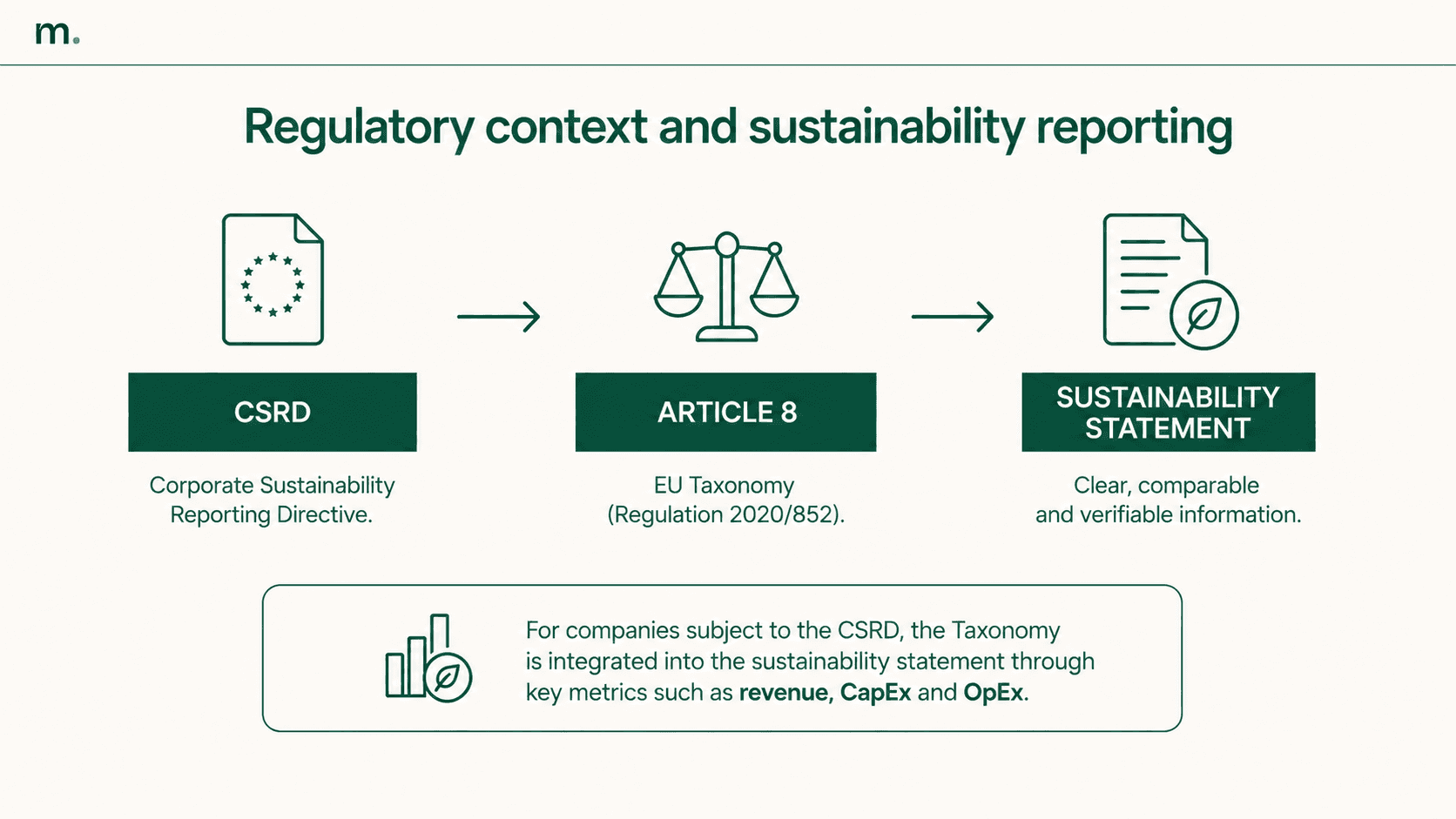
Infographic connecting the CSRD, Article 8 of the EU Taxonomy and sustainability reporting, highlighting revenue, CapEx and OpEx.

The goal is not to reduce the importance of the Taxonomy. It is to make the system more usable for companies and financial operators. The main difficulties that have emerged in recent years concern the complexity of some criteria, the application of the “Do No Significant Harm” principle, overlaps with other EU regulations and the difficulty of producing comparable evidence across companies and sectors.

For companies subject to the CSRD, the Taxonomy becomes part of sustainability reporting through specific indicators. For companies that are not directly required to report, it can still become relevant through requests from customers, corporate groups, banks or investors.

What is the EU Taxonomy and what is its main objective?

The legal reference is Regulation (EU) 2020/852, often searched for as “EU Taxonomy Regulation 852”. The Regulation establishes a common framework to determine whether an economic activity can be considered environmentally sustainable.
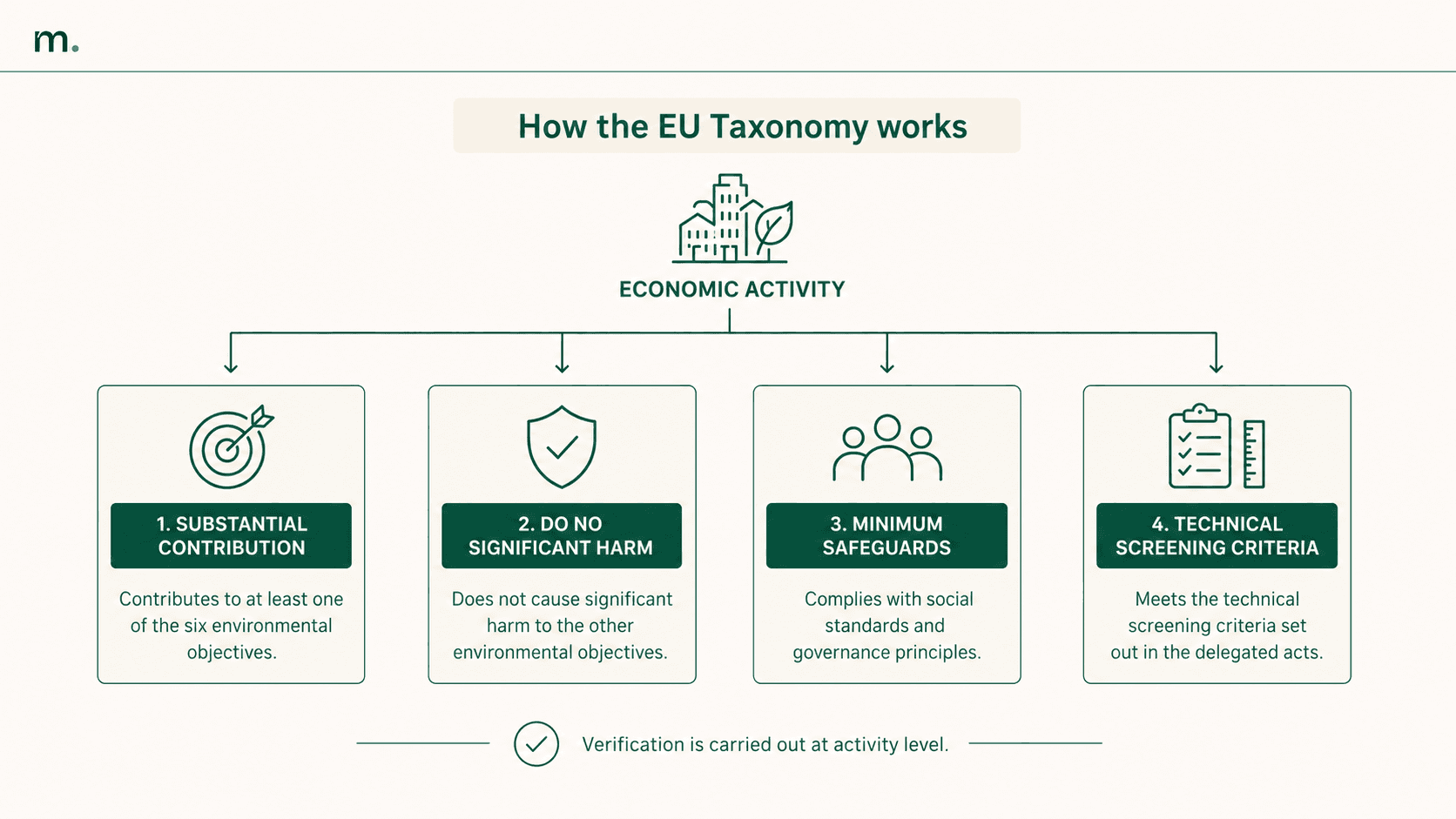
Infographic showing how the EU Taxonomy works: an economic activity is assessed against substantial contribution, DNSH, minimum safeguards and technical screening criteria.

What is the main objective of the EU Taxonomy Regulation?

In practical terms, the objective is to create shared criteria to assess economic activities from an environmental perspective. This allows companies, banks, investors and public authorities to use the same language when analysing production activities, projects, investments and economic data.

The Taxonomy is part of the European Green Deal and the European Union’s path towards climate neutrality by 2050. Its role is to translate long-term environmental objectives into criteria that can be applied to economic activities and corporate reporting.

The six environmental objectives of the Taxonomy

  1. climate change mitigation

  2. climate change adaptation

  3. sustainable use and protection of water and marine resources

  4. transition to a circular economy

  5. pollution prevention and control

  6. protection and restoration of biodiversity and ecosystems.
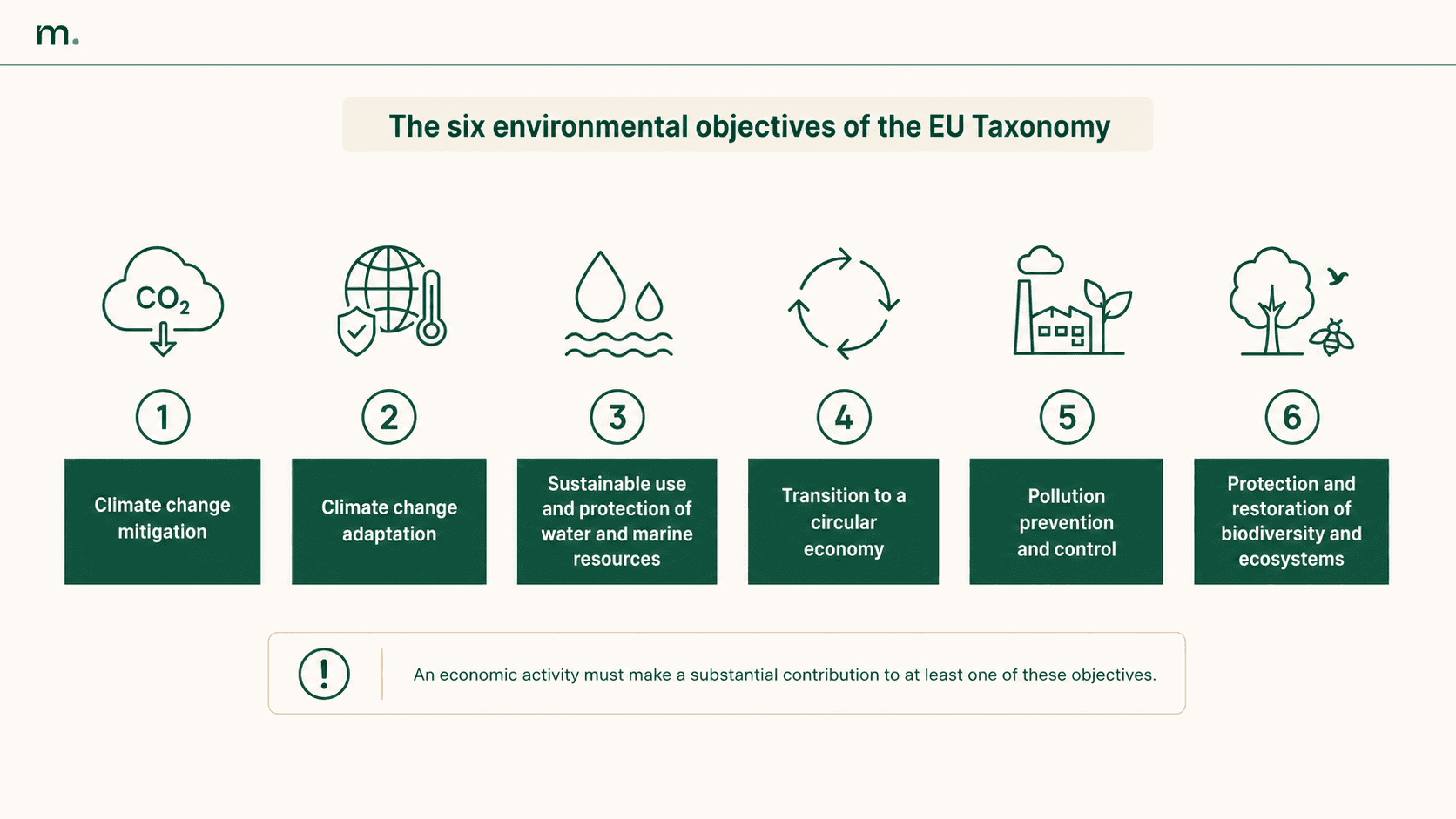
Infographic showing the six environmental objectives of the EU Taxonomy: mitigation, adaptation, water resources, circular economy, pollution and biodiversity.

An activity can be considered Taxonomy-aligned only if it meets four conditions:

  • it makes a substantial contribution to at least one environmental objective

  • it does not significantly harm the other objectives

  • it complies with minimum social and governance safeguards

  • it meets the technical screening criteria set out in the delegated acts.

This approach makes the Taxonomy different from a simple environmental statement. An activity is not assessed on the basis of a general commitment, but through specific requirements, technical thresholds and verifiable documentation.

It also plays an important role in preventing greenwashing. By establishing common criteria, it helps distinguish activities that are actually supported by data and evidence from those presented as sustainable without sufficient proof. This connection is also relevant to the Green Claims Directive, which reinforces the focus on verifiable environmental claims.

For a manufacturing company, the Taxonomy may concern investments in more efficient equipment, lower-emission production processes, waste management or the use of recycled materials. For a real estate company, it may concern buildings, renovations and energy performance. For a bank or investor, it becomes part of the assessment of financed activities.

Which companies are affected by the EU Taxonomy?

EU Taxonomy reporting obligations are linked to sustainability reporting. Companies subject to the CSRD must include the information required by Article 8 of the Taxonomy Regulation in their sustainability report.

In practice, a company must disclose what share of its turnover, investments and certain operating expenses is associated with Taxonomy-eligible or Taxonomy-aligned activities. This information makes it possible to measure the connection between economic activity and the EU’s environmental objectives.

The Omnibus package introduced a simplification process for European sustainability rules, with effects on CSRD, CSDDD and the EU Taxonomy. For companies, this makes it even more important to verify their scope carefully: company size, turnover, number of employees, group structure, listing status and applicable reporting obligations.

Companies that are not directly required to report may still be involved indirectly. A company may receive requests from customers, parent companies, banks or investors that need Taxonomy-consistent data to assess suppliers, financing, industrial plans or investment projects.

The relationship with the financial sector is one of the most relevant aspects. Banks, investors and intermediaries must also report the share of their exposures linked to Taxonomy-aligned economic activities. This is why they may ask companies for more precise information on activities, investments, environmental performance and transition plans.

Having already structured data can make the dialogue with financial institutions easier, especially when applying for new financing, efficiency projects, investments in equipment or interventions linked to the environmental transition. The issue is not only regulatory compliance, but also the quality of the information a company uses to present its economic activities to the market.

The Taxonomy also interacts with other European sustainable finance tools, such as the SFDR for financial market participants and the CSRD for corporate reporting. The result is a framework in which environmental information must be more comparable, documented and connected to economic data.

The first step, therefore, is not to calculate the indicators immediately, but to understand whether the company is directly subject to the requirements, whether it may receive indirect requests and which economic activities could be relevant under the Taxonomy.

Taxonomy-eligible and Taxonomy-aligned activities: an example and what changes

One of the most important aspects of the EU Taxonomy is the distinction between Taxonomy-eligible and Taxonomy-aligned activities.
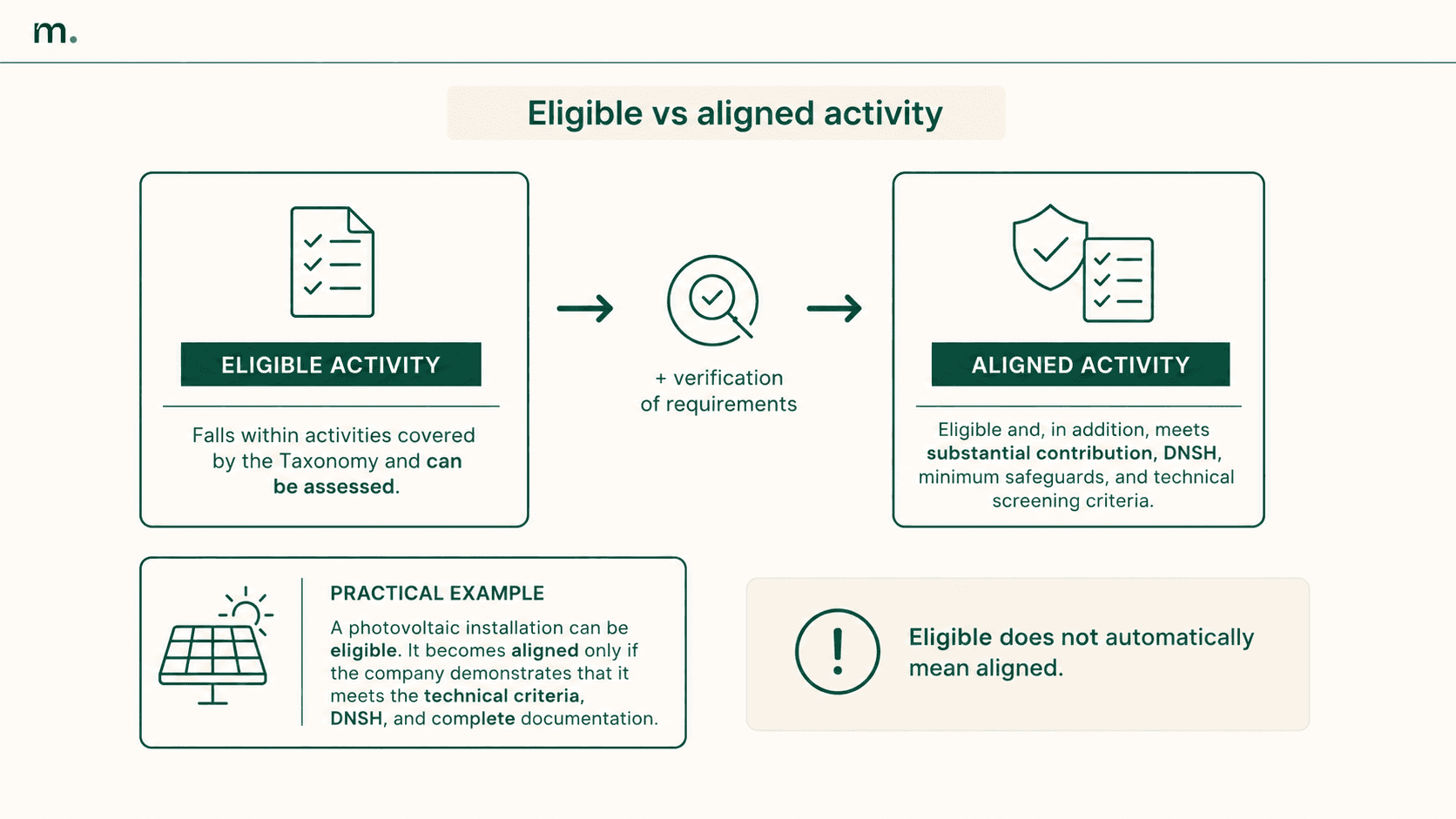
Infographic explaining the difference between eligible and aligned activities under the EU Taxonomy, with a practical example of a photovoltaic installation.

An activity is Taxonomy-eligible when it falls within the activities covered by the Taxonomy delegated acts. This means the activity is included in the regulatory framework and can be assessed against the European criteria.

An activity is Taxonomy-aligned when, in addition to being eligible, it meets all the required conditions. It must make a substantial contribution to an environmental objective, respect the “Do No Significant Harm” principle, comply with minimum safeguards and meet the technical screening criteria.

The difference matters because a company can have eligible activities that are not necessarily aligned.

Think of a manufacturing company installing a solar photovoltaic system on the roof of its facility to cover part of its energy consumption. The investment may be Taxonomy-eligible because electricity generation from solar energy is included among the activities considered by the Taxonomy. However, it is not automatically Taxonomy-aligned. To be aligned, the company must demonstrate that the system meets the applicable technical criteria, does not significantly harm the other environmental objectives and is supported by complete documentation: permits, technical sheets, expected production data, information on the materials used, end-of-life management of components and the required environmental checks.

Without this evidence, the investment may remain eligible, but it cannot be reported as aligned.

To reach a correct assessment, the company must start by mapping its economic activities. This phase requires a practical reading of the business model: which activities generate revenue, which investments are relevant, which processes have measurable environmental impacts and which company functions hold the necessary data.

The mapping can be based on NACE codes, but it should not stop at a formal match. The regulatory description of the activity needs to be compared with what the company actually does. In some cases, two activities with the same code may have different operational characteristics; in others, an investment project may be relevant under the Taxonomy even if it does not match the company’s main activity.

After mapping, the company must verify the technical criteria. This is where the main difficulties often emerge: unavailable data, documents spread across different departments, environmental criteria interpreted inconsistently and economic information not connected to technical data.

Reliable reporting starts when every assessment is traceable. For each activity, it should be clear why it was considered eligible, which criteria were applied, which data support alignment and which limitations were identified.

This step is particularly delicate for companies operating in sectors that are still in transition. In these cases, the Taxonomy can highlight the gap between current activities, planned investments and required criteria. The assessment can therefore also help identify which data are missing and which actions could improve alignment over time.

Required indicators: turnover, CapEx and OpEx

The EU Taxonomy requires non-financial companies to report three main indicators: turnover, CapEx and OpEx.
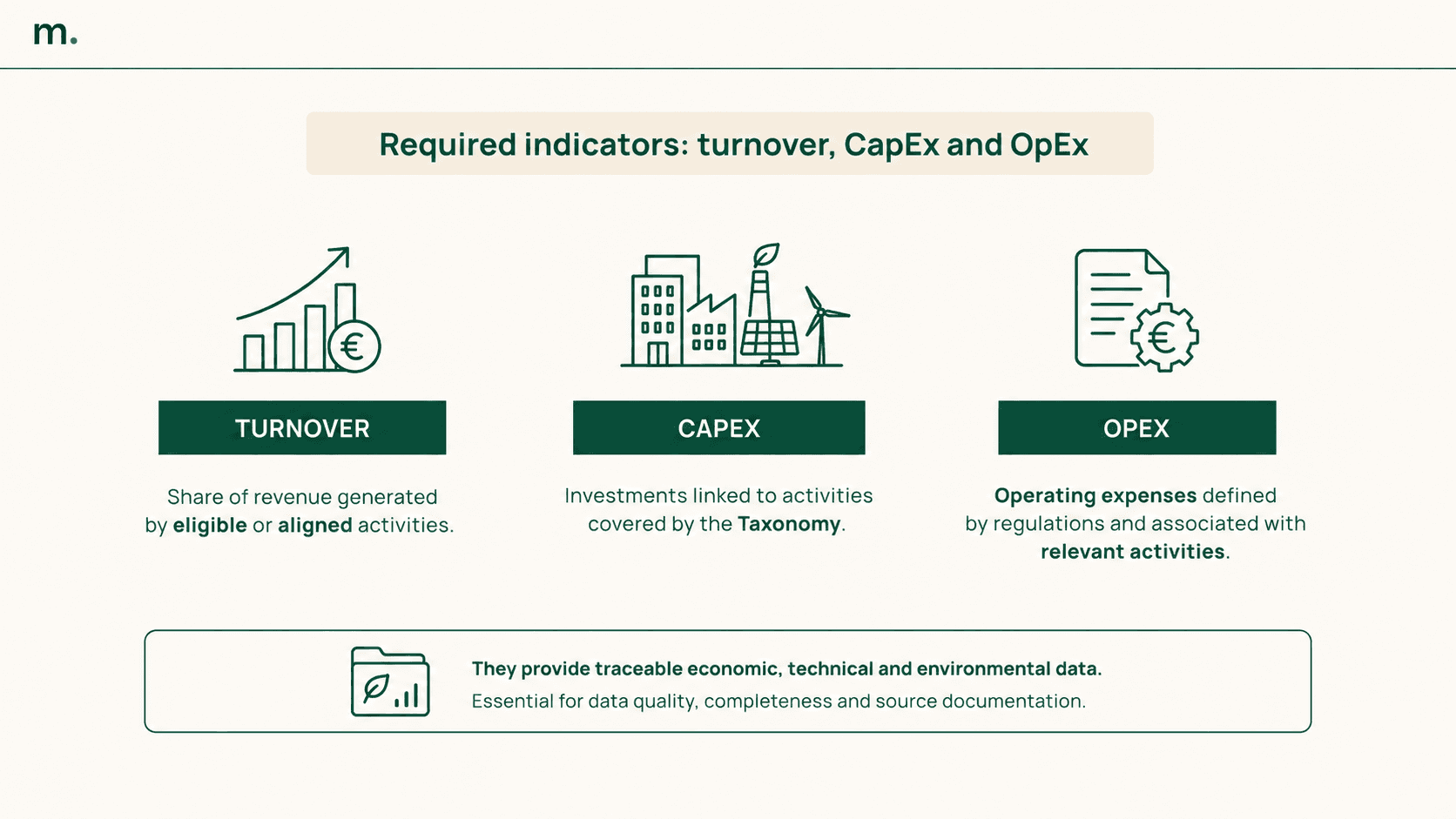
The turnover indicator measures the share of revenue generated by Taxonomy-eligible or Taxonomy-aligned activities. It connects the company’s economic performance to the activities assessed under the EU environmental criteria. To calculate it correctly, companies need revenue that can be separated by activity, clear allocation criteria and consistency with accounting data.

CapEx refers to capital expenditure, meaning investments. It is a highly relevant indicator because it shows how the company is directing resources intended for the future. It may include investments in equipment, buildings, technologies, energy efficiency, vehicles, production processes or projects linked to activities covered by the Taxonomy.

OpEx refers to certain operating expenses defined by the regulation. It is often the most complex indicator to manage, because it does not correspond to all company operating expenses. Companies need to understand which costs fall within the applicable definition, how they are recorded and how they can be linked to the relevant economic activities.

These indicators should not be treated as a year-end exercise. If data is collected only when the report is being prepared, the risk is to have information that is incomplete, difficult to verify or inconsistent.

A more effective process connects activities, economic data and technical data from the beginning. For each relevant activity, the company should know which share of turnover is associated with it, which investments are linked to it, which operating expenses fall within the scope and which evidence is needed to verify alignment.

This work requires close collaboration between sustainability and financial functions. Sustainability teams help interpret the environmental criteria; administration and controlling ensure consistency with economic data; technical functions provide operational evidence. Without this coordination, reporting risks becoming manual, slow and difficult to update.

The quality of the indicators also depends on the ability to document methodological choices. If revenue, an investment or an expense is included or excluded from the calculation, the reason must be clear. This is essential to make the sustainability report more robust and to prepare for potential assurance activities.

Taxonomy indicators can also interact with other environmental data already managed by the company, such as carbon footprint, LCA analyses or information collected across the supply chain. When these data points are consistent with each other, reporting becomes easier to control and update.

2026 updates and how to prepare

The most recent updates to the EU Taxonomy are part of the simplification process of the European sustainable finance framework.

On 4 July 2025, the European Commission adopted a Delegated Act to simplify the application of the Taxonomy. The changes concern disclosure obligations, certain aspects of the climate and environmental delegated acts and measures intended to reduce the administrative burden on companies.

The new measures apply from 1 January 2026 and cover the 2025 financial year. The most relevant elements include simplified reporting templates, the introduction of materiality thresholds and changes to some “Do No Significant Harm” criteria, especially to make the application of requirements linked to pollution prevention and control more manageable.

In March 2026, the Commission also opened a public consultation on the revision of the Taxonomy technical screening criteria. The revision responds to practical issues that have emerged over time: definitions that are not always clear, criteria that are difficult to apply, overlaps with more recent EU rules and the risk of reducing the system’s usefulness for companies and investors.

The direction of the revision is to make the criteria more understandable, more coherent with existing legislation and more proportionate to the information that is actually needed. This is especially relevant for DNSH criteria, which in many cases require technical data and documentation that are not always easy to collect or interpret.

For companies, simplification does not mean lower expectations on data. It means reducing redundant steps and criteria that are difficult to apply, while keeping the focus on clarity, consistency and comparability of information.

To prepare, a company should start by verifying its regulatory scope and then build a map of potentially relevant activities. From there, it can associate each activity with the necessary economic data, identify the technical evidence available and understand where information is missing.

The quality of reporting depends heavily on traceability. Every data point should have a source, an owner, a calculation criterion and a version. This applies to economic data, but also to technical evidence: certifications, energy audits, plant documentation, environmental analyses, contracts, technical sheets and internal procedures.

For many companies, working on the EU Taxonomy also becomes an opportunity to organise ESG data that already exists internally. The information is often already available, but spread across departments, files, suppliers and systems. The main issue is not always the absence of data, but the difficulty of connecting it coherently to the regulation.

A platform or ESG software can support this process when it allows companies to centralise information, assign responsibilities, keep track of sources and update regulatory criteria over time. The same applies to supplier assessment processes, when the required information comes from the value chain, or to related regulatory areas such as CBAM, where technical data, economic data and emissions data must be collected consistently.

The value of a digital tool is not to replace the technical assessment, but to reduce manual work and make evidence collection easier to control.

The EU Taxonomy will continue to evolve together with the European sustainability reporting framework. For companies, the most effective approach is to build an updatable process: mapped activities, reconcilable economic data, archived technical evidence and clear responsibilities.

In this way, the Taxonomy becomes a manageable part of sustainability reporting, instead of turning every year into a data collection process that has to be rebuilt from scratch.

Whitepaper

A Conversation between EFRAG and Industry

Dolor netus eget suspendisse pellentesque. Diam elit lobortis elementum mi sed turpis quisque feugiat leo. Ipsum purus faucibus sed potenti phasellus duis vestibulum risus sagittis. Sit viverra convallis ultrices netus pulvinar.

Download Now

The EU Taxonomy is the European system that defines when an economic activity can be considered environmentally sustainable.

For companies, it is a classification tool with concrete effects on reporting, investments and the relationship with banks, customers and investors. It helps connect economic activities, revenue, investments and certain operating expenses to common environmental criteria, reducing the risk of generic or non-comparable assessments.

In 2026, the Taxonomy is undergoing a new revision process. After the Omnibus package and the simplification Delegated Act adopted in 2025, the European Commission opened a public consultation to revise the technical screening criteria and make the framework clearer, more coherent and easier to apply in practice.

Infographic connecting the CSRD, Article 8 of the EU Taxonomy and sustainability reporting, highlighting revenue, CapEx and OpEx.

The goal is not to reduce the importance of the Taxonomy. It is to make the system more usable for companies and financial operators. The main difficulties that have emerged in recent years concern the complexity of some criteria, the application of the “Do No Significant Harm” principle, overlaps with other EU regulations and the difficulty of producing comparable evidence across companies and sectors.

For companies subject to the CSRD, the Taxonomy becomes part of sustainability reporting through specific indicators. For companies that are not directly required to report, it can still become relevant through requests from customers, corporate groups, banks or investors.

What is the EU Taxonomy and what is its main objective?

The legal reference is Regulation (EU) 2020/852, often searched for as “EU Taxonomy Regulation 852”. The Regulation establishes a common framework to determine whether an economic activity can be considered environmentally sustainable.

Infographic showing how the EU Taxonomy works: an economic activity is assessed against substantial contribution, DNSH, minimum safeguards and technical screening criteria.

What is the main objective of the EU Taxonomy Regulation?

In practical terms, the objective is to create shared criteria to assess economic activities from an environmental perspective. This allows companies, banks, investors and public authorities to use the same language when analysing production activities, projects, investments and economic data.

The Taxonomy is part of the European Green Deal and the European Union’s path towards climate neutrality by 2050. Its role is to translate long-term environmental objectives into criteria that can be applied to economic activities and corporate reporting.

The six environmental objectives of the Taxonomy

  1. climate change mitigation

  2. climate change adaptation

  3. sustainable use and protection of water and marine resources

  4. transition to a circular economy

  5. pollution prevention and control

  6. protection and restoration of biodiversity and ecosystems.

Infographic showing the six environmental objectives of the EU Taxonomy: mitigation, adaptation, water resources, circular economy, pollution and biodiversity.

An activity can be considered Taxonomy-aligned only if it meets four conditions:

  • it makes a substantial contribution to at least one environmental objective

  • it does not significantly harm the other objectives

  • it complies with minimum social and governance safeguards

  • it meets the technical screening criteria set out in the delegated acts.

This approach makes the Taxonomy different from a simple environmental statement. An activity is not assessed on the basis of a general commitment, but through specific requirements, technical thresholds and verifiable documentation.

It also plays an important role in preventing greenwashing. By establishing common criteria, it helps distinguish activities that are actually supported by data and evidence from those presented as sustainable without sufficient proof. This connection is also relevant to the Green Claims Directive, which reinforces the focus on verifiable environmental claims.

For a manufacturing company, the Taxonomy may concern investments in more efficient equipment, lower-emission production processes, waste management or the use of recycled materials. For a real estate company, it may concern buildings, renovations and energy performance. For a bank or investor, it becomes part of the assessment of financed activities.

Which companies are affected by the EU Taxonomy?

EU Taxonomy reporting obligations are linked to sustainability reporting. Companies subject to the CSRD must include the information required by Article 8 of the Taxonomy Regulation in their sustainability report.

In practice, a company must disclose what share of its turnover, investments and certain operating expenses is associated with Taxonomy-eligible or Taxonomy-aligned activities. This information makes it possible to measure the connection between economic activity and the EU’s environmental objectives.

The Omnibus package introduced a simplification process for European sustainability rules, with effects on CSRD, CSDDD and the EU Taxonomy. For companies, this makes it even more important to verify their scope carefully: company size, turnover, number of employees, group structure, listing status and applicable reporting obligations.

Companies that are not directly required to report may still be involved indirectly. A company may receive requests from customers, parent companies, banks or investors that need Taxonomy-consistent data to assess suppliers, financing, industrial plans or investment projects.

The relationship with the financial sector is one of the most relevant aspects. Banks, investors and intermediaries must also report the share of their exposures linked to Taxonomy-aligned economic activities. This is why they may ask companies for more precise information on activities, investments, environmental performance and transition plans.

Having already structured data can make the dialogue with financial institutions easier, especially when applying for new financing, efficiency projects, investments in equipment or interventions linked to the environmental transition. The issue is not only regulatory compliance, but also the quality of the information a company uses to present its economic activities to the market.

The Taxonomy also interacts with other European sustainable finance tools, such as the SFDR for financial market participants and the CSRD for corporate reporting. The result is a framework in which environmental information must be more comparable, documented and connected to economic data.

The first step, therefore, is not to calculate the indicators immediately, but to understand whether the company is directly subject to the requirements, whether it may receive indirect requests and which economic activities could be relevant under the Taxonomy.

Taxonomy-eligible and Taxonomy-aligned activities: an example and what changes

One of the most important aspects of the EU Taxonomy is the distinction between Taxonomy-eligible and Taxonomy-aligned activities.

Infographic explaining the difference between eligible and aligned activities under the EU Taxonomy, with a practical example of a photovoltaic installation.

An activity is Taxonomy-eligible when it falls within the activities covered by the Taxonomy delegated acts. This means the activity is included in the regulatory framework and can be assessed against the European criteria.

An activity is Taxonomy-aligned when, in addition to being eligible, it meets all the required conditions. It must make a substantial contribution to an environmental objective, respect the “Do No Significant Harm” principle, comply with minimum safeguards and meet the technical screening criteria.

The difference matters because a company can have eligible activities that are not necessarily aligned.

Think of a manufacturing company installing a solar photovoltaic system on the roof of its facility to cover part of its energy consumption. The investment may be Taxonomy-eligible because electricity generation from solar energy is included among the activities considered by the Taxonomy. However, it is not automatically Taxonomy-aligned. To be aligned, the company must demonstrate that the system meets the applicable technical criteria, does not significantly harm the other environmental objectives and is supported by complete documentation: permits, technical sheets, expected production data, information on the materials used, end-of-life management of components and the required environmental checks.

Without this evidence, the investment may remain eligible, but it cannot be reported as aligned.

To reach a correct assessment, the company must start by mapping its economic activities. This phase requires a practical reading of the business model: which activities generate revenue, which investments are relevant, which processes have measurable environmental impacts and which company functions hold the necessary data.

The mapping can be based on NACE codes, but it should not stop at a formal match. The regulatory description of the activity needs to be compared with what the company actually does. In some cases, two activities with the same code may have different operational characteristics; in others, an investment project may be relevant under the Taxonomy even if it does not match the company’s main activity.

After mapping, the company must verify the technical criteria. This is where the main difficulties often emerge: unavailable data, documents spread across different departments, environmental criteria interpreted inconsistently and economic information not connected to technical data.

Reliable reporting starts when every assessment is traceable. For each activity, it should be clear why it was considered eligible, which criteria were applied, which data support alignment and which limitations were identified.

This step is particularly delicate for companies operating in sectors that are still in transition. In these cases, the Taxonomy can highlight the gap between current activities, planned investments and required criteria. The assessment can therefore also help identify which data are missing and which actions could improve alignment over time.

Required indicators: turnover, CapEx and OpEx

The EU Taxonomy requires non-financial companies to report three main indicators: turnover, CapEx and OpEx.

The turnover indicator measures the share of revenue generated by Taxonomy-eligible or Taxonomy-aligned activities. It connects the company’s economic performance to the activities assessed under the EU environmental criteria. To calculate it correctly, companies need revenue that can be separated by activity, clear allocation criteria and consistency with accounting data.

CapEx refers to capital expenditure, meaning investments. It is a highly relevant indicator because it shows how the company is directing resources intended for the future. It may include investments in equipment, buildings, technologies, energy efficiency, vehicles, production processes or projects linked to activities covered by the Taxonomy.

OpEx refers to certain operating expenses defined by the regulation. It is often the most complex indicator to manage, because it does not correspond to all company operating expenses. Companies need to understand which costs fall within the applicable definition, how they are recorded and how they can be linked to the relevant economic activities.

These indicators should not be treated as a year-end exercise. If data is collected only when the report is being prepared, the risk is to have information that is incomplete, difficult to verify or inconsistent.

A more effective process connects activities, economic data and technical data from the beginning. For each relevant activity, the company should know which share of turnover is associated with it, which investments are linked to it, which operating expenses fall within the scope and which evidence is needed to verify alignment.

This work requires close collaboration between sustainability and financial functions. Sustainability teams help interpret the environmental criteria; administration and controlling ensure consistency with economic data; technical functions provide operational evidence. Without this coordination, reporting risks becoming manual, slow and difficult to update.

The quality of the indicators also depends on the ability to document methodological choices. If revenue, an investment or an expense is included or excluded from the calculation, the reason must be clear. This is essential to make the sustainability report more robust and to prepare for potential assurance activities.

Taxonomy indicators can also interact with other environmental data already managed by the company, such as carbon footprint, LCA analyses or information collected across the supply chain. When these data points are consistent with each other, reporting becomes easier to control and update.

2026 updates and how to prepare

The most recent updates to the EU Taxonomy are part of the simplification process of the European sustainable finance framework.

On 4 July 2025, the European Commission adopted a Delegated Act to simplify the application of the Taxonomy. The changes concern disclosure obligations, certain aspects of the climate and environmental delegated acts and measures intended to reduce the administrative burden on companies.

The new measures apply from 1 January 2026 and cover the 2025 financial year. The most relevant elements include simplified reporting templates, the introduction of materiality thresholds and changes to some “Do No Significant Harm” criteria, especially to make the application of requirements linked to pollution prevention and control more manageable.

In March 2026, the Commission also opened a public consultation on the revision of the Taxonomy technical screening criteria. The revision responds to practical issues that have emerged over time: definitions that are not always clear, criteria that are difficult to apply, overlaps with more recent EU rules and the risk of reducing the system’s usefulness for companies and investors.

The direction of the revision is to make the criteria more understandable, more coherent with existing legislation and more proportionate to the information that is actually needed. This is especially relevant for DNSH criteria, which in many cases require technical data and documentation that are not always easy to collect or interpret.

For companies, simplification does not mean lower expectations on data. It means reducing redundant steps and criteria that are difficult to apply, while keeping the focus on clarity, consistency and comparability of information.

To prepare, a company should start by verifying its regulatory scope and then build a map of potentially relevant activities. From there, it can associate each activity with the necessary economic data, identify the technical evidence available and understand where information is missing.

The quality of reporting depends heavily on traceability. Every data point should have a source, an owner, a calculation criterion and a version. This applies to economic data, but also to technical evidence: certifications, energy audits, plant documentation, environmental analyses, contracts, technical sheets and internal procedures.

For many companies, working on the EU Taxonomy also becomes an opportunity to organise ESG data that already exists internally. The information is often already available, but spread across departments, files, suppliers and systems. The main issue is not always the absence of data, but the difficulty of connecting it coherently to the regulation.

A platform or ESG software can support this process when it allows companies to centralise information, assign responsibilities, keep track of sources and update regulatory criteria over time. The same applies to supplier assessment processes, when the required information comes from the value chain, or to related regulatory areas such as CBAM, where technical data, economic data and emissions data must be collected consistently.

The value of a digital tool is not to replace the technical assessment, but to reduce manual work and make evidence collection easier to control.

The EU Taxonomy will continue to evolve together with the European sustainability reporting framework. For companies, the most effective approach is to build an updatable process: mapped activities, reconcilable economic data, archived technical evidence and clear responsibilities.

In this way, the Taxonomy becomes a manageable part of sustainability reporting, instead of turning every year into a data collection process that has to be rebuilt from scratch.

CONTRIBUTOR

Headshot Alessandro Nora

Alessandro Nora

CEO & Co-founder

Alessandro's goal is to make a real impact on sustainability. After founding a sustainable fashion marketplace, he decided to focus on ESG digitalisation with the aim of making sustainability more concrete, measurable and accessible for companies. A careful and methodical founder, with experience in Genoa, Berlin and Lisbon, Alessandro combines international vision and operational rigour in the development of digital solutions that simplify ESG regulations and compliance, supporting companies in adapting to ESG regulations, certifications and ratings through structured and audit-ready tools. Topics covered: CSRD, CSDDD, EUDR, CBAM ESG ratings, ESG certifications, Ecovadis, sustainability governance, regulatory compliance.

No headings found on page

Stay up to date with Metrikflow Insights!

We deliver expert insights, product updates, industry trends, and actionable strategies straight to your inbox. Stay ahead in ESG, GHG, and LCA — one edition at a time.

By submitting this form, you consent to receive the requested resource. For more information on how we process and protect your data, view our Privacy Policy.

The go-to software solution for Sustainability Managers.

Customer-Oriented

Data Accurate

Built on Smart Tech

ESG radar: The Metrikflow Newsletter

Everything you need to know about sustainability,
all-in-one email. Weekly insights. Zero spam.

By submitting this form, you consent to receive the requested resource. For more information on how we process and protect your data, view our Privacy Policy.

ESG radar: The Metrikflow Newsletter

Everything you need to know about sustainability, all-in-one email. Weekly insights. Zero spam.

By submitting this form, you consent to receive the requested resource. For more information on how we process and protect your data, view our Privacy Policy.

The go-to software solution for Sustainability Managers.

Customer-Oriented

Data Accurate

Built on Smart Tech

The go-to software solution for Sustainability Managers.

Customer-Oriented

Data Accurate

Built on Smart Tech

ESG radar: The Metrikflow Newsletter

Everything you need to know about sustainability,
all-in-one email. Weekly insights. Zero spam.

By submitting this form, you consent to receive the requested resource. For more information on how we process and protect your data, view our Privacy Policy.