

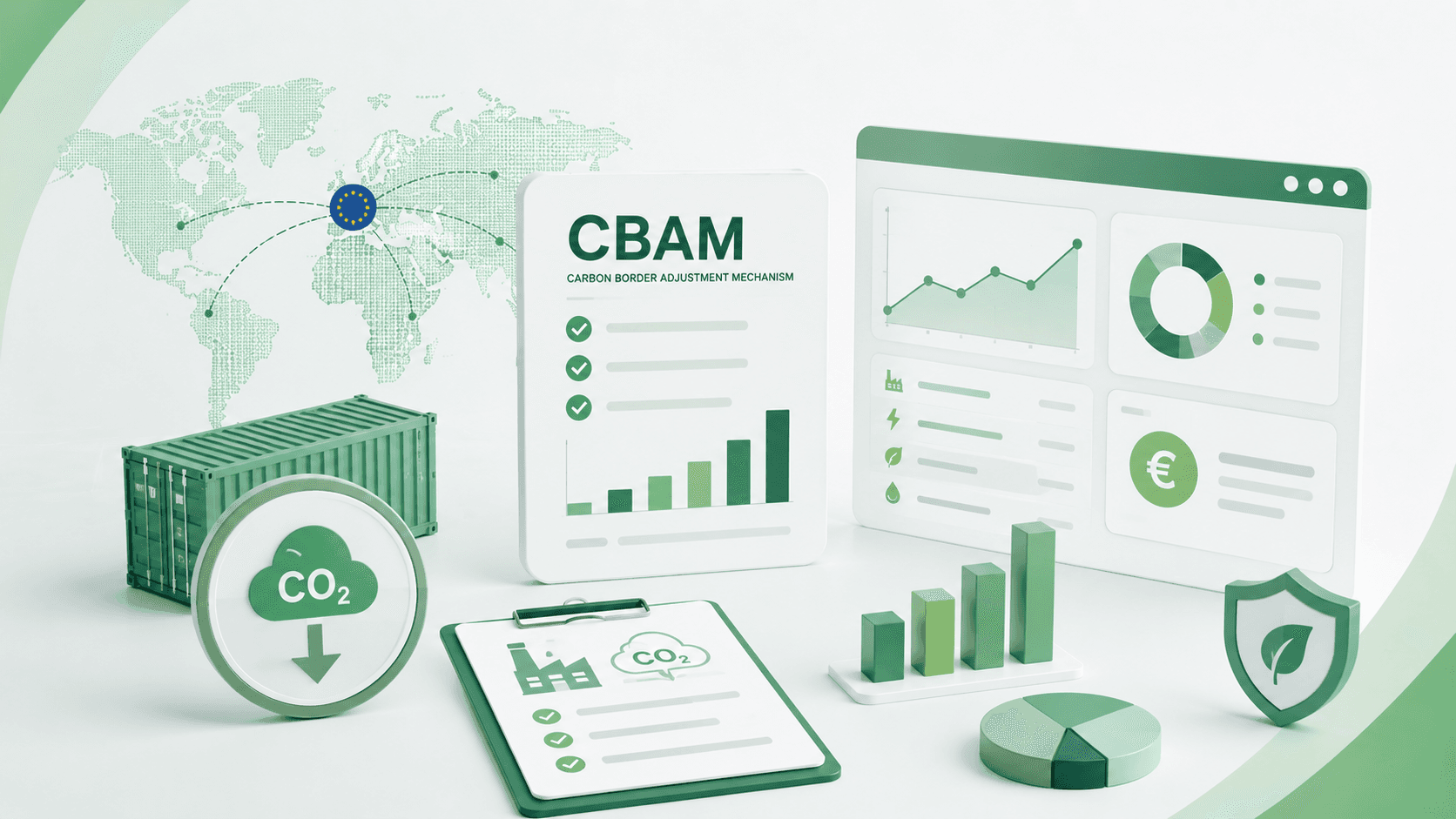
Starting in 2026, carbon emissions calculation will shift from being a sustainability topic to becoming a direct cost for European companies importing goods from non-EU countries.
With the introduction of CBAM (Carbon Border Adjustment Mechanism), Europe has turned the emissions embedded in imported products into a concrete economic factor, directly impacting prices, margins, and competitiveness.
It is no longer enough to know how much CO₂ is emitted. Companies must now understand how much CO₂ is embedded in each product across the entire supply chain.
But what exactly is CBAM? And how does it work in practice for companies? Let’s break it down.
What is CBAM (Carbon Border Adjustment Mechanism)
CBAM, short for Carbon Border Adjustment Mechanism, is a regulatory framework introduced by the European Union to apply a cost to the carbon emissions embedded in imported goods.
The goal is simple: to prevent so-called carbon leakage, where production shifts to countries with less stringent environmental regulations. Without such a mechanism, emissions might decrease locally but increase globally.
For years, European companies have been subject to carbon costs through the EU ETS (Emission Trading System), while imported goods were not — creating a competitive imbalance.
CBAM was introduced to correct this asymmetry.
It is not a traditional tax, but a carbon pricing alignment mechanism: imported goods must bear a cost equivalent to what European producers already pay.
CBAM specifically:
eliminates the competitive advantage of countries with weaker regulations
incentivizes emission reductions across the entire supply chain
drives greater transparency in environmental data
In this sense, CBAM is a key instrument of the European Green Deal and the path toward climate neutrality.
How CBAM works: from emissions to cost
To fully understand CBAM, it is essential to start with one core concept: embedded emissions.
Every imported product carries a certain amount of CO₂ generated during its production process. CBAM translates this information into an economic cost.
The mechanism works progressively:
1. Calculation of embedded emissions
Greenhouse gas emissions associated with the production of the good are calculated.
2. Determination of total emissions
Emissions per unit are multiplied by the quantity of imported goods.
3. Application of reductions
Free allowances (during the transition phase)
Carbon price already paid in the country of origin
4. CBAM cost calculation
Remaining emissions are priced based on the EU ETS carbon price.
The result is a real, tangible cost for the importer.
Embedded emissions: the core of CBAM
At the heart of CBAM lies a concept that fundamentally changes how environmental data is interpreted: product-level embedded emissions.
Every product imported into the EU carries a specific amount of CO₂ generated during its production. These are not abstract or company-level emissions, but precise, product-specific data tied to how, where, and with which technologies the product was manufactured.
These emissions are expressed as specific emissions (CO₂ equivalent per unit of product) and form the basis for CBAM cost calculation.
A key distinction is made between:
Direct emissions → from production processes
Indirect emissions → from energy consumption
This distinction is critical, as it directly affects both the calculation and the potential to reduce costs through more accurate data.
This regulation significantly raises the importance of emissions calculation. A general carbon footprint is no longer sufficient — the required level of detail is much higher. Data must be precise, traceable, and consistent across the entire value chain.
Who is affected by CBAM: sectors and companies
To enable a gradual implementation, CBAM initially applies to carbon-intensive sectors such as:
steel
cement
aluminum
fertilizers
electricity
hydrogen
However, these sectors are only the starting point. The regulation is designed to expand progressively to additional product categories, including downstream goods within supply chains.
This means that even companies not directly affected today may be impacted in the future — especially those operating within global supply chains.
CBAM reshapes responsibilities across the value chain:
EU importers are formally responsible for compliance
Non-EU producers are indirectly involved through data provision
Importers must:
collect emissions data
report to authorities
purchase CBAM certificates
However, they rely entirely on data provided by suppliers.
This makes CBAM a systemic mechanism: non-EU producers are required to provide increasingly detailed and verifiable data. Without it, default values are applied — often higher — leading to increased costs.
As a result, CBAM is not just a European regulation. It is a global driver pushing supply chains toward greater transparency.
Real data vs default values
One of the most critical — and often underestimated — aspects of CBAM is data quality.
When companies provide real, plant-specific data, CBAM costs reflect actual emissions more accurately. This creates real optimization opportunities, especially for companies that have already invested in energy efficiency or low-carbon technologies.
In contrast, when verified data is unavailable, the system applies default values set by the European Commission. These values are intentionally conservative and may include additional penalties over time.
The outcome is clear: two identical products can have very different CBAM costs, simply based on data quality and availability.
In this context, data management becomes a financial lever, not just an operational task.
Key challenges for companies
The complexity of CBAM lies not only in the regulation itself, but in its operational implementation.
Many companies must now collect data they have never managed in a structured way, often scattered across systems, departments, or external suppliers. Ensuring consistency, traceability, and future auditability adds further complexity.
Another challenge is the required level of granularity: data must be product-, plant-, and process-specific — not aggregated at company level.
Finally, the regulatory framework is still evolving. CBAM requirements will expand over time, making static solutions ineffective and pushing companies toward scalable, flexible approaches.
CBAM software and Metrikflow
For many companies, the real challenge is not understanding CBAM — it is making it operational.
Managing data collection, emissions calculations, and regulatory compliance manually is complex, time-consuming, and difficult to sustain.
This is why more and more organizations are adopting software solutions that integrate these processes.
In this context, Metrikflow’s CBAM module enables companies to:
centralize ESG data
structure information across the supply chain
engage stakeholders
support embedded emissions calculation in line with CBAM requirements
The platform reduces manual work, improves data quality, and generates consistent, reusable outputs.
The goal is not just to simplify compliance, but to turn CBAM into a continuous, integrated process within business operations and decision-making.
CONTRIBUTOR

Alessandro Nora
CEO & Co-founder
Alessandro's goal is to make a real impact on sustainability. After founding a sustainable fashion marketplace, he decided to focus on ESG digitalisation with the aim of making sustainability more concrete, measurable and accessible for companies. A careful and methodical founder, with experience in Genoa, Berlin and Lisbon, Alessandro combines international vision and operational rigour in the development of digital solutions that simplify ESG regulations and compliance, supporting companies in adapting to ESG regulations, certifications and ratings through structured and audit-ready tools. Topics covered: CSRD, CSDDD, EUDR, CBAM ESG ratings, ESG certifications, Ecovadis, sustainability governance, regulatory compliance.
Stay up to date with Metrikflow Insights!
We deliver expert insights, product updates, industry trends, and actionable strategies straight to your inbox. Stay ahead in ESG, GHG, and LCA — one edition at a time.
By submitting this form, you consent to receive the requested resource. For more information on how we process and protect your data, view our Privacy Policy.


